Washington Fines for Riding Without a Tab
Washington Fines for Riding Without a Tab
A missing Washington ATV or UTV tab can turn a ride into a citation, but the consequences depend on where you’re riding and what paperwork or road-use requirements are missing. The key is to identify which tab your machine needs, whether another registration is recognized, and what to do if you’ve already been stopped.
What “Riding Without a Tab” Means in Washington
In Washington, riders often use “tab” to mean the registration decal that shows a machine is registered for a particular kind of use. It is not the same as a Discover Pass, a title, proof of ownership, or permission to use a specific trail or road.
The first question is whether you have the right registration for the place you are riding. Washington distinguishes between off-road use and on-road use. An off-road tab does not automatically authorize travel on public roads, and an on-road tab does not mean every road is open to your machine. The Washington’s Two-Tab System explains how these registrations differ.
| Situation | What to check | Why the distinction matters |
|---|---|---|
| Riding off-road on public land | Whether your machine needs a valid off-road registration and visible decal | A missing or expired registration may be treated differently from a decal that is merely damaged or lost |
| Riding an approved road | Whether the machine has the required on-road registration, equipment, and paperwork | The off-road tab alone does not provide road-use authority |
| Visiting from another state | Whether Washington recognizes your home-state registration for the use you intend | Reciprocity may have conditions and may not cover every machine or route |
| Using a temporary permit | Whether it is still valid and what kind of riding it permits | A temporary permit may not authorize pavement travel |
| Riding on private property | Who controls the property and whether the route is open to public ORV use | Private ownership, public access, registration rules, and permission are separate issues |
A registration tab is also not a general riding pass. A machine can be properly registered and still be prohibited from a particular road, trail, or area. Land managers may require a separate recreation pass, and local rules can close routes to motorized use.
For many machines, the decal is the visible sign of registration, while the registration certificate supplies the supporting details. Washington also uses a metal tag for certain registered machines. That tag and the registration tab are related, but they are not interchangeable. See Washington’s Off-Road Tab Explained and Washington’s Metal Tag Explained for the roles of each.
The missing decal may not mean the same thing as no registration
There is a practical difference between a machine that was never registered, one whose registration expired, and one that is registered but has lost or damaged its decal. An officer may still ask questions or issue a citation if the required tab is not displayed, but having current registration documents can help establish what happened.
If the decal is missing, don’t assume that a receipt, a photo on your phone, or the registration card by itself replaces the required display. Find out how to order and properly place a replacement. The process for a lost decal is covered in Replacing Lost Washington Decals.
When a Missing or Expired Tab Can Lead to a Citation
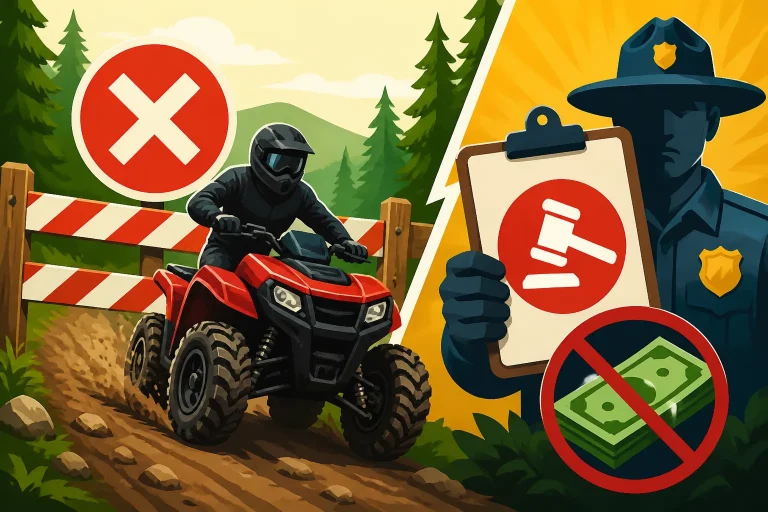
If Washington requires your machine to be registered for the place and type of riding you are doing, operating without the required registration can result in enforcement action. The exact outcome depends on the circumstances, the applicable rule, and the agency or court handling the matter. Do not rely on a single informal account of what a ticket “usually” costs: the amount and process can change, and a citation may involve more than one alleged violation.
A stop may bring up several separate questions:
- Is the machine registered for off-road use?
- Is the registration current?
- Is the required decal attached and readable?
- Is the rider using the machine on a road where that use is permitted?
- Does the machine have the additional registration and equipment required for that road?
- Is a separate recreation pass required at the site?
- Is the rider complying with age, supervision, helmet, and other use rules?
Those questions should not be collapsed into “I have tabs” or “I don’t have tabs.” A machine with valid off-road registration can still be cited for riding on a road that is not open to it. A machine on an approved route might still be missing a required on-road tab or equipment. And a Discover Pass, where required, does not replace ORV registration.
A citation for riding without the necessary tab may also be accompanied by a citation for another issue—for example, using a closed route or failing to meet a separate road-use requirement. The potential consequences and response options can differ for each item. Read the citation carefully and check which alleged violations are actually listed. For road-use violations, Washington Fines for Illegal WATV Road Use and What a Ticket for Riding an Unopened Road Costs cover different issues from registration itself.
What may affect the outcome
The details that matter can include whether you were on public land, a public road, private property, or a route managed under separate rules. They can also include whether the machine had a valid out-of-state registration, a temporary permit, or proof that a replacement decal was being obtained.
An expired tab is not the same as an unexpired registration with a decal that has fallen off, but neither situation should be treated as automatically harmless. The officer may need to establish the machine’s status, and the court or agency may consider the evidence and applicable rules.
If you are cited, don’t assume that paying the citation is the only option, or that explaining the problem roadside will resolve it. Follow the instructions and deadlines printed on the citation. If you dispute the alleged violation, use the response procedure described there and gather documents that relate directly to the issue.
Do not estimate a fine from an old post
Online comments, old fine schedules, and another rider’s ticket can be misleading. Local court procedures and penalty schedules may change, and a ticket for an unregistered machine is not necessarily the same as a ticket for an unauthorized road or trail. Check the court or agency identified on your citation for current information rather than budgeting around an unverified amount.
Which Tab Your Machine Needs
Before riding, match the registration to the machine and the planned route. Washington’s off-road and on-road registrations serve different purposes.
An off-road tab is generally the relevant registration for an ORV being operated off-road where registration is required. It does not by itself make a machine legal for ordinary public-road travel. The Washington’s Off-Road Tab Explained article provides more detail on what that tab covers.
A machine intended for qualifying road use may need an on-road tab in addition to the off-road tab. It must also meet applicable road-use requirements, which can include a completed road use declaration, required equipment, and access to a road that has been opened to WATVs. The Washington’s On-Road Tab Explained article explains the second tab, and What Washington Requires for On-Road ORV Use covers the broader conditions.
Do not assume that every road with a low posted speed limit is open. Road access can depend on state requirements and local decisions, and the exact route matters. Confirm the route before leaving, rather than using the presence of a tab as proof that you can ride there.
Expired registration is not a grace period
A registration that has expired should not be treated as current because the machine was registered last season, the renewal notice is on the way, or the rider has not yet received a new decal. Check the renewal status and the applicable registration information before operating. Riding on Expired Tabs and Washington ORV Registration Grace Period address the common assumption that an expired registration remains usable for a while.
If you have just bought a machine, find out what registration steps remain before taking it out. A bill of sale or title can help establish ownership, but neither automatically serves as a current ORV tab. Washington’s registration process and deadlines are explained in Registering a WATV in Washington.
Temporary permits and visitors
A temporary permit may be a useful option in specific circumstances, but it is not a universal substitute for annual registration. Check who can use it, which machine it applies to, how long it remains valid, and whether it covers the kind of riding planned. In particular, do not assume that a temporary off-road permit allows you to ride on pavement.
Visitors should check reciprocity before traveling. Washington may recognize certain out-of-state registrations under particular conditions, but that does not mean every home-state sticker automatically covers every machine or use. The Washington ORV Reciprocity Rules article explains why registration from another state needs to be checked against the intended activity. Visitors considering a temporary permit can also review [Washington Temporary ORV Permit for a Visitor].
What to Do If You Receive a Citation
A roadside conversation is not the place to guess at the rule or make promises about what your documents prove. Stay calm, follow lawful instructions, and make sure you understand what the officer says the issue is. Ask politely if you are unsure which registration or use requirement is involved.
After the stop:
- Read every item on the citation. Note the alleged violation, the issuing agency, the response options, and any deadline.
- Write down the circumstances while they are fresh. Record where you were riding, the route, the time, and what the officer told you.
- Gather relevant paperwork. This could include the registration certificate, purchase documents, proof of renewal, a permit, or evidence that the machine was registered in another state.
- Check the route and land rules. Save or note the information that identifies whether the road or trail was open to your type of machine.
- Contact the listed court or agency if anything is unclear. Ask about current procedures and how to submit documents, not for informal assurances that a ticket will be dismissed.
- Respond by the stated deadline. If you want to contest the citation, follow the listed process rather than ignoring it or assuming a conversation at the trailhead is enough.
A registration lookup can help you check the machine’s status, but it does not replace the physical decal or any required paperwork. Use Washington ORV Registration Lookup as a starting point if you need to verify a record, then confirm how to correct any registration problem with the appropriate licensing office.
If your tab was lost, damaged, or never arrived, keep records of the steps you take to correct the issue. A replacement request or proof of payment may help explain the situation, but it is not a guarantee that riding without the displayed tab is permitted. Until you have confirmed what the rules allow, the low-risk choice is to leave the machine parked.
Keep documents available, but don’t confuse them with the tab
Carrying the registration certificate can make it easier to answer questions about the machine, especially if the decal is damaged or the vehicle is registered out of state. Protect the paperwork from rain and mud in a secure pouch; waterproof registration holders are available from outdoor retailers and marketplaces such as Amazon.
The document should be easy to retrieve but secured so it does not fall out during a ride. A phone photo can be a useful backup, but don’t assume it is accepted in place of the required original or visible decal. Check the current requirements for your registration type.
How to Avoid a Tab-Related Stop
The most reliable approach is to check registration, display, route access, and separate passes as distinct items. A quick check before each trip is less complicated than trying to sort out the rules after a citation.
Before loading the machine, confirm:
- The registration is current and applies to that machine.
- The required decal is present, readable, and attached where required.
- Any metal tag required for the machine is present and legible.
- You have the registration documents the rules require you to carry.
- Your planned route is open to that machine and registration type.
- You have any separate recreation pass required at the riding area.
- Any temporary permit or out-of-state registration is valid for the planned use.
- The machine meets additional requirements if you intend to ride on an approved road.
Check the information from the relevant land manager or local authority, especially when riding in a new area. A trail map may show where routes are, but it may not answer whether a particular machine can use them today. Closures, seasonal restrictions, and local road decisions can affect access.
If you are riding only off-road, don’t buy an on-road tab just because you think it will make all riding legal. Conversely, if you plan to use an approved public road, don’t expect an off-road tab to cover that trip. Confirm the correct registration and the route rules together. More detail on whether the added road registration fits your plans is available in Adding the $12 On-Road Tab on Top.
Finally, treat each machine separately. A registration or permit associated with one machine should not be assumed to transfer to another. When a machine changes owners, confirm what paperwork and registration steps are needed before riding it. A seller’s old decal, title, or receipt is not proof that the new owner has completed the required registration.
Frequently Asked Questions
Can I ride while waiting for a replacement tab?
Do not assume you can. A replacement request or receipt may not substitute for the required displayed decal. Check the current instructions for your registration type and avoid riding until you know what is allowed.
Is an off-road tab enough to ride on a road?
No. Road use can require a separate on-road registration, required equipment, and an approved route. An off-road tab alone does not open a road to your machine.
Does a Discover Pass replace an ORV tab?
No. A Discover Pass, when required, is separate from ORV registration. It does not register the machine or grant permission to ride a closed route.
Can an out-of-state sticker protect me from a Washington citation?
Not automatically. Washington reciprocity has conditions, and the result may depend on the home-state registration and the type of use. Check Riding Washington With an Out-of-State Registration before relying on a visitor sticker.
Disclaimer
This article is for general informational purposes only and does not constitute professional advice. Laws, prices and regulations vary by location and change over time. Consult a qualified professional for guidance on your specific situation.