Washington Rules for Hunting From a Machine
Washington Rules for Hunting From a Machine
An ATV or UTV can make a long approach to hunting ground easier, but using it does not make every road or hunting method legal. The key is to separate transportation from hunting: ride only where the machine is allowed, get off before hunting, and follow firearm, land-access, and game regulations. Here’s how to plan a trip without confusing riding permission with hunting permission.
What “Hunting From a Machine” Means in Practice
Washington hunters can use a machine to reach an area where hunting is allowed, provided the route is open to that machine and the rider follows the applicable access rules. That is different from hunting from the machine or using it to pursue wildlife. An ATV, side-by-side, or other motorized off-road vehicle should be treated as a motor vehicle for planning purposes.
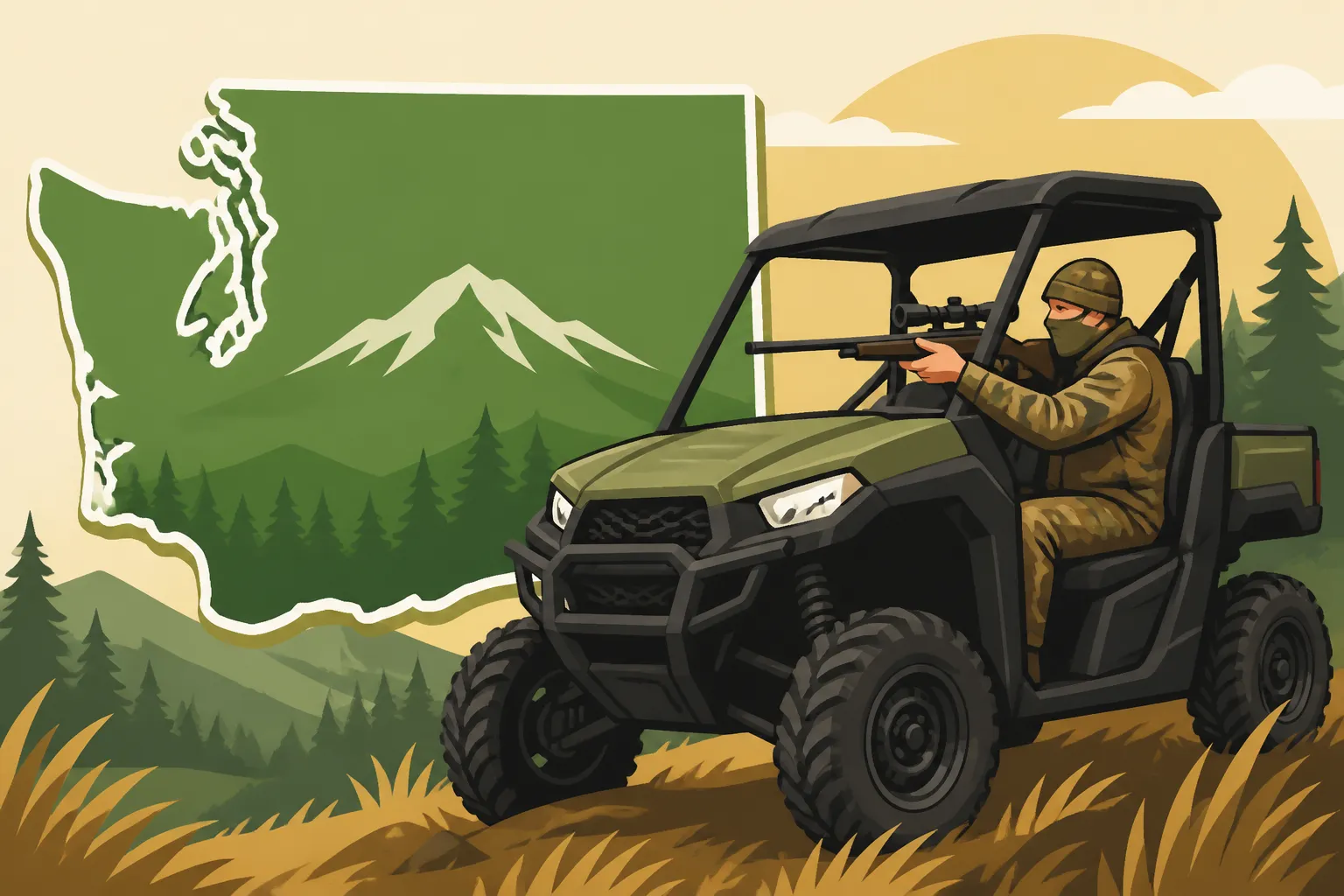
A cautious and practical rule is to use the machine for transportation, park legally, and continue on foot. Do not shoot from the seat, use the machine to chase or herd game, or treat a ride that brings you close to an animal as permission to take a shot. Hunting law can cover more than the physical act of firing; how a vehicle is used in relation to pursuing or taking wildlife matters too.
A useful distinction: access versus hunting
Consider three parts of a trip separately:
- Getting to the area: You may ride only on routes and land where that machine is allowed. A route that appears on an old map may now be closed, restricted, or limited to a different class of vehicle.
- Hunting the area: The place must be open to hunting for the species, season, and method you are using. Being able to ride there does not establish that hunting is allowed.
- Taking or retrieving game: You still have to follow rules for the shot, firearm transport, tags, and any motorized access restrictions that apply after the harvest.
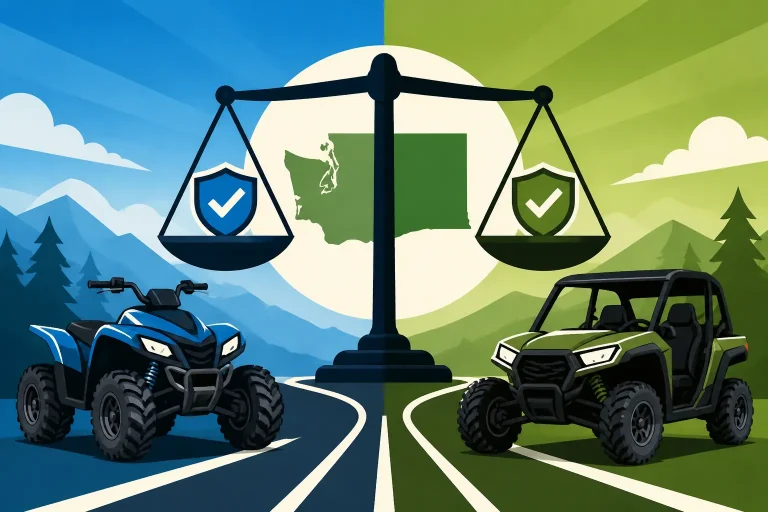
This distinction helps avoid a common mistake: assuming that because a machine can reach a spot, a hunter may hunt from it or drive wherever game travels. Riding access and hunting authorization are separate questions.
| Situation | Practical approach |
|---|---|
| Riding to a lawful hunting area | Confirm the route is currently open to your machine and that you have the required vehicle registration or permit. |
| Stopping to glass or plan | Keep the machine on an allowed route or designated parking area; do not use it to pursue or pressure wildlife. |
| Taking a shot | Dismount and follow firearm, hunting, and safe-shooting rules. Do not fire from or across a road. |
| Carrying a firearm while riding | Transport it unloaded and secured; check the rules for your firearm type and situation. |
| Retrieving harvested game | Use only routes where motorized travel is allowed, and follow land manager and game-handling rules. |
The boundaries can be less obvious when a rider stops beside a trail, uses a machine to follow an animal, or moves a short distance off a route. If the machine is helping locate, pursue, or take wildlife, do not assume that stepping off for the final shot makes the activity lawful. When in doubt, leave the machine parked and do not use it to influence the animal’s movement.
For the separate firearm-transport issue, see Washington Rules for Carrying a Firearm on a WATV. For the hunting-specific discussion involving an ATV, [Washington Rules for Hunting From an ATV] is also relevant.
Firearms, Shooting, and Riding Safely
A machine is not a safe or lawful shooting platform just because it is stopped. Washington generally restricts carrying or transporting a loaded firearm in or on a motor vehicle, subject to narrow exceptions. The safest routine is to unload before loading or boarding the machine, keep the firearm secured, and leave it unloaded until you are off the vehicle and in a lawful place to hunt.
“Unloaded” should be treated as a real condition, not a quick check of the chamber alone. Follow the rules for the particular firearm and ammunition, and use a case or other secure method appropriate to the machine. A firearm should not be loose on a rack where vibration, a tip-over, or a branch could affect the action or trigger. Keep it pointed in a safe direction while loading, unloading, and moving it.
Do not shoot from or across a road
Being on foot does not make every shot acceptable. Avoid shooting from, across, or along a public road, and do not take a shot where a road, trail, occupied area, or another person could be in the line of fire. A legal hunting area can still contain roads or access routes where shooting is prohibited or unsafe.
Before the trip, identify the road edge and the place where hunting may begin. Do not stop in a travel lane or block a road while handling a firearm. If you must pull over, use a place where parking is permitted and where other traffic can pass safely. On a narrow forest road, a machine parked around a blind corner can create a hazard even if the road sees little traffic.
Keep hunting and vehicle handling separate
A good routine is to stop, secure the machine, unload or verify the firearm’s safe condition as required, and then move away from the vehicle before preparing to hunt. Do not try to operate the machine while holding a firearm, and do not leave a firearm where a passenger or another rider can handle it unsupervised.
For a UTV, make sure passengers understand the same routine. A passenger’s firearm is not exempt from transport rules just because the driver is focused on the trail. Secure each firearm so it cannot slide, fall, or become accessible in an unsafe way. Follow applicable rules for youth riders and supervision as well as firearm rules.
Other road and trail requirements still apply. A machine set up for road use does not gain permission to hunt from the road, and a machine registered for off-road use does not gain permission to travel on a public road. Review Washington Rules for Riding a County Road and [Washington Rules for Riding Off a Designated Trail] if your route might involve either situation.
Land Access, Roads, and Hunting Boundaries
The machine’s registration, sticker, or permit answers only part of the access question. You also need to know who manages the land, which routes are open, and whether hunting is allowed in the area. Public land is not one uniform category: state, federal, county, and other lands may have different maps, closures, vehicle rules, and hunting restrictions. Private land requires permission unless access is clearly authorized.
Confirm the route, not just the destination
A route can be closed to motor vehicles even when the surrounding land is open to hunting. A trail may allow one kind of machine but not another, or a seasonal closure may apply during the hunting season. A road shown as open in an older map or a navigation app is not proof that it is currently open.
Check the current information from the land manager responsible for the route. Look for notices about seasonal closures, active timber work, fire restrictions, damaged roads, and motor-vehicle use boundaries. At the site, obey posted signs, gates, and closures. Do not ride around a barrier or assume a closed route becomes available because you are hunting.
For state land, review Washington Rules for Riding DNR Land. For federal land, see Washington Rules for Riding Federal Land. The rules for riding a closed road are covered in Washington Rules for Riding a Closed Road. These distinctions matter because permission to hunt and permission to drive are separate.
Stay on routes where motorized use is allowed
Do not leave an authorized road or trail to get closer to game, reach a shooting position, or avoid a longer walk. Off-route travel can damage land and may violate motorized-use restrictions even if the machine is being used for a hunting trip. A route’s apparent condition does not determine whether it is legal to ride.
This applies to retrieving game as well. A lawful harvest does not automatically authorize a vehicle to travel off-route or into a closed area. If motorized access for retrieval is not clearly allowed, contact the land manager before relying on it. Plan for the possibility that part of the recovery must be done on foot or with nonmotorized equipment.
Private, trust, and special-use land
Do not assume that an unmarked road is public or that a gate left open grants access. Private timberland, agricultural property, and other private land may require permission, even where a road connects to public land. State trust lands can also have access conditions that differ from other public lands. Check the rules for the specific parcel and route rather than relying on the general label “public.”
Special permits may apply to certain locations or activities, but a permit for vehicle access does not necessarily grant hunting rights, and a hunting license does not necessarily grant vehicle access. Keep the documents and permissions distinct when planning.
Registration, Permits, and Reciprocity
Hunting authorization and machine authorization are different. A valid hunting license or tag does not register an ATV, open a closed road, or satisfy a land manager’s vehicle-access requirement. Likewise, a vehicle registration or temporary permit does not give the rider permission to hunt a particular species or enter a hunting area.
Before you load the machine, identify which requirements apply to both the vehicle and the location:
- Vehicle registration or permit: Check what the machine needs for the kind of riding you plan to do. Washington’s off-road and road-use systems have different requirements. Start with Washington ORV Permits Explained and Registering a WATV in Washington.
- Route permission: Confirm that the road or trail is open to your machine, including any size or seasonal restrictions.
- Land-access pass or permit: Some locations require an additional pass or authorization. A pass for parking or recreation access does not by itself authorize hunting or off-route riding.
- Hunting license, tags, and season rules: Confirm the current requirements for the species, area, season, and hunting method through Washington’s official wildlife regulations.
- Special accommodation: If a disability affects how you can access or participate in a hunt, check directly with the responsible agency about available permits and exactly what they authorize.
Reciprocity does not transfer hunting rights
A registration or off-road permit from another state may affect whether a visitor can ride in Washington, but it does not replace Washington hunting requirements. Reciprocity concerns vehicle access under applicable rules; hunting licenses, tags, seasons, and method restrictions are a separate matter.
A visitor should confirm both questions before traveling: whether the machine’s home-state credentials are accepted for the intended riding, and what Washington hunting credentials are required for the hunt. See Washington ORV Reciprocity With Other States for the vehicle side of the question. Do not treat a reciprocal riding privilege as authorization to hunt.
Also keep road use separate from off-road access. A machine configured or registered for road use may still be limited to roads that are legally open to it. A temporary off-road permit may have its own limits and should not be treated as a road permit. Check the conditions attached to the specific credential you plan to use.
Save proof and check for changes
Carry the documents that apply to your trip, including vehicle registration or permit information and hunting credentials. A phone can be useful for maps and current notices, but do not rely on a signal being available at a remote trailhead. Save relevant official maps or notices for offline access, and keep required documents protected from rain and mud.
Before departure, verify that nothing has changed since you last rode the route. Fire closures, maintenance work, seasonal restrictions, and land-manager decisions can change access. Confirming the route shortly before the trip is more reliable than using an old screenshot or a friend’s memory.
Recovering Game and Planning the Ride
The return trip can create its own legal and practical problems. A hunter may be permitted to hunt an area but not to drive the harvested animal out by machine. The same road, trail, and land restrictions that applied on the way in still matter after the harvest.
Plan how the game will be moved before hunting. Consider the distance from the route, terrain, weather, machine capacity, and whether the land manager permits the intended motorized access. Do not overload a rack or passenger area, obstruct the driver’s view, or carry a firearm in a way that conflicts with transport rules. Secure the load so it cannot shift or fall off on a rough trail.
Follow all applicable rules for tagging, reporting, transport, and evidence of sex or species when required. Those requirements vary by game and hunt, so check the current Washington regulations for the animal you are pursuing. A machine does not change the hunter’s responsibility to handle and document the harvest correctly.
For more on that part of the trip, see Washington Rules for Packing Out Game. It is useful to plan for a pack-out that does not depend on driving beyond an authorized route. If the game is too heavy or bulky for a safe load, make another trip or use an allowed nonmotorized method rather than taking a risk with an unstable machine.
A pre-trip checklist
Use a short checklist to keep vehicle, hunting, and land rules from getting mixed together:
- Confirm that your license, tags, season, area, and hunting method match the current regulations.
- Check the land manager’s current map and notices for the planned route, hunting area, and any closures.
- Verify the machine’s registration or permit for the riding you intend to do, including any road segments.
- Confirm whether the location requires an additional land-access pass or permission.
- Transport firearms unloaded and secured, and identify a safe place to stop and prepare to hunt.
- Plan a legal route for returning and for packing out game.
- Carry the required documents and save maps or closure information where they can be viewed without cell service.
If the trip involves more than one manager or land type, check each segment separately. A route can pass from one jurisdiction to another, and a permission that applies on one side of a boundary may not apply on the other.
Frequently Asked Questions
Can I ride an ATV to a hunting area in Washington?
Often, but only if the route is open to that machine and you meet the registration, permit, and land-access requirements. Riding permission does not authorize hunting from the ATV or entry into a closed area.
Can I shoot from a parked ATV or UTV?
Do not treat a parked machine as a lawful shooting position. Washington restricts hunting from motor vehicles, and firearm and road-safety rules also apply. Dismount and hunt on foot from a lawful location.
Can I use my ATV to retrieve a harvested animal?
Only where motorized travel is allowed and the load can be carried safely. A harvest does not authorize off-route riding or travel through a closure. Check land-manager rules and game-transport requirements before the hunt.
Does an out-of-state ORV permit let me hunt in Washington?
No. A permit or registration may relate to riding access, but it does not replace Washington hunting licenses, tags, season rules, or land permissions. Confirm each requirement separately.
Disclaimer
This article is for general informational purposes only and does not constitute professional advice. Laws, prices and regulations vary by location and change over time. Consult a qualified professional for guidance on your specific situation.