What Washington Requires for On-Road ORV Use
It can feel incredibly frustrating to want to expand your riding horizons, to connect those amazing trails with a quick jaunt down a county road, only to be met with a wall of confusing rules and regulations. You've got this awesome machine, a quad or a side-by-side, and you just want to know how to legally get it from point A to point B on pavement without breaking the bank or running afoul of the law. This comprehensive guide is here to untangle the web of Washington State requirements, breaking down exactly what you need to do to make your Off-Road Vehicle (ORV) – which Washington prefers to call a Wheeled All-Terrain Vehicle, or WATV – compliant for limited on-road use.
Understanding the "Street Legal" Concept in Washington
The term "street legal" can be a bit of a misnomer in Washington when it comes to ORVs. It’s not like turning your quad into a car; it’s more about meeting specific requirements for limited road access. The state acknowledges that riders often need to connect trails, access services, or reach staging areas, and they've created a framework for that. But it's crucial to understand that this isn't a free pass to ride anywhere. There are very specific rules about where you can ride and what your machine needs.
Why Washington Calls Them WATVs (Wheeled All-Terrain Vehicles)
One of the first things you'll notice when you delve into Washington's ORV laws is the consistent use of the term "WATV" instead of the more common "ATV" or "UTV." This isn't just semantics; it's a legal definition that encompasses a wider range of vehicles. The state's intent was to create a single category that includes traditional quads, side-by-sides, and even some dirt bikes that meet specific criteria, ensuring consistent regulation across these popular off-road machines.
This consistent terminology helps avoid confusion when interpreting laws and applying for registrations. When you go to the Department of Licensing (DOL) or speak with a local law enforcement officer, they'll be operating under the WATV definition. Understanding this helps you correctly identify your machine within the state's legal framework and ensures you're looking at the right set of regulations for your specific vehicle. You can read more about [Why Washington Says WATV and Not ATV].
The Core Distinction: Off-Road vs. On-Road Tabs
At the heart of Washington's system for ORV use is the "tab" system. Every WATV needs an off-road tab, which signals that your machine is registered for use on designated trails and non-highway roads. This is your baseline for all off-pavement riding. However, to venture onto approved paved county roads or city streets, you need an additional, specific "on-road" tab.
This two-tab system might seem redundant at first glance, but it serves to clearly delineate where your machine is permitted. The off-road tab funds trail maintenance and access, while the on-road tab is part of a broader safety initiative for multi-use roadways. Without that specific on-road tab, your machine is legally restricted to off-pavement areas, regardless of how many accessories you bolt onto it. For a deeper dive, check out [Washington's Two-Tab System].
Common Misconceptions About Road Use
Many riders harbor understandable misconceptions about "street legal" ORVs. One common one is believing that if your machine has headlights and taillights, it's automatically good to go on the street. Unfortunately, the requirements are far more extensive than just basic illumination. Another mistaken belief is that all county roads are open, which simply isn't the case; specific ordinances dictate access.
It’s also not uncommon for people to assume that if they see somebody else riding on a paved road, it must be legal for everyone. However, that person might be breaking the law, or they might be one of the few who have met all the stringent requirements. Don't base your decisions on what you see others doing. Your best bet is always to consult the official regulations and ensure your machine and your riding habits comply fully.
Essential Equipment for On-Road WATV Use
Getting your WATV ready for limited on-road use means more than just throwing a license plate on it. Washington has a comprehensive list of equipment requirements designed to make your machine as visible and safe as possible when sharing the road with other vehicles. These aren't just suggestions; they are mandatory elements for compliance, and a law enforcement officer will be checking for them. This is often where riders turn to aftermarket suppliers like SuperATV for specialized parts that can transform their off-road warrior into a road-capable machine.
Lighting and Visibility Requirements
When you're sharing the road, visibility is paramount. Your WATV needs to be equipped with a range of lighting that makes it easily seen by other drivers, especially at dawn, dusk, or in inclement weather. This includes a headlight that emits a white light and a red taillight visible from a certain distance. But it doesn't stop there. You'll also need a brake light that illuminates when you hit the brakes, clearly signaling your intentions to traffic behind you.
Perhaps most critically, turn signals are required. These are often the biggest addition for many off-road machines, as they aren't standard equipment on many models. SuperATV, for example, offers various turn signal kits that can integrate seamlessly with different WATV models, ensuring you can signal your turns clearly and safely. Reflectors are also part of the visibility puzzle, typically on the rear and sides, to ensure your machine is seen even if its lights aren't on. For a full list, check out [Washington Lighting Requirements for WATVs].
Signaling, Braking, and Auditory Gear
Beyond lights, your WATV needs to communicate its presence and intentions effectively. A functional horn is a must, capable of emitting a sound audible from at least 200 feet, providing a warning to pedestrians or other vehicles. It's often one of the simpler additions, but a critical one for road safety.
Your braking system must be in top working order and capable of stopping your vehicle effectively. While off-road use is forgiving of some brake wear, on-road demands require precision and reliability. Additionally, mirrors are non-negotiable. You need at least one rear-view mirror, mounted to provide a clear view of the road behind you, allowing you to monitor traffic without constantly turning your head. Many riders opt for a secondary mirror for enhanced situational awareness. Upgrading to sturdy, street-legal mirrors is a common step, and companies like SuperATV offer options that can withstand both trail abuse and road vibration.
Safety Equipment for Riders and Passengers
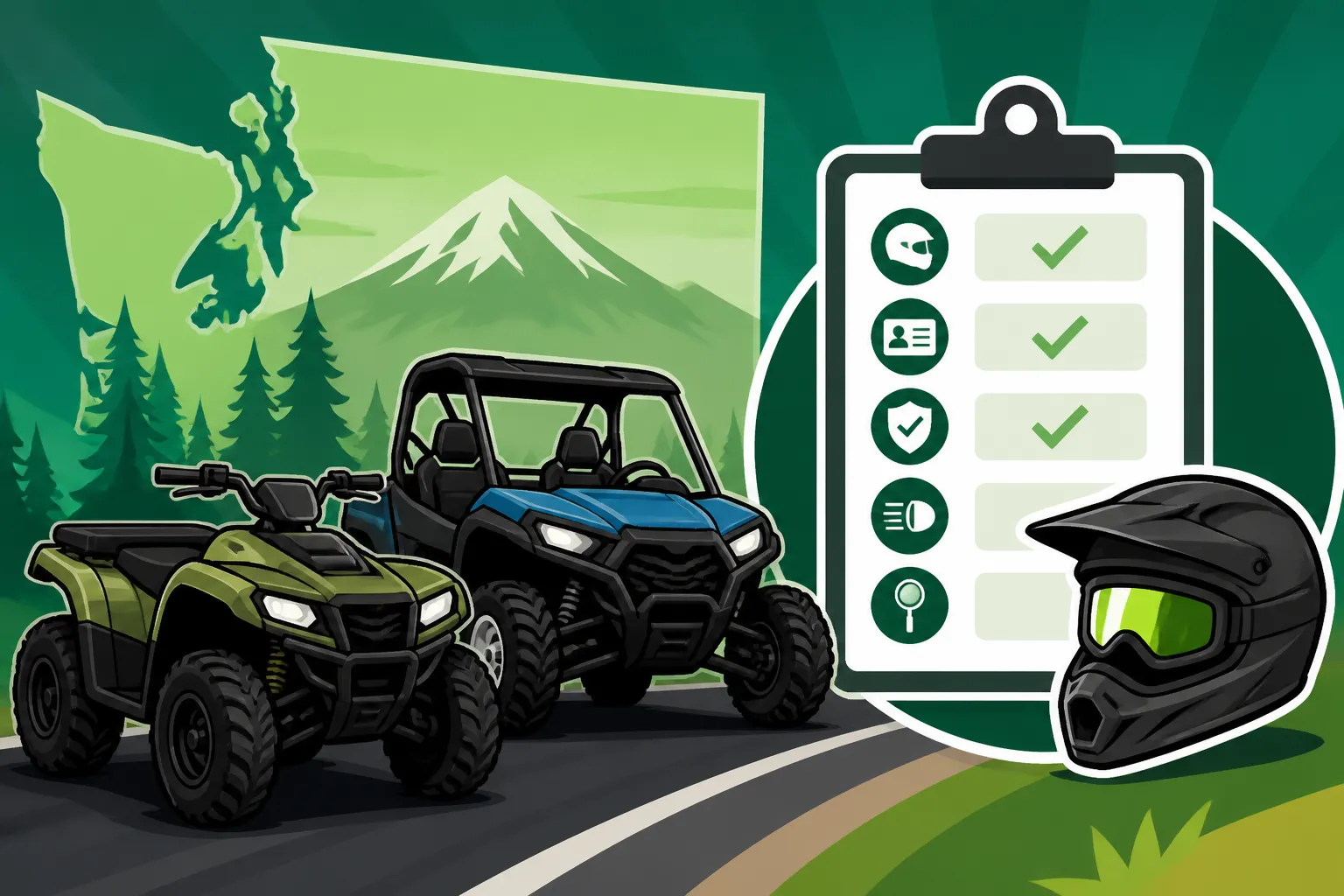
It's not just the machine that needs to be compliant; the riders do too. Washington has strict helmet laws, and for on-road WATV use, both the operator and any passengers must wear a United States Department of Transportation (DOT)-compliant helmet. This isn't just a recommendation; it's a legal requirement designed to protect riders in the event of a crash.
For utility vehicles (UTVs) or side-by-sides, which often come with factory-installed seatbelts, these must be worn by all occupants. If your UTV has multiple seating positions, each must be equipped with a functional seatbelt, and everyone riding must be properly buckled in. Additionally, while not strictly "equipment" on the machine, having eye protection (like goggles or a full face shield) is crucial if your WATV doesn't have a windshield. These personal safety items are just as important as the vehicle's modifications for legal on-road travel. More details on this can be found in [Washington Helmet Law for WATV Riders].
Licensing, Registration, and Insurance
Even with all the right equipment, your WATV isn't ready for the road until you've taken care of the necessary paperwork. This involves ensuring you have the proper driving credentials, getting your machine correctly registered with the state, and securing adequate insurance coverage. Skipping any of these steps can lead to hefty fines and legal complications, turning a fun ride into a costly headache.
Driver License Requirements
To operate any motorized vehicle on a public road in Washington, including a WATV that has been approved for limited on-road use, you must possess a valid driver's license. This isn't a special "ORV license"; it's your standard driver's license, the same one you'd use to operate a car or truck. There's no separate endorsement or certification needed for WATV road use specifically.
This requirement means that underage riders, even if they're permitted to operate ORVs off-road under supervision, cannot legally drive a WATV on a public road. The age limit for on-road WATV operation aligns with the state's minimum age for obtaining a driver's license. It's a fundamental aspect of road safety – ensuring that anyone operating a vehicle on shared roadways has demonstrated a baseline level of driving knowledge and skill.
The Road Use Declaration and On-Road Tab
Getting your WATV registered for on-road use involves a specific process with the Department of Licensing. First, you'll need to ensure your WATV is titled in your name. Then, you'll fill out a Road Use Declaration. This is a crucial form where you attest that your machine meets all the necessary equipment requirements for on-road operation. It's essentially your promise to the state that you've done your due diligence.
Once the Road Use Declaration is submitted and approved, and your machine passes the required safety inspection (which we'll cover next), you'll be issued the distinctive [Adding the $12 On-Road Tab on Top]. This tab, affixed to your WATV alongside your off-road tab, is the physical proof that your machine is authorized for limited road use. It's a yearly renewal, just like your standard off-road registration, so keep an eye on those expiration dates. More information on this specific form can be found in [The Washington Road Use Declaration].
Mandatory Insurance for Road Riding
Just like any other vehicle operating on Washington's public roads, your WATV, once authorized for on-road use, must carry liability insurance. This isn't optional; it's a legal mandate. The insurance requirements for a road-registered WATV are generally the same as those for a passenger vehicle, covering bodily injury and property damage liability. This protects you and others in the event of an accident.
Many standard ORV insurance policies might only cover off-road incidents. Therefore, it's absolutely vital to confirm with your insurance provider that your policy specifically extends coverage to on-road operation. If you're adding the on-road tab, inform your agent so they can adjust your policy accordingly. Having the proper insurance not only keeps you compliant with state law but also provides crucial financial protection against unforeseen circumstances. Don't risk riding on pavement without this essential safeguard. For details on coverage, check out [Washington WATV Insurance Requirement].
Navigating Washington's Road Access Rules
Even when your WATV is fully equipped, registered, licensed, and insured for on-road use, you still can't just ride it anywhere. Washington's road access laws are highly specific, empowering local jurisdictions (counties and cities) to decide which of their roads, if any, are open to WATVs. This means a road that's open in one county might be strictly off-limits just across the border.
Understanding County and City Ordinances
This is perhaps the most confusing and frustrating aspect for many WATV riders: the patchwork of local rules. Washington State law grants counties with populations over 15,000 the authority to opt-in to allowing WATV use on specific public roads under their jurisdiction. They must pass an ordinance, create a list of approved roads, and clearly post them. Conversely, smaller counties (under 15,000 residents) are generally open by default, meaning WATVs can use their roads unless the county specifically opts-out or lists roads as closed.
City streets often have their own separate ordinances. Some cities have embraced WATV use to connect their communities or support tourism, while others have chosen to prohibit it entirely. Before you even think about riding on a paved road, you must consult the specific county or city ordinances for the area you plan to ride in. Many counties publish these lists on their websites. Ignoring these local rules can quickly lead to citations and fines. For more specific information, see [Washington Rules for Riding a County Road].
Speed Limits and Highway Crossing Rules
When you are on an approved road, your WATV is subject to the same traffic laws as any other vehicle, including posted speed limits. However, there are additional restrictions specific to WATVs. Washington law generally limits WATV use to roads with a posted speed limit of 35 mph or less. You cannot ride on roads where the speed limit exceeds this threshold, even if it's an approved county road. This restriction is primarily due to safety concerns, as WATVs are designed for off-road performance and generally don't handle high speeds on pavement as stably as traditional vehicles.
Crossing major highways is also tightly regulated. While you might be able to cross a state highway, there are specific conditions. For instance, you can typically cross a highway posted between 35 mph and 60 mph only at an intersection, and you must do so in the most direct and expeditious manner possible. Riding along these highways is generally prohibited. Always be mindful of the posted speed limit of the road you are on, and the highway you are crossing.
Where You Absolutely Cannot Ride
Even with all the proper registration and equipment, there are places where WATVs are universally prohibited from on-road use in Washington. You cannot, under any circumstances, operate a WATV on state highways (unless specifically designated for crossing), interstates, or limited-access roadways. These are high-speed environments explicitly designed for conventional vehicles, and WATVs simply don't belong there for safety reasons.
Furthermore, any road or trail located within a federally designated wilderness area, national park, or certain other restricted federal lands will typically prohibit WATVs, regardless of state "street legal" status. It's crucial to understand that federal land rules often supersede state and local regulations. Always check with the land manager (e.g., US Forest Service, DNR, State Parks) before attempting to ride your WATV on any public land, paved or unpaved. This understanding is key to avoiding serious penalties, including [Washington Fines for Illegal WATV Road Use].
The Crucial Safety Inspection
Beyond all the paperwork and local ordinances, your WATV needs to prove it's roadworthy. This is where the mandatory safety inspection comes in. It's not just a formality; it's a thorough check to ensure your machine meets specific safety standards before it's allowed to share the road with cars and trucks. Failing this inspection means you won't get that coveted on-road tab.
What the Inspection Covers
The safety inspection for a WATV is designed to verify that all the required on-road equipment is present and fully functional. Inspectors will meticulously check your lighting system: headlights, taillights, brake lights, and most importantly, your turn signals. They’ll ensure your horn is operational and loud enough, and that your rearview mirror provides an adequate field of vision. Furthermore, they’ll examine your braking system to ensure it's effective and safe.
Beyond the specific additions, the inspection will also look at the general condition of your machine. This includes things like tire tread, exhaust system (ensuring it meets sound limits and has a spark arrester), and the overall structural integrity of the vehicle. If your side-by-side has seatbelts, the inspector will verify they are present and in good working order. Any deficiency in these areas means a failed inspection, requiring you to make repairs or additions before you can try again.
Finding an Approved Inspector and Cost
Not just any mechanic can perform a WATV safety inspection for on-road use. The inspection must be conducted by an authorized "WATV Inspector" who is certified by the Washington State Patrol. These are often specific dealerships, repair shops, or even independent mechanics who have gone through the necessary training and certification process. It's essential to confirm that the shop you choose is indeed an approved inspector for WATVs.
The cost of this inspection is capped by state law. While the exact fee can vary from shop to shop, it generally won't exceed a certain amount, typically around $50. It's always a good idea to call ahead and inquire about their current fee and to schedule an appointment. Don't just show up expecting an immediate inspection, as these can take time. For more information on fees, consult [Washington WATV Safety Inspection Cost].
Ensuring Your Machine is Road-Ready
Before you even take your WATV in for the inspection, do your own pre-check. Go through every single item on the state's equipment list for on-road use. Turn on all your lights, test your turn signals, honk your horn, and check your mirrors. Look for obvious issues like worn tires, loose components, or a damaged exhaust. If you've recently installed aftermarket parts, such as a SuperATV windshield or a new lighting kit, ensure they are properly installed and functioning as intended.
Having your machine thoroughly prepared saves you time and potentially a re-inspection fee. Imagine showing up only to find out your left turn signal isn't working, or your horn is too quiet. Taking the time to double-check everything beforehand will make the inspection process smoother and increase your chances of getting that approval on the first try. It’s an investment in your safety and your ability to legally enjoy Washington's roads.
| Requirement Category | Specific Item | Description for On-Road Use | Aftermarket Solutions (e.g., SuperATV) |
|---|---|---|---|
| Visibility | Headlight | White light, visible from specified distance, required day/night. | LED headlight upgrades, auxiliary lights. |
| Taillight | Red light, visible from specified distance, required day/night. | LED taillight kits. | |
| Brake Light | Red light, illuminates when brakes applied. | Integrated brake light kits. | |
| Turn Signals | Amber or red, front and rear, clearly visible. | Full turn signal kits, often with horn/mirror options. | |
| Reflectors | Red on rear, amber on sides (optional). | Adhesive or bolt-on reflector kits. | |
| Control & Warning | Horn | Audible from 200 feet. | Universal horn kits, often part of turn signal kits. |
| Mirrors | At least one rearview mirror providing clear view. | Single or dual rearview mirrors (SuperATV offers robust options). | |
| Brakes | Fully functional, capable of stopping vehicle effectively. | Maintenance of existing system. | |
| Muffler/Exhaust | With spark arrester, meets sound limits. | Aftermarket exhaust systems designed to meet regulations. | |
| Safety | Helmet | DOT-compliant, worn by operator & all passengers. | Purchase of certified helmets. |
| Seatbelts | Required if vehicle designed with them, worn by all occupants. | Replacement seatbelts, harnesses. | |
| Windshield/Eye Protection | Windshield or eye protection (goggles/face shield) for operator. | Aftermarket windshields (SuperATV has many UTV options), personal goggles. | |
| License Plate Light | White light to illuminate license plate. | Small LED license plate lights. |
Disclaimer
This article is for general informational purposes only and does not constitute professional advice. Laws, prices and regulations vary by location and change over time. Consult a qualified professional for guidance on your specific situation.