Riding on Expired Tabs
Oh, the dreaded "expired tabs" scenario. It's a gut-wrenching feeling, isn't it? You've got your machine loaded up, the sun is shining, and you're ready for a fantastic day on the trails or exploring some backroads, only to realize – perhaps while standing at the staging area or worse, during a quick pit stop – that your registration decals are past due. It's a common oversight that can quickly turn a fun outing into a stressful encounter with law enforcement, and unfortunately, it's a mistake that can carry some pretty significant penalties here in Washington. This guide is all about helping you understand exactly what riding with expired tabs means, how to avoid the headache, and what steps to take if you find yourself in this all-too-common predicament.
The Harsh Reality of Riding on Expired Tabs in Washington
Let's face it, nobody intends to ride with expired tabs. Life gets busy, renewal notices get lost in the shuffle, or maybe you just haven't had a chance to get to the Department of Licensing (DOL) or a subagent. But intention doesn't change the reality of the law. Once those decals are past their prime, you're technically operating an unregistered vehicle on public lands or approved roadways, and that's a situation you definitely want to avoid.
What Constitutes an "Expired Tab"?
In Washington, your wheeled all-terrain vehicle (WATV) or off-road vehicle (ORV) typically requires an annual registration. Many machines will have two distinct tabs: the off-road tab, which is mandatory for riding on designated trails and non-highway roads, and the optional on-road tab, which allows you to ride on approved public roads. Both of these tabs have their own expiration dates, and they need to be renewed every year.
Here's where it gets tricky: even if you only ever ride trails, if your off-road tab is expired, you're not legally registered. It doesn't matter if you're the safest rider out there or if you just rode the machine last month without an issue. The moment that expiration date passes, your machine is no longer considered legally registered for public use. Let's say you have a side-by-side that you primarily use at Capitol State Forest. You're meticulous about maintenance and safety gear, but you completely forgot to renew your off-road tab that expired in April. It's now June, and you're heading out for a weekend ride. From the state's perspective, you're riding an unregistered machine. The same goes if you've got both tabs, but only one is current. They both need to be up-to-date to be compliant with Washington's rules.
The Immediate Consequences of a Roadside Stop
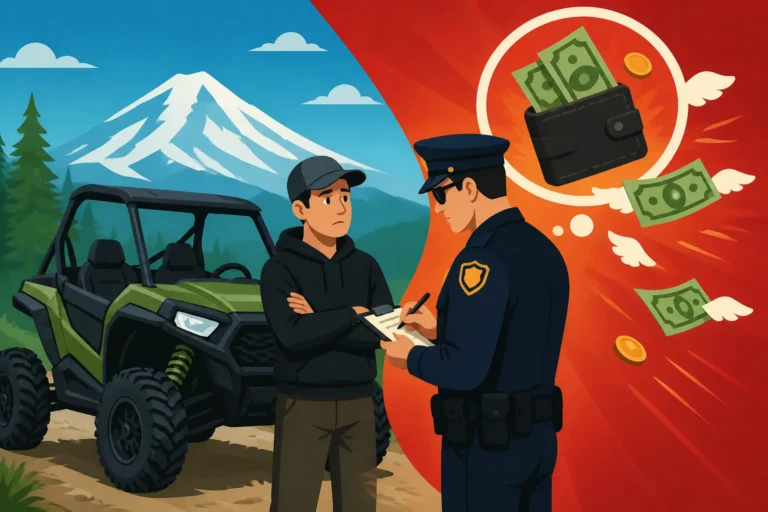
Imagine this scenario: you're enjoying a beautiful day riding a county road near Lewis County, a road that's explicitly approved for WATV use. You're going slow, being respectful, and then you see the flashing lights in your rearview mirror. A sheriff's deputy or a state trooper pulls you over. They'll likely start with a friendly chat, perhaps asking to see your driver's license, registration, and proof of insurance (if you're on a road). When they glance at your machine, those expired decals are often the first thing they'll notice, even before they ask for your paperwork.
At that point, the conversation shifts. What might have been a quick check-in turns into a potential citation. The officer isn't going to give you a pass just because you "forgot." Their job is to enforce the law, and an expired registration is a clear violation. You could be facing an immediate citation for operating an unregistered vehicle. This isn't just a slap on the wrist; it's a formal legal process that involves a fine and possibly even a court appearance. It's precisely the kind of situation that turns a leisurely ride into a deeply frustrating and costly experience, taking away from the freedom and enjoyment that ORV riding is all about.
Understanding the Penalties for Expired ORV Registration
The shock of being pulled over is just the beginning. The real sting comes with the penalties, which are designed to deter riders from neglecting their registration duties. These aren't minor inconveniences; they can hit your wallet hard and create ongoing headaches.
The Financial Hit: Fines and Fees
While I can't give you exact dollar figures because these things change and can vary by jurisdiction and the discretion of the officer, rest assured that the fine for riding with expired tabs in Washington is not negligible. It's going to be significantly more expensive than the actual cost of renewing your registration on time. Think of it as a penalty that aims to cover the state's administrative costs, discourage illegal operation, and fund various ORV programs.
Beyond the initial fine, you might also incur additional court fees or administrative charges if the citation requires a court appearance or involves further processing. It really adds up. When you consider that [Washington WATV Registration Cost] is a relatively small annual fee, paying a citation for neglecting it feels particularly painful. It’s a classic case of penny-wise, pound-foolish, where saving a few minutes on a renewal leads to a much larger financial outlay. It’s far cheaper and less stressful to simply keep your registration current. If you're wondering [What a Washington Citation for No Tabs Costs], you'll find that it's an amount you'd much rather spend on fuel or gear.
Beyond the Fine: Other Potential Repercussions
A fine is certainly a deterrent, but the consequences of riding with expired tabs can sometimes extend beyond just a monetary penalty. While it's relatively rare for a machine to be impounded solely for an expired registration on the first offense, it's a possibility, especially if there are other violations involved or if you're a repeat offender. Imagine the nightmare of having your pride and joy towed away, adding impound fees and retrieval hassle to your already growing list of problems.
Furthermore, an unresolved citation for an unregistered vehicle can complicate future registration attempts. You might find that you cannot [Renewing a Washington ORV Registration Yearly] until any outstanding fines or penalties associated with that machine are settled. It's like a snowball effect – one oversight can lead to a cascade of bureaucratic hurdles and added expenses. If you're using your machine on a public road, and it's deemed unregistered, it could even impact your insurance coverage in the event of an accident, as many policies require the vehicle to be legally operated. All of this contributes to a lingering sense of worry, which completely undermines the whole point of getting out and enjoying the fantastic Washington outdoors.
How to Stay Compliant: The Renewal Process
Avoiding the headache of expired tabs is actually quite simple, requiring just a bit of foresight and attention to detail. Staying compliant is far less stressful and certainly less expensive than dealing with the aftermath of a citation.
Timely Renewal: Your Best Defense
The most straightforward way to avoid trouble is to ensure your tabs are renewed every year, on time. Washington's ORV registrations typically expire annually, often on the same date you originally registered the machine. The Department of Licensing usually sends out renewal notices by mail, which are your first and best reminder. However, sometimes these get lost, or perhaps your address has changed.
It's a really good idea to set up your own personal reminders. Mark your calendar, put a recurring note in your phone, or even set an annual email reminder for yourself a month or two before your expiration date. This gives you plenty of time to take action. You can often renew your registration online, which is incredibly convenient. Simply head to the DOL website, enter your information, pay the fee, and your new decals will be mailed to you. Or, you can visit a local vehicle licensing subagent, who can process your renewal on the spot. This ensures you're always riding legal. For detailed steps, check out [Washington ORV Registration Online] or [Washington ORV Registration at a Subagent].
The Grace Period Myth and Reality
Many people wonder if there's a "grace period" for expired tabs, perhaps a few days or weeks where you can still ride without penalty. Unfortunately, when it comes to annual registration renewals, there isn't a grace period in Washington. Once the expiration date passes, your tabs are considered expired, and you're technically in violation. The law is pretty clear on this: the machine must be currently registered for use on public lands or roads.
It's important not to confuse the annual renewal with the "fifteen days from purchase" rule, which applies when you first acquire a machine. That rule, detailed in [Fifteen Days Before the Penalty], gives you a short window to get a newly purchased machine titled and registered before penalties kick in. That's a different scenario entirely from an expired yearly renewal. So, if you've recently been [Buying a Used ATV in Washington] and the previous owner's tabs were expired, the responsibility to get them current immediately falls on you. Do not assume you can ride it for a few weeks before getting around to it.
What to Do If Your Tabs Are Already Expired
If you've realized your tabs are already expired, the absolute first thing to do is not ride the machine. Don't risk a citation. Your next step should be to renew the registration immediately. The good news is that you can still renew an expired registration; it's not like the machine permanently loses its ability to be registered.
You'll need to go through the standard renewal process, whether that's online or in person at a subagent. However, depending on how long your tabs have been expired and if any citations have been issued, you might face additional fees or penalties on top of the regular renewal cost. It's a bit of a clean-up job, but it's essential to get it done to avoid further legal trouble. Sometimes, getting all your ducks in a row with documentation can feel a bit overwhelming, especially if there are past issues. Services like LawDepot can be helpful if you need to create a [Washington WATV Bill of Sale Requirements] when you're buying or selling, ensuring you have proper proof of ownership and reducing future headaches. This proactive step helps clarify ownership, which can be useful even if you're just renewing and need clear title proof. Once renewed, you'll receive new decals to affix to your machine, bringing you back into compliance.
Common Scenarios and Misconceptions
There are a few common misunderstandings that often lead riders down the path of expired tabs or other registration issues. Let's clear these up so you can ride with confidence and stay out of trouble.
"I Only Ride on Private Land, So Who Cares?"
This is a really common thought, and it's born from a kernel of truth. If your machine never touches public land or a public road, and it's only ridden on your own private property, then technically, Washington state ORV registration isn't required. However, the vast majority of riders, even those with large private parcels, eventually transport their machines on public roads to get to that private land, or they might cross a small strip of public land to access another section of private property or a trail system.
Here's the rub: the moment your machine is operated on any land or road managed by a public agency (like DNR, Forest Service, State Parks, or a county road that's open to ORVs), it needs current registration. Consider a hypothetical: you own a cabin deep in the Olympic National Forest, and you have miles of private logging roads. But to get to your cabin, you have to drive your WATV on a one-mile segment of a public forest service road. During that one mile, your machine needs to be properly registered. If you're stopped, your "private land only" argument won't hold water for that public stretch. Moreover, if you're ever transporting your machine on a trailer on a public highway, you should still have the registration and title sorted out, even if you're not riding it. While LawDepot doesn't handle registrations, they do provide various legal forms, which could include general indemnification agreements if you're ever allowing someone else to ride on your private land, emphasizing the importance of clear terms and conditions, even outside state registration. Riding responsibly also means respecting boundaries, so understanding [Washington Trespass Rules for Riders] is equally important.
Lost Decals or Metal Tag: Not the Same as Expired
Sometimes, riders confuse lost or damaged decals with an expired registration. They are definitely not the same thing! If your registration is current but your decals have fallen off your fender, or your metal tag has gone missing or is too worn to read, you're not riding with expired tabs. You're simply riding without visible proof of your current registration. This is still an issue, as law enforcement needs to be able to verify your compliance visually, but the solution is different.
If you lose a decal or if it gets torn off during a particularly aggressive ride, you need to order replacements. This process is usually simpler and less costly than renewing an expired registration. You can often do this through the DOL or a subagent. Details on how to do this can be found in articles like [Replacing Lost Washington Decals] or [Replacing an ORV Decal Lost Off a Fender]. Similarly, if your metal tag is current but simply too faded or damaged to read, which can happen after years of sun and mud, you'll want to get a replacement for that too. The good news is that [When a Metal Tag Is Too Worn to Read], getting a new one is generally a very minor fee, ensuring your machine remains easily identifiable and legal. Just remember to always carry your paper registration card with you while riding, as this provides official proof even if your decals are missing or damaged. For example, if you purchased your machine from a private seller and the original bill of sale (which you might have created using a LawDepot template) clearly states the current registration status, that could support your claim if a decal goes missing.
| Feature | Expired Tabs | Current Tabs |
|---|---|---|
| Legality of Riding | Illegal on public lands and roads | Legal on designated public lands and approved roads |
| Risk of Fines | High, significant financial penalties | None (for tab legality) |
| Risk of Impoundment | Possible in some severe cases or repeat offenses | Extremely low, unless other violations occur |
| Peace of Mind | Constant worry, potential stress during rides | Freedom to ride, focus on enjoyment and safety |
| Renewal Cost | Original fee + potential late fees/penalties | Standard annual renewal fee |
| Carrying Proof | Still need to carry expired registration proof, but it won't help | Must carry valid registration proof |
Ultimately, staying on top of your ORV registration is a small but critical part of responsible riding in Washington. A few minutes spent on renewal can save you a world of trouble and ensure that your time on the trails and roads is filled with enjoyment, not anxiety.
Disclaimer
This article is for general informational purposes only and does not constitute professional advice. Laws, prices and regulations vary by location and change over time. Consult a qualified professional for guidance on your specific situation.