Riding Washington Timberland With Permission
Riding Washington timberland with permission sounds straightforward, but “the owner said yes” may not settle which roads you can use, when you can ride, or what paperwork your machine needs. Timberland may be private, state-managed, or crossed by roads with separate access rules. The safest approach is to confirm the land, route, dates, and conditions before unloading.
What permission does and does not allow
Permission is about access to land. It does not automatically make every road or trail on that land open, waive posted closures, or replace your machine’s registration requirements. Treat land access and vehicle compliance as separate checks.
Start by identifying who manages the parcel. “Timberland” can mean privately owned company land, land managed by the Washington Department of Natural Resources, or a route that crosses more than one property. A road may also pass through private land while connecting to a public road or another recreation area. Don’t assume that a road shown on an old map, or one used by other riders, is open to you.
If a private owner or timber company grants access, follow the permission they give you, not a general assumption about what riders are allowed to do. Some owners may use a written permit or an access program; others may grant permission for a particular route or occasion. The terms can vary. For more on how access arrangements work, see Washington Rules for Riding Private Timberland and A Timber Company Permit in Washington.
Permission may have limits such as:
- A specific property, trail, or road network
- Certain dates, hours, or seasons
- A named group, number of riders, or particular machine
- A required route or parking location
- Restrictions on passengers, pets, camping, or fires
- A requirement to stay out of active work areas
- Conditions related to insurance, speed, noise, or equipment
Ask for the limits in clear terms. “You can ride here” is less useful than confirmation of which entrance to use, which roads are open, and whether the permission covers the day you plan to visit. If access comes with a permit, read its conditions and keep any required proof with you.
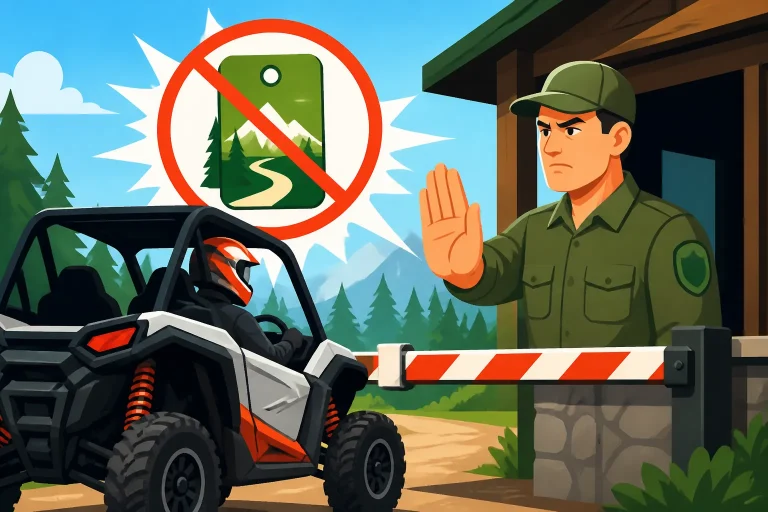
Permission also does not override a closure. A landowner, manager, or timber operator may close a road or section after granting access, including for hauling, maintenance, fire danger, or other operations. If a gate is locked or a closure sign conflicts with what you were told, stop and confirm before proceeding. A prior invitation is not a reason to ride past a closed gate. See Washington Trespass Law and Off-Road Riders for the separate question of access without permission.
Keep these two questions distinct:
- May you enter this land? Confirm the permission and its boundaries.
- May you ride this machine on this route? Check registration, route status, and any applicable rules.
A registration or ORV permit is not permission to enter private property. Likewise, an owner’s permission does not by itself meet Washington’s requirements for riding on a public road. If you expect to use a public road or a signed connection, check the rules for that route separately.
Confirm the land, route, and paperwork before you go
A little preparation can prevent the most common problems: arriving at the wrong entrance, finding out access has changed, or discovering that permission covers a different road than the one you planned to ride.
Check each part of the route
Ask the person granting access to identify the property and the permitted route as precisely as possible. A map, marked screenshot, or written directions can help, especially where roads branch or property boundaries are not obvious. Confirm whether access includes the trailhead or parking area, not just the riding route.
If the route crosses more than one ownership or management area, verify access for each part. Permission for one parcel does not carry over to a neighboring parcel. A timber road may also connect to a public road, state-managed land, or another private holding with different conditions.
For DNR-managed or state trust land, check the relevant access and recreation requirements rather than relying on a private-land permission. The rules for these areas are not interchangeable with a timber company’s conditions. See Washington Rules for Riding DNR Land and Washington Rules for Riding State Trust Land.
Check vehicle requirements separately
Before riding, confirm that your ATV or UTV has the registration or permit required for the kind of use planned. Washington’s requirements can depend on whether the machine is being used off-road only or on an authorized public road. If you are visiting from another state, do not assume your home-state sticker is accepted for every kind of riding. Check Washington ORV Reciprocity With Other States or, if applicable, Washington Temporary ORV Permit for a Visitor.
A landowner’s permission is not a substitute for an ORV tab, temporary permit, or any other vehicle requirement. Conversely, current tabs do not give you access to private timberland. If you expect to ride on a public road, check that the specific road is open to the machine and that the machine and rider meet the rules for that use. A road that happens to be gravel or wide enough for a side-by-side is not necessarily an authorized route.
Use this table as a pre-trip check, not as a substitute for the conditions set by the land manager or owner:
| What you are checking | What to confirm | Why it matters |
|---|---|---|
| Land access | Who manages each parcel and who granted permission | Permission may apply to only one owner’s land |
| Route | Which roads or trails are included | Approval to enter does not necessarily cover every branch |
| Dates and conditions | When access is valid and any limits on use | Access terms can change or be restricted |
| Closures | Whether the route is open on the day of the ride | Work, hazards, or other restrictions may close a route |
| Machine paperwork | Registration or permit for the intended use | Landowner permission does not replace vehicle requirements |
| Public-road sections | Whether the particular road allows your machine | Public-road rules are separate from private-land permission |
| Parking and staging | Where to unload and leave tow vehicles | Parking may be outside the permitted riding area |
A map can guide you, but it may not show current closures or prove that you have permission. If a route description is vague, ask before riding rather than trying to resolve the boundary at a fork in the road.
Keep useful proof accessible
If you receive written permission, keep a copy where it is easy to reach. That might be a paper copy stored securely or a saved message on your phone, with an offline copy in case reception is poor. A small waterproof document pouch, such as one available through Amazon, can help protect paper directions and permits from rain and mud; it does not replace keeping the information readable and available.
Save the name and contact details of the person who approved access, the date, and any map or route instructions. If permission is verbal, consider sending a brief message afterward that accurately summarizes what you understood and asking the owner to correct anything that is wrong. Do not treat a lack of correction as permission if the original terms were unclear.
Gates, active work, and changing conditions
Timber operations make access less predictable than a fixed trail system. Roads may be used by heavy trucks, maintenance equipment, or crews, and conditions can change between the time you get permission and the time you arrive. Your plan should include a way to stop or turn around without assuming that every road remains open.
Treat gates and signs as current information
A gate may mark a property boundary, a temporary work area, or a road that is not open to public use. Don’t tailgate another vehicle through, move a barrier, or assume that an open gate means unrestricted access. If the gate is locked or a sign says the road is closed, do not go around it. Contact the owner or manager and wait for clear authorization to use another route.
Even where you have permission to ride on a property, the owner may close part of it for a particular day or activity. Follow the signs and any directions from workers. If the owner’s earlier message and the current notice disagree, treat the restriction as active until the person responsible confirms otherwise. What to Do at a Locked Timber Company Gate covers how to handle that situation without turning a route problem into a trespass or safety problem.
Give timber traffic the right of way
A timber road is a work route, not a closed recreation circuit. Expect large vehicles, limited sight lines, loose surfaces, dust, and places where it is difficult to pull aside. Keep your speed controlled, stay alert at blind corners, and use the turnout or safe pull-off you have been told to use. Do not block a road, staging area, landing, or access point.
If you meet a logging truck or other work vehicle, get out of its path and follow any directions from the operator or crew. Avoid stopping where a driver cannot see you, and do not try to pass unless the route is clearly safe and the operator has indicated that you may proceed. If the road is actively being used and there is no safe way to share it, turn around or leave.
An open road on a map is not necessarily safe or available during active operations. Ask whether hauling or other work is scheduled for your visit. For related planning, see Riding Around an Active Timber Sale and Riding a Road That Crosses Private Land.
Leave the route as you found it
Stay on the authorized road or trail. Cutting around a muddy section can damage the land, widen the route, or take you beyond the area you were allowed to use. Don’t create a new bypass, cross a planted area, or use a spur simply because it looks rideable. If a route is blocked or conditions make it unsafe, turn around and contact the owner instead of improvising.
Pack out trash, secure loose items, and avoid disturbing equipment, signs, gates, or materials. Keep noise reasonable, particularly near homes, work sites, or areas the owner has asked riders to avoid. If you are riding with others, make sure every rider understands the access terms; one person’s permission should not be assumed to cover an entire group unless the owner said so.
A practical ride-day routine
The best time to settle access questions is before the machines come off the trailer. Use a simple routine to verify that the permission still fits the trip and that everyone knows what to do if conditions change.
- Reconfirm the visit. Check that your permission covers the date, group, and machines you are bringing. If there has been a gap since the approval, confirm that access is still available.
- Review the route and entrance. Make sure every rider knows where to unload, which roads are included, and where the permitted area ends.
- Check for closures. Look for current notices from the owner or land manager, and ask about active hauling, maintenance, or other work. For broader closure planning, see Checking Alerts Before You Load Up.
- Check each machine. Confirm that its paperwork fits the planned use. If the route includes a public road, verify the specific road and the requirements for riding there.
- Share the conditions. Tell the group about gates, restricted branches, speed or noise expectations, parking limits, and any instruction to leave if work begins.
- Carry the details. Keep permission, directions, and a contact number available. Do not rely on a single rider’s phone or memory.
- Stop if the situation changes. A new sign, locked gate, active work area, unclear boundary, or request from the owner is a reason to pause and ask before continuing.
If permission is denied, expires, or cannot be confirmed, choose a designated riding area rather than trying to negotiate access at a gate. If you are unsure whether a road is private, public, or managed under a different access system, do not treat uncertainty as approval. Confirm the status with the relevant owner or manager before riding.
A good timberland visit depends on more than getting a yes. Confirm who controls the land, what route and dates are covered, and what conditions apply; then check vehicle paperwork and current closures separately. Respecting gates and work activity helps protect both riders and future access.
Disclaimer
This article is for general informational purposes only and does not constitute professional advice. Laws, prices and regulations vary by location and change over time. Consult a qualified professional for guidance on your specific situation.