Washington Rules for Riding a Closed Road
A road that appears on an old map or riding app may still be closed to ATVs and UTVs. In Washington, a registration, temporary permit, or out-of-state sticker does not grant permission to use a closed route. The safest approach is to identify who controls the road, read the closure terms, and confirm access before riding.
What “closed road” can mean in Washington
“Closed” is not always a single legal status. A road may be closed to all public traffic, closed only to motorized recreation, closed seasonally, or temporarily restricted because of work or a safety risk. It may also be a private road where the owner has not allowed public access. The sign, gate, land manager’s order, and local rules help determine what the closure means.
That distinction matters because a route can look passable without being open to your machine. A road might remain open to authorized workers, emergency vehicles, or people with a specific access agreement while still being closed to recreational riders. A gate that is open when you arrive does not necessarily mean the road is open to the public.
Check the wording and the authority
Look for signs at the entrance, at junctions, and along the route. A notice may specify that access is closed to motor vehicles, that a road is closed during a particular season, or that only authorized users may pass. It may also identify the agency, company, or local authority that issued the closure.
If a sign is missing, damaged, or unclear, do not assume the route is open. Identify the land manager and ask whether your type of machine may use the road and whether any conditions apply. The distinctions in Washington Rules for Riding a Forest Road and Washington Rules for Riding a Logging Road are useful when a route crosses managed forest land, but a general description of a road does not replace a current closure notice.
A road can also be closed to WATVs because it has not been approved for their use, even if other vehicles are allowed. Washington’s road access rules can depend on the road’s location, posted speed, local ordinances, and the responsible authority. A valid registration does not create a right to ride every public road. For more on the local approval process, see Washington Counties That Allow WATVs on Roads and Finding a County’s Approved Road List.
A gate and a closure sign are not the same thing
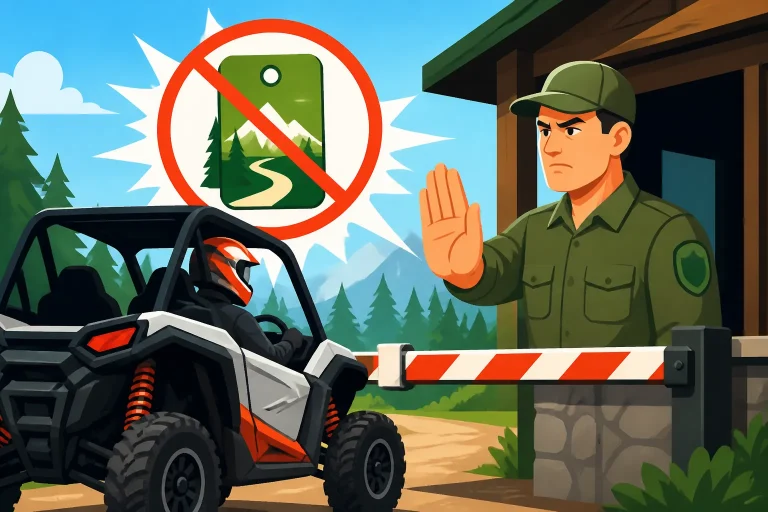
A gate is a physical barrier, but the reason for it may vary. It might mark a permanent closure, seasonal restriction, private property boundary, active work zone, or controlled access road. The presence of a gate is a strong reason to stop and check, not a puzzle to solve by riding around it.
Likewise, a gate that has been left open is not reliable proof of public access. It may be open for a work crew, a landowner, or another authorized user. If the notice says the road is closed, treat the notice as controlling unless the responsible authority confirms otherwise.
For a practical response to a locked entrance, see What to Do at a Locked Timber Company Gate. The key point is simple: do not lift, bypass, move, or ride around a barrier unless the land manager has explicitly authorized you to do so.
Why a road may be closed, and what that means for riders
Closures often protect people, property, or the road itself. A closure can be temporary and still be enforceable. It can also remain in place after the immediate reason is no longer obvious to a rider.
Common reasons include:
- Active logging or road work. Trucks, machinery, falling trees, and changing work zones create hazards that may not be visible from the entrance.
- Storm damage or unstable ground. A road may be unsafe after heavy rain, flooding, landslides, washouts, or fallen trees.
- Fire danger or fire response. A fire-related closure may protect the public and allow emergency crews to work.
- Wildlife, habitat, or seasonal restrictions. Some closures are intended to reduce disturbance during sensitive periods.
- Resource protection. A route may be closed to prevent damage to soil, water, vegetation, or nearby habitat.
- Private-property access limits. A landowner may restrict entry or allow it only with permission.
- Road maintenance or public safety. A road may be blocked while crews repair it or address a hazard.
- Local restrictions on WATV use. A road may not be approved for WATVs even if it remains open to other traffic.
A closure does not have to be permanent to matter. A road closed for hauling or a storm response is still not a recreational route while the restriction is active. Do not ride through a work zone because it appears quiet, or assume that a closure has ended because the weather has improved.
Do not treat access as a status you can infer from the map
Maps and GPS apps are useful for navigation, but they can lag behind road closures, gate changes, land-management decisions, and local ordinances. A road marked as open on an older map may have been closed since the map was made. Conversely, a route that appears blank on a map may have an authorized access arrangement that is not obvious from the map alone.
If you find a route that appears open on an old map but is signed or gated closed today, follow the current on-the-ground restriction while you verify the status. Riding a Road Shown Open on an Old Map explains why map lines are not proof of current access.
Before a trip, check the current information from the authority responsible for the road. If the area is managed by a state or federal agency, look for its current recreation alerts or contact the local office. If a timber company or private owner controls the route, ask that owner or manager directly. For an uncertain closure, a clear answer from the responsible authority is more useful than a guess based on tire tracks or another rider’s post.
Temporary closures can change during a ride
A route that was open when you planned the trip can close before you reach it. Storms, fire activity, road damage, emergency response, or active work can prompt a new restriction. A closure notice posted at a junction may apply even if you entered the area from a different access point.
If you encounter a new closure, stop before the restricted section. Do not continue to “just the next intersection” unless the notice or an authorized person specifically permits that movement. If you can safely turn around without entering the closed area, do so. If the route is blocked in a way that leaves you uncertain about a safe exit, contact the responsible agency or emergency services as appropriate rather than improvising a route through restricted land.
See Riding a Trail After a Storm Closure and Reading a Closure Notice Posted at a Gate for more on responding to closures that appear during a trip.
Registration, permits, and reciprocity do not open a closed road
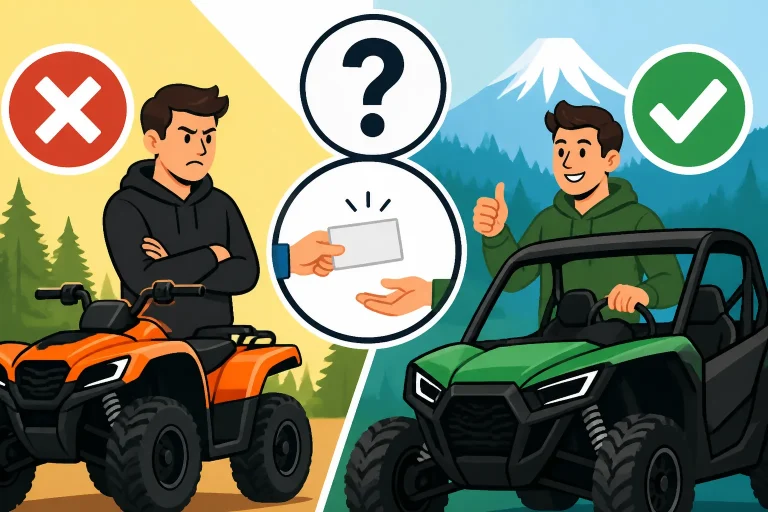
Washington ORV registration, a temporary permit, or a valid registration from another state addresses whether a machine meets certain registration or use requirements. It does not authorize travel on a route that is closed, private, or otherwise unavailable to the public.
That difference is easy to miss. A rider may have the correct tabs, required equipment, and paperwork and still be on a road where riding is prohibited. Conversely, an open route may have its own registration, permit, equipment, or land-access requirements. You need to satisfy both kinds of rules: the rules that apply to the machine and the rules that apply to the route.
A permit is not landowner permission
A temporary ORV permit or a registration sticker does not substitute for permission from a private landowner. It also does not override a closure imposed by the public agency or other authority responsible for the road. A permit can let a machine meet a defined registration requirement; it is not a pass through a closed gate.
The same principle applies to special access arrangements. If a landowner grants access for a particular purpose, route, time, or group, follow those terms. Permission to use one road does not necessarily extend to nearby roads, trails, or later visits. Get the conditions in writing when the arrangement is important or easy to misunderstand.
For visitors, Washington ORV Reciprocity Rules explains the role of out-of-state registration. Reciprocity may help determine whether a visitor’s machine is recognized for certain riding purposes, but it does not establish that a particular road is open. Similarly, [Washington Temporary ORV Permit for a Visitor] covers a separate permit option; it is not authorization to ignore a closure.
Road access and trail access are separate questions
A machine that is registered for off-road use may be allowed on designated routes but not on every paved or gravel road. A WATV that qualifies for road use may still be restricted from an unapproved road, a closed segment, or a route that the local authority has excluded. A trail connection does not automatically make an adjoining road open, either.
Check each part of a planned route separately:
- Is the road or trail open to the public right now?
- Does the responsible authority allow your type of machine on it?
- Does the route have a local approval, permit, or access condition?
- Does your machine meet the relevant registration and equipment requirements?
- Are there restrictions for the date, season, rider, or group?
If any answer is unclear, verify it before riding. Washington Rules for Riding DNR Land and [Washington Rules for Riding a National Forest] provide useful context for routes on those types of land, but current closures and local instructions still control.
What to do when you encounter a closed road
A calm, consistent response protects you, other riders, and the people managing the route. A road closure is not the time to test whether a machine can fit around a barrier or whether the sign is being enforced.
- Stop before the sign, gate, or blocked section. Avoid entering far enough that turning around becomes difficult or puts you in the path of work traffic.
- Read the notice carefully. Check whether it names the closure area, effective period, affected users, reason, or contact information.
- Do not cross or bypass the barrier. Do not move a gate, drive around a berm, use a side track to rejoin the road, or enter through another access point to get around the restriction.
- Find a safe legal route back. Use a route you already know is open, or return the way you came if that is safe and permitted.
- Confirm the status with the responsible authority. Ask whether the restriction is current, what area it covers, and what type of access is allowed.
- Update your plan. Tell your group, change the route, and make sure everyone understands where the closure begins.
- Report a safety problem if needed. If a sign or barrier is damaged, a washout presents an immediate hazard, or a closure appears to be ignored in a way that creates danger, contact the appropriate land manager or emergency authority.
Avoid confronting other riders at the gate. If someone is entering a closed area, do not follow them or try to enforce the closure yourself. Keep a safe distance and report a serious or immediate hazard to the appropriate authority.
If you discover a closure after entering the area
Sometimes a rider reaches a closure from a different direction or finds a notice that was not visible at the trailhead. Stop as soon as you can do so safely, read the notice, and turn around or use an authorized alternate route. Do not continue deeper into the closed section just to find a place to turn around unless stopping where you are would create a greater immediate danger.
If you cannot safely reverse course, seek guidance from the land manager or emergency services. Explain your location, the type of machine, the route you entered, and the wording on the notice. Do not assume that a closed road is safe simply because it is physically passable.
Do not rely on tracks, open gates, or other riders
Tracks on a road show that someone traveled there; they do not show that the trip was authorized. The rider may have permission, may have entered before the closure, or may simply have disregarded it. Similarly, an unlocked gate or the absence of a sign at one entrance does not necessarily cancel a closure posted elsewhere.
If the closure terms are unclear, take a photo of the notice for reference, note the road name or nearby junction, and contact the controlling authority. Do not post a guess as confirmed access information. Accurate updates can help other riders avoid both unsafe conditions and unauthorized entry.
Plan around closures before you unload
A little planning can prevent a long detour and reduce the chance of an accidental violation. Check closure information close to the day of the ride, especially after storms, during active fire conditions, or when road work is underway. A trailhead sign is important, but it may not be the only place where restrictions are posted.
Use several checks, not one map
Before leaving home:
- Identify who manages the road or the land around it.
- Check the manager’s current alerts, closure notices, and recreation information.
- Review a current route map, but treat it as a planning tool rather than proof of access.
- Look for local WATV road approvals and restrictions if your route uses public roads.
- Contact a private landowner or timber company if access depends on permission.
- Plan a legal alternate route and know where you can turn around.
- Tell your group that a closure means changing the plan, not trying another entrance.
Once at the site, check posted notices at the trailhead and at major junctions. Conditions can change between the parking area and the road you intended to ride. If a notice conflicts with an older printed map or an app, follow the current restriction while you confirm the details.
The practical steps in Checking Alerts Before You Load Up can help you make current closure checks part of trip planning. For information on closures that lift or change during a season, see How to Know When a Trail Reopens Mid-Season. Do not treat an expected reopening date as permission to ride before the land manager confirms that the route is open.
Keep a simple record when access is complicated
For a route involving several land managers or a private access agreement, keep the relevant contact information and written permission available during the ride. Save the date and terms of any access confirmation. That record will not override a later closure, but it can help you understand which route and conditions were authorized.
If you are riding with a group, share the same route plan and closure information with every rider. A leader’s permission or registration does not automatically cover every participant. Each rider should know where the route is open, where it ends, and what to do if the group reaches a closure.
When you cannot confirm access, choose a route that is clearly open rather than gambling on an ambiguous road. A detour is frustrating; a closed-road violation, unsafe work zone, or conflict with a landowner can turn a riding day into a much bigger problem.
Frequently Asked Questions
Can I ride around a gate if there is room beside it?
No. Space beside a gate is not permission to pass. A bypass can still violate the closure and may cause damage or create a safety hazard. Stop and verify access with the responsible authority.
Does an out-of-state ORV sticker let me use a closed road?
No. Reciprocity concerns registration recognition, not route access. A closed road remains closed unless the authority responsible for it permits your use.
What if the road is open to cars but not listed for WATVs?
Do not assume that ordinary vehicle access includes WATV access. Check the applicable local rules and approved road list. If your machine is not authorized for that road, use a route that is open to your type of vehicle.
Can I rely on an open gate or fresh tire tracks?
No. A gate may be open for authorized users, and tracks do not establish that the road is open to the public. Check the signs and confirm the road’s status with the authority that controls it.
Disclaimer
This article is for general informational purposes only and does not constitute professional advice. Laws, prices and regulations vary by location and change over time. Consult a qualified professional for guidance on your specific situation.