Why a Discover Pass Fails at a Federal Gate
A Discover Pass can be valid and still not open the gate in front of you. The reason is usually jurisdiction: Washington’s state pass and federal recreation sites are managed separately. Knowing who manages the land—and whether the pass covers that site—helps you avoid a last-minute access problem and plan the right documents for your ride.
Why a Discover Pass does not work at a federal gate
A Discover Pass is a Washington state recreation pass, not a universal pass for every public land site in the state. According to USDA Forest Service, federal and state recreation passes are managed by different jurisdictions and generally are not interchangeable. The Washington Discover Pass applies to lands managed by Washington State Parks, the Department of Natural Resources, and the Department of Fish and Wildlife.
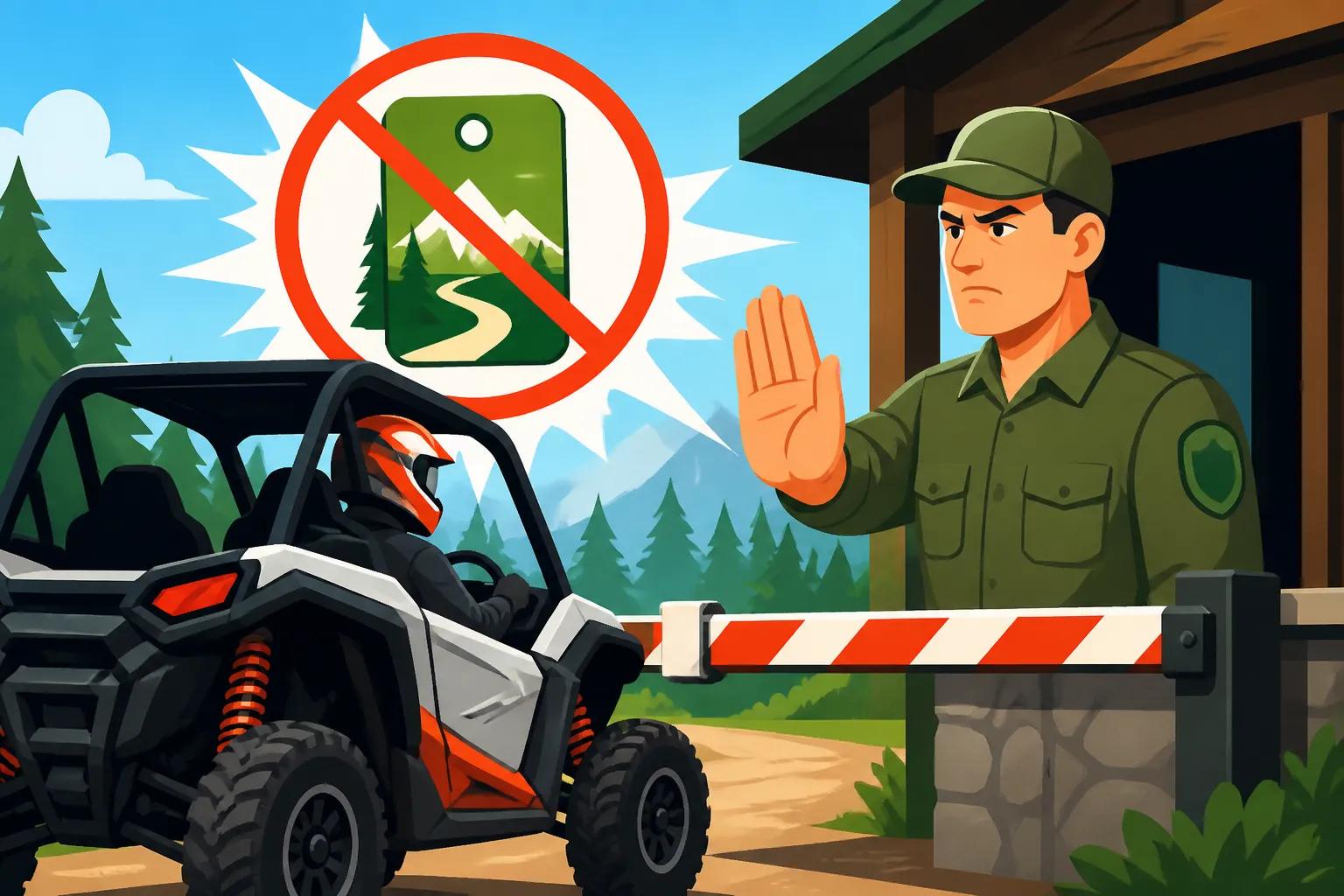
That means a federal gate may refuse a Discover Pass even if it is current and displayed correctly. The pass has not necessarily expired or been used incorrectly; it may simply be for a different land manager. A gate’s location in Washington does not make it a state-managed site.
The first thing to check is who manages the place you intend to visit. A trailhead, staging area, campground, or road can be near state land but still belong to a federal agency. Where management boundaries meet, a route may even pass through more than one jurisdiction. Don’t assume the pass that worked at one nearby entrance will work at another.
This distinction is useful when planning an ATV or UTV trip because access is not determined by the machine’s registration alone. A vehicle can have valid Washington tabs and still need a separate land-access pass, or be unable to use a route because that route is closed or not open to that type of vehicle. For more on state pass coverage, see The Discover Pass and Washington Riders and Where a Washington Discover Pass Is Required.
Separate the vehicle paperwork from the land pass
An off-road vehicle registration and a recreation pass solve different problems. Registration applies to the vehicle; a pass applies to access or parking at a site managed by an agency that accepts that pass. Having one does not automatically replace the other.
According to the Washington State Department of Licensing, off-road vehicles include motorcycles, all-terrain vehicles, and snowmobiles. The agency defines an off-road vehicle as a non-street-registered vehicle with two, three, or four wheels. Washington also provides separate requirements for titling and registering wheeled all-terrain vehicles, or WATVs.
For riding in Washington, the Department of Licensing says drivers must carry the off-road vehicle registration in the vehicle while operating it in the state. That registration does not tell you whether a particular federal gate accepts a Discover Pass. Likewise, a recreation pass does not substitute for the vehicle tabs required at a riding area.
| What you need to check | What it applies to | What it does not establish |
|---|---|---|
| Vehicle title and registration | The ATV, UTV, or other off-road vehicle | Whether a land manager accepts a Discover Pass |
| Discover Pass coverage | Eligible sites managed by Washington State Parks, DNR, or Fish and Wildlife | Access to federal sites |
| Site-specific access rules | The particular land, trail, road, or staging area | That the same rules apply at a nearby site |
| Riding-area requirements | The vehicle and riding activity at that location | That a pass alone makes an unregistered vehicle legal to ride |
A road-legal machine does not automatically have permission to use every road or enter every recreation area. A street-legal designation addresses the vehicle’s use on qualifying roads; it does not determine which land agency manages the property or what access pass that agency accepts. For help sorting out vehicle tabs and riding permissions, see Washington Rules for Riding Federal Land and Washington ORV Reciprocity With Other States.
How to confirm the right pass before you go
Before loading the machine, identify the specific destination—not just the general forest, park, or region. Look for the managing agency named for the trailhead, staging area, or access road you plan to use. If more than one agency manages nearby land, verify the rules for the exact entrance and route.
Use this sequence:
- Identify the site and entrance. A large recreation area may have multiple access points, and the rules at one entrance may not answer the question for another.
- Confirm the land manager. Check the site information or posted notices for the responsible agency. Do not infer the manager from a nearby town, road sign, or map label alone.
- Check the pass accepted there. If the site is federal, don’t assume a Washington Discover Pass will be accepted. Confirm the pass or access requirement with the agency responsible for that site.
- Check vehicle and riding rules separately. Find out whether your machine may use the road or trail, whether current tabs are required, and whether any other conditions apply.
- Check for current closures or changes. Access instructions can differ by entrance or change with site conditions. Confirm before you leave rather than relying on a pass that worked on an earlier trip.
- Keep proof available. Have your vehicle registration and any required pass accessible in the form the site instructions call for.
If information is unclear, ask the managing agency about the exact location and the pass you plan to use. A useful question is: “Is this entrance on land managed by your agency, and what pass or fee applies to this parking area?” That is more precise than asking whether a Discover Pass is accepted “in the area.”
The distinction matters even when no fee is charged to ride. An area can have separate rules for riding, parking, and vehicle registration. For example, Washington State Parks says there is no cost to ride in the Riverside State Park Off-Road Vehicle Area, but a Discover Pass is required for street-legal vehicles. That example is specific to that state park; it does not establish the rules at a federal site. Check What Washington Charges Visitors to Ride and Why Evans Creek Needs a Northwest Forest Pass for related differences in pass requirements.
What to do when a gate refuses your pass
Don’t treat a rejected pass as permission to go around a barrier or continue onto a road or trail. Stop and check the sign, site information, and managing agency. The gate may be marking a jurisdiction boundary, a parking requirement, a closure, or a restriction that applies to the route ahead.
Avoid assuming the problem is just a display issue. A Discover Pass is transferable between two vehicles, and the Department of Natural Resources says it must be displayed in the front windshield while parked at DNR sites. Those directions apply to the Discover Pass at DNR sites; they do not make it valid at federal sites. If the gate is federal, the central question is whether that site accepts the state pass at all.
If you have the wrong pass, the practical fix is to follow the site’s instructions for obtaining the pass it accepts, if one is required. Check whether the pass can be purchased in advance or at the location, and whether the entrance you are using offers that option. Do not count on buying a pass at a gate unless the managing agency confirms that arrangement.
If you cannot confirm access, choose another destination whose requirements you can verify before setting out. That may mean revising the route, parking location, or riding plan. It is better to resolve the uncertainty before unloading than to discover that a pass for state-managed land does not apply at a federal entrance.
The main takeaway is simple: match the pass to the land manager, then confirm the rules for the exact site and the vehicle you plan to ride. A Discover Pass can be perfectly valid for eligible state sites and still be the wrong pass at a federal gate.
Disclaimer
This article is for general informational purposes only and does not constitute professional advice. Laws, prices and regulations vary by location and change over time. Consult a qualified professional for guidance on your specific situation.