Washington Rules for Riding a Forest Road
Navigating the vast network of forest roads in Washington can feel like stepping into a maze with invisible rules. Many new riders, and even some seasoned ones, find themselves scratching their heads, wondering which roads are legal for their ATV or UTV, what gear they actually need, and how to avoid accidental trespassing or a hefty fine. This guide is here to untangle that confusion, providing clear, actionable insights into how to ride Washington's incredible forest roads safely and legally, ensuring your adventures are memorable for all the right reasons.
Understanding Washington's Forest Road Landscape
Washington state is a treasure trove of natural beauty, much of it accessible via an intricate web of forest roads. But here's the kicker: not all forest roads are created equal, and knowing who manages the land you're on is half the battle when it comes to riding legally. It's easy to assume "forest road" means "open to anything," but that's rarely the case. Each agency or landowner has its own set of rules, and they can change with the seasons, weather, or even active operations.
DNR, Forest Service, and Private Timberland Roads
When you're out exploring Washington's backcountry, you'll primarily encounter roads managed by three main entities: the Washington State Department of Natural Resources (DNR), the U.S. Forest Service (USFS), and various private timber companies. Each has distinct regulations that directly impact where and how you can ride your ATV or UTV.
DNR lands, often identifiable by their green dot road system in certain areas, are generally quite accessible for motorized recreation, provided you have the proper registration and [Washington ORV Permits Explained], like the Discover Pass. These roads are managed for multiple uses, including timber harvest, recreation, and conservation. However, access can be seasonal, and specific routes might be closed for active logging, fire danger, or to protect wildlife. Always check DNR's recreation maps and alerts before heading out. They are excellent resources for [Washington Rules for Riding DNR Land].
The U.S. Forest Service manages national forests, and their roads often fall under slightly different rules, sometimes requiring a Northwest Forest Pass for day-use areas or staging points, though the actual roads themselves might not require it for simple transit. USFS roads tend to connect vast wilderness areas and can range from well-maintained gravel to barely-there tracks. Pay close attention to signage; some roads might be open to full-sized vehicles but closed to ORVs, or vice-versa. There are often width restrictions on specific trails, so if you've got a wider side-by-side, it's crucial to know your machine's dimensions and check trail rules.
Then there are the private timberlands. This is where things can get tricky. Many private timber companies, like Weyerhaeuser or Hancock Forest Management, generously allow public access to their roads for recreation. However, this access is almost always a privilege, not a right, and it comes with very strict conditions. These companies prioritize timber operations, so their roads are constantly in use by heavy equipment. Gates can be locked without notice, and road closures are common, especially during fire season or active logging. Some companies require special permits or keys for access, while others have blanket prohibitions on motorized recreation. Ignoring these rules can lead to trespassing charges, which is a serious matter. Always research the specific timber company's policy for the area you plan to ride. [What a Timber Company Access Permit Costs] might be a question you'll need to research.
The Difference Between Open and Closed Roads
The distinction between an "open" and "closed" forest road is absolutely vital for legal and safe riding. It might seem obvious, but what constitutes "closed" isn't always a locked gate. Often, it's a sign, a barricade, or even just a notation on a map. Many riders get into trouble because they assume if a road "looks" open, it must be. This is a common and costly mistake.
An open road generally means it's legal for public access, subject to any posted restrictions. This includes things like speed limits, vehicle type restrictions (e.g., street-legal only, or ORVs welcome), and seasonal closures. On DNR and USFS lands, these roads are typically well-marked on official recreation maps and have clear signage at their entry points. An open road does not mean you can drive off the designated path; [Washington Rules for Riding Off a Designated Trail] are very clear about staying on established routes to prevent environmental damage and erosion.
A closed road, on the other hand, is off-limits. This could be due to active logging, which poses serious safety risks from heavy machinery and falling trees. It could also be for fire danger, particularly during Washington's dry summer and fall months, when a single spark from an exhaust system can ignite a massive wildfire. Environmental protection is another common reason, safeguarding sensitive habitats, newly planted trees, or areas recovering from natural events. Sometimes, roads are simply decommissioned or become impassable due to washouts or slides. Signs indicating "Road Closed," "No Trespassing," or a physical barricade or gate are all definitive indicators. Even if a gate is open, but a "Closed" sign is present, the road is closed. Always respect these closures; they are there for your safety, the safety of others, and the protection of our natural resources. [Washington Fines for Riding a Closed Trail] can be substantial, so it's not worth the risk.
Essential Gear and Rules for Riding Washington Forest Roads
Heading out on Washington's forest roads isn't just about finding a cool spot to ride; it's about being prepared and knowing the rules. The right gear, proper registration, and a good understanding of safety regulations are absolutely non-negotiable for a hassle-free and enjoyable experience. You're out in the wild, often far from immediate help, so self-reliance and adherence to regulations are key.
Required Registration and Tabs
Before your tires even touch the gravel of a Washington forest road, your ATV or UTV must be properly registered with the state Department of Licensing (DOL). This means having a current [Washington's Off-Road Tab Explained] displayed prominently on your machine. This tab is your passport to ride on designated non-highway roads and trails throughout Washington. Without it, you're not just risking a ticket; you're riding illegally.
The off-road tab is typically a small, colored decal that needs to be affixed to the rear of your machine, usually near the license plate area or on the fender, where it's clearly visible. The funds generated from these registrations go directly back into maintaining and developing the very trails and staging areas you love to ride, so it's an investment in your own recreation. Make sure to carry your physical registration document with you on your machine. While not always checked, a ranger or law enforcement officer may ask to see it, and having it readily available can save you a lot of hassle. Getting caught without proper registration can lead to a citation and dampen your entire day.
Some riders also opt for the [Adding the $12 On-Road Tab on Top] if they plan to ride on certain county roads or designated city streets that allow WATV access. However, for most dedicated forest roads, the off-road tab is sufficient, as these roads are generally considered non-highway. It's crucial to understand the distinction between "forest road" and "public road" for on-road legality. This guide is specifically about forest roads, which typically fall under the off-road designation.
Safety Gear and Machine Requirements
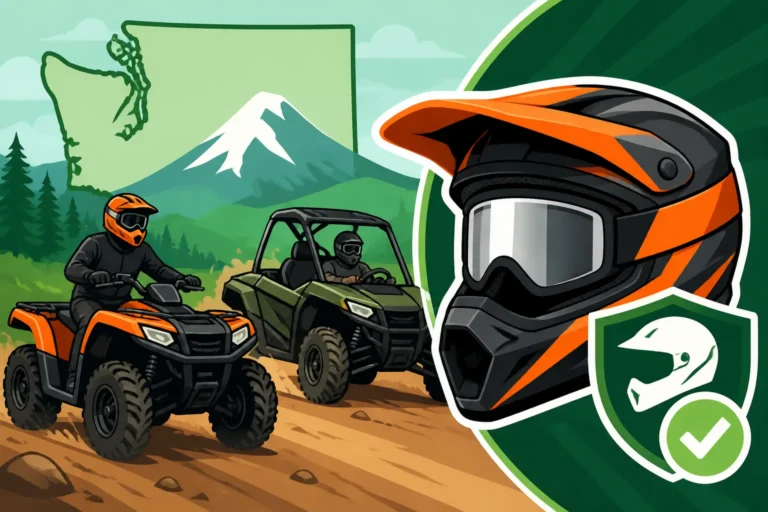
Safety isn't just a suggestion; it's the foundation of every good ride. Washington has specific requirements for riders and their machines, designed to minimize risks and protect both you and the environment. One of the most critical pieces of personal safety gear is a helmet. Washington law requires all riders and passengers of ATVs and UTVs on public lands to wear a U.S. DOT-compliant helmet. This applies regardless of age or experience level. It's not just a rule; it's common sense, especially on unpredictable forest roads where unforeseen obstacles or changes in terrain can happen in an instant. [Washington Helmet Law for WATV Riders] provides all the specifics.
Beyond helmets, your machine itself needs to meet certain requirements. A functioning spark arrester is mandatory on all ORVs ridden on public land in Washington. This device prevents hot carbon particles from exiting the exhaust system and potentially igniting dry vegetation, which is a massive concern during fire season. Regular maintenance of your spark arrester isn't just about compliance; it's about being a responsible land user. [Washington Spark Arrester Requirement] goes into more detail. Your machine also needs a proper muffler system that keeps noise levels within legal limits. Excessive noise not only disturbs wildlife but also irritates other forest users, leading to potential restrictions or closures. [Washington Sound Limits on Public Land] are in place for a reason.
Other recommended gear, though not always legally required for all forest road riding, includes eye protection (if your machine doesn't have a windshield), sturdy over-the-ankle boots, long pants, and a long-sleeved shirt to protect against branches, debris, and sun exposure. Equipping your machine with a horn, headlamps, and tail lamps is also smart, especially if you might be riding near dusk or in dusty conditions. Many experienced riders also ensure their machines have a robust skid plate system, perhaps from a brand like SuperATV, to protect the underside from rocks and debris that are common on forest roads.
Knowing Your Limits and Your Machine's
One of the biggest mistakes riders make is pushing their own limits or their machine's capabilities on unfamiliar terrain. Forest roads can be deceptive; a smooth stretch can quickly turn into a rocky, rutted, or muddy challenge. Understanding your skill level is paramount. If a section looks too difficult, it's always better to scout it on foot, or even turn around and find an alternative route. There's no shame in exercising caution; in fact, it's a sign of a seasoned and responsible rider.
Your machine also has limits. Every ATV and UTV has a designed width, ground clearance, and suspension travel. Attempting to navigate trails or obstacles that exceed these specifications can lead to getting stuck, damaging your machine, or even injury. For instance, some narrower single-track trails are not suitable for wider side-by-sides. Check your machine's owner's manual for its specifications and pay attention to posted trail width restrictions. Aftermarket parts from companies like SuperATV can enhance certain aspects of your machine's performance, like ground clearance or suspension, but they don't make it invincible. Being aware of your fuel range, especially when venturing deep into remote areas, is also critical. Always carry extra fuel if there's any doubt, along with a basic tool kit, tire repair kit, and a first-aid kit. A reliable GPS or detailed map, paired with knowledge of your location, can prevent you from getting truly lost.
Navigating Specific Forest Road Scenarios
Riding forest roads isn't always a smooth, uninterrupted cruise. You'll often encounter situations that require awareness, caution, and a good understanding of protocol. From sharing the road with massive log trucks to deciphering cryptic closure signs, knowing how to navigate these scenarios safely is a crucial part of becoming a responsible Washington ORV enthusiast.
Encountering Active Logging Operations
This is arguably one of the most important and potentially dangerous scenarios you'll face on Washington's forest roads. Active logging operations are common, especially on DNR and private timberland, and they demand your utmost respect and caution. Picture this: you're cruising down a gravel road, enjoying the scenery, when suddenly you hear the distant rumble of heavy machinery or see a "Log Trucks Working" sign. This isn't a suggestion; it's a warning.
Log trucks are massive, heavy, and often travel at speeds that can catch you off guard, especially around blind corners or on narrow roads. They have the right of way, always. If you encounter one, pull over immediately to the safest side of the road, give them ample room to pass, and wait for the dust to settle. Do not try to wave them down or assume they see you. Their focus is on their load and the road. The sheer size and weight of these vehicles mean they cannot stop quickly or swerve easily. [Meeting a Log Truck on a Gravel Road] highlights these dangers.
Beyond the trucks, logging areas themselves are incredibly dangerous. Falling trees, swinging cables, and large machinery create a hazardous environment. Never enter an active logging site, even if it looks quiet. Respect all warning signs, barricades, and posted closures. These are not put up to inconvenience you; they are there to protect your life. If you see active operations, turn around and find an alternative route. This might mean your planned ride is cut short, but it's a small price to pay for safety.
Dealing with Gates and Posted Closures
Gates and closure signs are a constant presence on Washington's forest roads, and understanding their implications is non-negotiable. It's a fundamental rule: if a road is gated or clearly marked as closed, you do not proceed. This applies even if the gate is unlocked or appears easily passable. The responsibility rests squarely on you, the rider, to respect these boundaries.
A gate often signifies private property, active operations, or a seasonal closure. Driving around a gate, cutting a lock, or ignoring a "Road Closed" sign is trespassing, plain and simple, and can lead to serious legal consequences, not to mention the possibility of losing access for everyone else. Many access privileges to private timberlands exist because riders have respected these rules. Abusing them can lead to landowners shutting down public access entirely. [What to Do at a Locked Timber Company Gate] is usually "turn around."
Sometimes, closures are seasonal, designed to protect roads during wet weather, which can lead to excessive erosion, or to protect wildlife during sensitive periods like mating or nesting seasons. Other times, specific sections might be temporarily closed due to maintenance, road damage, or special events. Always look for accompanying signage that explains the nature and duration of the closure. If there's no explanation, assume the closure is permanent or indefinite for public use. It's better to err on the side of caution.
Reading the Signs and Maps
In the vast expanse of Washington's forests, signs and maps are your best friends. They are the authoritative voice guiding your journey and keeping you legal and safe. However, they're only useful if you know how to read and interpret them. Don't rely solely on your phone's GPS; cell signal is notoriously unreliable in many forest areas. Always carry physical maps or downloaded digital maps that work offline. DNR and Forest Service offices often provide detailed recreation maps specific to their areas.
Learn to distinguish between different types of signs. A standard stop sign or yield sign applies just as it would on a paved road. However, you'll encounter signs specific to forest environments:
- "Non-Highway Vehicle Access Only": Great news! Your ORV is welcome here.
- "Road Closed to Motorized Vehicles": Time to turn around or find another route.
- "Green Dot Road": On DNR lands, these typically indicate roads open for public access, but always double-check specific area rules. [What a Green Dot on a Road Sign Means] can vary slightly by region.
- "Active Logging Operations": Extreme caution required, be prepared to yield to all industrial traffic.
- "Width Restriction": Pay attention to the maximum width allowed. If your machine is wider, you can't go.
- "Seasonal Closure": Indicates the road is closed during certain times of the year, often for environmental protection or road integrity.
It's also essential to cross-reference signs with maps. Sometimes a map might show a road as open, but recent events (like a washout or active logging) could lead to a temporary closure not yet updated on all maps. Always defer to the physical signage you encounter on the ground. When in doubt, call the local DNR or Forest Service office for the most current information before you leave home. [Washington Trail Closures to Check First] is a crucial step in trip planning.
Respecting the Environment and Other Users
Riding our beautiful Washington forest roads is a privilege, and with that privilege comes a significant responsibility to protect the environment and show respect to everyone else who uses these shared spaces. Our actions as ORV riders directly impact public perception and future access. Being a good steward of the land ensures these opportunities remain open for generations to come.
Treading Lightly and Staying on Designated Trails
The "Tread Lightly!" principle is more than just a catchy slogan; it's a fundamental ethos for responsible off-road recreation. It means minimizing your impact on the natural environment. For forest road riding, this primarily translates to staying on designated roads and trails. Never create new trails, cut switchbacks, or ride through sensitive areas like wetlands, meadows, or newly reforested sections. Riding off-trail leads to erosion, disturbs wildlife, spreads invasive species, and damages vegetation, scarring the landscape for years to come.
Forest roads, especially unpaved ones, are susceptible to erosion, particularly after heavy rains. If you encounter a muddy or wet section, ride straight through it rather than trying to go around. Riding around expands the disturbed area and widens the trail, causing further damage. This is where quality tires, and sometimes even a winch, come in handy. For extreme conditions, a powerful winch, perhaps one from SuperATV, can help you get unstuck without tearing up the surrounding ecosystem. Be mindful of your speed, especially on corners or crests, to avoid throwing excessive gravel and dust, which can impact air quality and visibility for others. When riding in wet conditions, understand that some forest roads might be closed seasonally precisely to prevent extensive damage.
Sharing the Road with Hikers, Bikes, and Wildlife
Forest roads are multi-use corridors. You're not the only one out there enjoying nature, and you'll often encounter hikers, mountain bikers, horseback riders, and even other vehicles like campers and passenger cars. This means sharing the road with courtesy and caution is paramount.
When approaching hikers or horseback riders, slow down, give them a wide berth, and be prepared to stop. Their experience in the forest is very different from yours, and the noise of your machine can be startling. A friendly wave and a brief stop to let them pass can go a long way in fostering good relationships between user groups. For horseback riders, the sudden appearance and sound of an ORV can spook horses, leading to dangerous situations for the rider. Always yield to horses and give them plenty of space, sometimes even turning off your engine if they appear agitated.
With mountain bikers, the same courtesy applies. They often travel at speed and can appear quickly around blind corners. Slow down, especially on hillsides and turns, and be prepared to stop. Communication is key; a small tap of your horn from a distance can alert them to your presence without being alarming. Remember, everyone is out there to enjoy the peace of the forest, and your actions directly influence their experience.
Wildlife is another integral part of the forest ecosystem. Keep an eye out for deer, elk, bear, and smaller animals. Collisions with wildlife are dangerous for both you and the animal. Be extra vigilant at dawn and dusk when many animals are most active. Give them space and never harass or chase wildlife. Your presence alone is an intrusion; minimize your impact by observing from a distance.
Packing It In, Packing It Out
This rule is simple, straightforward, and absolutely non-negotiable: whatever you pack into the forest, you must pack out. This includes all trash, food scraps, empty fuel cans, and even organic waste like fruit peels (which can take a long time to decompose and attract animals). Washington's forests are not landfills, and leaving litter behind not only degrades the natural beauty but also harms wildlife and pollutes the environment.
Carry a sturdy trash bag (or two) with you on every ride. Before you leave a staging area, trailside stop, or picnic spot, do a quick sweep to ensure no stray items are left behind. If you see someone else's litter, consider picking it up if it's safe to do so. Being an example of responsible behavior can inspire others.
This extends beyond just trash. If you're carrying tools or spare parts, ensure they're securely fastened and won't bounce off your machine. Any fluids like oil or coolant should be handled with extreme care to prevent spills. If you have to make a repair on the trail, be meticulous about collecting all discarded parts and packaging. Our collective responsibility to keep Washington's forest roads clean and pristine directly impacts our ability to continue enjoying them. It's a fundamental tenet of responsible recreation.
| Land Manager | Typical Access Rules for ORVs | Key Considerations | Required Passes/Permits (General) |
|---|---|---|---|
| WA DNR | Generally open on designated roads/trails (often "Green Dot" system), specific ORV parks. | Subject to seasonal closures (weather, fire), active logging operations. Check recreation maps & alerts. [Washington Rules for Riding DNR Land] | WA Discover Pass (for day-use areas) |
| U.S. Forest Service | Generally open on designated roads/trails, some with width restrictions. | Subject to seasonal closures, fire restrictions. May have specific trail designations (e.g., single-track vs. full-width). Check local forest service district. | Northwest Forest Pass (for some areas) |
| Private Timber | Varies wildly by company. Some allow access with permits, some have seasonal access, some strictly prohibit. | Critical to research specific company policies BEFORE riding. Active logging is a constant danger. Gates and "No Trespassing" signs must be obeyed. [Washington Rules for Riding a Logging Road] | Company-specific permits/keys (if allowed) |
Disclaimer
This article is for general informational purposes only and does not constitute professional advice. Laws, prices and regulations vary by location and change over time. Consult a qualified professional for guidance on your specific situation.