Where a Washington Discover Pass Is Required
A Discover Pass question often comes up when you’ve already picked a Washington riding area and are trying to work out what you need at the trailhead. The key is to separate land access from permission to ride: the pass may cover parking or vehicle access on certain state-managed lands, but it does not register your ATV or make every road or trail open.
Where a Discover Pass is generally required
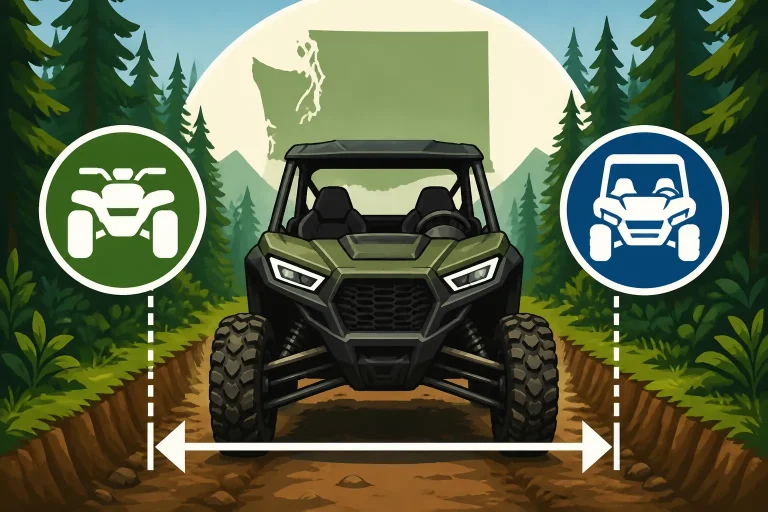
A Discover Pass is generally required when you park a vehicle on, or use a vehicle to access, Washington recreation lands managed by Washington State Parks, the Department of Natural Resources (DNR), or the Department of Fish and Wildlife (WDFW). It is a land-access pass, not an ATV registration decal.
That distinction matters because the pass requirement follows the land and the way you access it, not the kind of machine you brought. A truck and trailer parked at a state recreation site may need a pass even if the ATV on the trailer has all the right tabs. Conversely, a Discover Pass displayed in your tow vehicle does not register the ATV or authorize riding on a closed trail.
| Location or situation | Is a Discover Pass generally needed? | What to check |
|---|---|---|
| A Washington State Park accessed by vehicle | Usually, unless an exemption or other qualifying permit applies | The park’s current pass and fee instructions |
| A DNR recreation site or trailhead accessed by vehicle | Often | Whether the site requires a Discover Pass or another access permit |
| WDFW land or a wildlife area accessed by vehicle | Often | Site-specific rules, seasonal access, and any other required permit |
| Federal land, such as many National Forest or Bureau of Land Management sites | No; the Discover Pass is not the federal pass | The federal land manager’s own fee and pass rules |
| Private or tribal land | A Discover Pass does not grant access | Permission from the landowner or applicable land authority |
| A trip made without a vehicle | The vehicle-access pass may not apply | Rules for the specific site and activity |
“Generally” is important. A pass may not be required in every circumstance, and some sites have another fee, permit, or exemption that affects what you need. A campground reservation, special permit, or other paid use may change the access requirements at a particular location. Don’t assume that one rule applies to every state-managed trailhead.
If you’re planning an ATV trip, first identify the land manager for the staging area and the route. A recreation area can sit near more than one type of land, and a ride may move from state-managed ground onto federal, private, or other land. The pass for your parking spot does not automatically settle the access rules for the whole ride.
For a broader look at how the pass fits into a ride, see The Discover Pass and Washington Riders. If you’re unsure which kinds of public land are covered, State Parks, DNR and Fish and Wildlife Land explains why the land manager matters.
The pass is usually about vehicle access
The practical question is often not “Do I need a pass to ride my ATV?” but “Do I need a pass for the vehicle I’m using to get to this place?” That vehicle might be your tow rig, a car, or another vehicle you park at the site. Follow the pass instructions for the land and parking area, rather than assuming the ATV’s tabs cover the parking requirement.
The Discover Pass is not an all-purpose entry ticket for every activity on public land. In many situations, the requirement is tied to vehicle access or parking. If you arrive on foot or by bicycle, the vehicle-access requirement may not apply, but the specific site can still have other rules, closures, or fees. Confirm the current instructions for the exact location rather than treating the pass name as a blanket rule for all visitors.
Also check whether the place you plan to park is actually part of a state recreation site. A nearby highway pullout, private lot, county facility, or federal trailhead may follow different rules, even when it is close to a state-managed riding area.
State land does not mean every road or trail is open
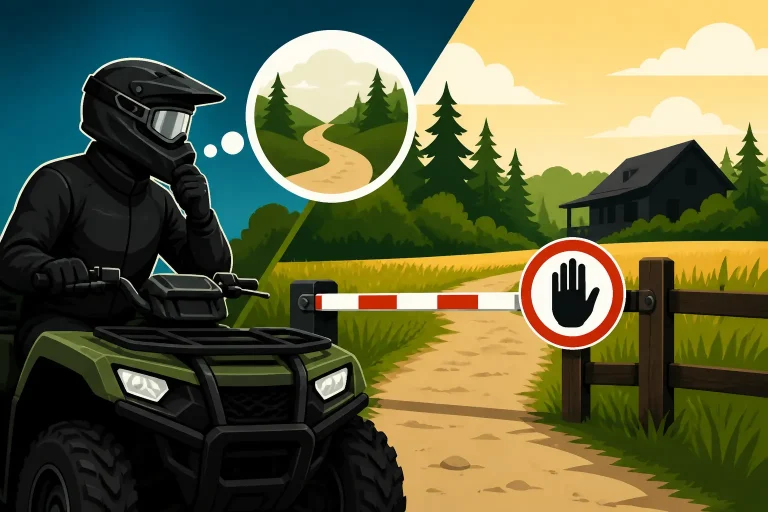
Having a Discover Pass only addresses one part of the trip. It does not give permission to ride anywhere on the property. You still need to follow the land manager’s designated routes, posted closures, vehicle-width limits, seasonal restrictions, and other site rules. A trail can be closed even when the parking area is open.
That is especially important when riding near gates, timber operations, sensitive habitat, or areas with seasonal restrictions. A road shown on an old map may have since been closed, and a permitted parking area may sit beside routes that are not open to motorized use. Check current alerts before loading up.
For DNR areas, review Washington Rules for Riding DNR Land and the current information for the specific recreation site. A Discover Pass is not a substitute for an ORV tab or other vehicle authorization; Washington ORV Permits Explained covers the separate registration and permit side.
When a Washington ATV or UTV rider needs one
The pass question is easiest to answer by separating three things: the machine, the transport vehicle, and the land.
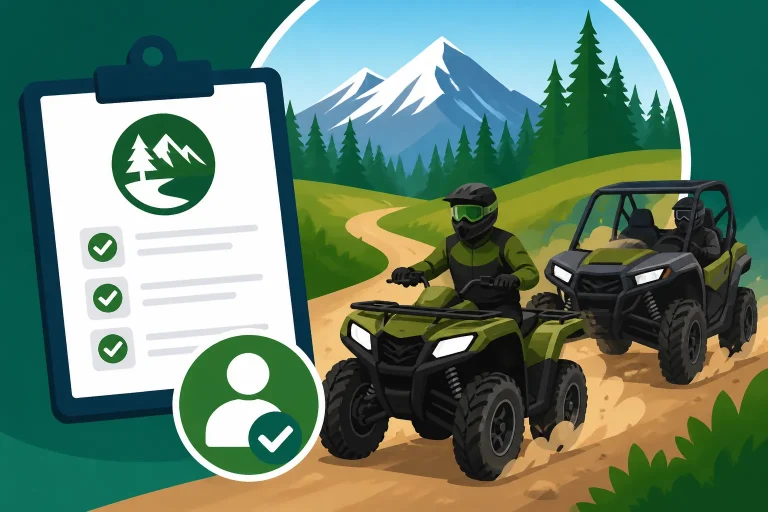
Your ATV or UTV may need Washington registration or another accepted form of authorization for its intended use. Your truck may need a Discover Pass to park at a state-managed recreation site. The land itself may have its own riding rules. Each requirement does a different job, so meeting one does not cancel the others.
A typical trailhead trip
Imagine you load a registered ATV onto a trailer and drive to a DNR trailhead. You park the truck and trailer in a designated lot, then unload and ride on the marked route.
You should check at least three separate questions:
- Does the parking area require a Discover Pass or another access permit?
- Is the ATV properly registered or otherwise authorized for the kind of riding you plan to do?
- Is the route open to your type and width of machine on the day you plan to ride?
If you can answer yes to the first two but the route is closed, the ride is still not allowed. If the route is open but you have not met the parking requirement, that does not make the parking area free. Plan for each part independently.
For road use, there may be additional equipment, registration, and road-access rules. A Discover Pass does not make a trail-only ATV street legal, and it does not make a road open to ORVs. If your route includes public roads, review the relevant local road rules and machine requirements before you ride.
One pass does not cover every kind of access
A Discover Pass does not replace:
- ATV or UTV registration, tabs, or required decals.
- A federal recreation pass at a federal site that charges for access.
- Permission to cross or ride on private property.
- A permit required for a special activity or restricted area.
- Compliance with trail closures, road restrictions, and land-manager rules.
Likewise, an ORV tab does not pay for every state recreation site where you park. The paperwork can feel repetitive, but the items serve different purposes. The registration identifies or authorizes the machine for particular uses; the Discover Pass addresses certain access and parking requirements on designated state recreation lands.
This separation is why “I have tabs” and “I have a Discover Pass” are not interchangeable answers. If you’re deciding which one applies, start by identifying the land manager and the vehicle you will park there.
Check both the destination and the approach
A rider may park at a state-managed trailhead but ride onto a different land manager’s property. Or the opposite may happen: the riding area is federal, but the chosen staging lot is on state-managed land. In either case, the pass needed at the lot may not be the pass needed elsewhere.
Don’t rely only on a general description such as “public land” or “forest.” A national forest, a state forest, a wildlife area, and a private timber property can be next to each other while having different access rules. A Discover Pass is not accepted everywhere just because a place is outdoors and open to recreation.
If the trip involves several trailheads or a route that crosses boundaries, make a short list of each place where you will park and each area where you intend to ride. Check the manager for each one. This is more reliable than buying a pass based on the name of the nearest town or forest.
Where it does not apply
A Discover Pass is not a universal Washington recreation pass. It does not automatically satisfy fees at federal recreation sites, give access to private property, or authorize entry onto tribal lands. It also does not turn a closed route into an open one.
Federal land
Many National Forest and Bureau of Land Management sites are governed by federal rules, not the Discover Pass program. Some federal sites require their own pass or a site-specific fee; other sites may not charge an access fee. The rules depend on the location and the facilities being used.
A common mistake is to see a Discover Pass sign at one trailhead and assume the pass works at the next stop because both places are in a forested area. Check the land manager shown on the current site information. If the destination is federal, look for the federal agency’s instructions instead. Why Federal Sites Refuse a Washington Discover Pass explains the difference.
Private and tribal land
A state pass does not grant permission to ride on private land. That includes land that looks undeveloped or appears to connect two public routes. A gate, road, or informal track is not an invitation to pass through. Ask the owner or access authority and follow any conditions they set.
Tribal lands also have their own authorities and access rules. Do not assume that a state pass or a public-road map gives permission to ride a tribal road or enter tribal property. Check with the relevant authority before planning a route.
The same caution applies to timberland. Some timber roads may be open under specific conditions, while others are closed or require separate permission. A Discover Pass does not provide a key, override a locked gate, or replace a timber company access permit.
County and city facilities
County parks, municipal trailheads, local roads, and other facilities may have their own parking fees or rules. The Discover Pass applies to the covered state recreation lands; it is not automatically accepted at every government-owned parking lot.
This is one reason to verify the exact location rather than search only for a nearby recreation area. A staging spot might be run by a county, a city, a state agency, or a federal land manager. The name of the broader forest or region may not tell you who controls the lot.
How to confirm the requirement before you go
A few minutes of checking can prevent a frustrating arrival at a trailhead with the wrong pass—or a pass that does not apply there.
- Find the exact parking location. Use the name of the trailhead, campground, or staging area, not just the general riding region.
- Identify the land manager. Look for whether the location is managed by State Parks, DNR, WDFW, a federal agency, a local government, or a private owner.
- Read the current access instructions. Check the manager’s official site information, posted notices, and any alerts for the location.
- Check for another fee or exemption. A reservation, permit, or site-specific fee can affect what you need. Do not assume a Discover Pass is the only possible requirement.
- Check the route separately. Confirm that your machine is allowed and the intended roads or trails are open.
- Follow the pass display instructions. If a pass is required, use the format and display method specified for the pass you have.
If you are comparing access passes, Where to Buy a Washington Discover Pass can help with the purchase side. For a trip that uses more than one vehicle, check [Washington Discover Pass for Two Vehicles] rather than assuming how the pass can be shared. Follow the provider’s current rules for the pass type and vehicles involved.
Check again close to the ride
Trail and road access can change because of weather, maintenance, fire danger, timber work, habitat protection, or other closures. A pass requirement can also be different at a particular site than at a nearby one. Save the official location page or check it again before leaving, especially if your last visit was a while ago.
A map is useful for route planning, but it may not show the latest closure or parking condition. Treat a map as a planning tool, not final permission. If signs at the site conflict with an old map or a saved route, follow current posted restrictions and contact the land manager when you need clarification.
For a trip across multiple public lands, write down the names of the parking areas and land managers. That small step helps avoid assuming that one pass, one registration, or one open-road list applies to the entire ride.
Keep the pass and registration separate
A simple way to stay organized is to keep the vehicle-access pass where its instructions say it belongs and keep the ATV’s registration documents with the machine as required. They are not the same document, and one should not be used as a substitute for the other.
Some riders use a small waterproof organizer for registration papers and trip notes. A weather-resistant pouch from a retailer such as Amazon may help keep paperwork dry in a wet truck or trailer, but it does not replace the required pass display. A second pouch or folder can be useful for separating tow-vehicle documents from the ATV’s papers; Amazon is one possible place to look for that kind of basic storage. If you shop for a holder on Amazon, check that it suits the pass format and display instructions you actually use rather than buying one based only on a product photo.
The most important habit is to check your documents before you leave, not once you reach the lot. Confirm the pass, the machine’s registration, and the current route status as separate items. That approach is more dependable than relying on memory from the previous season.
A quick rule for planning your ride
If you are driving to a Washington state recreation site, assume you may need a Discover Pass until you confirm otherwise. Then verify the specific lot and land manager. If the site is federal, private, tribal, county, or city property, check that authority’s own access rules instead.
For an ATV or UTV trip, keep the questions distinct:
- Where are you parking? That determines whether a Discover Pass or other access fee may apply.
- Where are you riding? That determines which routes are open and which land-manager rules govern.
- What machine are you bringing? That determines registration, tab, equipment, and road-use requirements.
If each answer is checked on its own, the pass question becomes much less confusing. You can arrive with the right access pass for the parking area, the right authorization for the machine, and a route that is actually open.
Disclaimer
This article is for general informational purposes only and does not constitute professional advice. Laws, prices and regulations vary by location and change over time. Consult a qualified professional for guidance on your specific situation.