A Timber Company Permit in Washington
Timber-company land can look like a network of open forest roads, but a map or unlocked gate does not necessarily mean you may ride there. In Washington, access depends on who owns or manages the land and what permission they have granted. Here’s how to understand a timber company permit, check its limits and avoid treating access as broader than it is.
What a timber company permit does
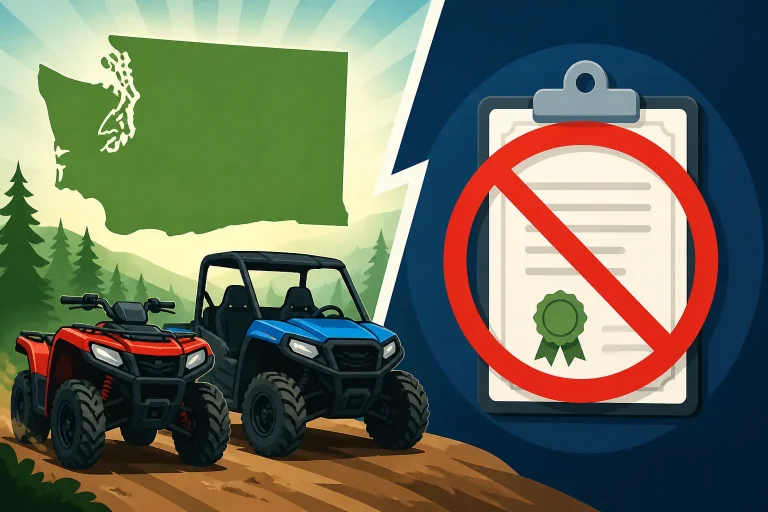
A timber company permit is permission from a landowner or land manager to enter specified property under stated conditions. It is not a single statewide permit, and there is no universal form that gives riders access to all private timberland in Washington. Each owner sets its own process, eligible activities, approved routes and closure rules.
A permit might cover recreational access on selected roads, a defined area, a particular date range or a specific activity. It may be issued to an individual, a group or a vehicle, depending on the company’s system. Some permissions may be paper-based or online; others may involve a key or another access procedure. Those details are company-specific, so confirm them with the landowner rather than assuming that one company’s process applies elsewhere.
Most importantly, permission to enter land is not the same as permission to ride anywhere on it. A permit may exclude certain roads, blocks, trails, facilities or active work areas. It may also be suspended or limited when conditions change. The written terms and current notices control—not an old map, a past visit or what another rider says was allowed.
A timber company permit is also different from an ORV registration, an access pass for public land, or permission to use a road that crosses private property. You may need several separate things for one outing:
- Landowner permission: Allows access to the private property under the owner’s terms.
- Vehicle registration or tabs: Required where applicable for the machine and the type of riding.
- Public-land pass or permit: May be required at a public trailhead or on certain public lands.
- Road or route authorization: Determines whether you may travel on a particular road, including roads that cross ownership boundaries.
A permit does not automatically make a machine street legal, make a closed road available, or replace the registration and equipment rules that apply to the ride. For the distinction between a landowner’s permission and the rules for private timberland, see Washington Rules for Riding Private Timberland and Washington Trespass Law and Off-Road Riders.
| Item | What it generally covers | What it does not automatically cover |
|---|---|---|
| Timber company permit | Entry onto the property or use of specified roads, subject to the terms | Every road, every parcel, or access during a closure |
| Washington ORV registration | Registration requirements for a machine | Permission to enter private land |
| Public-land pass | Access or parking requirements at certain public sites | Entry onto privately managed timberland |
| Road-use authorization | Use of an identified road or segment | Other roads in the area or a route beyond the authorized segment |
Confirm who owns the land and where permission applies
Before planning a route, identify the land manager and the boundaries of the area you intend to ride. Timberland can sit beside state, federal, tribal or other private land, and the roads can cross between them. A road that looks continuous on the ground may pass through several ownerships, each with different rules.
A recreation map can help with route planning, but it is not necessarily proof of current access. Ownership lines may be hard to see, road conditions change, and a route shown on a map may be closed or outside a permit area. Check the source and date of the map, then confirm the current conditions with the land manager.
Ask the landowner about the exact route
When requesting permission, be specific. Ask whether the permit allows ATV or UTV use, which roads are included, and whether you can connect those roads into a loop. Confirm whether the permission includes staging or parking, and whether it applies to passengers or other members of your group. If a road crosses another owner’s property, ask whether the permit covers that segment too.
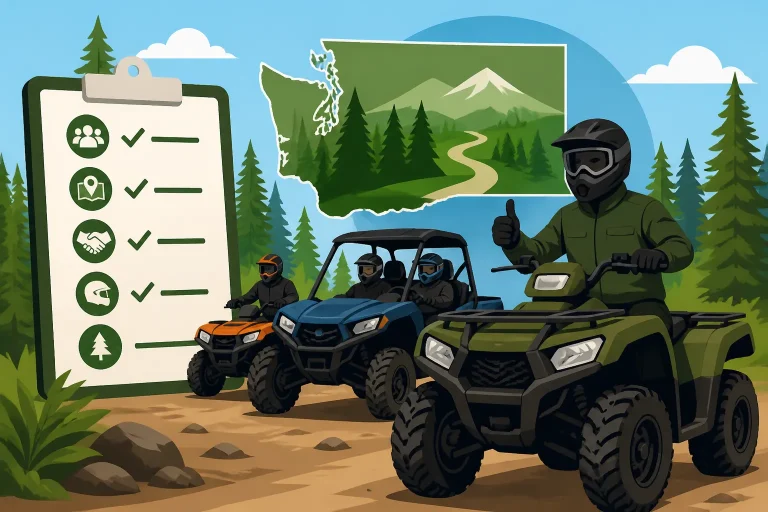
Useful questions include:
- Which property or access area does the permit cover?
- Which roads or routes are open to motorized recreation?
- Are there vehicle-width, machine-type or group-size restrictions?
- Are there days, times or seasons when access is not allowed?
- Where may riders park or unload?
- Are keys, gates, signs or check-in steps part of the process?
- How are closures and emergency notices communicated?
- Does the permit need to be carried, displayed or shown on request?
- Does each rider or machine need separate permission?
Get the answer from the company or its authorized representative. A local business, a neighbor, a social media post or another rider may be helpful for finding a contact, but none should be treated as a substitute for authorization from the landowner.
Don’t assume a public road makes nearby land public
Some forest roads are private, while others may be public roads that pass through timberland. The road’s appearance is not enough to establish its legal status or the limits on its use. If the route relies on a public road, verify that the road is open to the type of vehicle and use you have in mind. If it is a private road, verify that the owner’s permission includes it.
This matters especially where the public road ends and a private haul road continues. Permission to travel one segment does not necessarily extend to the next. For more on this boundary issue, see Riding a Road That Crosses Private Land and Washington Rules for Riding a Logging Road.
Separate timber company land from public land
A company may own the land, manage it for another owner, or control access under an agreement. Land that looks like forest may also be state trust land or other public land, with a separate permit or access system. A timber company’s permission does not necessarily authorize riding on neighboring public land, and a public-land pass does not grant access to private property.
Check the land manager for each part of your route. If your trip includes a public trailhead or a public recreation site, check that site’s pass requirements separately. The Discover Pass and Washington Riders explains why a public-land pass is not a general key to private timber roads.
How to request and use permission
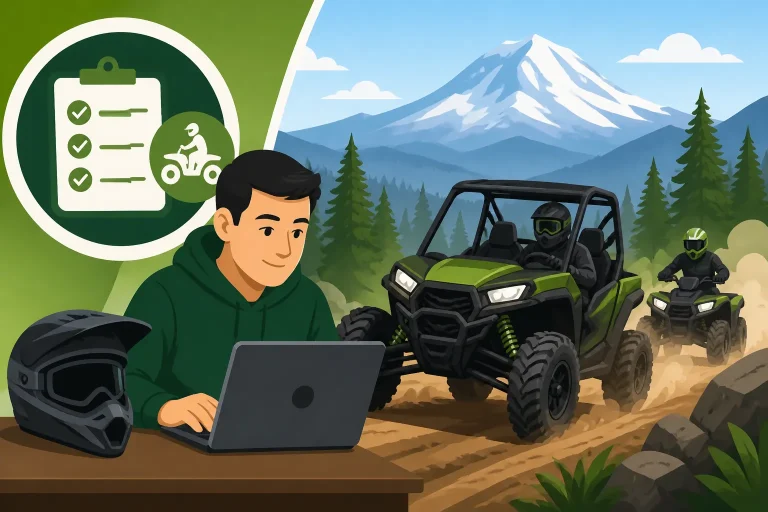
The safest approach is to check access before unloading or entering the property. Start with the company’s official recreation or land-access information, if it provides one. If you cannot find clear terms, contact the company and ask how motorized recreation permission is obtained. Do not rely on a permit process designed for a different activity, such as hunting or hiking, unless the owner confirms that it includes off-road vehicle use.
A practical process
- Identify the land manager. Use reliable ownership information, signs at the site or the company’s official contact channel. If ownership is unclear, do not assume the land is open.
- Describe your intended ride. Give the manager the area, route, dates, machine type and group size. Ask about trailer parking as well as riding access.
- Read the permission terms. Check what activities are allowed, where the permission applies, how long it lasts and what conditions can suspend it.
- Confirm current conditions. Ask whether roads are closed for hauling, fire danger, maintenance, weather or another operational reason. Check for notices again close to departure.
- Keep proof available. Follow the company’s instructions for carrying or displaying permission. Save contact details and any written route information where you can retrieve them.
- Follow posted instructions on site. Signs and barriers may reflect a closure or restriction that came after you received permission. Stop and confirm before proceeding if the directions conflict.
- Leave the route as you found it. Do not bypass a gate, move a barrier, damage a road or enter a work area to continue a planned ride.
Treat any permit as limited to the person, machine, place and time described in its terms. If a friend joins, do not assume the permit can be shared. Ask whether everyone needs individual permission and whether the company allows guests.
Check the full set of riding requirements
A landowner’s permit only addresses access. Riders still need to follow applicable Washington rules for registration, equipment, age, supervision and road use. Requirements can differ depending on the machine and whether the ride remains off-road or uses roads open to public travel. Review Washington’s Off-Road Vehicle Rules Explained and Washington ORV Reciprocity With Other States if your machine is registered outside Washington.
Do not assume that a visiting rider’s home-state sticker gives permission to enter private timberland. Reciprocity concerns vehicle or riding requirements, not a private owner’s access decision. Likewise, a Washington registration does not give a rider permission to enter property where access is restricted.
If your planned route reaches a public road, make sure both the machine and route are legal for that use. Private permission cannot override restrictions on a public road, and road legality does not grant entry onto private land. If you are uncertain whether a road segment is open to ORVs, verify it with the relevant road authority and land manager before riding.
Gates, closures and active forestry work
Timberland is working land. Road access can change with logging operations, hauling, maintenance, weather, fire risk or other safety concerns. A permit that allowed access earlier may not be enough to establish that the route is open today. Check current notices before each ride and pay attention to signs at entrances and along the route.
A locked gate is a clear reason not to continue through that entrance. Do not climb around it, lift a barrier, follow another vehicle through, or use a key that was not issued for your permission. Even an unlocked gate does not prove that the road is open to recreational riding; it may be open for authorized work traffic only.
Give active work room
Logging roads can carry large trucks and equipment, sometimes with limited sightlines, loose surfaces or little room to pass. A recreational permit does not give riders priority over work vehicles. If the road is closed for hauling or another operation, obey the closure rather than trying to time a crossing or negotiate passage on your own.
When a route is open, ride cautiously around bends, dust, hills and narrow sections. Be ready to stop and yield. Do not park where you block a road, gate, turnout or work access. Avoid entering areas with active equipment, falling hazards or other posted restrictions. For more on why operations can temporarily close a route, see Why a Forest Road Closes During Active Hauling.
Treat closures as part of the permit
A permit may be conditional on the owner keeping an area open. The landowner can limit or suspend access under the terms, and an operational closure may apply even if you have permission for the general property. Check the closure notice or contact the manager if the status is unclear; do not interpret silence as approval.
If you reach a closed road during a ride, turn around where safe and use only a route that is clearly authorized. Do not make an unapproved detour through another road, parcel or trail to get back to the staging area. The guidance in [Washington Rules for Riding a Closed Road] and Riding Past a Timber Sale Gate is relevant when a closure interrupts a planned route.
Respect boundaries and neighbors
A route can pass close to homes, grazing areas, water sources or other operations. Keep to the approved roads and observe any noise, speed, parking or group-size conditions in the permit. Do not create new trails, cut across a clear-cut, ride through a gate into a neighboring parcel, or assume that a visible road connection is included.
If you are not sure whether a road is within the authorized area, stop before entering it. Ask the landowner for clarification rather than relying on tire tracks or an old map. Permission for one area should never be stretched to cover another owner’s land.
If permission is unavailable or unclear
If a company does not offer recreational access, or its rules exclude your planned route, choose a place where motorized access is clearly authorized. Do not treat the lack of a sign as permission. Washington trespass rules and private-property rights still matter when a road or tract appears unused.
If you have already received permission but cannot verify whether it remains valid, postpone the ride or contact the manager. That may be inconvenient, but it is safer than risking trespass, conflict with a work crew or a ride into a closed area.
A few alternatives can make trip planning easier:
- Look for a designated public ORV area and check its current access conditions.
- Confirm which public land manager controls the staging area, trails and roads.
- Check whether a required public-land pass applies at the access point.
- Choose a route that does not depend on an uncertain private-road connection.
- If a group is involved, have each rider understand the boundaries and closure plan before departure.
A permit is most useful when its limits are clear. Keep the authorization, route information and contact details together, and give your group a simple rule: when the approved route or current access status is uncertain, stop and verify before continuing.
Frequently Asked Questions
Does a timber company permit let me ride on any road on the property?
No. Permission normally has limits, which may identify an area, road, date or activity. Use only the routes and access conditions confirmed by the landowner.
Can I ride through an open gate without a permit?
An open gate does not necessarily mean recreational access is allowed. Confirm permission with the landowner and follow signs or notices at the site.
Does a Washington ORV registration give me permission to ride on private timberland?
No. Registration concerns the machine and applicable riding requirements. Private-land access requires permission from the owner or an authorized manager.
Can a permit be used by my friends or another machine?
Do not assume it can. Ask the company whether permission applies to guests, multiple riders or multiple machines, and follow its conditions.
What should I do if a road is closed after I receive permission?
Stop and follow the closure. Do not bypass a gate or take an unapproved detour. Contact the land manager if you need clarification or a safe route back.
Disclaimer
This article is for general informational purposes only and does not constitute professional advice. Laws, prices and regulations vary by location and change over time. Consult a qualified professional for guidance on your specific situation.