Washington Rules for Riding DNR Land
Washington Department of Natural Resources land can offer a lot of room to ride, but access is not automatic: a road shown on a map may be closed, a permit does not make every route legal, and parking rules can be separate from machine registration. This guide explains what to check before you unload, how out-of-state permits fit in, and how to ride without turning a good day into a citation or a closed trail.
Start with the land, route and purpose of your ride
“DNR land” is a useful shorthand, but it does not mean one continuous riding area with one set of open routes. The Department of Natural Resources manages many different properties, including working state trust lands and developed recreation areas. Access can depend on the specific property, the route, the season, land-management activity and posted restrictions.
The practical rule is to confirm three things separately before you go:
- The land is open to the public for your planned activity. Public access may be limited, closed temporarily or subject to a permit or other condition.
- Your exact route is open to your type of machine. A route that allows a full-size vehicle, bicycle, motorcycle or horse is not necessarily open to an ATV or UTV.
- Your machine and parking vehicle meet the relevant requirements. ORV registration, any required permit, road-use equipment and a Discover Pass are different matters.
A trailhead sign or current official map can answer some of these questions, but do not assume a sign at one entrance covers every spur or connecting road. A route can cross land managed by another owner, pass a gate, or connect to a road where motorized access is restricted. If the ride crosses onto federal land, private timberland, tribal land or a county road, a different set of rules may apply. See Washington Rules for Riding Federal Land for the change in rules when your route leaves DNR-managed property.
The word “road” can be misleading, too. A gravel road may look public and drivable without being open for recreational motorized use. A road marked with a colored dot may be part of a local road system, but its status can change. Do not treat an old route file, an online map pin or tire tracks as permission. The on-site sign and current land-manager information matter more than what another rider did last season.
Before choosing a riding area, look up the current route information and any property-specific notices. If you are comparing places to ride, Washington DNR Forests Compared can help you think about the differences between riding areas, while Washington Trail Maps From DNR is a useful starting point for finding land-manager maps. Use a map as a planning tool, not as a promise that every line is open today.
| What you need to confirm | Why it matters | Where to check |
|---|---|---|
| Whether the property is open | Access can be limited by land use, closures or local conditions | Current DNR property information and signs at the site |
| Whether the route is open to your machine | Not every road or trail allows every vehicle type | Current motorized route map, signs and posted restrictions |
| Whether your machine is registered or permitted | Public-land riding requirements depend on your machine and registration status | Washington licensing information and the applicable permit rules |
| Whether the tow vehicle needs a pass | Parking on state recreation land may have a separate pass requirement | DNR site information, signs and Discover Pass guidance |
| Whether a temporary closure applies | Fire, weather, maintenance and timber operations can change access | Current alerts and notices before travel |
| Whether another land manager controls part of your route | Rules can change at a property boundary | Maps, boundary signs and the other land manager’s information |
A useful habit is to plan around an official staging area and a clearly identified motorized route network. That is usually more reliable than trying to improvise a route from a general-purpose mapping app after you arrive. If a closure blocks your planned connection, do not ride around the barrier to get back on track. Turn around and use an open route.
Get the right registration or permit for your machine
For Washington riders, the first paperwork question is whether the machine is properly registered for off-road use. Washington’s registration and tab system is separate from access permission: a valid registration does not open a closed route, and an open route does not excuse a missing registration. Start with Washington ORV Permits Explained if you need to sort out the basic permit and registration options.
A Washington-registered ORV generally needs the appropriate current off-road registration for public-land riding. The required decal or tab must be displayed as directed, and the registration documents should be available when you ride. Check Washington ORV Decal Placement if you are not sure where the decal belongs. Keep the paperwork protected from rain and mud, but easy to reach if asked to show it.
Do not assume that a machine’s license plate, a title, a bill of sale or a dealer tag is a substitute for the required ORV registration. Those documents may help establish ownership or road-use status, but they do not necessarily satisfy the rules for riding on public land. If you have just bought a machine, allow enough time to resolve registration questions before planning a public-land ride.
Visitors from outside Washington
If you are bringing a machine from another state, check whether Washington recognizes the registration or permit issued where the machine is based. Reciprocity is not simply a matter of having any sticker from home. It can depend on whether the other state has an equivalent program and whether your registration meets Washington’s conditions.
Read Washington Reciprocity for Off-Road Use before you travel. If your home-state registration does not qualify, you may need a Washington permit rather than relying on the sticker already on the machine. A temporary permit is not an all-purpose pass: check its eligible use, term and route limitations before setting off. [Washington Temporary ORV Permit for a Visitor] explains the visitor-specific issue.
Keep a record of the machine’s home-state registration and any Washington permit you obtain. Make sure the identifying information matches the machine you are actually transporting. A permit is not transferable just because a friend has one, and paperwork for one vehicle should not be assumed to cover another.
Off-road registration does not authorize road riding
A DNR road or trail can be open to ORVs while still being different from a public road where street-use rules apply. Do not use a route designation as proof that your machine can legally travel on every paved road needed to reach it. Road use can involve separate equipment, tabs, a license and local route restrictions. If pavement is part of your planned ride, review What Washington Requires for On-Road ORV Use and check the specific road’s current access rules.
This is particularly important when a route leaves DNR property and enters a county road or a town street. A machine that is properly set up and registered for off-road use may still not qualify for that road. Where the route crosses a highway or joins an open road, confirm the applicable rule rather than assuming the short connector is allowed.
Separate machine access from parking and site passes
One of the most common misunderstandings is treating an ORV registration and a Discover Pass as interchangeable. They are not. The machine’s ORV registration or permit relates to the machine and its legal use. A Discover Pass may be required for the vehicle you park at a state recreation site. Whether a pass is needed depends on the property, parking area and posted requirements, so check the specific location.
A rider may arrive with a registered ATV or UTV on a trailer and still need to address the tow vehicle’s parking requirement. Conversely, buying a parking pass does not make an unregistered ORV legal to ride. If you are unsure whether the pass applies at a particular DNR trailhead, see The Discover Pass and Washington Riders and confirm the site’s current instructions.
The pass is about access to designated state recreation lands and facilities, not a general license to travel over all state-owned land. A pass cannot override a gate, closed road, restricted property or route-specific motorized-use rule. It also does not replace a federal pass where the property is managed by a federal agency. DNR land and a nearby national forest can have different parking and recreation requirements even when they share a road or trailhead.
Before leaving home, confirm:
- Whether your chosen staging area requires a parking pass.
- Which vehicle the pass must be associated with or displayed in.
- Whether the pass is accepted at the specific site, rather than merely on nearby state land.
- Whether a separate fee, permit or reservation applies.
- Whether the pass has an expiration or other condition you need to account for.
If more than one truck is in your group, make sure the pass arrangement works for the vehicle that will actually be parked at the site. Avoid assuming a pass displayed in the lead truck covers a second vehicle in another lot. Read the pass instructions and the posted information at the trailhead.
For visitors, sort out both sides of the trip: the permit or registration for the machine and the parking access for the tow vehicle. If you are crossing between DNR and federal recreation areas, check each manager’s rules. A state pass does not automatically cover a federal site, and a federal pass does not automatically satisfy a state parking requirement.
Ride only on routes open to your machine
Once you reach an open property, stay on routes designated for your type of machine. “Public land” does not mean open riding anywhere you can physically drive. Riding off-route can damage vegetation and soil, disturb wildlife, create new tracks, and put you into places the land manager has deliberately kept closed.
Follow posted signs even if the route looks harmless or appears on an older map. A gate can be closed for an active timber operation, road maintenance, habitat protection, fire danger or another temporary reason. An old map may still show a road that has since been closed, rerouted or restricted to a different user group. The guidance in Riding a Road Shown Open on an Old Map is worth keeping in mind: a route’s appearance on a map does not guarantee present-day access.
At a junction, stop long enough to read signs and confirm the route you are about to take. Do not assume every branch in a motorized area is open to every vehicle. Restrictions can be based on vehicle type, width, season or the road’s purpose. If a sign is missing or hard to interpret, use a route you can confirm rather than guessing.
Do not bypass barriers
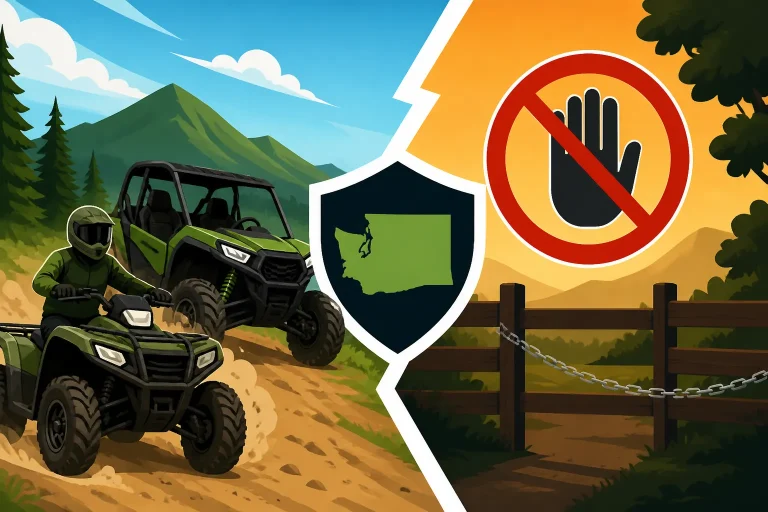
A locked gate is a clear signal to stop, even if the road beyond it looks passable or you see fresh tracks. Do not ride around the gate, lift a barrier, follow another rider through a closed area or use a nearby ditch to get past it. The closure may protect an active work site, private access, sensitive land or a road that is unsafe for public travel.
The same caution applies to temporary signs. A closure notice posted at a trailhead or road junction takes precedence over a route line on an older map. If a route is closed, turn back and select an open alternative. Washington Fire Closures That Shut Trails covers one reason routes can close quickly, but fire is only one of many possible causes.
Never assume you can cross private property to reconnect with a DNR road. A route can pass close to private land without granting a right to enter it. Keep to the designated public route, and stop if the boundary or access status is unclear. For the broader access issue, see Washington Trespass Law and Off-Road Riders.
Treat shared roads as working roads
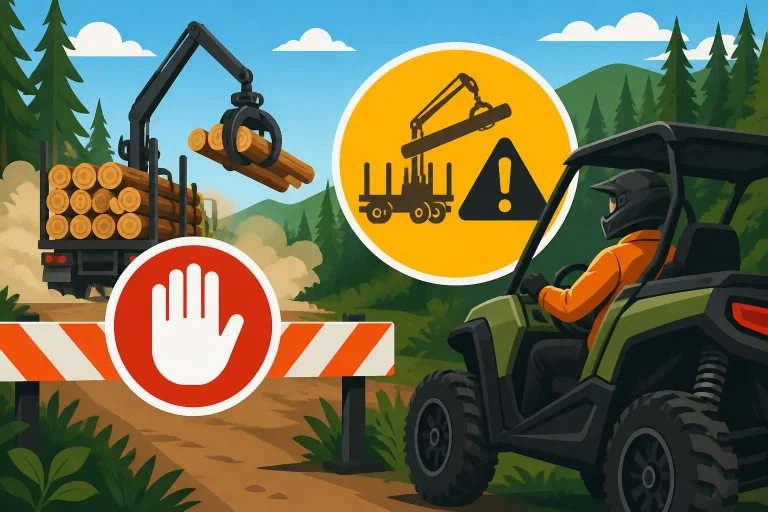
Many roads on DNR-managed land serve more than recreation. You may encounter logging trucks, maintenance vehicles, other permitted users or workers moving equipment. Expect large vehicles and limited sight lines, especially around bends, dusty sections and narrow road cuts. Keep to the right, slow down, and pull over only where there is room to do so safely.
Do not block gates, turnouts, loading areas or road junctions when you stop. If a truck is approaching, give it room and follow any direction from workers or posted signs. A road can be open to recreational riding while still being an active work route. That is a reason to ride cautiously, not a reason to challenge a temporary work closure.
Some roads may be seasonally restricted or closed during active operations. If you encounter a work crew or a newly posted closure, do not argue that your map showed the road open. Turn around and check for an alternate route. A short detour is better than entering an unsafe work area or interfering with a land-management operation.
Check closures, weather and land conditions before you haul
DNR access can change between the time you plan a trip and the time you arrive. Fire risk, storm damage, washouts, timber work, maintenance and other conditions can affect an area or a specific route. Checking the property’s current alerts before loading the trailer can save a long drive to a closed gate.
Look for notices from the land manager close to your departure date, then check again at the trailhead. If a closure notice gives a boundary or affected route, follow it as written. Do not interpret the closure narrowly just because the remaining route looks rideable. Conditions can also change during the day, so be ready to modify your plan if you see new signs or receive instructions from staff.
Weather deserves a separate check. Heavy rain can turn a firm road into slick clay, hide ruts and create standing water that is deeper than it appears. Snow or ice can obscure route markers and make a grade hazardous. Dry conditions can bring fire restrictions or closures. A machine that can physically make it through a muddy spot may still leave deep ruts or damage the route, so turn around if conditions are deteriorating.
Plan for the possibility that your preferred staging area is full or unavailable. Identify a legal backup lot or another open riding area, and do not create an informal parking area by stopping along a road. A trailer and tow vehicle can block access for emergency crews or work traffic. Use designated parking and follow posted instructions about overnight use.
Bring a current map or route information that remains usable if cell service drops out. A phone map can be convenient, but do not rely on live navigation as your only source in a remote area. Download or save the information before leaving coverage and carry a backup method of identifying your route. If you use a paper map, know how it marks closures and route types.
For physical map and paperwork protection, riders sometimes compare waterproof cases and document sleeves through retailers such as Amazon. Check that a case is genuinely suited to wet, dusty conditions and that it does not obstruct access to required documents. A sealed pouch can help keep papers dry, but it cannot make an outdated map current.
A simple pre-trip routine:
- Identify the exact DNR property and staging area.
- Confirm the current motorized route map and permitted vehicle types.
- Check alerts for closures, fire restrictions and active work.
- Confirm the machine’s registration or visitor permit.
- Check the parking-pass requirement for the tow vehicle.
- Save the route information for offline use.
- Recheck signs at the entrance and each major junction.
If you are riding with a group, make sure everyone knows the planned route and the turnaround point. A rider who joins late may have a different permit status or machine type. Agree on what the group will do if a closure blocks the route, someone gets separated, or conditions become unsafe.
Follow equipment and rider rules on public land
Registration and route access are only part of the picture. The machine must also meet applicable operating requirements, and riders must follow safety rules. Requirements can differ between riding off-road on public land and traveling on a public road, so do not assume equipment installed for one type of use covers the other.
Public-land riding rules may address items such as noise, mufflers, spark arresters, helmets, passengers and age or supervision. Requirements can depend on the machine, the location and how it is being operated. Review Washington Spark Arrester Requirement and Washington Sound Limits for ORVs before a ride, especially if you have changed the exhaust or fitted aftermarket parts. A machine that sounds acceptable in the driveway may be disruptive in a quiet recreation area or fail a required sound check.
Keep equipment in good condition. Check that the throttle returns properly, brakes work, tires are suitable for the planned route and lights function where required. Look for leaks, loose cargo and damaged steering or suspension components. For a UTV, check that belts, doors or nets and other occupant restraints are used as intended. Secure tools and recovery gear so they cannot fall onto the route.
Carry basic supplies for a ride that lasts longer than expected: water, warm or rain layers, a first-aid kit, a charged phone or communication device, and enough food and fuel for the planned route. In remote areas, someone outside the group should know where you are going and when you expect to return. A route plan is not just useful for navigation; it gives others a starting point if you do not come back on schedule.
Rider age and supervision rules deserve special attention when children are in the group. A parent’s presence at the staging area may not be the same as the supervision required while riding. Check Washington’s Supervision Rule for Riders Under 16, and confirm that the child’s machine fits their size and ability. A young rider should be able to reach and operate controls safely and should not be placed on a route beyond their experience.
Passengers must ride only on a machine designed and equipped to carry them. Do not let someone sit on a rack, fender or cargo area. For side-by-sides, use the installed restraints and seating positions. On a quad, do not add a passenger unless the machine is designed for one and applicable rules allow it. The fact that a short ride feels manageable does not make an unsafe passenger position acceptable.
Alcohol and impaired riding are a poor combination on any terrain. Uneven ground, blind corners, steep grades and other riders leave little room for delayed reactions. Keep the machine under control, ride at a speed suitable for visibility and conditions, and leave enough distance to stop safely.
If you buy accessories before a trip, match them to the actual machine and route. Amazon may be one place to compare items such as a first-aid kit, tie-downs or a weather-resistant document case, but check compatibility, quality and fit rather than choosing solely by a product photo. An accessory listing is not proof that a modification meets a land manager’s requirements. When a part affects exhaust, lighting, restraints or vehicle width, verify the relevant rule before installing it.
A practical checklist for a legal, low-impact ride
A successful DNR ride is usually the result of a few careful checks rather than one complicated permit. Use this checklist the day before you go, then repeat the on-site checks when you arrive.
Before leaving home:
- Confirm that the DNR property is open to recreation and that your planned staging area is available.
- Review the current motorized map for routes open to your machine type.
- Check for closures, fire restrictions, timber operations and other alerts.
- Confirm that your Washington registration or out-of-state permit is valid for the intended use.
- Determine whether the tow vehicle needs a Discover Pass or another site-specific parking credential.
- Check whether any portion of the route enters land managed by another agency or a private owner.
- Inspect the machine, secure cargo and carry required documents.
- Make sure every rider understands the route and the group’s plan if the route is closed.
At the trailhead:
- Read the entrance signs, including notices that may not appear on a map.
- Park in the designated area without blocking roads, gates or work access.
- Display the required parking pass as directed.
- Confirm the route direction and any restrictions at the first junction.
- Keep required registration or permit information available.
- Turn around if the route is closed, the boundary is unclear or conditions are unsafe.
While riding:
- Stay on designated routes and do not create new tracks.
- Obey closures even when they appear temporary or inconvenient.
- Yield and make room for work vehicles and other users.
- Keep noise under control and avoid unnecessary revving.
- Do not litter, damage vegetation or disturb wildlife.
- Leave a route if conditions are causing damage or becoming unsafe.
- Never ride around a locked gate or cross private land without permission.
Once you are done, pack out trash and check the machine for mud, seeds and plant material before moving to another riding area. Cleaning can help reduce the spread of invasive weeds, especially when you have ridden through wet or muddy ground. Secure the machine and trailer before using public roads, and do not assume a route back to the highway is legal simply because it is the shortest way to the truck.
Amazon can be useful for comparing practical items such as a small tool roll or storage bags, but choose gear for the conditions you actually face and inspect it before relying on it. A product purchase does not replace a map, current closure information, a suitable permit or safe judgment.
If you are unsure about a route or requirement, pause and confirm it with the land manager or the relevant licensing authority before riding. A few minutes spent checking can prevent a costly mistake and helps preserve access for the next rider. The core principle is simple: have the right paperwork for the machine and parking vehicle, follow current signs, and ride only where your machine is expressly allowed.
Disclaimer
This article is for general informational purposes only and does not constitute professional advice. Laws, prices and regulations vary by location and change over time. Consult a qualified professional for guidance on your specific situation.