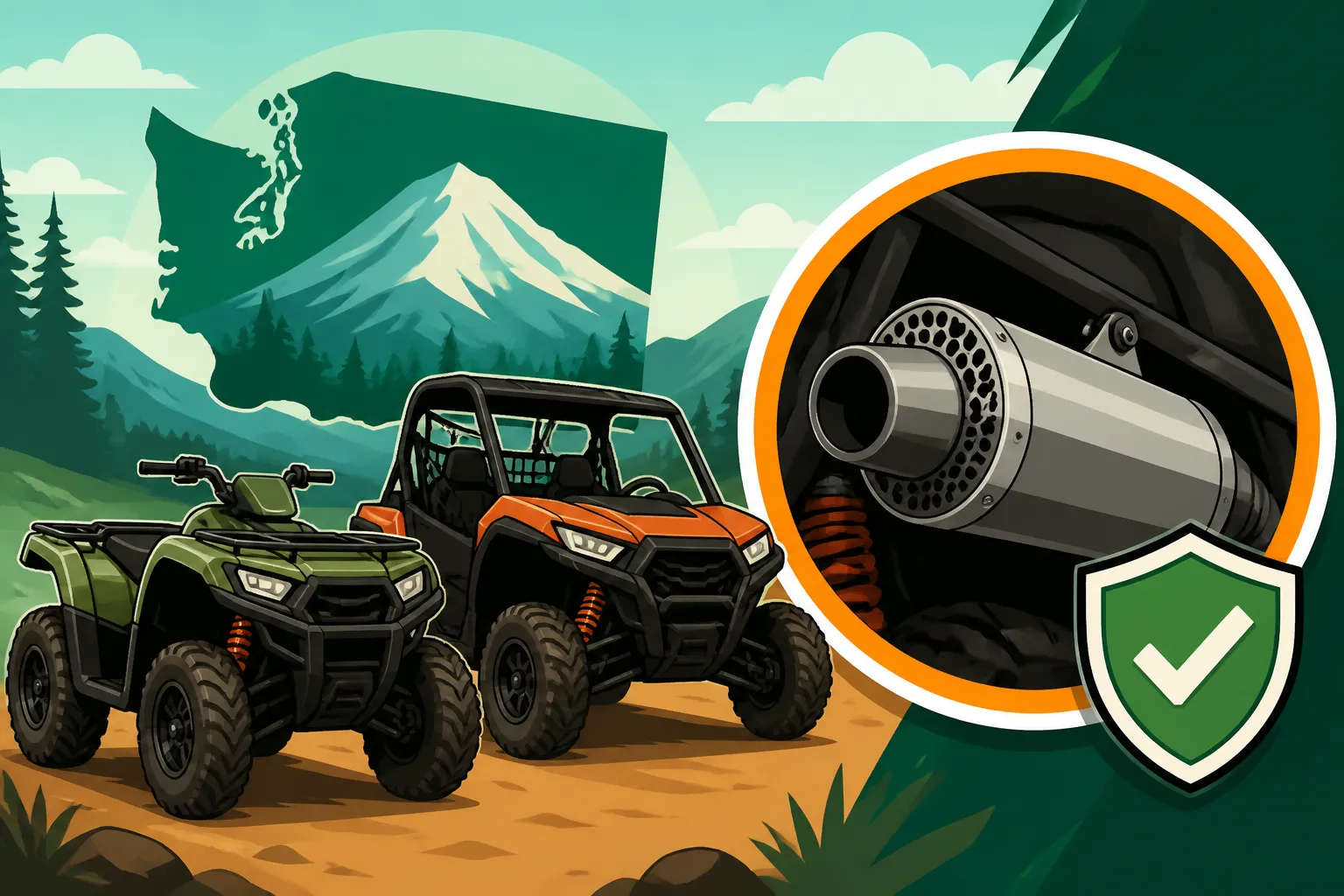
Washington Spark Arrester Requirement
It can be incredibly frustrating to get your ATV or UTV ready for a thrilling ride, only to worry if you’ve ticked every box for Washington State’s sometimes-complex equipment rules. One crucial, yet often overlooked, requirement is the spark arrester. This guide will walk you through exactly what a spark arrester is, why it's so important in our beautiful state, and how to ensure your machine is always compliant before you hit the trails.
What Exactly is a Spark Arrester and Why Does Washington Care?
You might hear the term "spark arrester" and picture something technical and complicated, but its function is quite straightforward. Imagine your ATV or UTV's engine at work – it creates combustion, and sometimes, tiny, superheated particles of carbon or metal can be ejected from the exhaust. In dry conditions, particularly during our long, hot summers, these little sparks are a massive fire hazard. A spark arrester is essentially a fine mesh screen or a series of baffles built into your exhaust system that catches these incandescent particles, preventing them from escaping and igniting dry grass, leaves, or forest debris.
The reason Washington State cares so much about spark arresters boils down to wildfire prevention. We live in a state blessed with vast, beautiful forests, arid eastern plains, and diverse natural landscapes, all of which are susceptible to devastating wildfires. A single spark from an off-road vehicle can quickly turn into an inferno, destroying thousands of acres, threatening homes, and endangering lives. The spark arrester isn't just a regulatory hurdle; it's a critical piece of safety equipment designed to protect our natural resources and communities. Without it, you’re not just breaking a rule; you’re risking catastrophe.
The Mechanism Behind Fire Prevention
Think of your engine as a miniature forge. When fuel and air mix and ignite in the combustion chamber, it’s a powerful, hot process. Not all of the carbon from this process is burned completely, and tiny bits can break off and get pushed out with the exhaust gases. If these bits are still glowing red hot when they hit the outside air, they can easily set things alight. This is especially true when you're traversing areas rich in dry tinder – think pine needles, dead leaves, or dry grasses that crackle underfoot.
The spark arrester acts as a physical barrier. It’s designed with openings small enough to stop these hot particles, but large enough to allow exhaust gases to flow through freely, minimizing any impact on engine performance. These trapped particles cool down within the muffler system before they can exit, rendering them harmless. It’s a simple but incredibly effective piece of technology that offers a crucial layer of protection against accidental fires, allowing us to enjoy our public lands without undue risk.
Federal and State Alignment on Safety
It's not just Washington state that takes spark arresters seriously. Many federal lands, like those managed by the U.S. Forest Service or Bureau of Land Management, also mandate their use. This means that whether you're riding on state-managed DNR lands or crossing into federal forestland, the expectation for a properly functioning spark arrester is consistent. This alignment highlights the universal recognition of the fire danger posed by recreational vehicles and the importance of this safety device.
So, when you see a sign at a trailhead reminding you about spark arresters, it’s not just a bureaucratic formality. It’s a direct response to a very real and present danger, especially during dryer seasons. Compliance isn't just about avoiding a fine; it's about being a responsible steward of the land and ensuring these incredible riding opportunities remain open for everyone, year after year.
Washington's Legal Requirement for Spark Arresters
Navigating Washington's laws around off-road vehicles can feel like deciphering ancient texts, but when it comes to spark arresters, the message is quite clear: if you're operating an off-road vehicle on any public land in Washington, you absolutely must have a U.S. Forest Service-approved spark arrester. This isn't a suggestion; it's a hard and fast rule designed to protect our forests and open spaces from the threat of wildfire.
The state's requirements are detailed within the Revised Code of Washington (RCW) and Washington Administrative Code (WAC) sections pertaining to nonhighway vehicles (NHVs) and off-road vehicles (ORVs). Essentially, any motorized vehicle used off paved roads needs this equipment. This includes your ATVs, UTVs, dirt bikes, and even some snowmobiles when they're operating in certain conditions. The approval part is key – it's not enough to just have a screen in your muffler; it needs to meet specific standards set by the U.S. Forest Service, often indicated by an "F.S. Approved" stamp or marking on the arrester itself or the exhaust system.
Public Lands: The Strict Application of the Rule
When we talk about "public lands" in Washington, we're referring to a wide array of areas. This includes state-managed lands by the Department of Natural Resources (DNR), state parks, lands managed by the Department of Fish and Wildlife, and federal lands like national forests, national parks (though ORV use is generally very restricted in national parks), and Bureau of Land Management (BLM) property. In all these locations, a U.S. Forest Service-approved spark arrester is non-negotiable. Rangers and wardens are empowered to check for compliance, and a missing or non-compliant arrester can lead to significant fines. You wouldn't want to receive a Washington citation for no tabs, and you certainly don't want one for lacking a spark arrester.
This rule is enforced year-round, but its importance is underscored during [Washington Fire Season and Trail Access]. During dry spells, especially from late spring through early fall, the risk of a spark-ignited fire skyrockets. Officials become even more vigilant, and temporary trail closures can occur if the fire danger becomes extreme. Having your spark arrester in top shape is a small but critical contribution to keeping our beloved trails open and safe.
Private Land and the Gray Areas
What about private land? The legal requirement for a U.S. Forest Service-approved spark arrester primarily applies to public lands. However, this doesn't mean you're off the hook when riding on your own property or private timberland with permission. While direct enforcement of the "approved" status might be less common, the underlying principle of fire prevention still applies. If a spark from your machine causes a fire on private land, you could still be held liable for damages, regardless of whether your arrester was "F.S. approved" or not. Common sense and good stewardship suggest that a functional spark arrester is always a wise choice, even when riding on private property.
Some private timber companies, when granting access to their lands, may have their own rules which often mirror public land requirements for safety equipment. Always check with the landowner or timber company if you’re riding on their property. Being prepared, having an arrester rated for Washington trails, and understanding [Washington Rules for Riding Private Timberland] can save you a lot of hassle and potential liability. It’s always better to be safe than sorry, especially when fire is a concern.
Checking and Maintaining Your Spark Arrester
A spark arrester is a durable component, but it's not invincible. Over time, it can accumulate carbon buildup, become damaged, or even fall out of the exhaust system. Regular checks and maintenance are crucial to ensure it's always doing its job effectively and that you're in compliance with Washington's regulations. Think of it as part of your pre-ride checklist, right up there with checking your tire pressure and fuel level.
Before every ride, especially if you're heading out to public lands like Capitol State Forest or Walker Valley, you should visually inspect your spark arrester. For most machines, the spark arrester is either integrated into the muffler or is an end-cap insert. Look for an "F.S. Approved" stamp to confirm it meets the standard. Check for any physical damage: Is the screen torn or punctured? Is it clogged with carbon? If you can't see daylight through the mesh, it's definitely time for a cleaning. A clogged arrester can restrict exhaust flow, potentially affecting engine performance, though this is usually minor.
Cleaning Your Spark Arrester
Carbon buildup is the most common issue you’ll encounter. Over many hours of riding, exhaust soot can cake onto the fine mesh of the arrester, reducing its effectiveness and potentially even causing back pressure in your exhaust. Cleaning is usually a straightforward process. For an end-cap arrester, you’ll typically remove a few bolts to take it out. Then, use a wire brush or a similar tool to scrape away the carbon deposits. Some riders use a solvent or carburetor cleaner, but often, a good stiff brushing is all it takes. Make sure the mesh is clear and free of debris before reinstalling it.
If your spark arrester is an integrated part of your muffler that can't be easily removed, consult your owner's manual. Some designs allow for internal cleaning through a port, while others might require a more specialized approach or even a full muffler replacement if the buildup is severe. The key is to ensure those tiny openings in the mesh are clear so exhaust gases can pass through freely while still trapping sparks.
When to Replace Your Spark Arrester
Sometimes, cleaning isn't enough, or the arrester suffers physical damage. If the mesh is torn, rusted through, or has holes larger than the specified maximum opening (which is usually around 0.023 inches for F.S. approved models), it's time for a replacement. A damaged arrester won't effectively stop sparks, rendering it useless for fire prevention and putting you in violation of the law. You can often find replacement spark arrester inserts for your specific muffler model.
If you're considering an aftermarket exhaust system, be very careful. Not all aftermarket exhausts come with an integrated spark arrester, and even fewer are U.S. Forest Service-approved. Always verify that any new exhaust system clearly states it is "F.S. Approved" and includes a spark arrester. Brands like SuperATV offer a range of aftermarket parts, and for any exhaust components, you should always double-check the product description to ensure compliance with spark arrester regulations. Investing in an aftermarket exhaust is great for performance or sound, but it should never come at the cost of safety and legality on Washington's trails. When you replace an arrester before a ride, you're not just doing maintenance; you're maintaining your access to our riding areas.
Consequences of Non-Compliance and Best Practices
Ignoring the spark arrester requirement in Washington State is a gamble with high stakes. The consequences aren't just about a potential fine; they extend to environmental damage, legal liability, and the possible closure of riding areas for everyone. It's a small detail with big implications, and understanding the risks is key to responsible riding.
If you’re caught riding on public land without a U.S. Forest Service-approved spark arrester, or with one that’s damaged and ineffective, you could face a citation. Fines vary, but they can be substantial, often in the hundreds of dollars. Beyond the monetary penalty, your machine might even be impounded, leaving you stranded far from home. Imagine having to explain that to your riding buddies! Furthermore, if your non-compliant machine is found to be the cause of a wildfire, you could be held liable for the full cost of fire suppression, which can run into millions of dollars, not to mention civil lawsuits for property damage. This isn't a hypothetical threat; it's a real legal consequence that can devastate lives and livelihoods.
Environmental Impact and Trail Closures
Beyond the personal financial and legal risks, the broader environmental impact of a wildfire caused by an unarrested spark is catastrophic. Fires destroy wildlife habitats, pollute the air, degrade water quality, and can take decades, even centuries, for ecosystems to recover. The sight of a burned-out forest is heartbreaking for anyone who loves the outdoors. This is why agencies like the DNR and U.S. Forest Service are so vigilant about fire prevention, and why the spark arrester is such a critical piece of equipment.
Repeated incidents of wildfire, particularly those traced back to recreational users, can lead to widespread and long-term trail closures. When a forest burns, it often takes years for the land to stabilize and for trails to be rebuilt and declared safe. Entire riding areas could be closed indefinitely, taking away cherished recreational opportunities from thousands of riders. This affects not just your fun, but also local businesses that rely on the tourism generated by our outdoor activities. Nobody wants to be the reason that [Washington Trails Closed by Timber Work] or fire closures shut down their favorite riding spots.
Embracing Best Practices for Fire Safety
The best practice is simple: always ensure your spark arrester is F.S. approved, clean, and in good working order before every ride. Make it part of your routine checks, alongside confirming your [Washington ORV Registration and Use Tax] are current and your [Washington ORV Decal Placement] is correct. Consider carrying a small fire extinguisher on your machine, especially during dry periods. Many riders also carry a shovel for quickly dousing small starts. Brands like SuperATV often offer accessories and parts that can help with compliance and safety, so always look for certified products.
Beyond your machine, be mindful of your actions. Avoid riding or parking on dry grass. Be careful with campfires, ensuring they are always completely extinguished. Dispose of cigarettes properly. These small acts of vigilance collectively contribute to a safer environment for everyone. Being a responsible rider means more than just knowing [Washington Rules for Riding a Forest Road]; it means protecting the very places we love to ride. Let’s all do our part to keep Washington's beautiful landscapes green and accessible for generations to come.
| Land Type | Spark Arrester Requirement | Notes |
|---|---|---|
| Washington DNR Land | U.S. Forest Service (F.S.) Approved | Strict enforcement; fines and impoundment possible. |
| Federal Land (USFS, BLM) | U.S. Forest Service (F.S.) Approved | Universal requirement across federal lands. |
| Washington State Parks | U.S. Forest Service (F.S.) Approved | Part of general ORV regulations within park boundaries. |
| Private Timberland | Generally F.S. Approved (or functionally equivalent) | Check landowner rules; liability for fire remains a risk. |
| Personal Private Property | Not legally mandated F.S. Approved, but highly recommended | Common sense for fire prevention; liability for fire still applies. |
Disclaimer
This article is for general informational purposes only and does not constitute professional advice. Laws, prices and regulations vary by location and change over time. Consult a qualified professional for guidance on your specific situation.