Washington Rules for Filming on Public Land
Washington Rules for Filming on Public Land
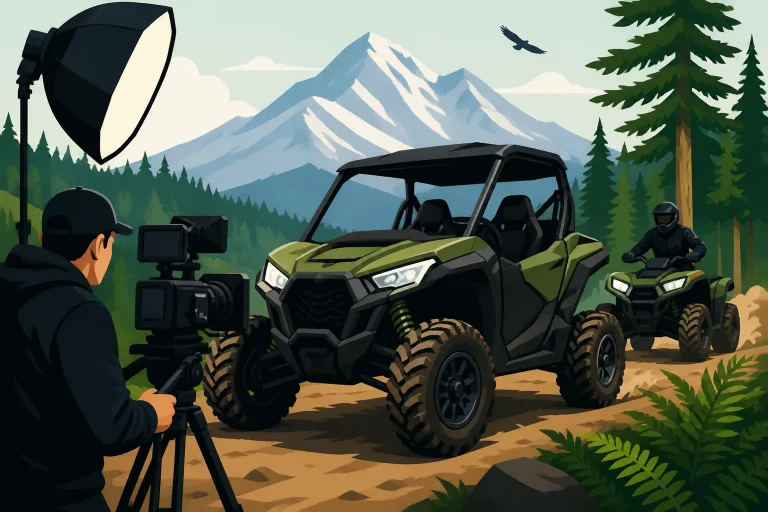
Filming an ATV or UTV ride in Washington can mean anything from a passenger recording a short clip to a production crew closing a road for a commercial shoot. The rules depend on who manages the land, what the filming involves, and whether the riding itself is allowed. Sorting out those questions before you load up helps prevent a permit problem, a trail closure violation, or an expensive change of plans.
Start by identifying the land manager and the kind of filming
“Public land” is not one system with one filming rule. A trailhead, forest road, state park, national forest, and Bureau of Land Management site can all have different managers and requirements. Even adjacent pieces of land may be governed by different rules.
Before planning shots, identify the specific location and the agency or organization responsible for it. A map can help you narrow down the area, but confirm the manager and current access conditions with that manager. A road shown as open on an old map may have since closed, and a place that allows public riding may still restrict production activity.
Separate the filming from the ride
A camera does not make an otherwise prohibited ride permissible. First confirm that the ATV or UTV may use the route. Then check whether filming, production equipment, or the intended use of the footage creates additional requirements.
For a riding location, check:
- Whether the route is open to the type of machine you plan to use.
- Whether the route has a width restriction or other vehicle limits.
- Whether the riding area has seasonal closures, fire restrictions, or active work.
- Whether the ride requires a pass, permit, registration, or other access document.
- Whether filming or staging equipment needs separate permission.
- Whether there are limits on drones, sound, group size, parking, or roadside stops.
The rules for riding on state-managed land are not necessarily the same as those for federal land. Start with Washington Rules for Riding DNR Land if the location is managed by the Washington Department of Natural Resources, and review Washington Rules for Riding Federal Land for a national forest or other federal site.
Distinguish personal recording from a production
A rider recording a trip for personal use is different from a crew producing an advertisement, documentary, branded video, or other organized project. That does not mean every personal clip is automatically exempt from every site rule, or that every video posted online requires a permit. It means the agency may assess the activity differently based on what you are doing, where you are doing it, and how much the production affects the site.
The word “commercial” can be less clear in practice than it sounds. A paid production, a crew hired by a business, or a shoot promoting a product is a strong reason to ask the land manager about a filming permit. A monetized channel, sponsored post, or video that may later earn revenue can be a less straightforward case. Do not assume that a small crew or a phone camera settles the question. Explain the project accurately and ask the land manager whether permission is required.
| Filming plan | What to check first |
|---|---|
| Rider records a short personal clip while stopped safely | Riding rules, filming restrictions, and whether stopping is allowed at that location |
| A group documents a recreational ride | Group-use rules, route access, staging space, and whether the gathering requires approval |
| A creator makes sponsored or monetized content | Whether the agency treats the planned use as commercial filming or another regulated activity |
| A business hires a crew to produce promotional footage | Filming authorization, location conditions, insurance, fees, and any required production documents |
| Crew brings lighting, stands, generators, or other equipment | Equipment restrictions, staging permission, vehicle access, and possible impacts to the land |
| Drone footage is planned | Separate aviation requirements and the land manager’s rules for takeoff, landing, and operating at the site |
The table is a starting point, not a substitute for the site’s rules. A small production may be simple to approve, while a seemingly modest shoot can create problems if it blocks access, disturbs wildlife, or uses equipment in a restricted area.
Find out whether a filming permit is required
There is no single permit that covers filming on every public parcel in Washington. Requirements vary by manager and by the activity involved. Some filming may be allowed without a special authorization; other projects may need a permit, a use agreement, proof of insurance, payment of applicable costs, or approval for specific equipment and locations.
A permit decision may depend on practical details such as:
- Whether the footage is personal, editorial, educational, promotional, or commercial.
- Whether the shoot involves a production company, hired crew, or contracted services.
- The number of people and vehicles involved.
- Whether the crew will use tripods, lights, generators, signs, props, or other equipment.
- Whether filming could interfere with other visitors or require an area to be reserved.
- Whether the shoot involves a road, trail, facility, or other sensitive location.
- Whether the activity could affect plants, wildlife, cultural resources, or public safety.
- Whether the production needs vehicle access beyond what ordinary visitors are allowed.
These details are why an online post from someone who filmed at a location may not answer your question. That person’s shoot might have been personal, covered by a prior approval, or conducted under a different manager’s rules.
Ask the right office, with a useful description
Contact the land manager responsible for the exact location. If the location crosses boundaries or uses multiple sites, ask each relevant manager. For example, a shoot might park at one managed area, travel on a road controlled by another entity, and film on land managed by a third. Permission from one does not necessarily cover the others.
When asking, provide enough detail for staff to make a meaningful decision:
- Name the location, route, and dates you are considering.
- Describe the purpose of the footage and how it will be used.
- Explain whether the work is paid, sponsored, promotional, or part of a business project.
- List the number of people, machines, support vehicles, and other equipment.
- Identify any planned road or trail stops, staging areas, or repeated takes.
- Ask specifically whether a filming permit, event approval, or other authorization is needed.
- Ask about application timing, insurance, fees, site restrictions, and required documents.
- Keep the response and any issued approval with the production plan.
For a project in a state forest, see Washington Rules for Filming a Commercial in a State Forest. Where the production includes a coordinated gathering or organized ride, Washington Rules for an Organized Ride may also help identify a separate approval issue. If staff direct you to an event or special-use application, check Applying for a DNR Special Use Event Permit rather than assuming a filming request covers the gathering.
Ask for written confirmation when possible. A phone conversation can be helpful for initial guidance, but a written response or formal authorization gives the crew something concrete to follow. If the agency says a permit is not needed, save that response and still follow ordinary access, riding, and safety rules.
Understand what an approval may and may not cover
A filming authorization is usually limited to the stated locations, dates, equipment, crew, and activity. It may not authorize riding on a closed route, access through a locked gate, use of a road controlled by another agency, or a separate event. Read the conditions carefully and ask before changing the plan.
The land manager may also set practical conditions. These can include where vehicles may park, when the crew may work, which routes remain open to other users, what equipment is allowed, and how the site must be left afterward. If the project changes substantially—for example, the crew grows, equipment is added, or a new location is included—ask whether the approval needs to be revised.
A permit is also not the same as an ordinary riding pass or vehicle registration. A Discover Pass, an ORV permit, or an appropriate registration may be needed for access or riding, but none should be treated as automatic permission for a production. Review Washington ORV Permits Explained for the distinction between riding-related requirements and other site permissions. For land where a Discover Pass applies, confirm that requirement separately through The Discover Pass and Washington Riders.
Plan the ride so filming does not interfere with access or safety
Even if no special filming permit is required, the crew must comply with the same riding and access rules as other visitors. A camera operator, producer, or sponsor does not get to turn a public trail into a private set.
Keep the route and vehicle legal
Check the route before the shoot, not only when you arrive. Confirm that the machine is allowed on that particular road or trail and that the route is open on the planned date. Washington has different rules for road riding and off-road use, and local road access can depend on the location. The fact that a route is paved, appears on a map, or connects two riding areas does not by itself establish that an ATV or UTV may use it.
If the plan includes public roads, verify that the machine meets applicable road-use rules and that the specific road is open to it. Do not use a filming schedule as a reason to ride on a road that is closed to the machine. Washington Rules for Riding a County Road and Washington Rules for Riding a Forest Road cover issues that can arise when a shoot includes a road segment.
Also check how the filming plan affects the machine’s status. A road-registered WATV may have different permissions from an off-road-only machine, but registration does not open every road. See What Washington Requires for On-Road ORV Use for the separate road-use requirements.
Do not block trails or create a private set
A public trail is shared space. Avoid parking machines or support vehicles where they narrow a trail, obstruct a gate, block a turnout, or prevent emergency access. Do not ask other riders to wait or leave unless the land manager has specifically authorized an appropriate closure or managed production area.
Plan shots around ordinary use:
- Pull completely clear of the travel route before stopping.
- Keep tripods, camera bags, and cables out of the trail corridor.
- Do not place signs or props where they could be mistaken for official markers.
- Avoid repeated high-speed passes that raise dust, create noise, or surprise other users.
- Do not stage vehicles at a locked gate or use a closed road as a filming location.
- Leave room for emergency responders, maintenance crews, and other visitors.
- If the location is busy, choose a less congested time or a different site rather than trying to control public access.
A few people filming a moving ride can still create a safety issue if they stand in a blind corner or in the path of oncoming machines. Assign one person to watch the route and keep the group together. Do not put an operator in a position where they must choose between getting the shot and riding safely.
Consider sound, wildlife, and resource impacts
Motorized filming can attract attention, but avoid increasing the impact for the camera. Revving engines, repeated passes, off-trail riding, and unnecessary idling can disturb other visitors and wildlife. They can also damage the surface, spread dust, or create avoidable noise complaints.
Follow posted sound limits and equipment requirements. Public-land rules may include requirements for spark arresters or mufflers, and a production does not create an exception. See Washington Sound Limits for ORVs and Spark Arresters on Washington Trails for related riding considerations.
Stay on designated routes and keep the crew out of sensitive areas. Do not cross streams or ride through vegetation to get a different camera angle unless the route is specifically open for that use. If the land manager identifies wildlife, cultural, or habitat restrictions, treat them as production constraints, not obstacles to work around.
Check closure notices and alerts shortly before travel. A route can close because of fire danger, storm damage, timber activity, road work, or another site condition. An approval for filming does not necessarily override a later closure. For a practical pre-trip check, see Checking Alerts Before You Load Up.
Treat drone filming as a separate question
A drone adds another layer of rules. The person operating it must comply with applicable aviation requirements, and the land manager may impose separate restrictions on launching, landing, or operating from the site. The fact that a drone can fly over an area does not necessarily mean that takeoff and landing are allowed there, or that filming is permitted.
Ask the land manager about the exact location and proposed operation. Be especially careful around other visitors, wildlife, roads, emergency activity, and restricted areas. Do not assume that approval for ground-based filming includes drone operations. If drone footage is central to the project, identify it in the first permit inquiry so the agency can address it directly.
Build a reliable pre-filming checklist
A short planning process can prevent most avoidable problems. The key is to confirm the ride, the production, and the land access as separate parts of the plan.
- Map the whole route. Identify the staging area, roads, trails, filming spots, and any transitions between land managers.
- Confirm the manager. Contact the entity responsible for each relevant location rather than relying on a general map label.
- Check riding access. Verify that your machine may use the route and that the route is open on the planned date.
- Describe the production accurately. Explain how the footage will be used, whether it is paid or sponsored, and what equipment and personnel are involved.
- Ask about authorization. Confirm whether filming, a group gathering, equipment, drone use, or commercial activity needs separate approval.
- Check related requirements. Ask about registration, access passes, insurance, fire restrictions, parking, and any application or processing steps.
- Get the conditions in writing. Keep the approval and relevant correspondence available to the person leading the shoot.
- Brief everyone involved. Make sure riders, camera operators, and support drivers understand the permitted locations and site rules.
- Recheck before departure. Look for closures, fire restrictions, access changes, or updated directions from the manager.
- Stop if conditions change. If the route closes, the crew exceeds the approved scope, or the activity creates a safety problem, pause and contact the manager.
Make a simple production plan
A one-page plan can keep a small shoot organized. Include the site name, manager contact, route, dates, crew size, machine count, parking location, filming equipment, and the person responsible for communicating with the agency. Add permit conditions, emergency access instructions, and a backup location.
Keep the plan realistic. A tightly timed schedule with repeated runs may encourage unsafe riding or put pressure on staff to use a route after conditions change. Build in time for checking the site, waiting for other visitors, and abandoning a shot if it would block access or disturb the area.
For a commercial project, ask the land manager what application materials are required before you hire the crew or announce a filming date. The agency may need time to review the proposal, and approval may depend on conditions that affect the budget or schedule. Do not assume that submitting an application is the same as receiving permission.
Keep documents accessible, but do not over-rely on them
Carry or store the relevant authorization in a way the production lead can access. Also make sure the people riding have the documents required for their machines and route. An approved filming permit does not replace a registration or a required pass. Conversely, having current tabs or a pass does not authorize commercial filming where separate approval is required.
If an officer, ranger, or site employee asks what the crew is doing, give a clear explanation and show the applicable documents. If the activity is outside the approved scope, stop and ask for direction rather than arguing that the camera crew has permission to be there.
Frequently Asked Questions
Can I record a personal ATV ride on public land without a filming permit?
Sometimes, but the answer depends on the land manager and the activity. A rider taking a brief personal video may not need the same approval as a production crew, but ordinary riding, equipment, drone, and site rules still apply. Ask the manager when the location or activity is unclear.
Does posting a video online make filming commercial?
Not automatically in every situation. Sponsorship, paid production work, business promotion, monetization, and the scale of the shoot may all matter to the agency’s decision. Explain how the footage will be used and ask the manager rather than relying on a general rule.
Does an ORV permit or Discover Pass give permission to film?
No. A required pass or vehicle document may cover a particular access or riding requirement, but it should not be treated as filming authorization. Check filming requirements separately with the manager of the site.
Can a filming permit let my group ride on a closed trail?
Do not assume so. A filming approval is limited to its stated terms and does not automatically override route closures or vehicle restrictions. Get explicit written authorization from the agency responsible for the route before relying on an exception.
Do I need a separate approval for a drone?
Possibly. Aviation rules and land-manager restrictions are separate questions, and permission for ground filming may not cover drone use. Ask about the specific site, launch and landing locations, and planned operation.
Disclaimer
This article is for general informational purposes only and does not constitute professional advice. Laws, prices and regulations vary by location and change over time. Consult a qualified professional for guidance on your specific situation.