Reading a Closure Notice Posted at a Gate
A closure notice at a Washington gate can be easy to misread when it names a road, trail, season or type of vehicle rather than saying simply “closed.” Before taking an ATV or UTV past it, work out what area the notice covers, who issued it, and whether it is still in effect. That quick check can prevent a wrong turn, a safety risk or a citation.
Start by identifying what is closed
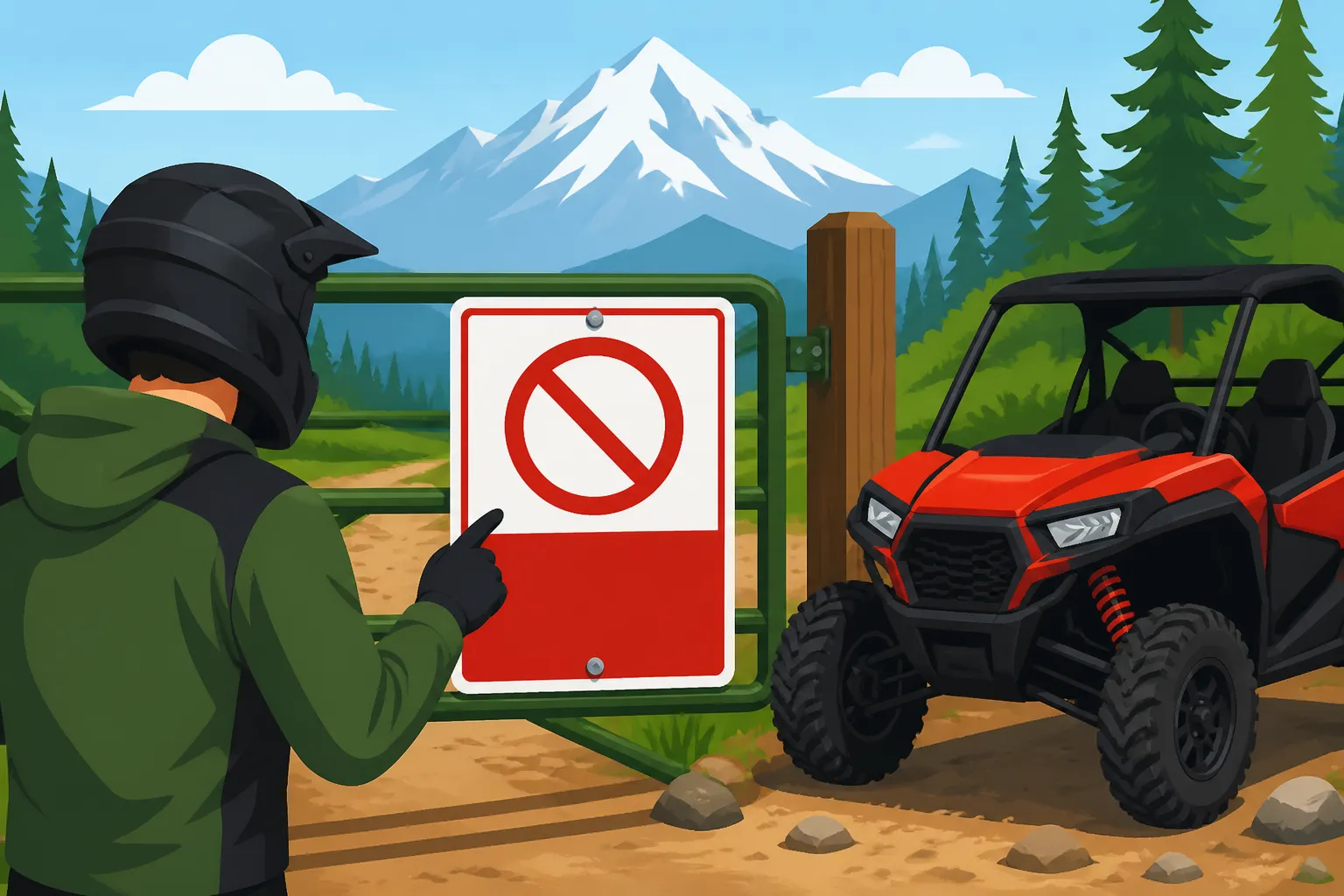
Read the entire notice before deciding what it means. The large word “CLOSED” is important, but the smaller text often explains the boundary, route, dates, vehicle types or reason. A notice may apply to a particular trail, road, recreation area or land-management activity—not necessarily every route beyond the gate. Don’t assume the opposite, either: a closure on one sign may be part of a broader restriction.
Look for the name of the route or place, nearby landmarks, map references and any boundary description. If a sign refers to a numbered road or trail, compare that wording with a current map. A route number can be more useful than a general place name, especially where several roads meet near the same gate. Reading a DNR Recreation Map can help with matching a named route to the map, but a map should not be treated as permission to pass a closure notice.
Pay attention to these details:
- The affected route or area: Is the notice for the road you’re on, a trail branching off it, a work zone, or the wider area?
- The boundary: Does the restriction begin at the gate, at an intersection, or beyond a named feature?
- The activity: Does it restrict all public access, motorized use, or a specific type of activity?
- The vehicles: Does it name ATVs, UTVs, ORVs, or a particular vehicle class?
- The dates and times: Is it seasonal, tied to a specific date range, or active until further notice?
- The issuer: Which agency, landowner or land manager posted it, and is there a way to contact them?
- The reason: Is the notice tied to hazards, maintenance, fire conditions, wildlife, a timber operation or another temporary restriction?
The reason can explain why the closure exists, but don’t use it to decide that the restriction no longer matters. A road may look clear even when a work crew, unstable ground or an access restriction remains in effect. Follow the actual terms on the notice and confirm any uncertainty with the organization responsible for the land.
| What the notice says | What to check before riding |
|---|---|
| A named trail is closed | Whether connecting routes are also restricted and where the closure begins |
| A road is closed to motorized use | Whether the restriction applies to your machine and the whole road or only a segment |
| The area is closed to public access | Whether any exception is stated; otherwise, don’t enter |
| Closed during a date range | The stated start and end dates, and whether a new notice extends the closure |
| Closed until further notice | Current status with the land manager; don’t assume it has reopened |
| Road work or timber activity | The exact work zone and whether access is prohibited during operations |
A closure notice may be posted by a public land manager, a private landowner or an organization responsible for access. The rules and contact process can differ. Washington Rules for Riding DNR Land, Washington Rules for Riding Federal Land and Washington Rules for Riding Private Timberland cover why it matters to know whose land you are on. A riding permit or registration does not automatically authorize entry onto a closed route or private property.
Check dates, boundaries and the kind of restriction
Read dates as written
If a notice gives a start and end date, check both before you ride. Don’t assume that the end date means the gate will be open the moment that date arrives. The closure may be extended, a new hazard may have appeared, or access may depend on a follow-up inspection. When a notice says “until further notice,” treat the route as closed unless the responsible land manager confirms otherwise.
A seasonal closure also needs careful reading. It may apply during a specified period, or it may depend on conditions such as weather, fire danger or active work. A date on an old sign, map or saved screenshot cannot reliably confirm the route’s current status. Check recent notices before leaving, particularly if your ride depends on one road or trail staying open. Checking Alerts Before You Load Up offers a useful pre-trip step; How to Know When a Trail Reopens Mid-Season explains why reopening status should be confirmed rather than inferred.
If the notice is damaged, partly covered, or missing a date that seems necessary to understand it, don’t fill in the gap yourself. Take a photo from a safe place, note the route and sign location, then check with the issuer. Until you can establish that access is allowed, choose another route.
Separate an area closure from a route closure
A sign at a gate can refer to different things. It may close the road immediately ahead, prohibit entry into a broader area, or warn that a specific trail beyond the gate is closed. Those distinctions matter, but a rider shouldn’t treat uncertainty as permission to pass the sign and investigate.
Look for additional notices at nearby junctions and at the start of the route. If signs appear to conflict, follow the more restrictive instruction until the land manager clarifies it. A route shown as open on a map does not override a current closure notice. Likewise, a sign for one trail does not necessarily close every trail in the surrounding area—but don’t continue into a closed segment just because another route appears open.
For road access, the posted restriction may cover a defined segment rather than an entire road network. Confirm the start and end points before planning to ride through or around the area. Washington Rules for Riding a Closed Road is relevant when a notice concerns a road rather than a designated trail. For land managed by a timber company, a gate and its sign can also mark a private access decision; don’t bypass them to reach a route that appears on a public map. See What to Do at a Locked Timber Company Gate if that is the situation.
Don’t infer an exception
A notice may mention work vehicles, authorized personnel, residents or another exception. That does not mean a recreational rider can decide they qualify. Unless the sign or responsible land manager clearly says your use is permitted, stay out of the closed section.
Also distinguish a closure from a warning. A warning about loose rock, heavy equipment or changing conditions may not itself prohibit travel, but it signals a hazard that needs attention. Read the full message and any accompanying instructions. If you cannot tell whether the notice is a warning or a prohibition, ask the issuer rather than treating it as optional.
Decide what to do at the gate
If a notice clearly closes the route or area to your ride, stop before the closure and turn around. Don’t ride around a locked gate, move a barrier, use a side track to get past it, or follow another vehicle through. A gap beside a barrier is not proof that the route is open. Neither is the absence of a physical gate: posted restrictions can apply without a locked barrier.
A closed route can also be unsafe even when no crew or obvious hazard is visible. Road conditions may change beyond the point you can see, and the closure may protect work that is difficult to spot from the entrance. Avoid stopping in a way that blocks a gate, work access or other traffic. If it’s safe, record the notice details and use an alternative route that you have confirmed is open.
If the wording is unclear, use this sequence:
- Stop short of the barrier or restricted area. Don’t cross it while you try to interpret the sign.
- Read and photograph the whole notice. Include any dates, map references, contact information and nearby route markers.
- Identify the issuer and land manager. Use the contact details on the notice or the manager’s current public information.
- Ask a precise question. Give the route name or number, the location of the sign, your vehicle type and the date you plan to ride.
- Confirm the full route, not just the entrance. Ask whether the connecting road or trail is open and where any restriction begins and ends.
- Choose a confirmed open alternative if you can’t verify access. Don’t treat a lack of a reply as approval.
This process is especially useful when the sign says a road is closed but a nearby trail map still shows it as part of a riding route. It is also useful when multiple managers or landowners control neighboring parcels. A trail may cross from one kind of land to another, and permission on one part does not necessarily apply to the next. Confirm each segment that your planned ride depends on.
A temporary permit, out-of-state registration or Washington tabs address different questions from whether a route is open. They don’t cancel a closure. Before riding, check both the rules that apply to your machine and the current access status for the land and route. Washington ORV Reciprocity With Other States may help visitors understand permit recognition, but reciprocity should not be mistaken for permission to use a closed road or trail.
Prepare for closures before the ride
The easiest time to handle a closure is before the machines are unloaded. Check the land manager’s current alerts, maps and route information, and look for temporary notices that may not appear on a general recreation map. If the ride crosses several roads or parcels, confirm each leg instead of checking only the destination.
Build a backup route into the plan. A single closed gate can make an otherwise reasonable ride longer or leave a group without a safe way to continue. Make sure the alternative is actually open to your vehicle type and allowed use. A route that works for a truck or passenger car may not be open to an ATV or UTV, and a road that is physically passable may still be restricted.
For a group ride, share the closure information before departure. Agree that anyone in the group can call a stop if a sign or barrier contradicts the plan. Keep the group together while turning around, and don’t split up to look for a way around the closure. If a reroute requires crossing private property or another managed area, get permission or use a route with confirmed access.
A short pre-ride check can help:
- Confirm that the route is open on the day you plan to ride.
- Check the notice’s dates, scope and issuing authority.
- Verify any uncertain boundary or exception with the land manager.
- Save contact details and a backup route where you can access them.
- Recheck for changes if conditions shift or the ride is postponed.
- Leave the route closed if its current status cannot be confirmed.
A closure notice is an instruction about access, not a suggestion to test the trail and see whether it feels passable. When the sign is clear, follow it. When it is unclear, pause and verify. If you cannot confirm that your planned route is open, turning around is the practical choice.
Disclaimer
This article is for general informational purposes only and does not constitute professional advice. Laws, prices and regulations vary by location and change over time. Consult a qualified professional for guidance on your specific situation.