If Your Home State Has No ORV Program
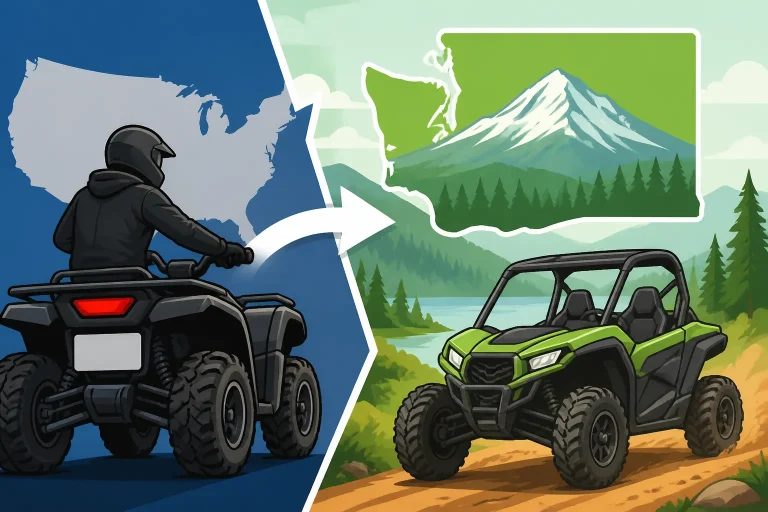
A state that does not register off-road vehicles may give you no sticker or card to show when you travel. That can make riding in Washington confusing: your machine may be legal at home, but Washington still has rules for visiting riders. Here’s how to work out whether you need a temporary permit, what it covers, and what to check before unloading.
Why having no home-state ORV program matters
Washington’s reciprocity rules depend on the registration or permit system where your machine is based. A visitor with current credentials from a state Washington recognizes may be able to ride without getting Washington registration. But if your home state has no ORV program, you may not have an equivalent credential to rely on.
That does not necessarily mean your machine is illegal to ride in Washington. It does mean you should not assume that being legal at home automatically satisfies Washington’s requirements. The practical question is whether you have a document Washington accepts for your machine and intended use.
The distinction matters because states handle off-road vehicles differently. Some require registration or a use sticker; others may have limited requirements or no comparable program. A vehicle’s regular license plate, title, or proof of ownership is not necessarily a substitute for an off-road credential. Nor does a lack of registration requirements at home automatically exempt a visitor from Washington’s rules.
For a broader explanation of how state systems interact, see Washington ORV Reciprocity With Other States. If you have no home-state registration to show, the most relevant question is usually What a Visitor With No Home-State Registration Buys.
Before traveling, identify the machine and the type of riding you plan to do. Washington distinguishes between off-road use and road use, and those are not interchangeable. A quad or side-by-side intended for trails may have different requirements from a machine equipped and registered for approved road use. A temporary off-road permit should not be treated as a road-use credential.
A useful way to think about the situation is:
| Your situation | What to check before riding in Washington |
|---|---|
| Your state issues an ORV registration or sticker | Confirm Washington recognizes the credential and that it is current |
| Your state has no ORV program | Check whether you need a Washington temporary ORV use permit |
| You have a title but no ORV credential | Do not assume the title alone is enough for riding |
| You plan to ride on public land | Check the land manager’s access, pass, and trail rules as well |
| You plan to use roads | Check road-use requirements separately; a temporary trail permit does not make a machine road legal |
If you are uncertain, resolve the permit question before the trip rather than at a trailhead. A machine can be properly owned and transported yet still lack the credential required for a particular ride.
How a Washington temporary ORV permit can help
Washington offers a temporary ORV use permit for certain visiting riders who do not have qualifying home-state credentials. For someone whose state has no ORV program, this may be the route to consider. Confirm eligibility and the current application or purchase process with the Washington Department of Licensing or an authorized licensing office before you travel.
The permit is intended to cover a limited period of off-road use. It is not a replacement for permanent Washington registration, and it does not change the machine’s equipment or legal status. It also does not grant access to every trail or public property. Land managers can set separate rules, closures, and pass requirements.
For the visitor-specific details, see Washington Temporary ORV Permit for a Visitor. The permit’s time limit and conditions are important: plan the trip around the period it covers, and check the official requirements for the dates you will be riding. Avoid relying on an old permit or secondhand advice about how long it lasts.
The permit is tied to the machine, not simply to the person carrying it. Treat it as machine-specific paperwork, and do not assume you can move it to another quad or side-by-side. The rules are explained further in Why a Temporary Permit Stays With One Machine.
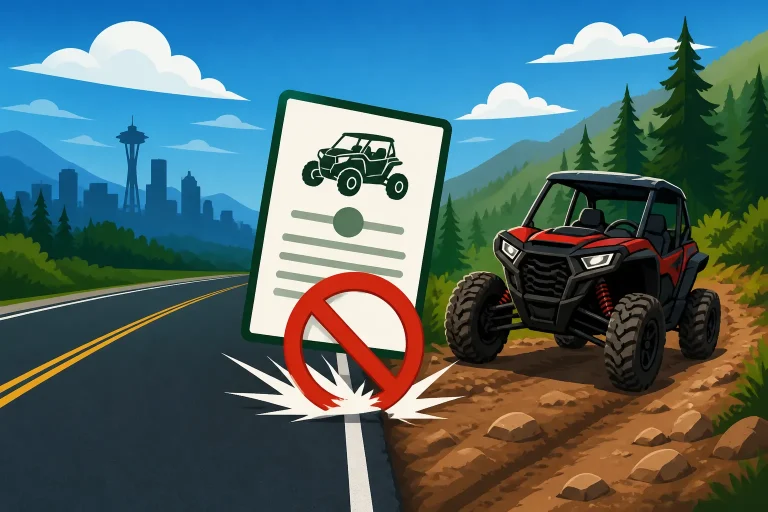
Before setting out, make sure you understand what the permit allows and what it does not. In particular, it is for off-road use, not general pavement travel. A permit for trail riding should not be treated as permission to ride on a city street, county road, or highway. See Why a Temporary Permit Keeps You Off Pavement for the difference.
A temporary permit also does not take the place of other documents you may need. Keep proof of ownership and any required permit information with the machine, and make sure the vehicle identification number is readable. If the machine is borrowed or rented, ask the owner or rental business what registration or permit applies to that specific vehicle. Do not assume that a permit purchased for one machine covers another.
Check the trail, land, and access rules separately
A Washington ORV permit answers only one part of the access question. Before riding, check the rules for the specific land and route you plan to use. Public land can be managed by different agencies, and a credential that satisfies the state’s ORV requirement does not automatically satisfy a land manager’s pass requirement.
For example, riding on Department of Natural Resources land can involve additional access rules. Review Washington Rules for Riding DNR Land and check the current information for your destination. Some trailheads or recreation areas may require a separate pass, while others may have different arrangements. Do You Need a Discover Pass to Ride in Washington? explains why the answer can depend on where you park or recreate, rather than simply on whether the machine has an ORV permit.
Also confirm that the trail is open to your type of machine. A route may have width restrictions, seasonal closures, or limits based on vehicle class. A trail shown on an old map may have since closed or changed. Look for current notices from the land manager, especially when timber work, weather, fire restrictions, or maintenance can affect access. Checking Alerts Before You Load Up can help you build this step into trip planning.
Keep these questions separate when you prepare:
- Does Washington require you to have a temporary ORV permit or another credential?
- Is the trail open to your machine and the kind of riding you plan to do?
- Does the land manager require a separate pass or impose other access conditions?
- Are there current closures, equipment rules, or seasonal restrictions?
- Are you staying off roads unless you have the separate credentials and equipment required for road use?
This separation prevents a common mistake: assuming that buying a permit settles every access issue. A permit may address the machine’s ORV registration status, while the destination’s rules still determine where and when you can ride.
A practical checklist before you leave home
A little preparation can prevent a wasted trip or an avoidable stop. Start with the machine’s paperwork, then confirm the permit and destination requirements.
- Identify the machine. Record its make, model, and vehicle identification number. Check that the VIN is legible and matches the ownership documents.
- Confirm your home-state situation. Find out whether your state issues an ORV registration, sticker, or other credential. If it has no ORV program, do not invent or substitute a document that your state does not issue.
- Check Washington’s current permit requirements. Ask whether a visitor in your circumstances needs a temporary ORV use permit, how to obtain it, and what documents are needed.
- Confirm the permit’s limits. Verify its period of validity, the machine it applies to, and whether it covers only off-road use.
- Choose a legal riding area. Check that the trail is open to your vehicle type and that the route is suitable for its width and capabilities.
- Check extra passes and access rules. Confirm whether the trailhead or recreation area requires a separate pass and whether parking has its own rules.
- Carry the relevant documents. Keep the permit and ownership paperwork protected from rain and mud, and make them available if asked.
- Recheck conditions before departure. Closures and access information can change, so review current alerts close to the ride.
If you are planning to ride only on designated off-road trails, keep the machine off public pavement unless you have confirmed that the route and vehicle meet the separate road-use requirements. A temporary ORV permit is not a shortcut to road access.
The safest plan for a rider from a state without an ORV program is straightforward: verify whether Washington requires a temporary permit, obtain the correct credential for the specific machine if needed, and check the destination’s rules independently. That gives you a clearer answer than relying on the absence of home-state paperwork as proof that no Washington paperwork is needed.
Disclaimer
This article is for general informational purposes only and does not constitute professional advice. Laws, prices and regulations vary by location and change over time. Consult a qualified professional for guidance on your specific situation.