What a Visitor From a Reciprocal State Can Ride
A reciprocal registration can save a visiting ATV or UTV rider from buying another off-road registration, but it is not a pass for every Washington trail or road. The key is understanding what reciprocity covers, what it does not, and what to check before unloading your machine.
What reciprocity lets a visitor do
Washington may recognize a visitor’s current off-road registration from a state with a reciprocal arrangement. When that registration qualifies, it can allow the machine to be operated off-road in Washington without obtaining a separate Washington ORV registration. Reciprocity is about the machine’s registration status; it does not automatically grant access to every riding area or road.
Rules can depend on the visitor’s home state, the kind of registration or sticker it issues, and the machine being brought into Washington. A license plate or registration for ordinary highway use should not be assumed to count as the required off-road credential. Likewise, a sticker that has expired, belongs to another machine, or applies only to a different vehicle category may not qualify.
Before traveling, check the details of Washington ORV Reciprocity With Other States and confirm that your registration applies to the specific ATV, UTV, or dirt bike you plan to ride. If the rules for your home state or vehicle type are unclear, contact the Washington agency or land manager responsible for the place you intend to visit. Bring proof of current registration and be ready to show it.
Reciprocity is also not a substitute for other requirements. A visitor may still need to follow Washington rules on:
- Where the machine may be operated, including designated trails and open roads
- Helmet use, supervision of younger riders, and other rider-safety requirements
- Equipment, noise limits, and spark arresters where applicable
- Site access passes or permits
- Seasonal closures, fire restrictions, and posted restrictions at trailheads
The distinction is simple: reciprocal registration may satisfy a registration requirement, but it does not make an otherwise closed route open or waive a land manager’s access rules.
| What the visitor has or wants to do | What reciprocity may cover | What still needs checking |
|---|---|---|
| Ride off-road on an eligible public route | Recognition of qualifying home-state ORV registration | Vehicle eligibility, route rules, closures, and any required site pass |
| Ride on a Washington road | Usually not road permission by itself | Washington road-use requirements, local authorization, and whether the machine qualifies |
| Ride on land managed by a specific agency | May help satisfy registration rules | The agency’s access rules, permits, passes, and trail designations |
| Visit without qualifying home-state ORV registration | Reciprocity may not apply | Whether a Washington temporary permit or another credential is required |
Where the machine can be ridden
A reciprocal registration does not create a general right to ride on public land. Washington has different rules for state-managed trails, federal land, private timberland, city streets, and county roads. The land manager’s route rules matter as much as the registration on the machine.
Designated off-road routes
For off-road riding, the safest starting point is the official map or current notice for the riding area. Confirm that the route is open to your type of machine, then check whether there are width, sound, equipment, or seasonal restrictions. A route shown on an old map may have since closed because of timber work, fire danger, road damage, or another access change.
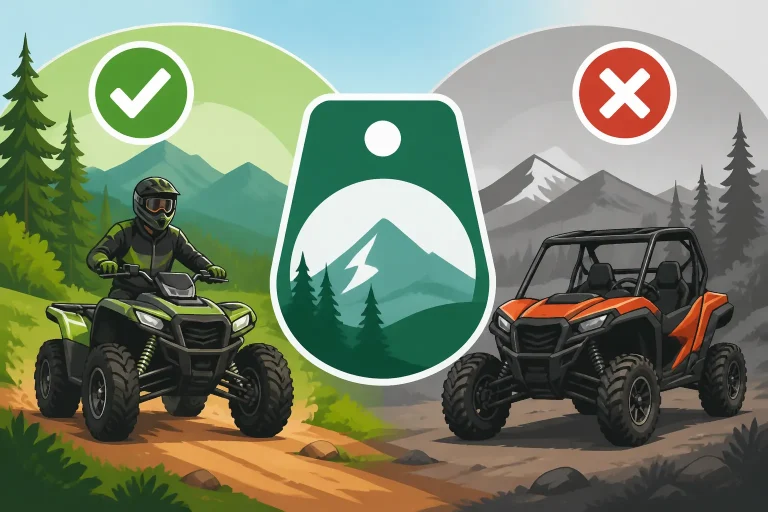
The rules can vary even within one forest or recreation area. Some roads are open to certain vehicles while nearby trails are limited to narrower machines. Follow signs at the entrance and at junctions, and do not assume that a route suitable for an ATV is also open to a wide side-by-side.
For state-managed routes, review Washington Rules for Riding DNR Land. For national forest areas, check Washington Rules for Riding a National Forest and the notices for the particular forest or trail system. Those checks are worthwhile even if your home-state registration is clearly valid: registration and route access answer different questions.
Land passes and permits are separate
Some riding locations require a site pass or other access credential in addition to valid ORV registration. The requirement depends on where you park or ride, not simply on where your machine is registered. A pass required at one trailhead may not be required at another.
Check the rules for the specific parking area and land manager before leaving home. Do You Need a Discover Pass to Ride in Washington? explains why a Washington pass may be needed at some state-managed sites but does not replace credentials required by other agencies. A pass displayed in a tow vehicle also does not necessarily satisfy a separate requirement for the machine itself.
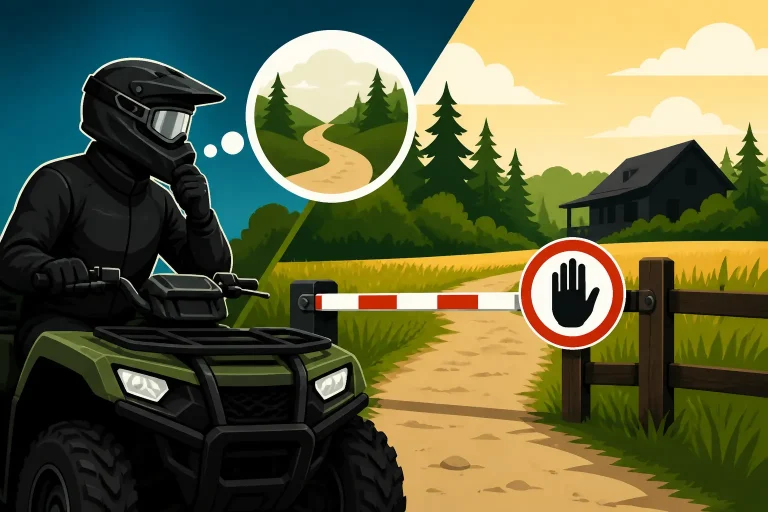
Private timberland has its own access conditions. A road that appears on a map may cross private property, be closed during active hauling, or require the landowner’s permission. Do not treat a reciprocal registration as permission to pass a locked gate or ride on private land. Confirm access directly with the landowner or company when necessary.
Roads are a separate question
The biggest potential misunderstanding is assuming that a machine legally registered in another state can therefore ride Washington pavement. Off-road reciprocity does not, by itself, establish that the machine is legal to use on a Washington road.
Washington has requirements for machines used as wheeled all-terrain vehicles on approved roads, and road access depends on the location and type of road. A route may be open to qualifying machines only where a county or city has authorized it, or where a specific highway segment has been approved. A road’s posted speed, traffic status, and local rules can all affect access.
Before planning a pavement connection between a campground and a trail, verify both parts: whether your machine satisfies Washington’s road-use requirements and whether that particular road is open to it. The overview in Washington Road Reciprocity and Its Conditions helps explain why home-state status should not be treated as blanket road permission. For the broader requirements, see What Washington Requires for On-Road ORV Use.
If you are unsure, trailer the machine between locations rather than assuming a short road section is legal. A brief connection on pavement is still road use, and a route that looks quiet or lightly traveled is not necessarily authorized.
What to check before you travel
A little preparation can prevent a wasted trip or an avoidable citation. Verify the registration, route, and access requirements separately; one does not automatically answer the others.
- Confirm your home-state registration. Check that it is current, applies to off-road use, and identifies the machine you are bringing. If your state issues different credentials for different vehicle classes, make sure the one you have covers your ATV or UTV.
- Check whether Washington recognizes it. Use the current information from Washington’s licensing or recreation authorities. For an overview of how the rule works, see Washington Reciprocity for Off-Road Use. Do not rely only on what a friend was told about a different state or vehicle.
- Choose the exact riding area. Review the land manager’s map, route designations, closures, and vehicle restrictions. If you will cross from one managed area to another, check both.
- Look for site-specific passes or permits. Confirm the requirement for the trailhead and parking area, including whether the credential applies to the vehicle, the person, or the parking location.
- Treat road riding as a separate plan. Verify that both the machine and each road segment are authorized for use. Do not assume a trail connection, county road, or paved access road is open.
- Carry proof and follow posted instructions. Keep registration information available and bring any required passes or permits. Obey signs and current closure notices, even if an older map or online discussion suggests the route is open.
If your home-state credential does not qualify, or your state does not have a comparable ORV registration system, ask whether you need a Washington temporary permit before riding. Temporary permits have specific limits and conditions; they are not a universal alternative that grants road access. See Washington Temporary ORV Permit for a Visitor and What a Visitor With No Home-State Registration Buys for the situations in which that option may matter. Confirm the current permit rules and duration with the official source before your trip.
Keep records for each machine in a group. One rider’s registration does not cover another person’s ATV, and a permit tied to one machine should not be treated as transferable. If you are renting, ask the rental provider what registration or permits the machine carries and what routes it may use. The operator remains responsible for obeying the rules at the riding location.
A practical way to avoid confusion is to plan around the most restrictive part of the trip. If your registration is accepted for off-road use but a desired road connection is not clearly authorized, treat the road as unavailable and choose a route that stays on approved trails or roads. If a pass or permit requirement is uncertain, confirm it before arrival rather than relying on a trailhead kiosk or a mobile signal in the forest.
The core takeaway: a reciprocal state credential may let you ride eligible off-road routes without duplicating registration, but it does not automatically cover road use, site passes, closures, or local access rules. Verify those pieces independently for the machine and riding area you have in mind.
Disclaimer
This article is for general informational purposes only and does not constitute professional advice. Laws, prices and regulations vary by location and change over time. Consult a qualified professional for guidance on your specific situation.