Washington Arrester Rules on Public Land
A spark arrester can look like a small exhaust part, but it can determine whether your ATV or UTV is allowed on a Washington trail. Requirements depend on who manages the land, and a quiet muffler alone may not satisfy them. Here’s how to check the rules, confirm your machine’s equipment, and avoid arriving at a trailhead with a preventable problem.
What a spark arrester does and where rules apply
A spark arrester is designed to stop hot particles from escaping an engine’s exhaust. It does not eliminate fire risk, but it can reduce the chance that exhaust sparks ignite dry vegetation. That matters on forest roads and trails, especially during dry weather.
For riders, the practical rule is to expect a functioning, approved spark arrester to be required when operating an off-road vehicle on public forest land. Requirements may apply on land managed by the Washington Department of Natural Resources, the U.S. Forest Service, or the Bureau of Land Management. A state park or another public-land manager may have its own rules, too. Don’t assume that one agency’s requirements automatically settle the rules on another agency’s land.
The word “public” does not mean that every road or trail is open to every machine. Access can depend on the land manager, the road or trail’s designation, seasonal restrictions, and your machine’s equipment. Check the rules for the specific area, not just for the county or region. For a broader explanation of agency-specific access, see Washington Rules for Riding DNR Land, Washington Rules for Riding a National Forest, and Washington Rules for Riding BLM Land.
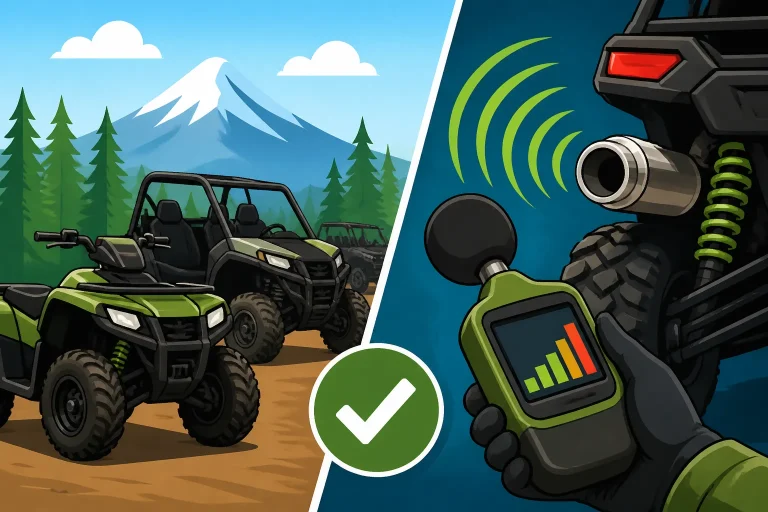
A spark arrester requirement is also separate from a sound requirement. An exhaust can be quiet and still lack an approved arrester; conversely, an arrester does not guarantee that the exhaust meets applicable noise rules. Keep the two checks distinct, and review Washington Sound Limits for ORVs if you also need to check noise limits.
| Situation | What to check |
|---|---|
| Riding a DNR forest road or trail | DNR rules and any posted site requirements |
| Riding in a national forest | Forest-specific rules, closures, and equipment requirements |
| Riding on BLM-managed land | BLM rules for that area and the route you plan to use |
| Riding at a state park or other public recreation site | The managing agency’s rules for motorized use |
| Riding near a fire restriction or seasonal closure | Current notices, which may add limits or close access |
A route can cross different kinds of land, and a road that appears continuous on a map may pass from one manager’s property to another. When you’re unsure, check each manager’s requirements along your planned route. Also look for signs at the entrance or staging area. Posted information may flag local restrictions, but it is not a substitute for checking whether a trail is open.
For more about trail-specific equipment requirements, Spark Arresters on Washington Trails is a useful companion topic. The key takeaway is simple: confirm that your machine has an approved arrester that is present, intact, and operating as intended before riding.
How to check whether your ATV or UTV has one
Many stock off-road machines have a spark arrester built into the exhaust assembly. That does not mean every machine still has one. A previous owner may have modified the exhaust, removed an internal part, or replaced the muffler with a component that does not include an arrester. Aftermarket exhaust parts can also differ in whether they include one.
Start with the owner’s manual and the machine’s exhaust documentation. Look for an explicit statement that the exhaust system includes a spark arrester and is approved for the use you have in mind. If the paperwork is unclear, contact the manufacturer or a qualified service shop with the machine’s make, model, and year. Don’t rely only on the fact that the exhaust looks stock or that the vehicle runs quietly.
Some arresters use an accessible screen or similar internal component. Others are built into the exhaust in a way that isn’t obvious from the outside. An intact outlet or muffler casing by itself does not prove that an arrester is present. Nor does a generic “off-road” label establish approval for public-land use.
Check for signs that the exhaust has been altered:
- A non-stock muffler or exhaust canister with no clear arrester information.
- Missing fasteners, an open housing, or evidence that an internal screen was removed.
- A cut or modified exhaust outlet.
- Repairs or replacement parts that don’t match the original system.
- A screen or arrester that is damaged, badly corroded, or clogged with deposits.
If the machine was bought used, ask what exhaust work has been done and check the components rather than relying on a seller’s recollection. A machine can be mechanically sound yet still be missing equipment needed for the land where you plan to ride. If you are checking other pre-ride details on a used machine, Checking a Used Machine in Washington can help you think through broader inspection points.
When the manufacturer’s documentation is inconclusive, a dealer or qualified repair shop may be able to identify the exhaust and confirm whether it contains an appropriate arrester. Ask a direct question: does this exact exhaust configuration include an approved spark arrester, and is it intact? “It has a muffler” is not an answer to that question.
Avoid relying on an online listing alone. If you shop through a retailer such as Amazon, match the part to the exact machine and confirm the manufacturer’s stated arrester status and applicable approval. Listings can use broad fitment descriptions, and a replacement muffler may fit without including an arrester. Keep any product documentation with your machine records, but remember that paperwork does not make an incorrectly installed or altered part compliant.
Keeping the arrester effective and dealing with changes
Having the right part installed is only one part of the job. An arrester that is clogged, damaged, loose, or removed for service may not function as intended. Follow the machine and exhaust manufacturer’s maintenance instructions, and inspect the system periodically—particularly after repairs, hard use, or a change to the exhaust.
Let the exhaust cool completely before inspecting or servicing it. Hot components can cause serious burns. Use the manufacturer’s procedure to access and clean a screen or other serviceable arrester component. Don’t enlarge, cut, remove, or replace it with an unapproved screen. Those changes may defeat the part’s function or its approval, even if the exhaust still appears to work normally.
If you’re considering an aftermarket exhaust, verify the arrester before buying or installing it. Check for clear documentation that identifies the compatible machine and confirms that the system includes an appropriate spark arrester. If you can’t establish that, choose a different option or ask a qualified shop to verify it. Avoid assuming that an exhaust sold for recreational use is automatically suitable for every public-land requirement.
A changed exhaust may also affect noise compliance. So if you replace or modify the system, recheck both the arrester and noise rules rather than treating one as a substitute for the other. [An Arrester Rated for Washington Trails] and Replacing an Arrester Before a Ride cover the practical questions to ask when choosing or replacing equipment.
A sensible pre-ride check can be brief:
- Confirm which agency manages the area and check its current riding rules.
- Verify that the exhaust on your exact machine includes an approved spark arrester.
- Look for signs of damage, missing parts, tampering, or excessive deposits.
- Make sure any replacement or aftermarket parts are compatible and properly installed.
- Check for fire restrictions, closures, and other current access notices before loading up.
A staging-area sound check or inspection does not necessarily replace your own equipment check. Staff may not inspect every part of every vehicle, and the rules can still apply whether or not someone checks your machine at the entrance. For more on what to expect at one type of inspection, see How a DNR Staging Lot Sound Check Works.
Fire restrictions, closures, and what to do if you are unsure
Spark arresters reduce one potential ignition hazard; they do not give you permission to ride during a closure or override fire restrictions. Public-land managers may restrict access when fire danger is high, close roads or trails for resource protection, or impose other temporary limits. Conditions and rules can vary by location, so check current notices before setting out.
Fire restrictions may affect more than whether a vehicle can enter an area. They can also regulate other activities, and the details depend on the notice and the land manager. Don’t interpret the presence of a spark arrester as a general exemption from fire-season rules. See Washington Rules for Riding During Fire Season for related considerations.
Check official agency information close to your ride, then read signs at the entrance and at any closure point. A trail may be open while a nearby road is closed, or conditions may change after you’ve made your plan. Checking Alerts Before You Load Up and Reading a Closure Notice Posted at a Gate can help you build these checks into your trip routine. If an area is posted closed, stay out even if another route or map suggests that access may be possible.
If you cannot verify that your machine has an appropriate arrester, the safer choice is to postpone riding on land where one is required until the question is resolved. Ask the land manager or a qualified shop what documentation or equipment is acceptable for your machine. Bring the exact make, model, year, and exhaust details when you ask; a general question about “ATVs” may not be enough to identify a modified system.
A few straightforward habits help prevent confusion:
- Keep the owner’s manual and exhaust documentation available.
- Record the make and part number of any replacement exhaust components.
- Check the arrester after exhaust work or before a long trip.
- Confirm current rules separately for each land manager on your route.
- Recheck closures and fire notices before every ride, even if the area was open on a previous visit.
The most reliable approach is to treat spark-arrester compliance as both an equipment check and a land-access check. Confirm the part on the machine, confirm the rule for the land, and confirm that the area is open. That combination is more useful than assuming that a stock-looking exhaust or a familiar trail settles the question.
Disclaimer
This article is for general informational purposes only and does not constitute professional advice. Laws, prices and regulations vary by location and change over time. Consult a qualified professional for guidance on your specific situation.