Washington Reciprocity for Off-Road Use
Washington Reciprocity for Off-Road Use
A valid ATV or UTV registration from home does not automatically answer every Washington riding question. Reciprocity can determine whether your machine needs Washington ORV registration, but it does not replace land-access rules, trailhead passes or road-use requirements. Here’s how to sort out what to bring, when a temporary permit may be needed and what to confirm before unloading.
What Washington ORV reciprocity means
Reciprocity is a recognition arrangement: Washington may allow a visitor to operate an off-road vehicle using valid registration from the visitor’s home state, rather than requiring Washington registration for the trip. The important point is that reciprocity concerns the vehicle’s registration status. It is not a general pass to ride anywhere, and it does not necessarily apply to every kind of out-of-state sticker or permit.
A registration card or decal from another state is most useful when it clearly identifies the machine and shows that its registration is current. But the name of the document alone does not settle the question. One state may issue a registration, another may issue a trail permit, and another may use a sticker that applies only to certain public lands. Washington’s recognition can depend on whether the home-state credential qualifies under the applicable reciprocity rules.
That is why two visitors with similar-looking decals may not have the same answer. One may have a current, recognized ORV registration. Another may have a trail pass that is valid only on particular land or does not meet Washington’s registration requirements. If you are unsure which kind you hold, confirm it before your trip rather than assuming that any out-of-state decal counts.
Washington’s reciprocity framework is about legal operation, not simply whether a machine has been registered somewhere. A visitor should be prepared to show that the registration belongs to the machine, remains valid, and is the right kind of credential for off-road use. For a broader overview of how states handle this, see Washington ORV Reciprocity With Other States.
Registration is not the same as land access
A recognized home-state registration may satisfy the registration requirement for a visiting machine, but a land manager can still have separate conditions for using a riding area. Those can include an access pass, a permit for that specific site, a closed-season restriction, an approved route, equipment rules or a requirement to stay on designated trails.
Think of these as separate questions:
- Is the machine properly registered or covered by an accepted visitor arrangement?
- Is this particular riding area open to the machine and rider?
- Does the site require an additional pass or permit?
- Is the route suitable and legal for this type of vehicle?
For example, a pass that lets a vehicle park at a recreation site is not automatically an ORV registration. Likewise, registration does not necessarily pay for parking or grant access to a trail system. The Washington ORV Permits Explained overview can help separate state registration and permits from other kinds of recreation access requirements.
Land ownership matters too. Rules on Washington Department of Natural Resources land may not be identical to those on federal land, state parks, county property or private timberland. A credential accepted for one area is not proof that another area is open. Check the land manager’s rules for the exact staging area and routes you plan to use.
A practical comparison
| What you have or need | What it may cover | What it does not automatically cover |
|---|---|---|
| Current home-state ORV registration | Registration recognition where Washington reciprocity applies | Access to every trail or public land area |
| A state trail permit or sticker | Use where that specific permit is accepted | Washington registration reciprocity by itself |
| Washington temporary ORV use permit | A visitor’s registration need when home-state credentials are not accepted or available | On-road use or access to a closed route |
| Recreation or parking pass | Access or parking at locations covered by that pass | ORV registration |
| Out-of-state road registration | The vehicle’s status under the issuing state’s rules | Permission to ride a Washington street or highway |
The table is a starting point, not a substitute for checking the current rules that apply to your machine and destination. Keep the registration record and permit information together, and make sure the VIN or other identifying details match the machine you brought.
Check your machine and registration before traveling
Start with the credential issued by your home state. Confirm that it is current for the full period of your visit and that it applies to the machine you intend to ride. Look for the machine’s make, model or VIN on the paperwork, and check that the decal displayed on the vehicle corresponds to that record. If the state’s credential applies only to a specific land system, do not assume that it functions as general ORV registration in Washington.
The machine type can also matter. ATVs, side-by-sides, dirt bikes and other off-road machines may be treated differently by a state’s registration system. A document for a road-registered motorcycle, for example, should not be assumed to establish the same status as an ORV registration. Similarly, a registration tied to one machine cannot simply be treated as coverage for every vehicle on the trailer.
If you are bringing a side-by-side or another larger machine, check the trail system’s width limits and vehicle rules separately. Reciprocity does not change the physical or administrative limits of a trail. A machine can have acceptable registration and still be too wide for a designated route.
Bring proof, not just a decal
A decal is useful for showing status on the machine, but carry the related registration documentation as well. That way, if the decal is damaged, difficult to read or questioned, you can show the issuing state’s record. Keeping documents protected from rain and mud is sensible; Keeping a Registration Card Dry on a Wet Ride covers practical ways to do that.
Before departure, check the following:
- The registration is valid for the dates you expect to ride.
- The paperwork identifies the machine you are transporting.
- The decal is displayed as required by the issuing state.
- You have any Washington permit required for that machine.
- You have checked the destination’s current access, closure and pass rules.
- Each rider understands which trails and roads are open to the machine.
If you are traveling with multiple machines, check each one separately. Do not assume that one registration record, permit or decal covers an entire household’s trailer. Registering Two Machines in Washington explains why machine-by-machine paperwork is worth sorting out in advance.
Confirm the exact out-of-state credential
When the wording on a credential is unclear, ask a focused question rather than simply asking whether Washington “takes” your sticker. Identify the state that issued it, the kind of document it is, the machine it covers and the riding area you plan to visit. Those details help the agency or land manager distinguish a registration from a site-specific pass.
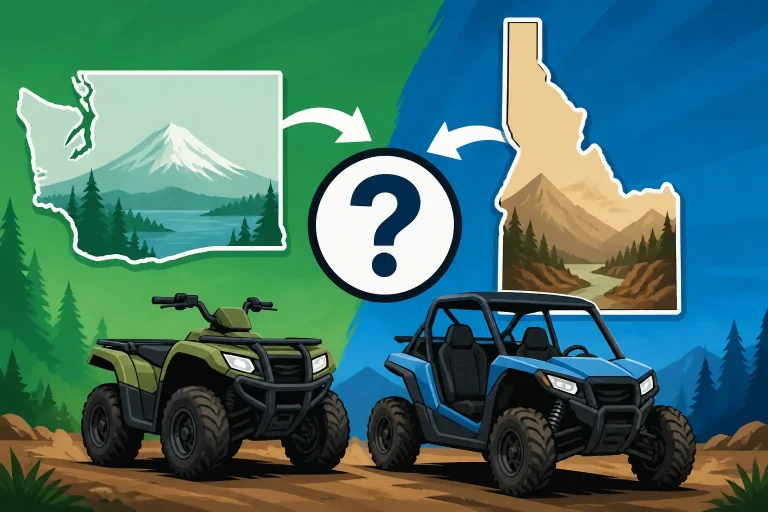
Visitors from neighboring states should be especially careful not to rely on assumptions based on proximity. A credential that works across a state line for one type of riding may not be accepted for another. For specific questions, see Does Washington Honor an Oregon ORV Permit? and Does Washington Honor an Idaho Sticker?. The answer depends on the actual credential and applicable rules, not simply on where it was issued.
If the credential is not accepted, or you cannot establish that it qualifies, do not ride on the assumption that the decal is close enough. Find out whether you need a Washington permit before heading to the trailhead. Some registration and permit transactions may require information about the machine, so having the VIN and ownership documents available can save a second trip.
When a visitor may need a Washington permit
A visitor may need a Washington temporary ORV use permit if the machine does not have a current home-state registration that Washington recognizes, or if the visitor’s home state does not provide the kind of registration needed for reciprocity. The specific answer depends on the vehicle, the credential and the rules in effect for the planned use. Check with the appropriate Washington licensing source before riding.
A temporary permit is not a shortcut around every requirement. It addresses the registration question for eligible off-road use; it does not authorize travel on public roads, override trail closures or replace any separate site-access pass. The permit also applies to the machine identified by the transaction, so confirm whether each machine in your group needs its own coverage. For the visitor-focused process, see [Washington Temporary ORV Permit for a Visitor].
If you arrive without accepted registration and without the required Washington permit, the practical result may be that you cannot legally ride the machine in a place where registration is required. Do not count on being able to fix the issue at the staging area. A registration counter, permit seller or reliable phone service may not be available when you arrive.
A simple decision process
Use this sequence before loading the machine:
- Identify the credential. Is it a current ORV registration, a site-specific trail pass, a road registration or another kind of document?
- Confirm it covers the machine. Compare the paperwork with the vehicle’s identifying information and make sure the decal belongs to that machine.
- Check Washington recognition. Confirm that the credential qualifies for reciprocity rather than assuming that any out-of-state sticker is accepted.
- Check the destination. Look up the land manager’s registration, pass, route and closure requirements for the specific riding area.
- Get a Washington permit if needed. If the home-state document does not qualify, confirm the correct permit and purchase it before riding.
- Keep proof with you. Carry the registration and permit documentation while the machine is in use.
This order prevents a common mix-up: buying an access pass when the missing item is registration, or obtaining registration and assuming it includes access to a particular recreation site. What a Visitor With No Home-State Registration Buys discusses the situation where a visitor has no qualifying home-state credential.
Keep a temporary permit with its machine
Permits and registrations are generally associated with a particular vehicle, not with a person’s entire group. Do not plan to move a permit between machines unless the issuing rules explicitly allow it. If friends are sharing a trailer, make a list of the machines, their VINs, and the registration or permit associated with each one.
This is also why it is useful to handle paperwork before the trip. If the wrong machine information is entered or a permit is purchased for only one vehicle, correcting the problem after arrival may be difficult. See Why a Temporary Permit Stays With One Machine for more on why a permit should be treated as vehicle-specific.
Visitors should also check the permit’s permitted uses and validity period directly with the issuing source. Avoid relying on an old receipt, a friend’s past trip or an outdated description online. Rules and transaction details can change, and a permit that was suitable for a previous visit may not fit a new trip or machine.
Off-road reciprocity does not give road permission
The most important boundary is between off-road use and riding on a road. Reciprocity for off-road registration does not, by itself, make an ATV or UTV street legal in Washington. It does not authorize a rider to use a city street, county road or state highway simply because the machine is registered at home or carries a Washington temporary ORV permit.
Washington has separate requirements for eligible wheeled all-terrain vehicles to use certain roads. Those requirements can involve the machine’s equipment and classification, the rider, the road itself and local authorization. Even a machine that qualifies for road use cannot travel on every road. The relevant city or county must allow use on the route, and state-highway use is subject to its own restrictions.
Before planning a pavement connection, check Washington Road Reciprocity and Its Conditions. Also review Washington Rules for Getting Across a Road if your route crosses a road rather than riding along it. A legal crossing and riding down the road are different activities.
Do not treat an out-of-state road plate as a Washington road tab
A machine may have some form of road registration in its home state, but that does not necessarily establish that it meets Washington’s requirements for on-road WATV use. Conversely, off-road registration reciprocity does not create road privileges. Confirm the machine’s classification and road-use status with the appropriate Washington authority before using pavement.
For road riding, make sure the route is actually open to the vehicle. Local rules can differ between nearby communities, and a road that appears suitable on a map may be closed to ORVs. The Washington Road Use Declaration information is relevant to Washington on-road registration requirements, but a declaration or tab does not erase local route restrictions.
A temporary ORV permit should be treated as off-road authorization only unless its terms clearly say otherwise. Do not use it as a substitute for the registration, equipment or local permissions needed for road use. See Why a Temporary Permit Keeps You Off Pavement for this distinction.
Other rules still apply on the trail
Reciprocity settles only one part of the trip. Riders still need to follow the rules for the land and route, including closures, speed limits, noise restrictions, trail direction, vehicle-width limits and any rider age or supervision requirements. Equipment rules can also apply even when a machine is properly registered.
Federal, state and local lands may have different access rules, and recreation fees are not interchangeable. A site may require a pass for parking or access even though the machine has accepted registration. For land-specific considerations, see Washington Rules for Riding Federal Land.
Before leaving, check current alerts from the agency that manages the riding area. Seasonal closures, fire restrictions, active work and damage to a trail can change what is open. If the site’s requirements are unclear, contact the land manager with the name of the area and the machine type. A little confirmation at home is much easier than discovering at the gate that the vehicle lacks the right credential or the trail is closed.
Frequently Asked Questions
Does a Washington temporary ORV permit let me ride on roads?
No. A temporary ORV use permit addresses off-road registration needs; it does not, by itself, authorize street or highway use. Road access has separate vehicle, rider and route requirements.
Is an out-of-state decal enough to prove reciprocity?
Not always. The decal should correspond to a current credential that Washington recognizes for the machine. Carry the registration paperwork and confirm that the document is an ORV registration rather than a site-specific pass.
Does reciprocity include a recreation or parking pass?
No. Registration reciprocity and land-access passes serve different purposes. Check whether the riding area requires an additional pass or permit.
Can one permit cover several machines?
Do not assume so. Permits are commonly tied to a specific machine. Check the issuing rules and make sure each vehicle in your group has the required registration or permit.
Disclaimer
This article is for general informational purposes only and does not constitute professional advice. Laws, prices and regulations vary by location and change over time. Consult a qualified professional for guidance on your specific situation.