Washington Sound Limits for ORVs
A loud ATV or UTV can draw attention at a trailhead, but sound rules are more than a matter of courtesy: an exhaust that exceeds the applicable limit can keep you from riding or lead to enforcement. Washington riders need to know what the common state-land limit means, how sound checks work, and why a machine that passes one check may still face rules elsewhere.
The sound limit Washington riders should know
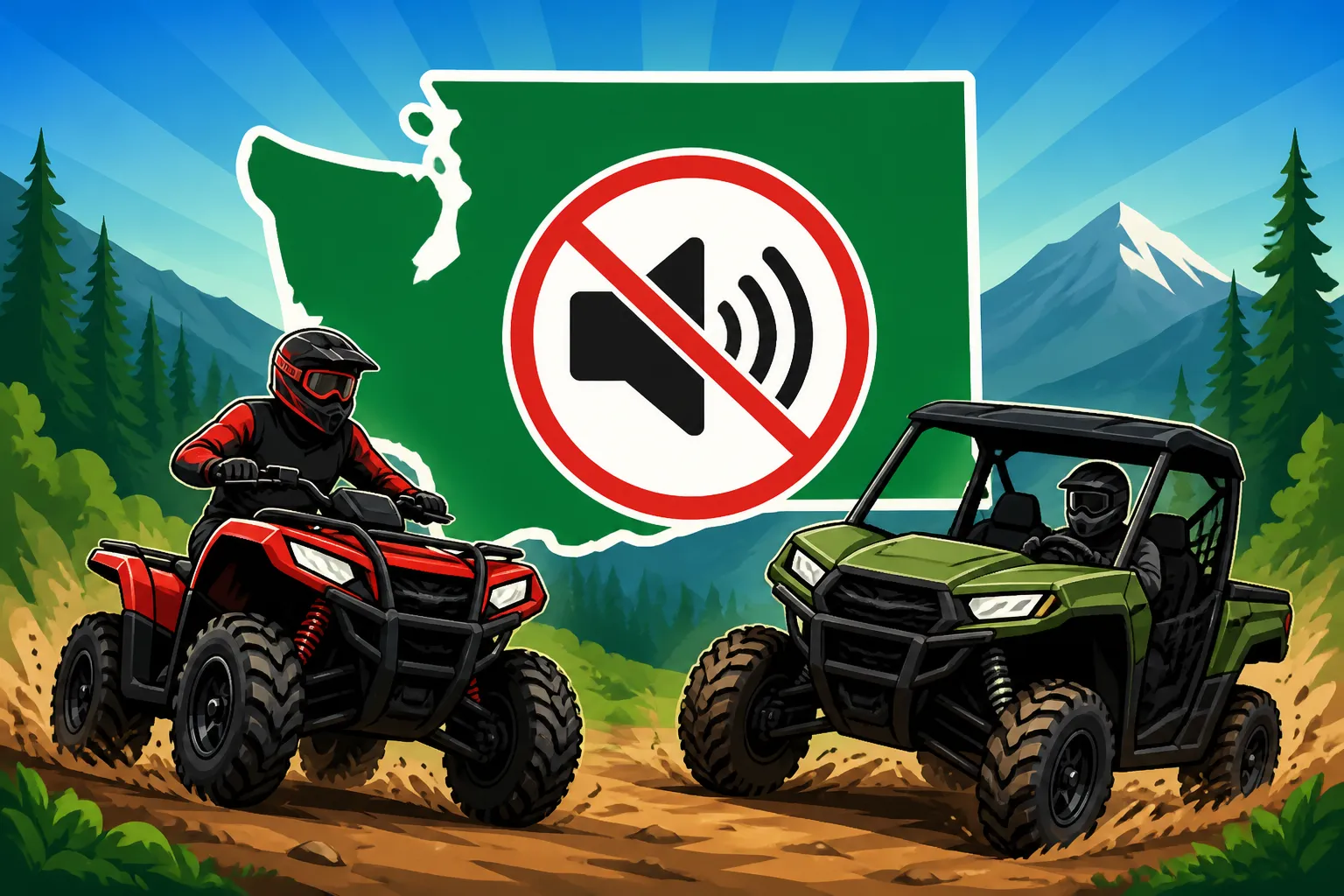
Washington ORVs are commonly subject to a maximum sound level of 96 dBA on public riding areas where that standard applies. The limit is measured using a prescribed test, not by guessing how loud the machine sounds from the seat. The test controls factors such as meter placement and engine speed, so a reading taken with a phone app or an ordinary meter at a different distance is not a reliable compliance check.
The 96 dBA figure is useful when preparing a machine for Washington trails, but it should not be treated as a blanket rule that answers every question everywhere. The applicable requirement can depend on who manages the land, where you are riding, and whether the machine is being used off-road or on a road. A land manager or local authority may have additional requirements.
For example, a machine that meets a public-land ORV sound standard still needs to comply with other equipment rules and any access restrictions for the specific route. Riding on an approved public road may involve requirements beyond the sound limit. See Washington Muffler Requirements for an ORV for the separate rules on having a functioning muffler, and What Washington Requires for On-Road ORV Use for the broader requirements that apply when a WATV is used on roads.
| Question | Practical answer |
|---|---|
| What sound limit is commonly used for Washington ORVs? | 96 dBA on public riding areas where that standard applies |
| Can a phone app confirm that a machine passes? | No. It can give a rough indication, but it is not a substitute for the prescribed test |
| Does a quiet-sounding machine automatically pass? | No. Sound level is measured using a controlled procedure |
| Does passing a sound check guarantee access? | No. Other equipment, land-access and route rules still apply |
| Should you check before riding? | Yes. Confirm the current requirements with the land manager for your riding area |
Sound is usually measured in decibels using an A-weighted scale, shown as dBA. The scale is logarithmic, so a small numerical difference is not necessarily a small change in perceived sound. The test result also depends on using the correct procedure. A meter held too far from the exhaust, pointed the wrong way, or used while the engine is at the wrong speed can produce a reading that does not show whether the machine meets the official standard.
That is why the limit is best understood as a testable equipment requirement, not a subjective rule about whether your ATV “seems loud.” A machine can sound moderate to its rider and still fail a properly conducted test. Conversely, a loud impression from nearby does not prove that the machine exceeds the limit.
How sound checks work and what to expect
A sound check is intended to measure the machine consistently. The tester uses a sound meter at a specified position and checks the engine under prescribed conditions. The exact procedure matters: distance, angle, engine speed, background noise and other test details can affect the result. Follow the instructions of the person conducting the check rather than trying to reproduce it from memory.
Some Washington riding areas may conduct sound checks at or near staging areas. A check may be part of an effort to keep machines within the applicable limit and reduce noise impacts for riders, nearby residents and other land users. The procedure and enforcement approach can vary by site. For an overview of what a check at a DNR staging lot may involve, see How a DNR Staging Lot Sound Check Works.
If your machine is tested, keep the area around it quiet and follow directions. Avoid revving the engine before or during the test unless asked. If the tester says the reading is too high, ask what procedure was used and whether you can make an adjustment and have the machine retested. Do not assume that arguing from a phone reading or a different test setup will resolve the issue.
A consumer sound meter can help identify a possible problem, but it is not a compliance certificate. Low-cost meters sold through retailers, including Amazon, may be useful for rough comparisons when used consistently. They may not have the accuracy, calibration or setup needed for an official decision. A phone app is even less dependable for this purpose because microphones and software vary between devices.
Use an informal reading as a screening tool only. If the result is close to the limit, treat that as a reason to get a proper test, not as proof that the machine passes. If you ride in more than one jurisdiction, confirm which standard and procedure apply at each location.
Sound is also only one part of an equipment check. A compliant muffler must be present and working properly; an exhaust leak, damaged packing, loose connection or altered system can increase noise. Public-land requirements may also include a spark arrester. Review Spark Arresters on Washington Trails separately, because a spark arrester and a muffler address different risks and one does not replace the other.
Getting an ATV or UTV ready to pass
The most useful preparation is to keep the exhaust system in sound working order and avoid modifications that increase noise. Before a trip, check the machine rather than waiting for a trailhead test to reveal a problem.
- Inspect the muffler and exhaust. Look for cracks, loose joints, missing fasteners, damaged baffles or signs that exhaust is escaping before it reaches the outlet.
- Check for worn or altered components. A muffler that has lost internal packing, been modified or is not designed for the machine may be louder than expected.
- Listen for a new change. A sudden increase in sound can point to a leak or a failed component. Do not dismiss it as normal until you have inspected the system.
- Use parts suited to the machine. Confirm that any replacement muffler or exhaust component fits the make, model and year and does not remove required noise-control features.
- Arrange a proper test if you are uncertain. This is especially sensible after exhaust work, after a machine has become noticeably louder, or before a trip to an area that checks sound.
A quieter aftermarket component is not automatically legal, and an exhaust that fits physically is not necessarily suitable for a particular machine. Check the manufacturer’s specifications and the rules for the land where you plan to ride. Avoid removing or bypassing sound-control parts to gain performance; that can make the machine fail a check and may violate equipment rules.
Do not confuse sound compliance with a general right to ride. A machine can pass a sound test and still be barred from a route because the land manager has not opened it to ORVs, a gate is closed, or the route has other restrictions. For public-land access and operating rules, see Washington Rules for Riding DNR Land and Washington Rules for Riding Federal Land. Check current notices for closures before hauling out.
If a machine fails a check, do not try to evade the requirement by riding away before the issue is addressed. Ask the tester or site staff what options are available. Depending on the location and the circumstances, you may need to repair the exhaust, use a different machine, or leave the area. The consequences and procedures are not necessarily identical at every site.
Sound rules are part of responsible riding
Noise affects more than the rider and the people nearby. It can carry along a forest road, into a campground, or across a boundary between public and private land. A machine that is unnecessarily loud can make it harder for residents and other visitors to accept continued ORV access. Keeping equipment in good condition helps protect that access and makes a ride more pleasant for others.
Good riding habits help, too. Avoid unnecessary high revving in parking areas, near campsites and around homes. Move through staging areas at a controlled pace, and do not use the throttle to make noise when the machine is stationary. These habits do not replace a legal sound test, but they reduce disturbance and make shared riding areas easier to use.
Remember that the same machine may encounter different rules during a single trip. A trail, a forest road, a county route and a private timber road can each have different access conditions. The route being physically open does not automatically mean it is open to your machine. Before heading out, check the land manager’s current rules, sound-check procedures and closures. For broader route-planning help, Washington Rules for Riding a Forest Road explains why access can depend on the road and who manages it.
The practical approach is straightforward: keep the muffler and exhaust intact, treat 96 dBA as an important benchmark where the applicable Washington standard uses it, and confirm the current requirement for your destination. A sound meter at home can alert you to a possible issue, but only the proper test and the applicable local rules determine whether your machine is acceptable for that ride.
Disclaimer
This article is for general informational purposes only and does not constitute professional advice. Laws, prices and regulations vary by location and change over time. Consult a qualified professional for guidance on your specific situation.