Washington Rules for Riding During Fire Season
Fire season does not automatically mean every Washington ATV and UTV trail is closed, but it can bring restrictions that change quickly with weather and fire danger. The hard part is knowing which notice applies to your riding area and what to do if conditions worsen. Here’s how to check access, reduce fire risk, and avoid riding into a closure.
Fire season is not one statewide riding ban
“Fire season” describes a period of elevated wildfire risk, not a single rule that closes every trail in Washington. Whether you can ride depends on the land, the current conditions, and any restrictions issued by the agency or landowner responsible for that area.
A riding area may remain open while campfires are prohibited. Another may limit vehicle access or close a specific trail, road, or staging area. A full area closure can also be issued when conditions or nearby fire activity make public access unsafe. These restrictions can differ between nearby properties because they may be managed by different agencies.
That distinction matters: a fire restriction on one activity does not necessarily prohibit all riding, but an explicit road, trail, or area closure does. Don’t assume that a gate being open, an old map showing a route, or a friend’s recent ride means the route is currently available. Check the current notice for the exact location and activity. Washington Fire Restrictions That Close Trails explains how fire-related restrictions can affect access.
| Notice or condition | What it may mean for your ride | What to check |
|---|---|---|
| Campfire restriction | Fires may be prohibited even if riding remains allowed | Whether the notice applies to the land or campground you plan to use |
| Trail or road closure | The named route is off limits, even if nearby routes remain open | Closure boundaries, dates, and any alternate routes |
| Area closure | Access to a broader riding area may be prohibited | The full closure map and current reopening notice |
| High fire danger without a closure | Riding may still be permitted, but conditions call for extra caution | Current alerts, equipment rules, and local restrictions |
| Active wildfire or smoke | Access, visibility, and escape routes can change quickly | Emergency notices and instructions from responders |
Restrictions can be issued or updated by the land manager, fire authority, or private landowner, depending on who controls the location. A state forest, national forest, county road, and private timber road may not share the same rules or alert system. For land-specific access basics, see Washington Rules for Riding DNR Land and Washington Rules for Riding a National Forest.
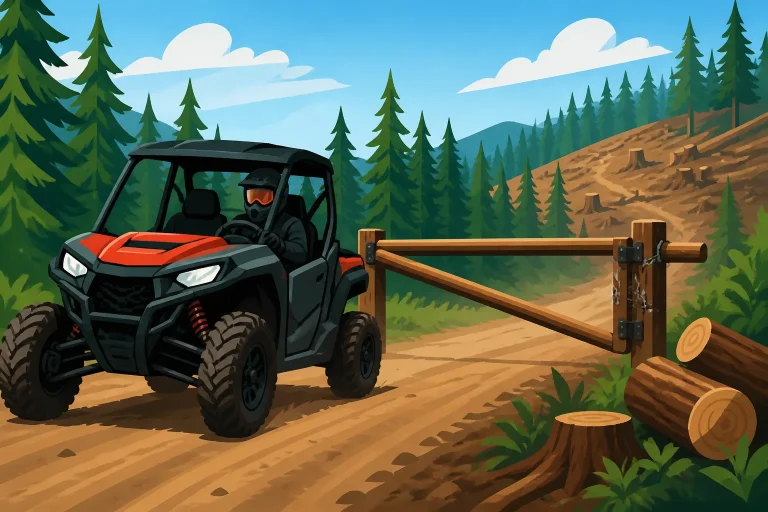
A closure notice also applies even if the route looks safe to you. Fire crews may need roads clear, hazards may be hidden beyond the visible area, or a closure may protect people from changing wind and smoke. Stay outside marked boundaries and don’t ride around a gate or barrier. If you’re unsure whether a road or trail is included, treat the notice as a reason to pause and confirm before entering. Reading a Closure Notice Posted at a Gate covers what to look for.
Check the exact riding area before leaving
A reliable pre-ride check starts with the managing agency or landowner for your specific destination. Search for current closure and fire-restriction notices, then compare them with the route you intend to ride. A broad search result or an old social media post may not reflect a change made that morning.
Use this process before loading the machine:
- Identify who manages the area. The rules may come from a state, federal, county, or private land manager. If your route crosses more than one property, check each one.
- Look for current alerts and maps. Read the text as well as the map. A notice may close a specific road, trail, campground, or access point rather than the entire riding area.
- Check the effective details. Confirm which places and activities are covered and whether the notice has an end date or a reopening condition. Don’t assume a closure has ended simply because the date has passed; look for an updated notice.
- Check again on the day of the ride. Conditions can change after you plan your trip. Checking Alerts Before You Load Up is useful when you need a last check before driving out.
- Have a backup plan. Choose another area only after checking its own status. A nearby trail system may be under a different restriction, or it may be closed for a separate reason.
A fire restriction and a riding closure are not interchangeable. For example, a ban on campfires may leave motorized routes open, but a notice that closes a trail or road means you cannot use that route. Read the words of the notice rather than relying on a headline or a general “open” status for the larger recreation area.
Also consider the journey to the trailhead. If smoke, fire activity, or an evacuation notice affects the approach road, do not treat the trail’s open status as permission to drive through a hazardous or restricted area. Follow official directions, and don’t enter a closed road to reach an open trail.
If the area becomes smoky or you see signs of a nearby fire after arrival, stop and assess whether you can leave safely. Smoke can obscure turns and other vehicles, and changing wind can make a route that was clear on arrival unsafe later. Follow instructions from emergency personnel. Do not block access roads or staging areas that may be needed by responders.
Prepare the machine and ride to limit ignition risk
Even where riding remains open, dry vegetation and hot machine components create avoidable risks. Start with the equipment required by the land manager, then add sensible precautions for dry conditions. Requirements can vary by location, so confirm the current rules rather than assuming every riding area has the same standards.
Check that the machine is in good condition before the trip. Pay particular attention to the exhaust and any required spark arrester. The arrester should be present, correctly fitted, and maintained; a damaged or modified component may not do its job. Rules can depend on where you ride, so review the applicable requirements in Washington Spark Arrester Requirement. A compliant arrester is not a substitute for obeying a closure or other fire restriction.
Inspect the underside and areas around the exhaust for dry grass, leaves, mud, or other material that could accumulate near hot parts. Clear debris before riding and during breaks. Check for damaged wiring, leaking fuel, and other mechanical problems that could create additional risk. Follow the manufacturer’s maintenance instructions, especially if the machine has recently been through deep grass, brush, or rough terrain.
While riding, stay on routes that are open and designated for your machine. Do not cut across dry grass, ride through brush, or use an unmarked shortcut to avoid a closure. These detours can damage land, violate access rules, and put hot components in contact with vegetation. Avoid spinning tires in dry plant matter, and be cautious about stopping in tall grass. When you park, choose a clear, stable surface away from dry vegetation if one is available.
A fire extinguisher suitable for the machine and its likely risks can be a practical safety item, but carrying one does not make riding through a closure acceptable. Secure equipment so it cannot fall off or interfere with the machine. Know where it is and how to use it before you need it. You can also carry a charged phone or another reliable way to contact help, but don’t depend on cell coverage in remote areas.
Fuel needs extra care. Use approved containers, secure them properly, and keep them away from heat and sparks. Avoid spills, and clean any spill before operating the machine. Don’t store fuel in a place where it can move, leak, or contact hot components. Check the land manager’s rules before carrying or storing fuel at a trailhead or campsite; [Washington Rules for Carrying Fuel] provides more detail.
Other good habits are straightforward:
- Keep the muffler and exhaust system in working order. A noisy or damaged exhaust is a mechanical issue and may also breach local sound rules. See Washington Sound Limits for ORVs.
- Avoid parking over dry grass or brush, particularly near the exhaust.
- Don’t smoke or discard cigarette materials in dry vegetation.
- Don’t burn trash or use a camp stove where a restriction prohibits it.
- Keep your group together enough to share closure or emergency information, but leave room for other trail users and emergency vehicles.
- Carry out food wrappers, cigarette waste, and other rubbish.
Campfire rules deserve special attention because they can change independently of trail access. A campground may be open while fires are prohibited, or a restriction may apply only to particular types of flame or equipment. Read the current notice for the place you plan to stop, and follow it even if other riders are using a fire. For the details of that separate activity, see [Washington Rules for Campfires at a Trailhead].
If you encounter a fire, smoke, or a new closure
If you see a fire, smoke that appears to be growing, or a new barrier or closure notice, don’t ride closer to investigate. Move away from the hazard if you can do so safely, follow posted directions, and contact emergency services if there is an immediate threat or a fire has not been reported. Share your location as clearly as possible. In remote terrain, a road name, trail marker, staging area, or map location can help responders understand where you are.
Do not try to fight a wildfire. A small ignition can spread quickly, and wind or changing conditions can cut off an exit. Your priority is to get yourself and your group to safety and avoid obstructing responders. If emergency personnel direct you to leave or use a particular route, follow their instructions.
When a trail or road is newly closed, turn around and use a legal, open route out if one is available. Do not cross a tape line, remove a barrier, or ride around a locked gate. If the route you came in on is unsafe or blocked, follow emergency directions rather than improvising a way through the closure. If you have to wait, move to a safe location that does not block traffic or emergency access.
After the ride, report any machine problem that may have caused a leak or ignition concern, and clean the machine before taking it to another riding area. Grass, seeds, and mud can collect in places that are easy to miss. A careful post-ride inspection helps you spot damage before the next trip.
The practical rule is simple: check the notice for the land you’ll use, obey any closure exactly, and treat dry conditions as a reason to ride conservatively even when access remains open. A few minutes spent confirming conditions can prevent a wasted trip—and help keep an open riding area from becoming a source of fire.
Disclaimer
This article is for general informational purposes only and does not constitute professional advice. Laws, prices and regulations vary by location and change over time. Consult a qualified professional for guidance on your specific situation.