Riding Past a Timber Sale Gate
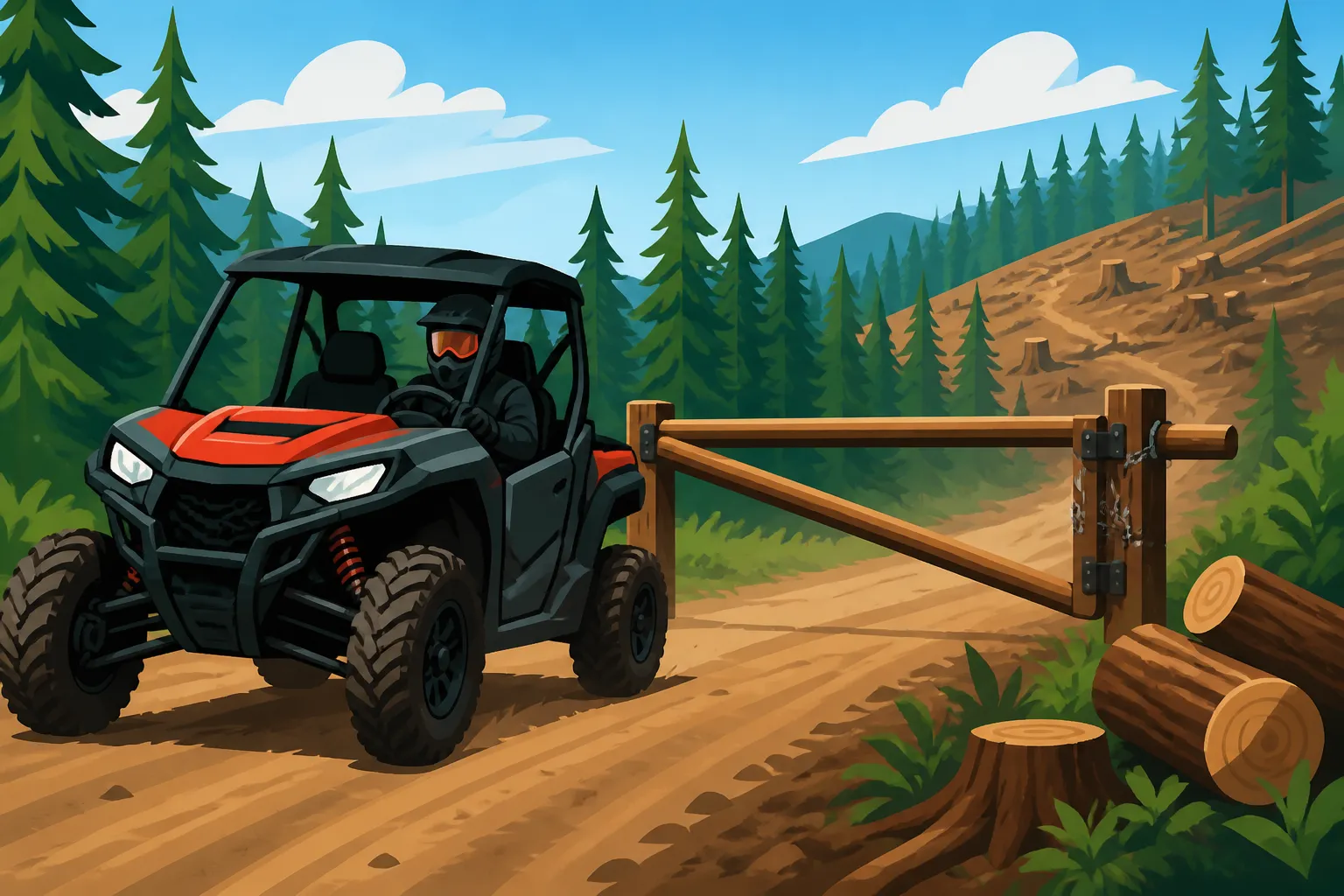
A timber sale gate can look like a temporary obstacle on a familiar Washington forest road. But it may mark an active work area, a public closure or private land where your riding permission does not apply. Before you approach or reroute around it, figure out who controls the road, what the closure covers and how to reach a legal alternative.
Treat a timber sale gate as a real closure
A gate at a timber sale is not just a barrier to navigate around. It may protect riders from logging trucks, falling trees, equipment, unstable road surfaces or work happening out of sight. Even if the road looks quiet, the activity may be farther along the route or scheduled to resume while you are riding.
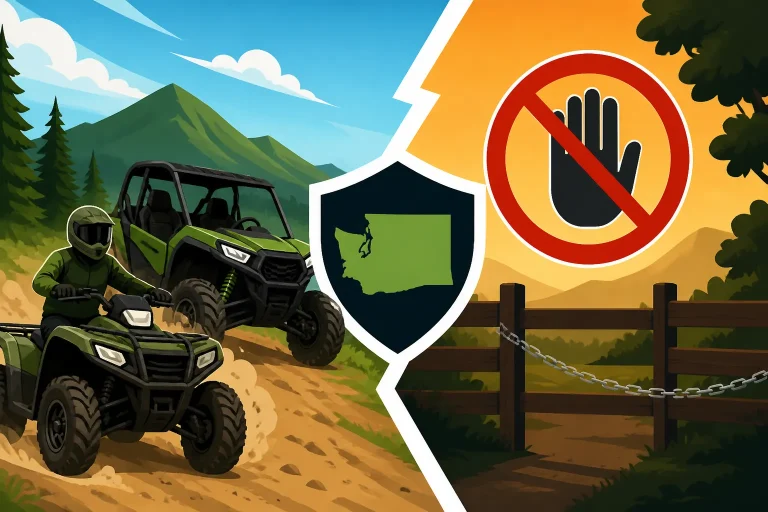
The safest practical rule is simple: if a gate is closed or a notice says the road is closed, stop and do not go around it. That means not riding around the hinge, squeezing beside the barrier, following another machine through, or using a nearby spur to rejoin the road beyond the closure. A route that appears open on an old map may still be closed today.
A closed gate does not always tell you who owns or manages the road. It could be on state-managed land, private timberland, or a road that crosses more than one kind of property. Nor does a familiar trail connection mean that access continues through a work zone. The relevant question is not only whether the road is usually open, but whether you are authorized to use that specific section under current conditions.
| What you see | What it may mean | Sensible response |
|---|---|---|
| Closed gate with a timber-sale or work notice | A temporary closure or restriction for logging activity | Stop, read the notice from a safe location and use another route |
| Closed gate with no clear sign | The reason and responsible manager may not be obvious | Do not assume it is okay to pass; seek current information |
| Open gate with trucks or active work nearby | Access may still be restricted or hazardous | Keep clear and follow posted instructions |
| A route shown open on an older map | The map may not reflect a current closure | Confirm before riding; do not treat the map as permission to pass |
| A bypass track around a barrier | It may be unauthorized, unsafe or outside the designated route | Do not use it unless the land manager expressly identifies it as an open route |
A timber sale closure can be different from a permanent no-entry sign. It may apply only during active hauling or a specified work period, and it may be lifted once work ends. But riders should not decide for themselves that the work is finished based on an empty road, a quiet worksite or the absence of a truck at the gate. Closures can be in effect even when activity is intermittent.
For the broader rule on barriers and closed routes, see Washington Rules for Riding a Closed Road. If a road is closed for hauling, the hazards and access issues are discussed in Why a Forest Road Closes During Active Hauling. Those distinctions matter: a road that is physically passable is not automatically open for recreation.
Check who controls the road and what permission covers
Washington riding access depends on the land and road manager, as well as any current closure. A public recreation map, a trail sign or a past ride may help you understand the area, but none of those alone guarantees that a particular road is open now.
On state-managed land, start with current notices from the relevant land manager. If the road is on Washington Department of Natural Resources land, use current DNR recreation information and closure notices rather than relying only on a saved map. Learn the general access framework in Washington Rules for Riding DNR Land. A timber sale, fire restriction, maintenance project or other temporary condition may change access even where riding is generally allowed.
Private timberland calls for separate care. Permission to ride on a company’s land is not the same as permission to pass through every gate or enter every active work area. If you have an access permit, check its terms and any current restrictions. If the permit or landowner’s instructions do not clearly cover the route past the gate, do not treat general permission as an exception to a closure. Washington Rules for Riding Private Timberland explains why access on working private land can depend on specific permission and conditions.
A gate may also mark a boundary or control access to a road that crosses different ownerships. Do not assume that a road is public because it connects two public-looking routes, has tire tracks, or appears on a map. For background on the risks of entering land without permission, see Washington Trespass Law and Off-Road Riders.
When you can safely read a sign from outside the closed area, look for:
- The name of the agency, company or land manager responsible for the closure.
- The road or area covered by the notice.
- Whether the restriction is a full closure, a time-based restriction or a warning to yield to work vehicles.
- The closure dates or conditions, if provided.
- Contact information or directions for checking current status.
Do not cross the gate to get a better look at a sign, and do not stand where a truck could approach unexpectedly. If the notice is missing, unreadable or ambiguous, uncertainty is a reason to pause, not permission to proceed.
If a timber company has issued you a key or access instructions, that does not necessarily mean every gated road is open. Confirm exactly which gate and route the permission covers, and whether it remains valid during the sale. A key opens a barrier; it does not by itself establish that you have permission to ride beyond it. For more on that distinction, see Getting a Gate Key From a Timber Company.
What to do when you reach the gate
A calm, predictable response protects you and makes it easier to sort out the route without entering a hazardous work area.
- Stop before the barrier. Leave enough room for other riders or vehicles to stop safely. Do not block the road or stand in a place where equipment may need to pass.
- Read the notice from the safe side. Note who issued it, what route it covers and whether it gives an end date or contact method. Do not cross the barrier to investigate.
- Do not bypass the gate. Avoid riding around it, lifting it, moving signs or taking an informal track that appears to reconnect beyond the closure.
- Check current information. Use the land manager’s current alerts, maps or contact channel. If the notice names a company or agency, contact that party when practical and ask whether the road is open to recreational riding.
- Turn around if status is not clear. Choose a route that is confirmed open, or end the ride. Do not make an exception because the detour is inconvenient or the group is already at the gate.
- Update your route before continuing. Make sure the alternative does not send you onto another closed road, private property or a route that your machine is not allowed to use.
Never move a closure sign or gate to help another rider through. Do not assume that an open gate means recreational access is allowed: a barrier may be open for scheduled work, a landowner or authorized vehicles. Follow posted instructions and keep clear of machinery.
If you encounter active logging, give work vehicles and crews plenty of space. A loaded log truck may need the full road and may not be able to stop quickly. Dust, blind corners, radio-controlled traffic or equipment noise can make it hard for a rider to hear or see approaching vehicles. Even a road that is normally used by ORVs can be unsafe during a work shift.
If the closure starts after you have already entered a road network, do not continue deeper to see whether another exit is available. Turn back where it is safe and use a route you know is open. If turning around would put you in immediate danger, prioritize reaching a safe place without entering the work area, then contact the appropriate manager. That is different from treating the gate as optional.
Plan around closures before you unload
The easiest way to avoid a gate-side decision is to check access before the trip and leave room in your plan for a detour. Forest roads and trail connections can change with timber work, maintenance, weather, fire restrictions or other temporary conditions. A route that worked on your last visit may no longer be available.
Before leaving home:
- Check the managing agency or landowner’s current alerts for the riding area.
- Compare current notices with your map, especially if your route uses a forest road or connects several trail systems.
- Look for closures that affect access roads, not only designated trails.
- Save an alternate route that stays within areas where riding is allowed.
- Confirm any private-land access conditions directly with the landowner or permit issuer.
- Tell everyone in the group that a closed gate means turning around, not improvising a bypass.
An older map is useful for orientation but not for deciding whether a current closure applies. Roads can be closed temporarily, rerouted or affected by a sale that was not underway when the map was produced. Riding a Road Shown Open on an Old Map covers why a mapped route should not be treated as current authorization. For trip planning, Checking Alerts Before You Load Up can help you build a current status check into your routine.
If you use a gate key or have a company permit, keep the written instructions accessible and verify that they apply to the planned route and date. Ask what to do if you arrive during a timber sale or see a new closure notice. Do not assume a prior conversation, past access or permission for one road extends to other roads in the area.
A practical backup plan might be a nearby confirmed-open trail, a shorter loop that avoids the sale area, or a different staging location. If no safe, authorized alternative is available, reschedule. A wasted drive is frustrating; riding into an active work zone can put you, logging crews and other road users at risk.
Disclaimer
This article is for general informational purposes only and does not constitute professional advice. Laws, prices and regulations vary by location and change over time. Consult a qualified professional for guidance on your specific situation.