Riding Past a Closed Gate in Washington
A closed gate can turn a planned Washington ATV or UTV ride into a confusing choice: turn around, find another route, or try to pass through. The safe answer is to treat the closure as a real restriction until you confirm otherwise. This article explains what a gate may mean, how to check access, and what to do if your route is blocked.
What a closed gate means for your ride
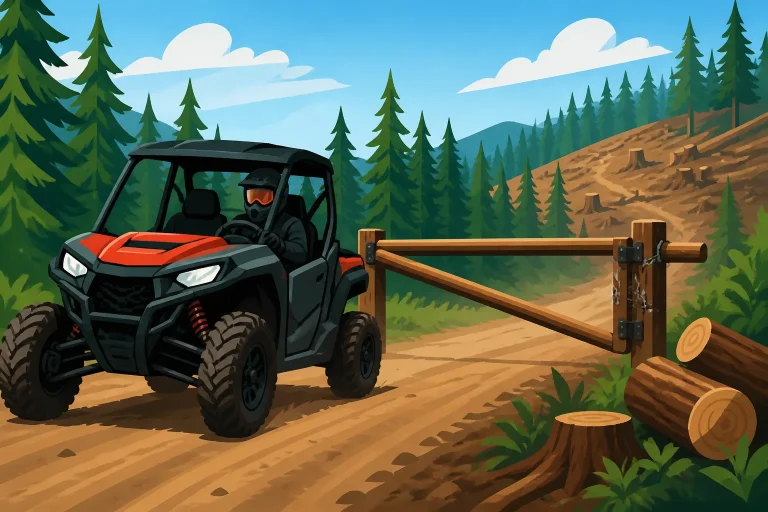
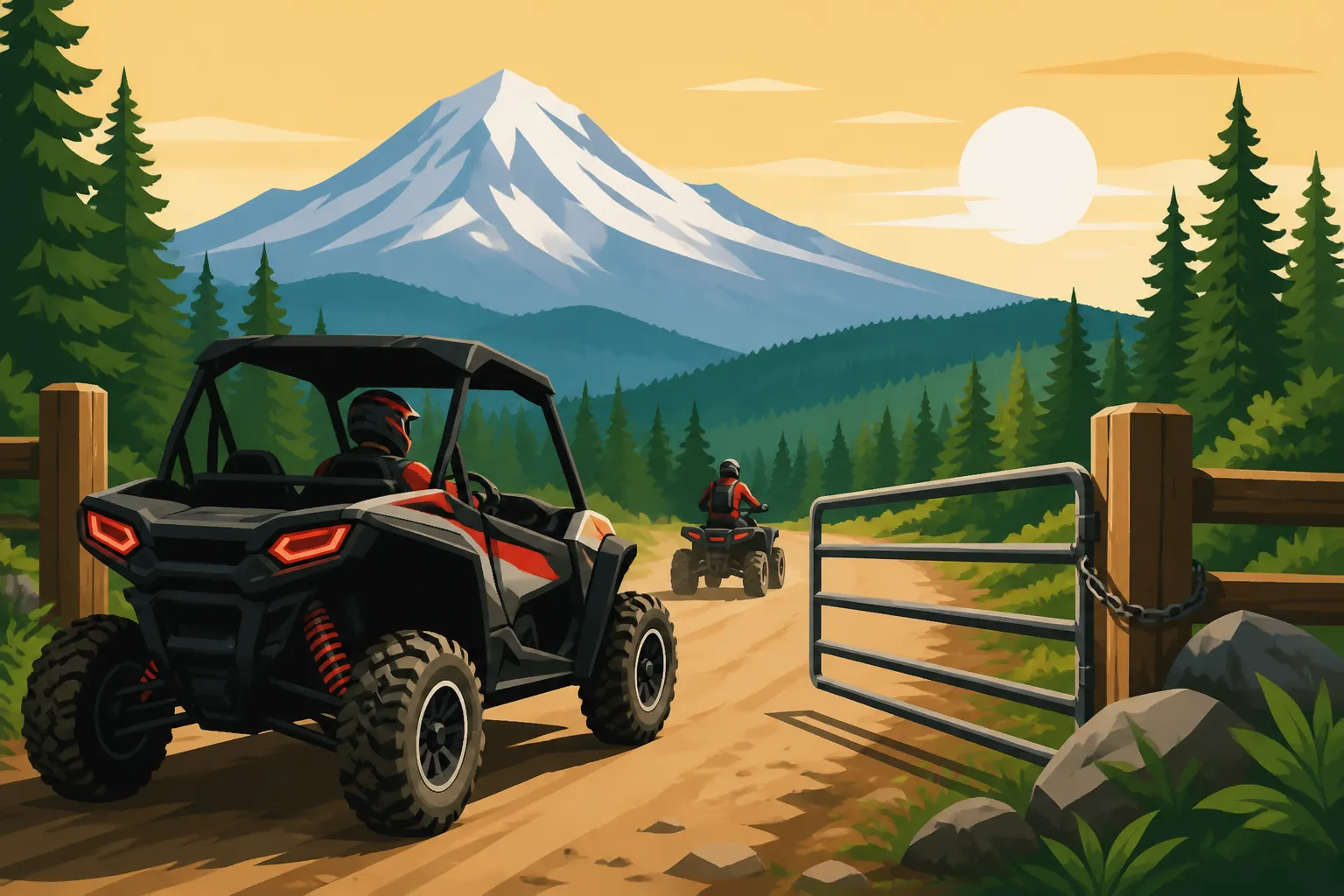
A gate is a physical barrier, but the reason it is closed may not be obvious from the trailhead. It could mark private property, a road closed to motorized use, a temporary work zone, a seasonal restriction, or a route that is open only to people with specific permission. The presence of a trail on a map does not prove it is open today.
The practical rule is simple: do not ride around, over, or through a closed gate unless the land manager or property owner has clearly authorized that route. A machine’s registration, tabs, permit, or recreation pass does not by itself give you permission to cross a closure.
A gate may have signs posted nearby, but not every closure is explained with a detailed notice at the exact point where you encounter it. Look for signs on the gate, fence, road, and nearby trail junctions. If there is no sign, that absence is not a reliable signal that riding through is allowed.
| What you find | What it may indicate | Safer next step |
|---|---|---|
| A gate with a closure sign | A specific restriction, which may be temporary or ongoing | Read the sign and follow its terms; check with the land manager if unclear |
| A locked gate with no sign | Access may still be restricted, or the gate may be closed for operational reasons | Do not bypass it; identify the land manager or property owner |
| A gate marked for authorized users | Access is limited to people with permission or a particular role | Turn back unless you have the stated authorization |
| A gate on private timberland | The road may be controlled by the landowner or operator | Confirm permission directly; public access is not automatic |
| A gate that is open but has a closure notice | The route may still be closed to riding despite the gate’s position | Follow the notice, not the gate position |
| A temporary barricade or work-zone sign | Active work, hauling, hazards, or a short-term closure may be in effect | Keep clear and find another legal route |
For more context on the general restrictions, see Washington Rules for Riding a Closed Road and Washington Trespass Law and Off-Road Riders. Those topics help distinguish a route that is physically accessible from one that is legally open to your machine.
A gate is not an invitation to find a way around
Riding around a gate can damage the road edge, vegetation, or drainage, and it can put you onto land or a route that is closed for a reason. The detour may also cross a ditch, fence, unstable shoulder, or terrain that is unsafe for your machine. A narrow gap may look like a rider-made bypass, but that does not establish that the route is authorized.
Do not assume that a gate is only intended to stop full-size vehicles. If the route is closed, bringing an ATV or UTV around the barrier does not make the ride acceptable. Nor does following tracks from another machine: another rider may have permission, may have made a mistake, or may have entered illegally.
Why gates close, and why the reason matters
A closed gate can reflect a long-term access rule or a short-term safety concern. The distinction matters because a road that is normally open might still be off-limits during timber hauling, fire restrictions, repair work, or a temporary closure. Conversely, a gate may control vehicle access while allowing some other use. Do not infer that an exception for workers, landowners, or another type of visitor applies to recreational riders.
Private property and timberland access
Many forest roads cross land that is privately owned or managed. A road can appear on a map, connect two public routes, or have been accessible on a previous trip without being open to the public now. The owner or operator may close it, change access conditions, or require permission.
When a gate appears to be on private timberland, do not treat a public-road map or a nearby public trail as proof of permission. Check the landowner’s current access information or contact the appropriate operator. Washington Rules for Riding Private Timberland explains why permission matters, and What to Do at a Locked Timber Company Gate covers the practical response when a timber-company gate stops your route.
A permit from one landowner also does not necessarily apply to a different property. If the road crosses several parcels, access may depend on each owner’s rules. Stay on clearly authorized routes and do not assume that an open gate farther down the road means the entire route is public.
Work, weather, fire, and seasonal closures
A gate may be closed because crews are working, heavy trucks are hauling, road conditions have deteriorated, or a fire-related restriction is in place. These closures can change during a season. A road that was passable or open last weekend may be closed on the day of your ride.
Active hauling deserves particular caution. A logging road can be narrow, dusty, steep, and difficult to see around; trucks may have limited room to stop or maneuver. If a gate or notice closes a route during work, do not enter to “just get through.” Use another route and check for current information before returning. Riding Past a Timber Sale Gate and Why a Forest Road Closes During Active Hauling provide more detail on work-related restrictions.
Weather and seasonal conditions can also affect access. A road may be closed to prevent damage to soft ground, protect sensitive areas, or reduce risk during hazardous conditions. A closure notice is not a suggestion to assess the route yourself. Even if the surface looks firm from the gate, the restriction may apply to the whole road or area.
What to do when you reach a closed gate
A blocked route can be frustrating, especially after you have hauled a machine a long way. It is still better to stop and verify access than to risk trespass, a citation, damage, or a dangerous encounter with equipment. Use a practical process:
- Stop before the barrier. Leave room for workers, vehicles, emergency access, and other users. Do not block the gate or pull into a restricted area to read a sign.
- Read all posted notices. Check the gate, posts, nearby junctions, and any closure boards. Look for the route or area covered, the reason, any dates, and instructions about alternate routes.
- Do not bypass the barrier. Avoid riding around the gate, moving a barricade, climbing a fence, or following another rider through. Do not open a gate unless the notice or the responsible party specifically allows it.
- Identify who manages the route. A public agency, private landowner, timber operator, or another entity may control access. If the sign names a contact or directs riders to an official alert page, use that information.
- Check current closure information. A map can help identify the road, but use current alerts or direct confirmation to determine whether it is open. Checking Alerts Before You Load Up is useful when planning around changing closures.
- Turn around and use a known legal route. Do not create a shortcut through an unmarked road, adjoining property, or trail that you have not confirmed is open to motorized use.
- Report a safety issue if appropriate. If a gate is damaged, a sign is unreadable, or a hazard blocks a route, contact the responsible land manager rather than trying to fix or move the barrier yourself.
If you cannot identify who controls the road, treat that uncertainty as a reason to stop, not as permission to continue. A nearby recreation office, land-management contact, or official map may help establish who to ask. Avoid relying only on a social media post, an old map, or another rider’s recollection.
Do not assume your permit or pass overrides a gate
Permits, registrations, and recreation passes serve different purposes. A permit may allow use under certain conditions, while a pass may cover access or parking at a particular recreation site. Neither necessarily opens every road or cancels a posted closure.
Likewise, Washington registration or out-of-state reciprocity does not grant access to a road that is closed or privately controlled. Access permission and vehicle compliance are separate questions: your machine can be properly registered and still be prohibited from entering a particular route.
The same principle applies on public land. A route within a recreation area is not automatically open to every vehicle or every kind of motorized use. Check the specific route, land manager, and current restrictions. For background, see Washington Rules for Riding DNR Land and Washington Rules for Riding Federal Land.
Plan a route that does not depend on passing the gate
The best way to handle an unexpected closure is to plan for one before leaving. Choose a primary route and a realistic alternative, and make sure both are authorized for the type of machine you are riding. A route that is suitable for an ATV may not be suitable for a wide side-by-side, and a road that is open to highway vehicles may have separate restrictions for off-road machines.
Before the trip:
- Check official closure notices and route information close to your departure time.
- Confirm that your planned roads are open to motorized recreation, not merely visible on a map.
- Note where private property, work areas, and seasonal closures may affect the route.
- Carry a map or navigation tool that works where cell service is limited, but do not treat a map’s route line as current access authorization.
- Agree with your group that nobody will split off or bypass a gate to rejoin the route farther ahead.
- Leave enough daylight and fuel to turn around without rushing.
On the ride, keep track of signs and junctions rather than relying on memory alone. A gate may be easy to miss on the way in and difficult to relocate after taking a side road. If the route becomes unclear, stop in a safe place and confirm your position before proceeding.
If you discover that a closure has appeared since you planned the trip, change the plan. Do not try to reason from the gate’s appearance, the number of tire tracks, or how close you are to your destination. A short detour or an early return is usually the least costly choice.
For closures tied to active work, follow directions from authorized staff and keep a safe distance from equipment. Do not argue at the gate or try to negotiate access with a worker who may not be responsible for granting it. Ask the land manager or property owner through the appropriate contact channel.
A closed gate is best treated as a clear point to pause. Find out who controls the route and whether it is open to your machine at that time. If you cannot confirm that access is allowed, turn around and choose a route you know is open. That approach protects your ride, the land, and future access for other riders.
Disclaimer
This article is for general informational purposes only and does not constitute professional advice. Laws, prices and regulations vary by location and change over time. Consult a qualified professional for guidance on your specific situation.