Washington Trespass Law and Off-Road Riders
Off-road riders can cross a boundary without realizing it: a forest road may look public, a gate may be open, or a trail map may be out of date. In Washington, registration and riding permits do not give you permission to use someone else’s land. The safest approach is to confirm who manages the route, whether motorized travel is allowed, and what access conditions apply before you ride.
Why registration and riding permits do not grant land access
Washington’s off-road requirements and land-access rules answer different questions. Registration or tabs identify a machine for the kinds of use they cover. A pass or permit may satisfy a site-specific requirement. Neither one automatically authorizes you to ride across private property, use a closed road, or travel on a trail that does not allow motorized vehicles.
The same distinction applies to visitors. A machine’s home-state registration or Washington permit may help satisfy applicable vehicle requirements, but it does not replace permission from a landowner or land manager. For more on what an out-of-state permit can and cannot do, see Washington ORV Reciprocity Rules.
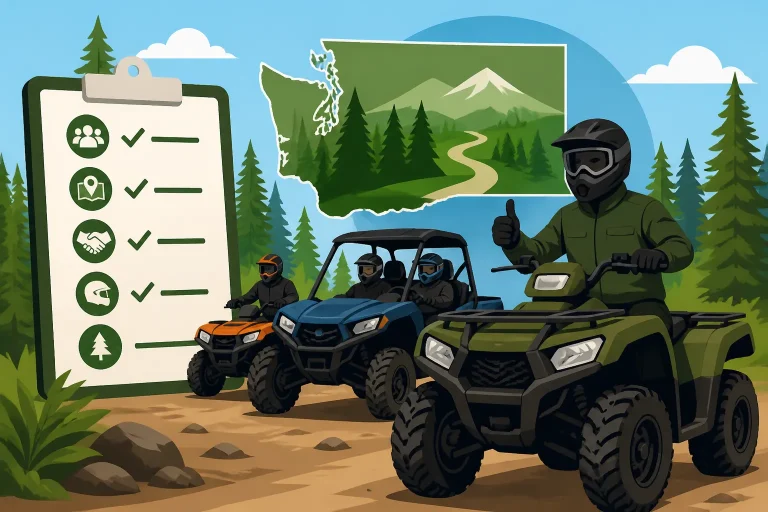
Before a ride, think of access as a separate checklist:
- Is motorized travel allowed here? A trail open to hikers, cyclists, or horses may still prohibit ATVs and UTVs.
- Is this route open now? Seasonal restrictions, maintenance, fire conditions, timber work, or other closures can change access.
- Who manages the route? A public-looking road might cross private land, tribal land, or land with its own access conditions.
- Do you have the required permission or pass? A landowner’s permission and a recreation pass serve different purposes.
A useful way to avoid confusion is to treat each route as a permission question, not just a navigation question. A map shows where a road or trail may be; it does not necessarily show whether your machine may use it today.
| Situation | What you should confirm | What does not settle access by itself |
|---|---|---|
| Riding a designated public trail | The route is open to your type of machine and there is no current closure | Having tabs or a registration card |
| Using a forest road | The managing agency allows motorized use on that road | Seeing tire tracks or finding the road on an old map |
| Crossing private timberland | The owner or authorized manager allows your ride and any conditions are met | An open gate or a public-road connection |
| Riding on trust land | The applicable access permission and land rules cover your activity | A general ORV registration or a pass for another site |
| Visiting from another state | Your machine meets applicable Washington requirements and the route is open to you | A home-state sticker alone |
A Discover Pass, forest pass, or other access pass may be required at a specific trailhead or recreation site. That requirement does not necessarily mean every road nearby is open to ORVs. Likewise, a route may be open to riding while parking at its staging area requires a pass. Check both the riding rules and the parking or site-access rules.
How trespass risk arises on roads, trails, and private land
Trespass problems often start with reasonable assumptions that turn out to be wrong: “The gate was open,” “There were tracks,” or “The map showed a road.” Those clues do not reliably establish permission. A landowner may allow logging traffic or other authorized users while restricting recreational riding. A road may also be open to travel by one type of vehicle but closed to ORVs.
Washington trespass law generally concerns entering or remaining on property without authorization, including after being told to leave. How a particular situation is treated depends on the facts and the applicable law. Do not assume that a lack of a fence, a missing sign, or an unlocked gate means you have permission. Signs, barriers, direct instructions, and other notices may all matter; the safest response to a clear restriction is not to enter.
Public roads and private roads are not interchangeable
A paved road or county route can lead to a private road without making the private road public. The same is true of a forest road that crosses a patchwork of public and private parcels. Check the route itself, not merely the road that gets you to it.
If a road is posted closed to ORVs, do not ride it just because it appears on a map or connects two open areas. For more on that distinction, see Washington Rules for Riding a Closed Road. A road may also be closed for a temporary reason, such as active hauling, maintenance, or a safety concern.
Private timberland requires particular care
Private timberland can look like public forest, and access policies can change with operations, safety concerns, or ownership. Permission may be limited to certain roads, dates, activities, or users. A general invitation to use one area does not necessarily authorize travel across the property to reach another.
If you are riding on private timberland, confirm the exact access conditions with the landowner or the person authorized to manage access. Ask whether ORVs are allowed, which routes you can use, whether a key or permit is required, and whether any gates must remain closed. The details in Washington Rules for Riding Private Timberland can help you think through the landowner-permission side of the question.
Trust land, tribal land, and other managed areas have their own rules
“Public land” is not one single access category. State agencies, federal land managers, tribal governments, and private owners can set different rules. A route that is legal on one side of a boundary may be prohibited on the other.
For example, state trust land has its own access rules and may require permission beyond ordinary vehicle registration. See Washington Trust Land and Its Own Rules. Tribal roads and lands are not automatically open to recreational ORV use simply because they connect to a public route. Follow the rules posted by the relevant authority and do not treat a route as public unless access is clearly authorized.
On state-managed land, confirm both the route designation and any current closures. Washington Rules for Riding DNR Land explains why a general right to visit an area does not mean every road or trail is open to motorized riding. Federal land has its own route and closure rules as well; Washington Rules for Riding a National Forest is a useful starting point when planning a forest ride.
Gates, signs, maps, and permission: what to do before and during a ride
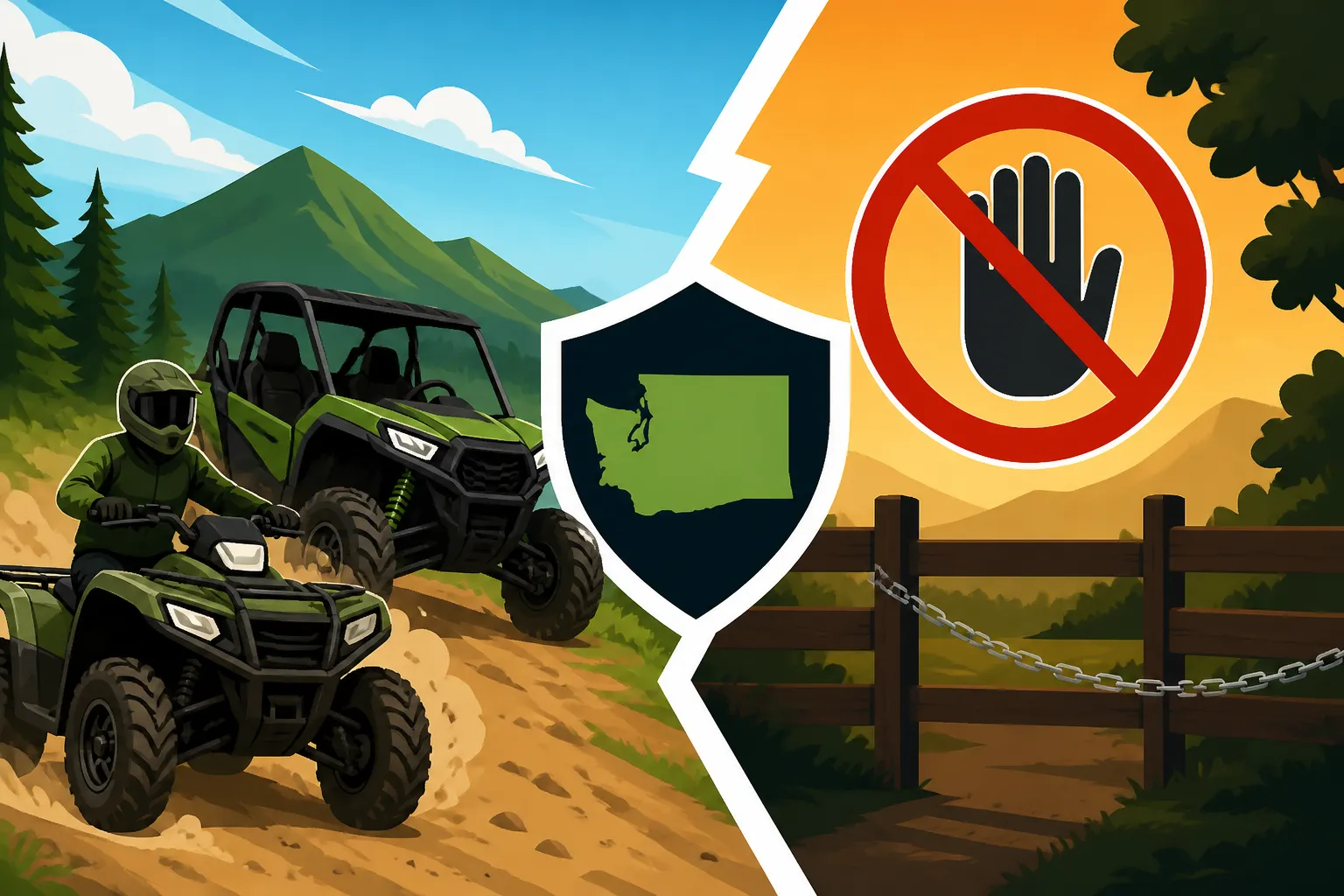
A gate is a boundary clue, not an invitation. An open gate may have been left open for authorized traffic, and a closed gate may mark a road that is restricted even if it is not locked. Never force, bypass, or ride around a gate to continue your route. If you need more detail, see Riding Past a Closed Gate in Washington.
When a gate is open and the route appears available, look for other information before proceeding: signs at the entrance, closure notices, permit instructions, and route markings. If the status remains unclear, choose another route or contact the land manager. Avoid treating another rider’s tracks as proof that access is allowed; they may be old, unauthorized, or left by a different kind of user.
A practical pre-ride process is:
- Identify the land manager or owner. Use current maps and agency or landowner information to check who controls the route. If a route crosses more than one parcel, check each relevant section.
- Confirm motorized access. Look for a current route list, official recreation map, posted notice, or direct confirmation from the responsible office. Make sure the route allows your type of machine.
- Check for temporary restrictions. Closures can arise from fire danger, weather damage, timber operations, maintenance, or safety concerns. Check alerts close to departure, not only when you first plan the trip.
- Get specific permission when needed. Ask which roads or trails are included, whether a permit or key is required, and whether there are limits on dates, hours, group size, or activity.
- Keep proof of permission available. If permission is given in writing, save it where you can access it without relying on cell service. Follow any conditions exactly.
- Stay on the authorized route. Do not cut a new path, leave the road to go around an obstacle, or assume a nearby trail is included.
- Turn back when access is uncertain. A short detour is better than entering property without permission.
For private timberland, a permit or direct authorization may come with conditions. Ask how long it is valid, whether it applies to every rider in your group, and whether it covers only specified routes. A permit to enter one property does not necessarily authorize travel across a neighbor’s parcel. If an access permit has a cost or application process, confirm the current details with the landowner or manager; What a Timber Company Access Permit Costs discusses that issue.
Maps deserve a similar check. A printed map or saved route may be useful for navigation, but routes can close or change. A line on a map does not prove that the public has a legal right to ride there. Use up-to-date information from the agency or owner responsible for the area, and compare it with signs on the ground. If they conflict, do not assume the map overrides a posted closure.
If you discover that you have entered property without permission, stop riding and leave by the route you came in if it is safe and lawful to do so. Do not continue deeper into the property, argue with a landowner, or try to conceal your presence. If someone tells you to leave, do so calmly and promptly. If a gate or barrier is involved, do not alter it or damage it; report a problem to the responsible manager instead.
What to check when a ride crosses several kinds of land
A route that looks continuous on a screen may cross several jurisdictions. One section might be an agency-managed trail, the next a county road, and the next private timberland. Permission and vehicle rules can change at each boundary. A route is only as accessible as its most restricted segment.
This is particularly important when using a route to connect a staging area with a trail system, campground, or town. Permission to ride at the destination does not automatically include permission to use the connecting road. Before loading up, confirm the entire intended route, including the entrance, connecting roads, crossings, and return path.
For each segment, ask:
- Who owns or manages it?
- Is it currently open to ORVs?
- Does the rule cover the kind of machine you are riding?
- Are you required to carry a pass, permit, or written permission?
- Are there seasonal restrictions, operating conditions, or specific gates?
- Is there a legal route back if a closure blocks your planned exit?
When a ride depends on private access, do not rely on a verbal “you should be fine” from someone who may not control the property. Get confirmation from the owner or authorized manager. If access is granted by a club, guide, campground, or another intermediary, verify that the person has authority to grant it and that the permission covers your planned use.
The same careful approach applies to visitors bringing machines into Washington. Reciprocity concerns whether an out-of-state machine or registration is recognized for relevant requirements; it is not a general land-access agreement. Check applicable visitor requirements separately, then confirm the rules for each riding area. For permitted temporary use, see Washington Temporary ORV Permit for a Visitor.
A simple rule keeps the categories clear: vehicle compliance lets you meet the applicable machine requirements; land permission lets you use a particular place. You may need both, along with a site pass or other authorization. Do not treat one as a substitute for another.
If you are planning a ride with uncertain access, choose an alternative route before you go. Save current maps and closure information, keep permission details with your group, and make sure everyone understands where the authorized route ends. Those small checks help prevent a navigation mistake from turning into a trespass dispute or an unsafe encounter.
Disclaimer
This article is for general informational purposes only and does not constitute professional advice. Laws, prices and regulations vary by location and change over time. Consult a qualified professional for guidance on your specific situation.