Why a Forest Road Closes During Active Hauling
A forest road that was open on your last ride can be closed without much warning when logging trucks are hauling. The closure protects workers and riders from a serious collision, not just inconvenience. Here’s how to recognize an active-hauling closure, what to do at the gate, and how to keep a Washington ATV or UTV ride safe and lawful.
Why active hauling closes a forest road
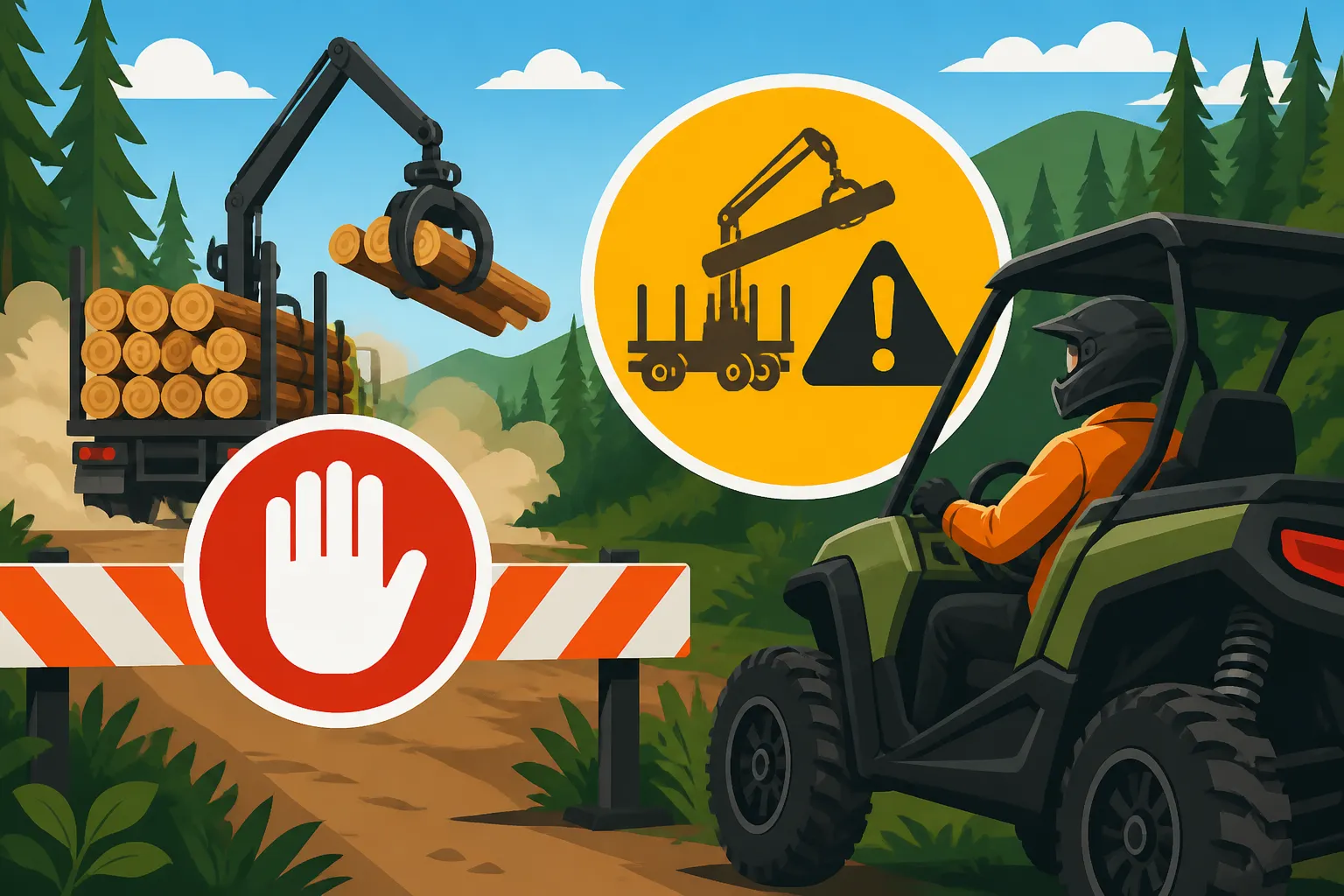
Logging roads are working routes, not simply recreational trails. During a timber operation, loaded trucks may travel a narrow road repeatedly, sometimes around blind corners, over steep grades, or through areas with limited room to pass. Heavy equipment may also be moving logs, clearing brush, or maintaining the road.
A rider on an ATV or UTV can be difficult for a truck operator to see, especially where dust, trees, curves, or changes in elevation limit visibility. A loaded truck needs more room and distance to stop than a small machine. On a narrow road, neither driver may have a safe place to pull aside. A temporary closure reduces the chance that riders and hauling crews meet in those conditions.
Closures can apply to a particular road segment, an access spur, or a broader work area. They may be in place only during hauling hours, throughout a work shift, or for longer while timber work or road repairs continue. The exact arrangement depends on the operation and the land manager or landowner. Don’t assume that a road is open just because no truck is in sight at the moment.
A barrier or closure notice is also a warning that conditions may change ahead. A road that looks quiet from the entrance could lead to active loading, a truck turnaround, heavy machinery, or a blocked route with no safe way to turn around. Riding past a sign or around a gate can put you directly into the work zone.
Forest roads can cross land with different owners and rules. A road shown on a map is not automatically open to public riding, and an old map or previous ride does not confirm current access. For broader context, see Washington Rules for Riding a Forest Road and Riding a Road That Crosses Private Land.
How to recognize a closure and make a safe decision
Closures may be marked with a gate, temporary barricade, posted notice, cones, or signs at an access point. A sign may identify a timber sale or hauling operation, give a closure period, or direct visitors to stay out. Even if the notice is brief or weathered, treat a clear closure marker as meaningful. Do not rely on whether you can see workers from where you are.
Before a ride, check the road or recreation-area alerts available from the land manager. Conditions can change after you plan a route, and a map may not show a short-term hauling restriction. If the road is on private timberland, the landowner or timber company may control access. A permit or permission to use nearby land does not necessarily authorize entry into a closed work zone. See Checking Alerts Before You Load Up and Washington Rules for Riding Private Timberland.
At the road, stop before the closure point and look for posted information. If the notice gives a contact or an approved alternative, follow its directions. If it does not, don’t move a barrier, slip around a gate, or enter through another route to avoid the closure. A locked gate is not an invitation to find a side entrance. For more on that situation, read What to Do at a Locked Timber Company Gate.
Use this simple check before continuing:
- Look for signs and barriers. Check the entrance and any nearby notice board for closure information.
- Identify the road and the boundary. Make sure you know whether the route is public, private, or subject to a specific permit.
- Respect the restriction. If a sign or gate closes the route, turn around unless the responsible authority clearly confirms that access is allowed.
- Choose a route that is confirmed open. Don’t treat an unmarked spur or parallel track as a safe detour.
- Tell your group. Make sure every rider understands the closure and the new plan before moving on.
A notice may not spell out every detail. When it’s unclear whether a closure applies to your route, ask the land manager or landowner before riding in. If you can’t confirm access, the safe choice is to stay out and use another area.
| What you see | What it may mean | Safer response |
|---|---|---|
| A locked gate or barricade | The route is closed or access is controlled | Stop and do not go around it |
| A notice naming hauling or timber work | Trucks, equipment, or crews may be operating ahead | Follow the posted restriction |
| No truck in sight | Hauling may be intermittent or out of view | Don’t assume the road has reopened |
| An old map showing the road | The map may not reflect current access | Check current alerts and signs |
| A side track around a closure | It may enter the work zone or private land | Don’t use it as a detour |
| A road that looks quiet after work hours | The closure’s schedule may be unclear | Confirm access before proceeding |
The key is to separate what you can observe from what you know. Seeing no workers is not proof that the closure has ended. A quiet stretch of road may still be part of the active operation, or trucks may return without much warning.
What to do when you meet hauling traffic
If you encounter a logging truck on a road that is open to your group, stay visible and predictable. Slow down early, keep to the side where the road safely allows, and give the truck ample room. Avoid stopping where the driver has limited sight distance, such as just beyond a curve or over a rise. Don’t assume the truck can move aside or stop quickly for you.
A narrow road may not have room for two vehicles to pass. If there is a safe, clearly visible pullout, use it and wait for the truck to pass. Keep your group together and make sure no rider is hidden behind a bend, dust cloud, or rise. Don’t pull into soft shoulders, ditches, or unstable ground simply to make room. If there is no safe place to pass, back away only when you can do so without creating another hazard, and follow any directions from the crew.
Never ride close behind a loaded truck. Logs, dust, loose gravel, and limited visibility can all create hazards. Give the vehicle time and space, and don’t try to pass unless the road is open, visibility is good, and there is ample room to do so safely. If crew members are controlling traffic, follow their instructions rather than attempting to negotiate around the work.
A road that is open to traffic may still have restrictions that affect the way you ride. Follow posted speed limits and access rules, and be prepared for changing conditions. More practical context is available in Meeting a Log Truck on a Gravel Road.
If you arrive at a closure while already on the road, don’t continue toward the work area to see whether you can get through. Turn around only where it is safe, and avoid blocking the road or access for trucks. If you are unsure how to leave, stay outside the work zone and contact the appropriate land manager or landowner for directions. Don’t treat a worker’s presence as permission to enter; get clear authorization for the route and time you intend to ride.
Planning around a temporary closure
A closure does not always mean the entire riding area is unavailable. It may affect one route while other trails or roads remain open. But a nearby route is not automatically an authorized detour. Confirm that the alternative is open to your machine and that you have permission to use it.
Plan a route with a turnaround option before you leave. This matters especially when riding in a group, towing a trailer, or traveling through an area with limited cell service. If a closure blocks the planned way in, you should know how to return without entering a work zone or relying on an unverified shortcut.
When checking possible alternatives, verify:
- Whether the road or trail is currently open.
- Whether the access is public or requires permission.
- Whether your machine is allowed on that route.
- Whether the route connects to the place you intend to reach.
- Whether any other closures, gates, or seasonal restrictions affect the trip.
If a gate is locked and the notice does not explain whether access is temporarily restricted or controlled by a permit, don’t assume you can obtain a key on the spot. Ask the landowner or timber company about access arrangements before the ride. A key, where one is issued, may be limited to a specific user, route, or period. See Getting a Gate Key From a Timber Company.
Keep in mind that active hauling can resume after a quiet interval. A crew may be loading at a landing, taking a break, or working farther along the road. If a notice says the route is closed, the absence of truck traffic is not a reason to cross the boundary. For related guidance, see Riding Past a Timber Sale Gate and Washington Rules for Riding a Closed Road.
The practical rule is straightforward: treat a marked hauling closure as a firm stop, not a challenge to work around. Check current access information, respect the barrier, and choose a route that is confirmed open. That keeps riders away from heavy equipment and lets crews work without having to watch for unexpected traffic.
Disclaimer
This article is for general informational purposes only and does not constitute professional advice. Laws, prices and regulations vary by location and change over time. Consult a qualified professional for guidance on your specific situation.