Why Road Reciprocity Needs Equal Standards
Why Road Reciprocity Needs Equal Standards
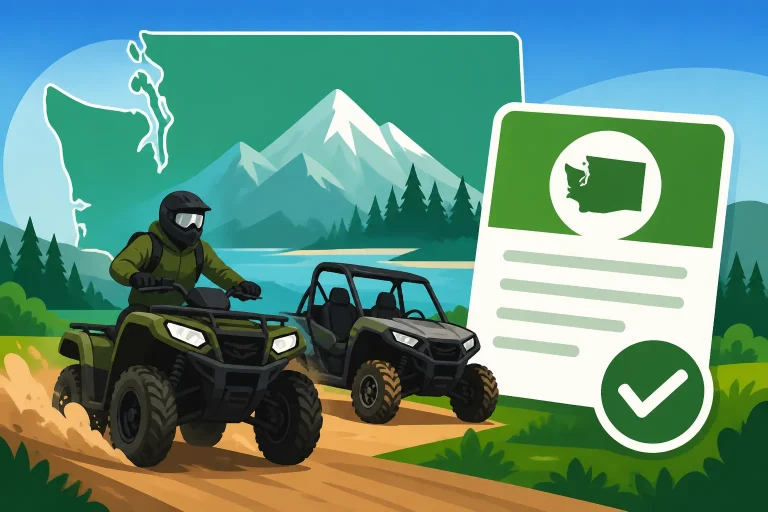
A visitor may arrive in Washington with a registered ATV or UTV and assume the home-state sticker is enough to ride local roads. It may not be. Road reciprocity depends on more than registration: comparable rules help make sure visiting machines and riders meet a fair baseline, while local road-access restrictions still apply.
What Equal Standards Means for Road Reciprocity
Reciprocity is an arrangement in which one jurisdiction recognizes certain permissions or credentials issued by another. For an ATV or UTV, that could include recognizing an out-of-state registration for some kinds of riding. But recognition does not automatically make every public road available to the visitor.
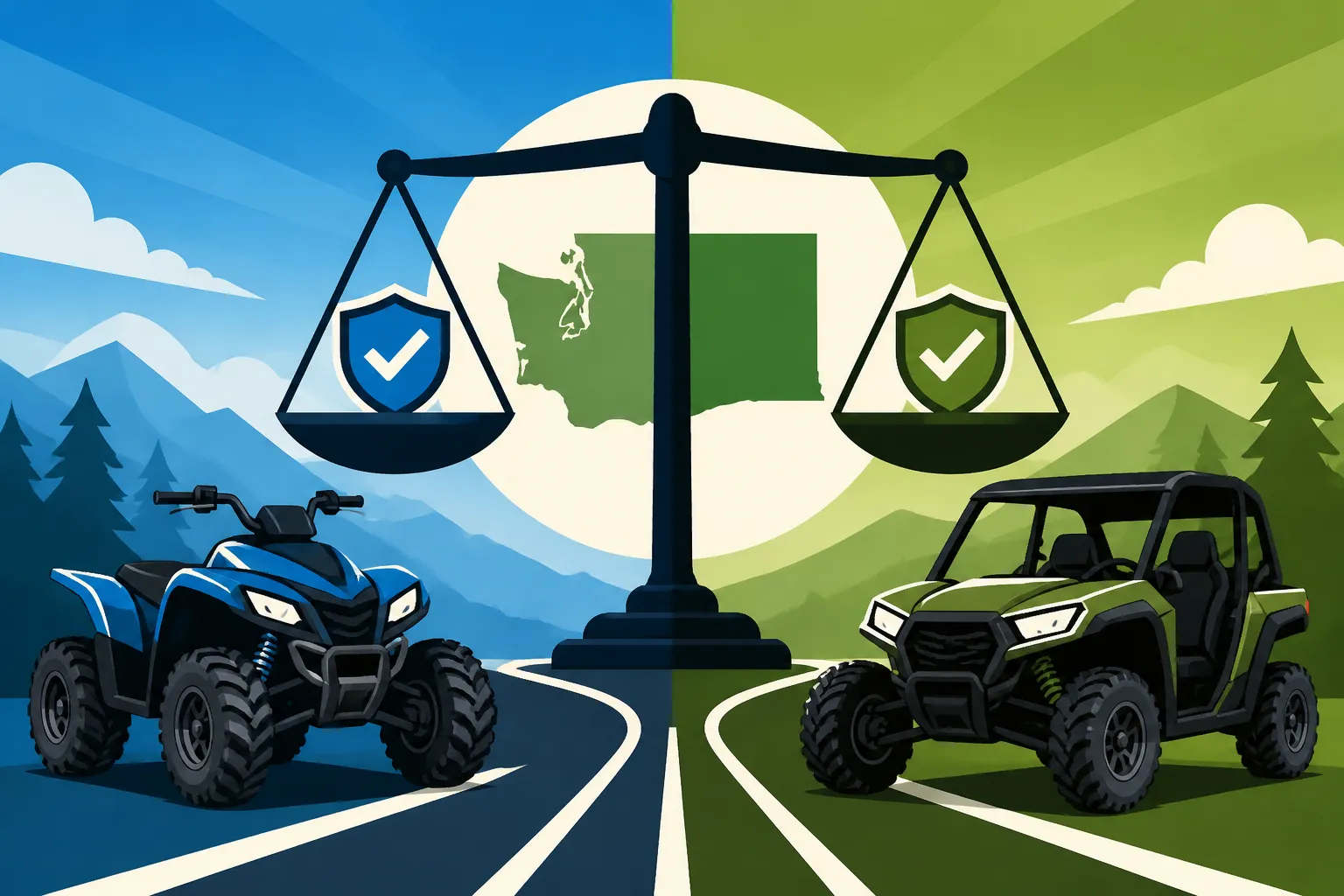
For road use, comparable standards matter because a machine operating on pavement shares space with ordinary traffic. A jurisdiction needs a way to determine whether a visiting machine is authorized and whether its equipment and operator meet the conditions for that kind of use. If one state grants road privileges to visitors from Washington, while Washington grants the same privilege without comparable conditions, the two systems would not offer a balanced exchange.
“Equal standards” does not necessarily mean two states must use the same forms, decal colors, labels, or administrative process. One state might issue a registration card, while another uses a sticker or permit. The important question is whether the underlying privileges and safeguards are sufficiently comparable. That can involve how a machine is registered, what equipment is required, where it may operate, and what the rider must carry or demonstrate.
It also helps to separate three ideas that are often treated as one:
- Registration or a permit: Evidence that the machine is recognized under a jurisdiction’s rules.
- Road-use eligibility: Whether the machine and rider satisfy the conditions for operating on a public road.
- Access to a particular road: Whether that road or segment is open to this type of vehicle.
A valid registration can establish the first point without resolving the other two. A machine might be properly registered at home but still lack the equipment needed for Washington road use. Even a machine that qualifies for road use may be barred from a particular county road or city street.
Washington’s approach is therefore not simply “a sticker from another state means road access.” A visitor should check how the state treats out-of-state machines and whether the home jurisdiction offers comparable road privileges. The details are discussed in Washington Road Reciprocity and Its Conditions and Washington ORV Reciprocity With Other States.
| Question | What it helps establish | What it does not establish by itself |
|---|---|---|
| Is the machine registered or permitted at home? | Whether the home jurisdiction recognizes the machine for the relevant use | That Washington allows it on public roads |
| Does the home jurisdiction offer comparable road privileges? | Whether reciprocal treatment may apply | That every Washington road is open |
| Does the machine meet Washington road-use conditions? | Whether its equipment and documentation may qualify | That a specific road segment permits ORVs |
| Is the road open to this vehicle? | Whether the planned route is allowed | That the rider meets every other requirement |
Why Reciprocity Depends on Comparable Rules
Reciprocity works best when both jurisdictions extend similar treatment under broadly comparable conditions. Without that balance, a rider could potentially use a less demanding registration system at home to obtain road privileges elsewhere that residents of the destination jurisdiction must qualify for under stricter rules.
That is a fairness concern, but it is also a safety and enforcement concern. Road-use requirements can cover equipment, registration documents, inspections, operator qualifications, and restrictions on where a machine may travel. Those conditions help distinguish a vehicle prepared and authorized for limited road use from an off-road machine that is not.
A reciprocal arrangement can reduce unnecessary barriers for visitors. A person who has already registered a machine under a recognized home-state system may not need to repeat every step from scratch just to visit. But reciprocity is not a promise to waive the destination state’s safety rules or road restrictions. It is a way to recognize comparable authorization, not a blanket exemption from local law.
The comparison also needs to focus on the relevant kind of privilege. A state may recognize an out-of-state off-road permit for trail riding while offering no equivalent road privileges. Those are different uses. A visitor’s right to ride a designated trail does not automatically include the right to ride a paved road to reach that trail.
This distinction can feel technical, but it prevents a common misunderstanding: off-road reciprocity and road reciprocity are not interchangeable. The fact that Washington may recognize some out-of-state credentials for off-road use does not by itself prove that a visiting machine can use Washington roads.
Nor does a home-state registration necessarily settle questions about Washington equipment requirements. A machine intended for road operation may need to satisfy additional conditions. These can include required equipment and the rules governing the person operating it. The relevant Washington requirements are covered in What Washington Requires for On-Road ORV Use and Washington WATV Road Requirements.
A fair comparison should therefore ask what each jurisdiction actually allows, rather than compare only the names of the permits. Two states may use different terminology but offer similar rights. Conversely, two permits with similar names may authorize very different things. The practical test is about the privilege and the conditions attached to it, not the label on the paperwork.
What Visiting Riders Should Verify
Before bringing an ATV or UTV onto a Washington road, check the rules for the machine, the rider, and the planned route. Do not rely only on a registration card, an online discussion, or what another rider says was accepted in the past. Requirements and local road decisions can change, and an enforcement officer may need to assess the machine under the rules in effect for that location.
Confirm what the home-state credential authorizes
Read the information that came with the registration or permit, or ask the issuing agency what uses it allows. Find out whether it is for off-road riding only or whether it authorizes some road use at home. If road use is allowed, ask what conditions apply and whether the credential covers the machine you plan to bring.
A permit that only authorizes trail riding should not be treated as proof of road eligibility. If the home state has no comparable road-authorization system, reciprocal road treatment may not apply. For visitors whose home state does not offer the same kind of registration, When Washington Reciprocity Does Not Cover a Visitor explains why having some form of home-state paperwork may not be enough.
Check Washington’s machine and rider requirements
Confirm whether the machine must meet Washington’s road-use conditions even if it is registered elsewhere. Check the requirements for equipment, documentation, and any inspection or declaration that may apply. Also verify the rules for the person operating it. A credential for the machine does not remove rider-related requirements, and permission for an adult does not automatically answer the rules for a younger operator.
Make sure any required documents are available while riding. If the registration is hard to read, expired, or does not clearly identify the machine, resolving that before the trip is safer than trying to explain it beside a road. For a closer look at visitors’ paperwork and registration questions, see Riding Washington With an Out-of-State Registration.
Verify the route, not just the county
Washington road access can depend on the road’s location and the decision made by the relevant local authority. A machine that is eligible for road use may still be unable to travel on a particular road. County and city rules can differ, and a route may include a mixture of roads with different access conditions.
Check the current road list, ordinance, or other official information for the places you plan to ride. Do not assume that an open road in one county continues to be open after crossing into another. Likewise, a map that shows a road may not show whether the road is approved for ORV use.
The distinction is especially important when a route uses a short paved connection between trails. A rider may have a valid machine and still be prohibited from using that connector. The rule for crossing a road can also differ from the rule for traveling along it. Plan the connection before unloading, rather than treating the nearest pavement as an automatic route to the next trail.
Ask a specific question when the answer is unclear
A useful question to an agency or licensing office is not simply, “Is my ATV legal in Washington?” Explain that the machine is registered in a particular state, describe what that registration authorizes at home, and ask about the specific type of road use you have in mind. For route access, identify the county, city, or road segment.
Keep the answer and supporting documents available, but do not assume that informal guidance overrides a posted closure or a local ordinance. If the answer is uncertain, the lower-risk choice is to trailer the machine to an authorized riding area and avoid public-road use until the applicable rules are clear.
Where Reciprocal Permission Stops
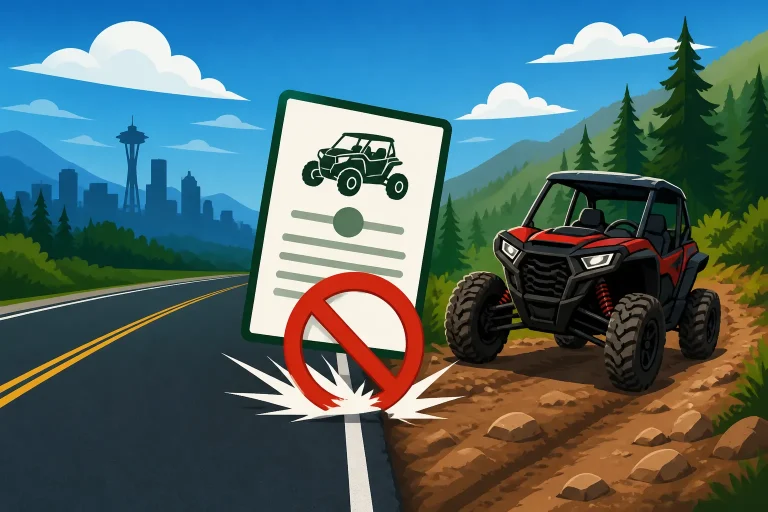
Even when reciprocal treatment applies, it has limits. The most important limit is that reciprocity is not statewide permission to ride wherever a car can travel. A road-use credential does not make an otherwise closed road open, and it does not turn an off-road vehicle into a generally registered passenger vehicle.
Local access is a separate decision. Washington counties and cities may set rules for the roads under their control. Some roads may be open to qualifying machines, while others remain closed. A route can change status at a boundary, and a local sign or posted notice can provide important information. Riders should check the current approved road information rather than assume that a route is open because it appeared in an old map or ride report.
A second limit is that the rider and machine still need to meet applicable conditions. Reciprocity should not be read as permission to skip required equipment, carry no registration evidence, or ignore operator rules. A machine that qualifies under one state’s standards may still need to satisfy Washington conditions to use a road in Washington.
A third limit is the difference between road use and trail use. A visitor may have permission to ride a designated off-road area without permission to travel on nearby pavement. The trail permit, the machine’s road status, and the road’s access rules must each be considered. This is one reason a visitor should not infer road rights from a trail sticker alone.
Finally, reciprocity may depend on the laws and policies of both jurisdictions. If a home state changes its rules, or if its privileges are not comparable to Washington’s, the result may change. A visitor should confirm current requirements with the relevant official source, especially before a long trip or a route that relies on public roads.
The practical rule is simple: treat reciprocity as one part of the eligibility check, not the whole answer. Confirm the home-state credential, Washington’s road-use conditions, the rider requirements, and the route itself. If any one of those pieces is missing, road use may not be permitted.
A Practical Pre-Ride Check
Use this sequence before riding a visiting ATV or UTV on a Washington public road:
- Identify the credential. Determine exactly what the home-state registration or permit authorizes, and check that it is current and tied to the machine.
- Check reciprocal eligibility. Confirm whether Washington recognizes the credential for the kind of road use planned, rather than assuming an off-road permit also covers pavement.
- Review Washington conditions. Verify required machine equipment, documents, and rider qualifications. Do not assume that home-state compliance automatically satisfies Washington’s conditions.
- Confirm the road is open. Check the current county or city information for each part of the route, including short connectors and crossings.
- Carry the required proof. Keep registration and any other required documentation accessible and legible while riding.
- Follow signs and closures. A valid credential does not override a posted closure, a gate, or a local restriction.
- Choose a fallback route. If a segment’s status is unclear, use a trailer or a route confirmed to be open rather than testing the rule on the road.
This checklist is useful for residents too. A Washington registration does not guarantee that every road is open, just as an out-of-state credential does not automatically disqualify a visitor. The same basic questions apply: Is the machine eligible? Is the rider qualified? Is this road open? For broader context, see Washington Rules for Riding a County Road.
The best way to avoid a citation or an unsafe roadside conversation is to settle those questions before the ride. Reciprocity can make cross-border riding more practical, but it only works when riders understand what is being recognized and what still depends on Washington rules.
Frequently Asked Questions
Does an out-of-state ATV registration automatically allow road riding in Washington?
No. Registration is only one part of the question. The machine may need to qualify for reciprocal road use, meet Washington conditions, and travel only on roads that are open to it.
Does off-road reciprocity also cover public roads?
Not necessarily. Permission to ride designated off-road areas and permission to use public roads are separate issues. Check what the credential authorizes and what Washington recognizes for the planned use.
Do equal standards mean every state must use the same permit?
No. The forms and terminology can differ. The key issue is whether the privileges and relevant conditions are comparable, not whether the documents look alike.
Can a reciprocal credential override a local road closure?
No. Reciprocity does not make a closed road open. Check the current rules and notices for the county, city, or specific road segment.
Disclaimer
This article is for general informational purposes only and does not constitute professional advice. Laws, prices and regulations vary by location and change over time. Consult a qualified professional for guidance on your specific situation.