Why Juniper Dunes Charges Nothing
Juniper Dunes is known as a place to ride without paying an entrance or day-use fee, but “free” does not mean unregulated or cost-free to reach. The key is to separate the recreation-site fee from your machine’s Washington registration, any applicable permit, and the rules for where you can ride.
What “free” means at Juniper Dunes
Juniper Dunes is a Bureau of Land Management recreation area in southeastern Washington. Riders generally do not pay an entrance or day-use fee to ride in the designated off-highway vehicle area. There is no staffed fee gate collecting a riding charge at the site.
That answers the headline question, but it does not mean every cost associated with a trip disappears. Your machine may still need the proper registration or permit, and you are responsible for following land-use restrictions. Travel costs, fuel, equipment and any fees at other places you visit are separate from a Juniper Dunes entry fee.
It also helps to distinguish the riding area from nearby land with different rules. Juniper Dunes Wilderness borders the recreation area, but it is not an extension of the motorized riding zone. Motorized vehicles are not allowed in designated wilderness. A map that shows nearby public land does not, by itself, mean that all of it is open to riding.
The lack of a fee is therefore best understood as a feature of this particular recreation site, not a general rule for every public riding area in Washington. Some sites charge for parking, camping or access; others do not. Before traveling, check the current site information and signs for the precise access point and riding area you plan to use.
Why Juniper Dunes does not collect a riding fee
Public recreation sites do not all use the same funding or fee model. A developed campground, a staffed entrance station and an open riding area may have different facilities, operating costs and management arrangements. A fee-free site may rely on public funding and have fewer services than a place that collects fees. The absence of a charge does not mean managing the area takes no work or costs nothing.
It is safest not to assume that every service at Juniper Dunes is funded by a separate riding charge. The fee status tells you what you are expected to pay at the site; it does not provide a complete account of how land management, maintenance or public access are funded. For a broader explanation of how Washington registration revenue is used, see Where Washington ORV Fees Are Spent. Those state funds are distinct from a site-specific entry fee.
A practical consequence is that visitors should plan for a more self-sufficient outing than they might at a developed recreation facility. Do not count on finding services at the riding area, and check current access information before loading your machine. Bring what you need for the trip, keep waste secured, and leave the area in good condition. Fee-free access is not a promise that every amenity will be available or that conditions will remain unchanged.
The site’s rules still apply even when no one collects money at the entrance. Restrictions can cover where vehicles may travel, what areas are closed and how visitors should use the land. Signs and current notices matter more than an old map, social post or assumption based on a previous visit.
A free site does not replace your Washington permit
A recreation-site fee and a vehicle permit answer different questions. The site fee, if there is one, concerns access to a particular place. Registration or an off-road permit concerns the machine’s legal operation. Paying no entrance fee at Juniper Dunes does not exempt a Washington rider from applicable state requirements for using an ORV on public land.
Before you go, make sure your machine has the appropriate Washington registration or permit for your circumstances. The details can depend on where the machine is registered, whether it is used off road or on roads, and whether you are a Washington resident or visitor. Washington ORV Permits Explained covers the broader distinction between state permit requirements and the fees a recreation site may charge.
Visitors should not assume that an out-of-state sticker automatically works everywhere in Washington. Reciprocity depends on the applicable rules and the visitor’s home-state requirements. If you are riding a machine registered elsewhere, check Washington ORV Reciprocity With Other States before your trip. If you need a visitor permit, review [Washington Temporary ORV Permit for a Visitor] and confirm that it suits your machine and intended use.
| Question | What it concerns | What to check |
|---|---|---|
| Is there a Juniper Dunes riding fee? | Access to this specific recreation area | Current site information and posted notices |
| Does the machine need a Washington ORV permit? | Legal use of the vehicle in Washington | Your registration, residency and machine type |
| Is a Discover Pass required? | Access to certain Washington state recreation lands | The land manager for the access point and destination |
| Can I ride into nearby wilderness? | Where motorized travel is allowed | Official maps, signs and closure notices |
| Are all nearby routes open? | The specific route or riding area | Current land-manager information and on-site signs |
A permit is not a blanket authorization to ride anywhere. It does not open a closed route, allow entry into designated wilderness or override a site restriction. For rules specific to the type of land, read [Washington Rules for Riding BLM Land] and follow the signs at the site.
Do you need a Discover Pass at Juniper Dunes?
A Discover Pass is associated with recreation access on certain Washington state-managed lands. Juniper Dunes is managed by the federal Bureau of Land Management, so a Discover Pass is not the same thing as a Juniper Dunes riding fee and is generally not required simply to ride at the BLM area.
That distinction is useful because “public land” is not one single fee system. A state-managed recreation site may require a state pass, while a federal site may have its own fee rules or no entry fee. Some federal recreation areas do charge fees, so it would be wrong to conclude that every BLM site is free. For a fuller explanation of which Washington lands a Discover Pass covers, see Do You Need a Discover Pass to Ride in Washington?.
Pay attention to the land involved in your whole trip, not just the main destination. You could travel through or stop at another recreation site with different rules. If a route, staging area or overnight stop is managed by a different agency, check that location separately. The fee rules for one property do not necessarily carry over to another.
When in doubt, identify the land manager for the place where you will park, unload and ride. Then check that manager’s current requirements. This is especially helpful when maps show adjoining public lands, because a boundary can separate land with different rules even when the scenery looks continuous.
Keep the riding area separate from Juniper Dunes Wilderness
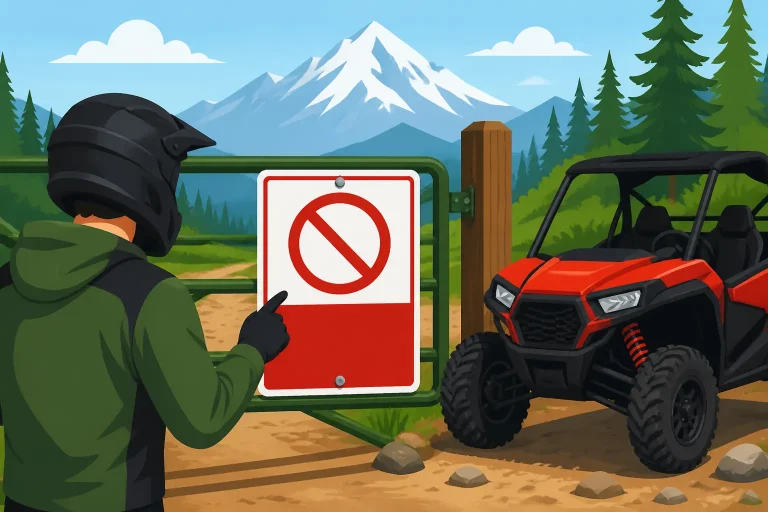
The main riding mistake to avoid is treating the dunes and the nearby wilderness as one open motorized area. Designated wilderness is protected from motorized vehicle use. A machine that is properly registered and carrying any required permit still cannot be taken into an area closed to motorized travel.
Use official maps and signs to identify where the designated riding area ends. Do not rely only on tire tracks or the fact that another vehicle appears to have traveled somewhere. Tracks can lead into a closed area, and a route that was open at some point may later be restricted.
If you are uncertain whether a particular patch of sand or route is open, stop and check before proceeding. Staying on authorized routes and within the designated riding area protects the land and helps keep access available for other visitors. Why a Wilderness Area Borders Juniper Dunes explains why the adjacent wilderness has a different purpose and different rules.
Conditions and access can also change. A site may have a temporary closure, a route restriction or a change in access information. Check alerts before you travel rather than relying on an old trip report. Checking Alerts Before You Load Up offers a useful routine for confirming closures and conditions before leaving home.
Plan the trip as fee-free, not rule-free
A no-fee riding area can make a trip simpler, but preparation still matters. Before loading your machine, work through these steps:
- Confirm the current fee and access information. Check the land manager’s latest notices for the recreation area, parking or staging location, and any planned closures. Do not treat a past visit as proof that current conditions are identical.
- Check your machine’s paperwork. Make sure your Washington registration or applicable visitor permit is in order. Keep required documents with you and verify that your machine’s registration matches the way you plan to use it.
- Review the riding boundary. Identify the authorized riding area and the wilderness boundary on a current map. Follow posted signs, and turn back if the route is unclear.
- Check separate destinations. If your trip includes another trailhead, campground or state recreation site, look up its rules independently. A free Juniper Dunes visit does not make every stop free.
- Prepare for a self-supported visit. Bring the supplies you need, plan for your return trip, and avoid depending on services that may not be available at the site.
- Leave the area as you found it. Secure trash, avoid damaging vegetation or land outside the authorized riding area, and respect closures and other visitors.
The main takeaway is straightforward: Juniper Dunes generally does not charge an entrance or riding fee, but riders still need to meet the applicable permit rules and stay within the areas open to motorized use. Confirm the current site details before you go, especially if you are a visitor, plan to use adjoining lands or have not ridden there recently.
Frequently Asked Questions
Is Juniper Dunes free to ride?
The designated Juniper Dunes off-highway vehicle area generally has no entrance or day-use riding fee. Check current site information before traveling in case access conditions or requirements change.
Does a Washington rider need an ORV permit there?
A lack of an entrance fee does not remove applicable Washington ORV registration or permit requirements. Check the rules that apply to your machine and how you plan to use it.
Do I need a Discover Pass for Juniper Dunes?
A Discover Pass is for certain Washington state-managed recreation lands, not a general pass for all public land. Juniper Dunes is a BLM area, but check requirements for any other sites you visit.
Can I ride into Juniper Dunes Wilderness?
No. Designated wilderness is closed to motorized vehicles. Stay within the authorized riding area and follow current maps and posted signs.
Disclaimer
This article is for general informational purposes only and does not constitute professional advice. Laws, prices and regulations vary by location and change over time. Consult a qualified professional for guidance on your specific situation.