Washington Width Limits on a Forest Trail
A side-by-side can fit between the trees on one Washington forest route and still be too wide for the next trail over. The key is not a machine’s marketing label; it is the width limit for the specific route and the machine as equipped. Here’s how to check before unloading, avoid a costly wrong turn, and choose trails that match your ATV or UTV.
There Is No Single Width Limit for Every Washington Forest Trail
A forest trail’s permitted width depends on the route and the land manager’s rules. A route may be designated for narrow machines, open to wider off-road vehicles, or closed to motorized use altogether. Forest roads and trails can have different rules even when they’re in the same recreation area.
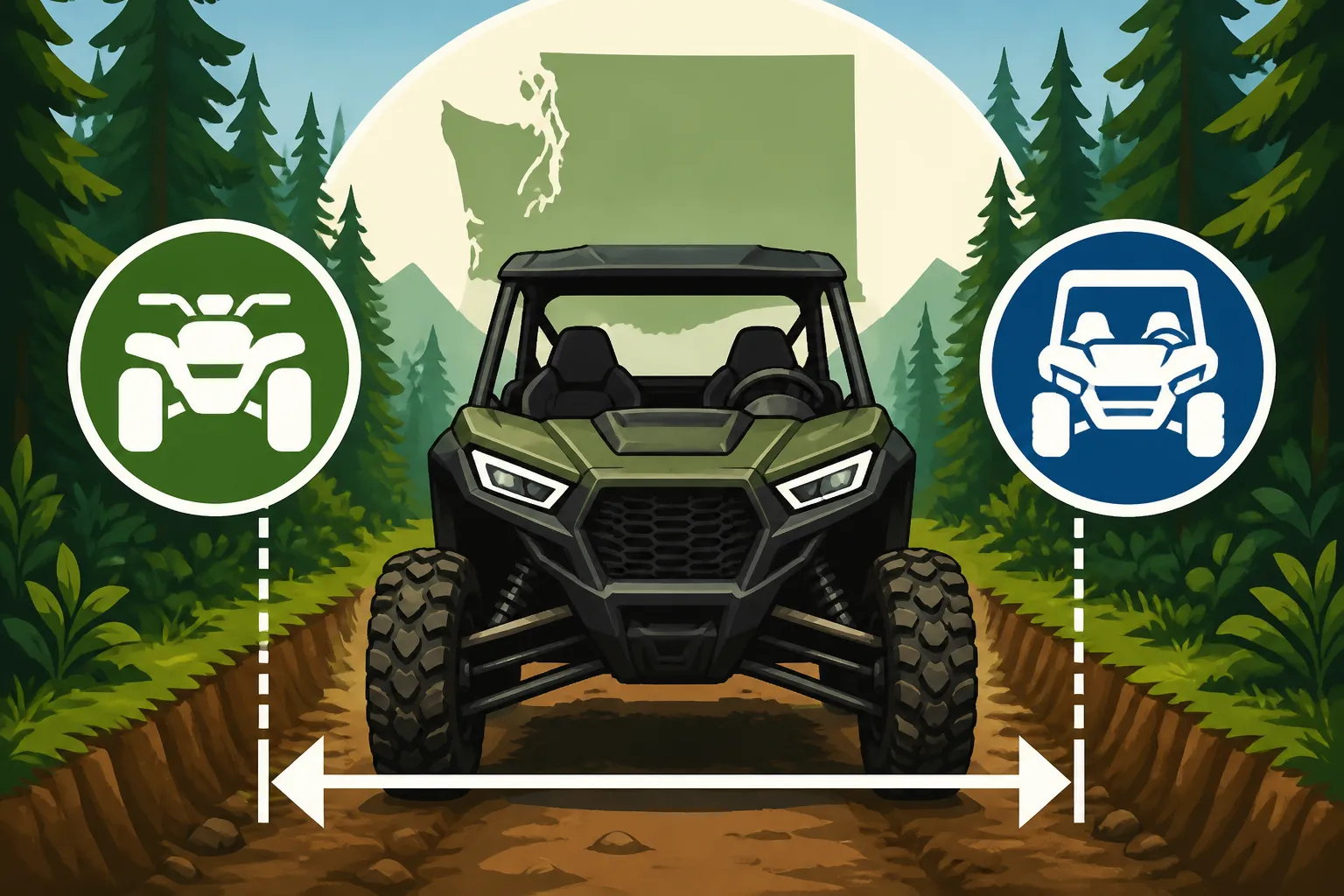
Some Washington trail systems use a 50-inch class of trail for narrow vehicles. That is a route-specific limit, not a guarantee that every trail in a forest—or every public forest trail in Washington—has the same restriction. Other routes may accommodate wider machines, but you need to confirm that for the route you plan to ride.
A trailhead sign, recreation map, route designation, or current land-manager notice may identify the allowed vehicle class or width. A trail’s name, appearance, or location on a map is not enough to establish that your machine can legally use it. The same caution applies to online trail reports: they can help you understand conditions, but they may not reflect current access rules or closures.
If you’re riding on Washington Department of Natural Resources land, start with the agency’s current information for that recreation area and its roads and trails. On federal land, check the responsible agency’s route information. The rules can differ between nearby land parcels, so don’t assume that permission on one route carries over to another. For a broader look at land-specific requirements, see Washington Rules for Riding DNR Land and Washington Rules for Riding Federal Land.
| What you’re checking | What to confirm | Why it matters |
|---|---|---|
| Trail designation | Whether the route is open to motorized use and which vehicle class is allowed | A route can be open to some machines but not yours |
| Width restriction | The stated maximum, if one is posted or listed | A wide UTV may be excluded from a narrow trail |
| Route type | Trail, forest road, or other designated route | Different rules can apply within one riding area |
| Current status | Closures, seasonal restrictions, and temporary notices | A normally open route may be closed |
| Machine setup | Actual width with tires, accessories, and modifications | The machine may be wider than its published specification |
Width is only one part of access. A route may also have requirements or limits related to permits, vehicle registration, noise, spark arresters, or other equipment. Check those separately rather than treating a width designation as full permission to ride. Washington ORV Permits Explained covers the separate permit question.
Check Your Machine’s Actual Width, Not Just Its Model Name
A model name such as “compact” or “trail” does not tell you whether a specific route allows the machine. Even two machines in the same product line can have different widths. Trim, tires, wheels, and added equipment can change the measurement too.
Start with the manufacturer’s specifications, but treat them as a starting point. Check the exact model and configuration, including whether the published width refers to the machine as sold with a particular tire or wheel package. If you have changed the setup, measure the machine in its current condition before you plan around a narrow-route limit.
Measure the widest point
For practical trail planning, identify the widest part of the machine from side to side. On many quads and side-by-sides, that will be the outside edges of the tires, but accessories or modifications can extend farther. Check the trail manager’s instructions for how it defines or measures vehicle width if a route has a specific maximum.
A careful measurement can help you avoid relying on a brochure figure that no longer matches your machine. Park on level ground, keep the wheels straight, and use a tape measure across the widest points. If you’re close to the posted limit, do not assume that a small difference is harmless. Confirm how the route’s limit applies and leave a margin for measurement uncertainty.
For more detailed buying and sizing considerations, see Measuring Width Before You Buy and How Narrow a Machine Must Be for Single Track. If you’re shopping for a UTV that can use more of the available trail network, Best UTV Width for Washington Trails can help you weigh width against passenger and cargo space.
Include changes made after purchase
A machine can become wider after it leaves the dealer. Common changes to check include:
- Wider tires or a different tire profile
- Wheel spacers or wheels with a different offset
- Tracks or other conversion equipment
- Fender extensions, brush guards, or other accessories
- Cargo that sticks out beyond the vehicle
- A trailer or other equipment being towed, where the route rules address it
Not every add-on changes the machine’s measured width, and the route’s definition controls. The practical point is to check the full setup rather than assume that the original specification still applies. If your measurement is near a posted maximum, ask the land manager how to interpret it before traveling.
Match the Route to the Machine Before You Ride
When a forest has a mix of narrow trails and wider routes, planning around the machine’s limits is safer and more useful than hoping a route will work out on arrival. A map may show a connected trail network, but the connection does not mean every vehicle can use every segment.
Use the current map and any posted signs together. A map can show the route and its designation; a sign at the entrance may clarify the restriction or announce a closure. If they appear to conflict, stop and confirm with the land manager rather than choosing whichever information seems more convenient.
A practical pre-ride check
- Identify the land manager. Confirm whether the route is on state, federal, county, or private land. Nearby routes may have different owners and rules.
- Find the current route map. Look for vehicle-class designations, width limits, gates, closures, and seasonal restrictions. Washington Trail Maps From DNR explains what to look for on DNR maps.
- Check the exact route, not just the riding area. Verify the trail segments you plan to use, including the way in and out.
- Compare the route limit with your machine’s actual width. Use the current configuration, not an old specification or a measurement from a different set of tires.
- Check for recent notices. A timber operation, maintenance work, fire restriction, or other temporary change may affect access. Checking Alerts Before You Load Up is useful when a trip depends on a particular route being open.
- Have a fallback plan. Identify a legal route or riding area that suits your machine if the planned trail is closed or too narrow.
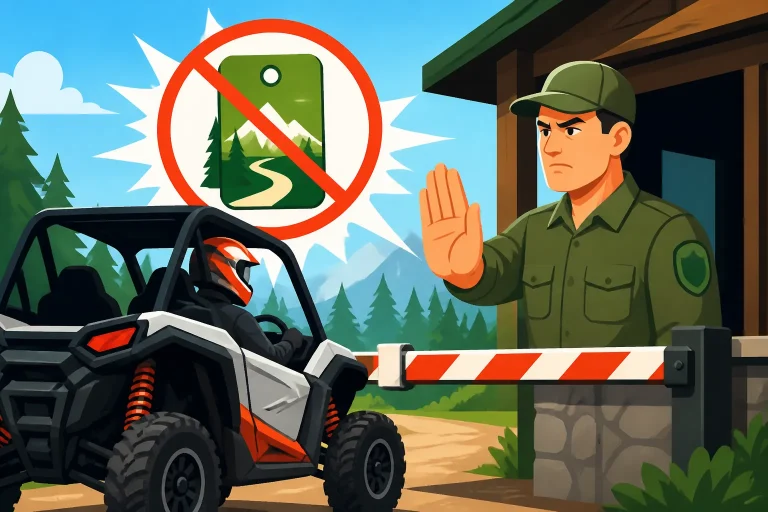
If your machine is wider than a route’s limit, do not try to squeeze through, remove equipment at the trailhead, or continue until the trail becomes impassable. Width restrictions are access rules, not just estimates of physical clearance. A machine might fit through a gap and still be prohibited from using the route.
A narrow trail can also be physically difficult for a wide machine even when the route is open to it. Tight turns, trees, berms, soft shoulders, and obstacles can leave little room to maneuver. A legal width limit does not promise that every machine below it will have an easy ride. Consider your experience, the vehicle’s turning radius, and the trail’s difficulty before committing.
What to Do When a Route’s Width Rule Is Unclear
Do not rely on a guess when a trail listing does not state a limit, a sign is missing, or the map is hard to interpret. Contact the land manager responsible for that specific route and ask about the vehicle class and width rule. Provide the trail name or map location and your machine’s measured width and configuration. A general question about an entire forest may not get you a useful answer if different routes have different designations.
At the trailhead, read signs before entering and follow any posted restriction. If a route appears narrower than expected or a sign indicates that your machine is not allowed, turn back and choose a permitted route. Never go around a closure barrier or take an unofficial bypass. Besides risking a citation or damage to the trail, doing so can create problems for other riders and may lead to further access restrictions.
Keep the distinction between a forest road and a trail clear. A wider road may be open to your machine while a nearby narrow trail is not. Conversely, a road that looks like a suitable alternative may have its own restrictions or may be closed to public motorized use. Confirm the status of each route independently.
For riders choosing between a quad and a side-by-side, width is one of the trade-offs worth considering before purchase. Wider machines can offer more room for passengers and gear, but they may have fewer narrow trails available to them. A narrower machine may reach more trail segments but offer less cabin and cargo space. The right choice depends on the routes you actually plan to ride, not just the machine’s listed capability. Washington Trails for a Wide Side-by-Side offers more context for planning around wider machines.
Before each trip, verify the route rules again. A trail you rode last season may have a new designation, temporary closure, or changed access condition. Checking the map, signs, and current notices takes less time than towing a machine to a trail it cannot legally use.
Disclaimer
This article is for general informational purposes only and does not constitute professional advice. Laws, prices and regulations vary by location and change over time. Consult a qualified professional for guidance on your specific situation.