What Direct Supervision Means in Washington
What Direct Supervision Means in Washington
Washington’s supervision rule can be easy to misread: having an adult somewhere at the trailhead is not necessarily the same as supervising a young rider. If someone under 16 will ride on public land, plan who will accompany them, what that adult needs to qualify, and how the group will stay together. The key is active, close supervision—not just being reachable by phone.
The basic supervision rule
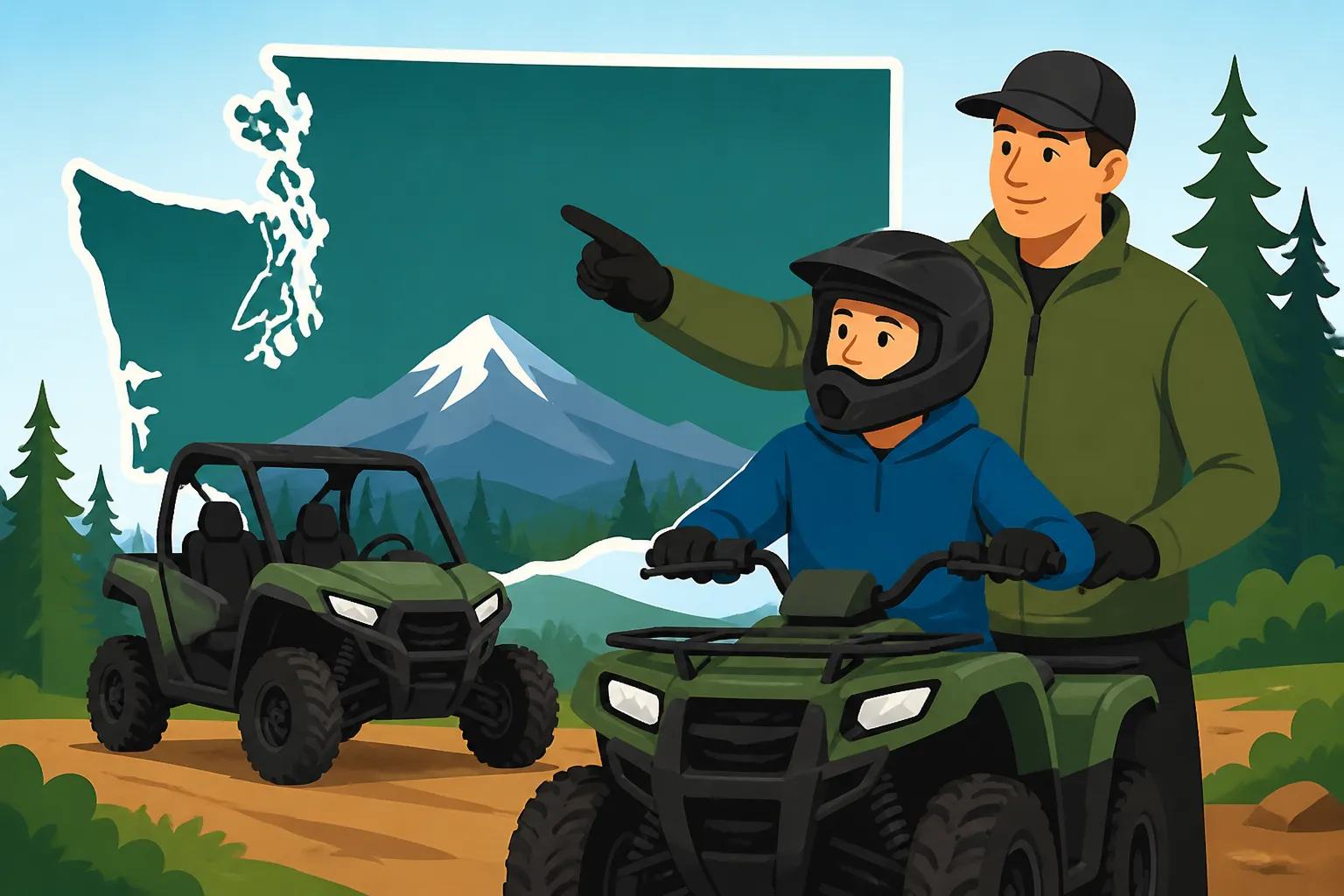
For riding an off-road vehicle on public land in Washington, a rider under 16 generally needs to be accompanied by an adult who is at least 18 and has a valid driver license. In practice, direct supervision means the adult is part of the ride and can keep watch, respond to changing conditions, and help the younger rider make safe decisions.
That is more involved than driving the young rider to a staging area, waiting in a parked truck, and expecting them to ride alone. Nor is it enough to have an adult somewhere else on the trail system who could be called if something goes wrong. A supervising adult should be close enough to see how the ride is unfolding and to intervene when needed.
The rule applies to the young rider’s use of the machine, not just to the trip as a whole. If the adult leaves the riding area, gets separated from the group, or cannot keep track of the rider, supervision has effectively broken down. A plan to meet back at the parking lot later does not replace accompanying the young rider during the ride.
Washington’s age rule is one part of the requirements for riding on public land. Registration, permits or passes, land-manager restrictions, and the vehicle’s suitability still matter. For a broader summary of the age requirement, see Washington’s Supervision Rule for Riders Under 16 and Why Washington Riders Under 16 Need a Licensed Adult.
Who can supervise
The adult should meet both parts of the basic standard: be at least 18 and hold a valid driver license. An older sibling, family friend, or other responsible adult may be able to supervise if they meet those requirements and are actually accompanying the young rider. Being a parent or guardian alone does not substitute for the age and license requirements.
Do not assume that a learner permit, expired license, or a license that is not currently valid will qualify. If the supervising adult’s driving status is uncertain, confirm the requirement before the trip. The practical solution is to choose a clearly eligible adult rather than make the ride depend on a technical interpretation at the trailhead.
The adult should also be capable of supervising the particular rider and machine. A person who qualifies on paper may still be a poor choice if they cannot keep pace, do not know the area, or are managing several other tasks. The role calls for attention, judgment, and the ability to respond—not just an eligible birthday and license.
Accompanied means present during the ride
“Direct supervision” is best understood as active accompaniment. The adult should be riding with the young person or otherwise positioned to supervise them throughout the activity. They should be able to notice when the rider is struggling, when the terrain changes, or when the group is approaching a hazard or a closed route.
Avoid treating a phone, radio, or tracking app as a substitute for physical supervision. Those tools may help a group communicate, but they do not let an adult intervene in time if a young rider loses control, takes a wrong turn, or encounters a sudden obstacle. Likewise, visual contact from a distant overlook may not be enough to provide meaningful supervision over a large or winding trail network.
The safest arrangement is usually a small group with the adult close to the young rider. The adult can lead at a controlled pace, or ride behind to keep the youth in view; which position works better depends on visibility, trail width, traffic, and the young rider’s skill. On unfamiliar or technical terrain, keep the group compact and stop when needed rather than stretching out across a long trail.
What supervision looks like on the ground
A clear plan turns a general rule into practical behavior. Before starting, agree on who is supervising, which machines and routes the group will use, how fast the group will travel, and what everyone should do if separated. The young rider should know that a change in route or pace is not a reason to leave the adult behind.
Before leaving the staging area
Check that the supervising adult meets the age and license requirements, and that the youth is riding an appropriate machine. The adult should know the route, understand any closures or restrictions, and be prepared to adjust the ride if the terrain is beyond the young person’s ability. A route that is easy for an experienced adult may be too difficult for a new rider or a smaller machine.
Talk through basic decisions before helmets go on:
- The young rider stays with the supervising adult and does not take a separate route.
- The group stops together at intersections, confusing junctions, and trail crossings.
- If anyone loses sight of the group, they stop in a safe place and follow the agreed plan rather than continuing to search alone.
- The rider tells the adult about fatigue, equipment problems, or discomfort before those issues become urgent.
- Nobody enters a closed trail, private property, or a route that the group has not confirmed is open.
The adult should not rely on the young rider to lead through unfamiliar terrain unless the adult can still actively supervise and control the group’s decisions. For many families, the simplest arrangement is for the adult to choose the route and set a pace the younger rider can comfortably maintain.
While riding
Keep the young rider within practical reach and check in regularly. “Close” does not mean riding so close that one machine’s sudden stop creates a collision risk. It means staying near enough to maintain awareness and provide help without depending on a long-distance call or a later meeting point.
Adjust spacing for the terrain. On a wide, open route, the adult may be able to keep the youth in view while leaving room between machines. On a narrow trail, at a blind corner, or near a road crossing, the group may need to pause and proceed one at a time. Dust, trees, hills, and bends can quickly break sightlines, so do not assume that being on the same trail is the same as staying together.
The supervising adult should also manage the ride’s pace. A young rider may feel pressure to keep up with faster adults or may follow another machine beyond their skill level. Make it clear that the group will slow down or stop rather than ask the youth to ride beyond their ability. If the rider is tired, anxious, or making repeated mistakes, ending or shortening the ride is a sensible safety decision.
If the group gets separated
Agree on a simple separation plan in advance. For example, riders can stop at a safe location rather than continuing farther along a route. The adult should make sure the young rider knows which intersections or landmarks are suitable places to wait, and what to do if they cannot see or hear the supervising adult.
Communication devices are useful backups, especially in places where cell service is unreliable. But they should support a plan, not replace one. A radio can help reunite a group; it does not make a young rider’s solo trip supervised. If the group cannot maintain contact or the adult can no longer monitor the youth, pause the ride and regroup.
Situations that often cause confusion
The rule is about supervision while riding, but it is easy to confuse it with age limits for particular vehicles, road use, or other land-access requirements. Those are separate questions. Meeting the supervision requirement does not automatically make every machine, route, or type of riding lawful.
Riding on a public road
Off-road supervision does not give a young rider permission to operate a WATV on a public road. Road use has its own operator, vehicle, equipment, registration, and route requirements. A supervising adult cannot make an otherwise ineligible rider road-legal simply by riding nearby.
Before taking a machine from a trail onto pavement, check the requirements for that specific road and vehicle. A WATV may be allowed on some designated roads and prohibited on others, and an off-road-only registration does not authorize ordinary road travel. Start with Washington’s Off-Road Tab Explained and Washington’s On-Road Tab Explained if you need to understand the difference between the two tabs.
Also distinguish a legal road segment from a short crossing. A route that allows an approved crossing does not necessarily allow riding along the road. Adults and young riders should agree on exactly where the group may travel before reaching pavement, rather than improvising at an intersection.
A passenger is not the supervised operator
An adult riding as a passenger on the same machine is not automatically a suitable supervisor for a young person operating a different machine. The young rider still needs to be accompanied and actively monitored. A passenger may be unable to respond as effectively as an adult riding alongside, especially on a busy or technical route.
The vehicle must also be designed and equipped for its passengers. Never add a passenger to a machine that is not intended for one, and do not assume that carrying a young rider as a passenger satisfies the requirements for operating their own vehicle. Separate passenger and age rules can apply. Washington Passenger Rules on a WATV covers that distinct issue.
A parent nearby is not necessarily enough
A parent or guardian waiting at camp may be responsible for the young person, but that does not necessarily meet the public-land accompaniment requirement while the youth is riding. The adult expected to supervise should be on the ride and able to keep track of the rider.
The same distinction matters when a group has several adults. If the person who planned to supervise is delayed, turns back, or is assigned to another part of the group, choose another eligible adult who can take over before the youth continues. Do not assume that a different adult’s presence somewhere in the larger party is enough.
Private property and public land
The rule discussed here concerns riding on public land. Private land is not automatically open to ORV use, and permission from a landowner does not necessarily resolve every safety or local requirement. Riders need permission to use private property and should check any conditions the owner sets. A road, trail, or timber area may also cross different ownerships, so a route that begins on private ground may enter public land or another owner’s property.
For land-specific rules, check the agency or property manager responsible for the area. DNR land, federal land, state parks, and private timberland can have different access rules, closures, permits, and route restrictions. See Washington Rules for Riding DNR Land and Washington Rules for Riding Federal Land before choosing an area.
Visitors and rented machines
A visitor should not assume that a home-state sticker or adult-supervision arrangement automatically satisfies Washington requirements. Reciprocity rules and the rules for operating on public land are separate considerations. Confirm both the visitor’s registration or permit status and the age-supervision rule before riding. What a Visitor From a Reciprocal State Can Ride explains the separate reciprocity question.
Renting a machine does not remove the rider’s responsibility to follow land rules. A rental company may set its own age, experience, or supervision conditions, but those terms do not replace public-land requirements. Ask the rental provider who must accompany a young rider, what machines may be used, and whether the rental is approved for the intended area. Also check Washington Rules for a Rented Machine rather than treating the rental agreement as proof that every route is open.
A practical checklist for the supervising adult
A little preparation prevents common misunderstandings at the trailhead. Use this checklist before loading the machines and again if the group changes plans.
- Confirm the rider’s age and the applicable rule. If the rider is under 16 and will operate on public land, arrange for an eligible adult to accompany them.
- Choose a qualified adult. The supervisor should be at least 18 and have a valid driver license. Pick someone who can stay attentive and manage the ride.
- Check the location. Verify the land manager, open routes, closures, required passes or permits, and any local restrictions.
- Confirm the machine is suitable. Consider the rider’s size and experience, the machine’s controls, the route’s difficulty, and whether the vehicle is allowed where the group plans to ride.
- Set a route and pace. Choose a manageable route and make clear that the group will stop or turn back if conditions exceed the rider’s ability.
- Agree on how to stay together. Set expectations for spacing, junctions, stops, and what to do if someone loses sight of the group.
- Keep road use separate. Do not assume that adult supervision authorizes a young person to ride on pavement.
- Reassess during the ride. Fatigue, weather, visibility, trail conditions, and the rider’s confidence can change. Shorten or stop the ride when needed.
The adult’s job is not to guarantee that nothing goes wrong. It is to make informed choices, stay engaged, and reduce the chance that a young rider is left to handle a situation beyond their experience. A conservative route and a slower pace are often more useful than trying to complete a planned loop at all costs.
A young rider can also help make supervision work. They should know how to operate their machine, use protective gear, follow the group’s signals, and speak up when something feels unsafe. The adult remains responsible for guiding the outing, but clear communication makes it easier to spot problems early.
Frequently Asked Questions
Does the supervising adult have to be the rider’s parent?
Not necessarily. The adult should meet the age and valid-driver-license requirements and actively accompany the young rider. A parent or guardian is not the only possible supervisor, but a parent waiting elsewhere does not replace the required accompaniment.
Can the young rider go ahead while the adult catches up?
That is a poor way to meet direct supervision. The adult should be able to monitor the rider throughout the activity. If the group becomes separated, stop in a safe place and regroup instead of continuing alone.
Does direct supervision make a young rider legal on a road?
No. Road operation has separate requirements. Supervision on public land does not override age, license, vehicle-equipment, registration, or road-access rules.
Does the same rule apply to every riding area?
The general age-supervision rule concerns public-land ORV use, but the location may have additional conditions or restrictions. Check the responsible land manager’s current rules before riding.
Disclaimer
This article is for general informational purposes only and does not constitute professional advice. Laws, prices and regulations vary by location and change over time. Consult a qualified professional for guidance on your specific situation.