Does Washington Honor an Idaho Sticker?
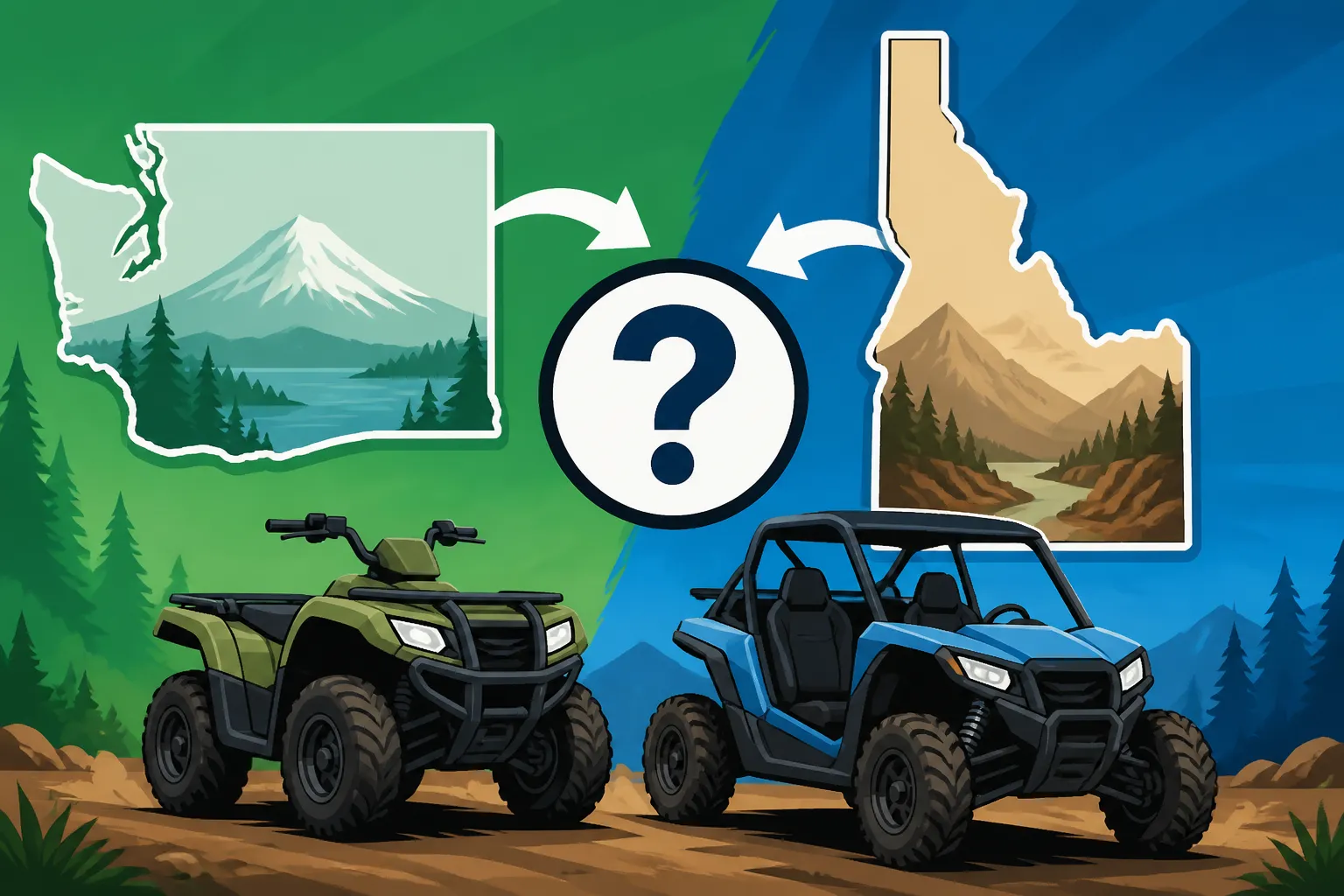
An Idaho OHV sticker may let you ride off-road in Washington, but it is not a universal pass for every trail, road, or public-land parking area. The key is whether the Idaho registration is current and Washington’s reciprocity rules cover your machine and the place you plan to ride. Here’s what the sticker does, what it does not do, and what to check before loading up.
When Washington generally accepts an Idaho sticker
Washington generally recognizes a valid out-of-state OHV registration for a nonresident’s off-road use when the home state provides reciprocal riding privileges. Idaho has an OHV registration program, so an Idaho-registered machine will generally have a registration credential to show. That does not mean every Idaho sticker is automatically accepted in every circumstance: the registration must be current, belong to the machine, and meet Washington’s reciprocity conditions.
The word “sticker” can refer to different things. Make sure yours is the Idaho OHV registration decal or other valid registration credential for the machine, rather than a parking pass, trail-access receipt, or permit for a particular Idaho riding area. If you are unsure what your document covers, check with the Idaho agency that issued it and confirm Washington’s current requirements before your trip.
Reciprocity is about registration. It does not make Washington treat the machine as if it were registered for every type of use. Your Idaho sticker may satisfy the registration requirement for off-road riding, but it does not, by itself, provide permission to ride a Washington public road or guarantee access to a specific trail system.
| What you want to do | Does an Idaho OHV sticker cover it? | What else to check |
|---|---|---|
| Ride off-road on an area open to your machine | Generally, if the Idaho registration is valid and reciprocity applies | Land-manager rules, closures, machine limits, and any separate access pass |
| Ride on a public road in Washington | No, not by itself | Washington road-use requirements and whether that road is open to WATVs |
| Park at a recreation site | Not necessarily | Whether the site requires a separate parking or recreation pass |
| Ride with a borrowed or recently purchased machine | Not automatically | Whether the registration matches the machine and who may legally use it |
For the broader rules that apply to riders from other states, see Washington ORV Reciprocity Rules. The practical question is not just “Do I have an Idaho sticker?” It is also “Is this the right registration for this machine, and is this place open to it?”
What the sticker does not authorize
It does not make an off-road machine street legal
An Idaho OHV sticker is not a Washington on-road tab. It does not certify that a quad, dirt bike, or side-by-side meets Washington’s equipment and registration requirements for road use. Even if the machine is registered for off-road use in Idaho, that alone does not authorize riding it along a Washington street or county road.
Some Washington machines can qualify for on-road use as wheeled all-terrain vehicles, or WATVs. That involves separate requirements, which can include the appropriate Washington registration and equipment, as well as road-use rules. A qualifying machine still may use only roads or segments where local rules permit it. An Idaho sticker does not replace any of those steps.
Before planning a paved connection, check both the machine requirements and the specific route. Washington Road Reciprocity and Its Conditions explains why road-use reciprocity is separate from ordinary off-road reciprocity. For a quick distinction between an off-road tab and permission to use pavement, see Riding Pavement With Only the Off-Road Tab.
It does not open a closed road or trail
Registration is not access permission. A valid Idaho sticker cannot override a posted closure, a seasonal restriction, a gate, a landowner’s rules, or a trail system’s machine restrictions. Public land is managed by different agencies, and each area can have rules about vehicle type, width, route designation, noise, spark arresters, and current closures.
Check the land manager’s current information for the exact riding area, not just a general map or an old social media post. Roads and trails may close for weather, fire danger, active work, or resource protection. Where access depends on a marked route or designated trail, stay on that route even if another road looks open.
It may not cover parking or other site charges
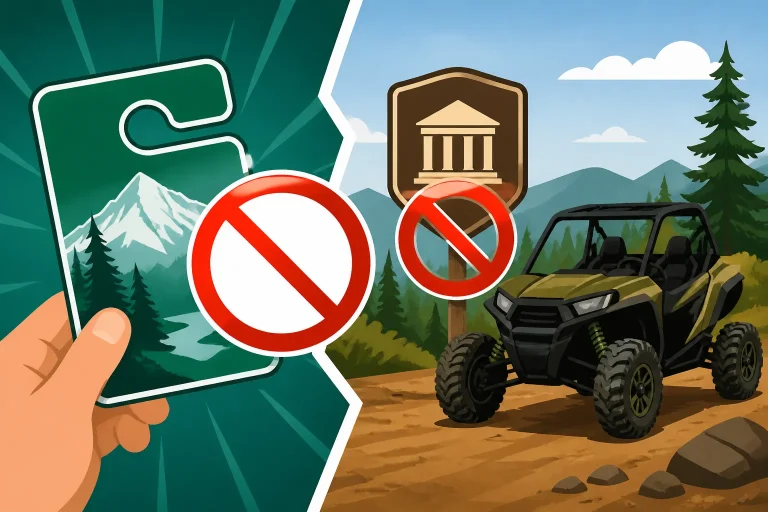
A vehicle registration sticker and a recreation-site parking pass serve different purposes. Depending on where you park or ride, Washington may require a separate pass or permit. The Idaho sticker should not be assumed to cover a Washington parking requirement.
Likewise, a pass for a trailhead or recreation area does not substitute for vehicle registration. Check the land manager’s instructions for the specific staging area or trailhead. Federal sites and Washington-managed lands can have different pass rules, so one pass should not be assumed to work everywhere.
What to check before riding in Washington
A short pre-trip check can prevent a long drive that ends at a closed gate or a registration problem. Use this sequence:
-
Confirm the Idaho registration is current. Check that the decal or document is valid for the ride dates and is associated with the machine you are bringing. If you recently bought the machine, borrowed it, or changed its registration, verify that the paperwork matches the current situation.
-
Confirm that reciprocity applies. Washington’s out-of-state rules depend on the registration and reciprocity conditions, not simply on where the rider lives. Review Riding Washington With an Out-of-State Registration and check current instructions from the relevant Washington agency if anything about your registration is unusual.
-
Check the riding area’s rules and status. Confirm that the area is open, that your machine type and size are allowed, and that your intended route is designated for motorized use. Land managers can change access or close routes, so check close to departure.
-
Look for a separate pass requirement. Identify the agency that manages the parking area and follow its instructions. If you will visit more than one kind of public land, check each destination rather than assuming the same pass applies everywhere.
-
Carry proof of registration. Keep the registration information with the machine and make sure it is readable if asked. Protect paper documents from rain and mud; a waterproof document sleeve from a retailer such as Amazon can help, but it does not replace carrying the required proof.
-
Check age and supervision rules for young riders. Registration does not exempt a rider from Washington’s youth requirements. If a child or teenager is coming along, review Washington’s Supervision Rule for Riders Under 16 before the trip.
These checks matter even when a rider has visited Washington before. A sticker that worked for one off-road area does not necessarily settle road access, parking, or the rules at a different land-management unit.
When an Idaho sticker may not be enough
A few situations deserve extra attention:
- The decal is expired or hard to identify. Do not assume that a faded sticker or an old registration card proves current registration. Get clarification from the issuing agency before traveling.
- The machine has changed hands. If the sticker or paperwork is still associated with a previous owner, make sure the registration is valid for the machine and that you have the documentation needed to show that connection.
- You are visiting from a state without applicable registration. Washington has a temporary ORV permit option for some visitors who do not have qualifying home-state registration. Idaho riders with valid Idaho registration generally should not assume they need that permit, but someone whose machine is not properly registered may need to explore the visitor rules. See [Washington Temporary ORV Permit for a Visitor] and confirm eligibility before relying on it.
- You plan to use paved roads. The Idaho sticker does not stand in for Washington’s road-use requirements. Confirm that the machine qualifies, that the route is legally open, and that you have any required Washington credentials.
- The registration or machine type is unusual. Imported machines, rentals, borrowed machines, and machines with paperwork problems can require a closer review. Ask the issuing agency or Washington licensing authorities what documentation applies rather than relying on another rider’s experience.
For off-road use, an Idaho sticker is generally a useful registration credential under Washington’s reciprocity framework when it is current and valid for the machine. Treat that as the starting point, not the end of the checklist. The trail must be open, the machine must be allowed, any separate parking pass must be handled, and road use requires its own permission.
If anything about the registration is unclear, confirm it with the agency that issued the Idaho credential and the Washington agency responsible for the land or use you have planned. That is especially important before a long trip, a ride involving paved connections, or a visit to an area with changing seasonal access.
Disclaimer
This article is for general informational purposes only and does not constitute professional advice. Laws, prices and regulations vary by location and change over time. Consult a qualified professional for guidance on your specific situation.