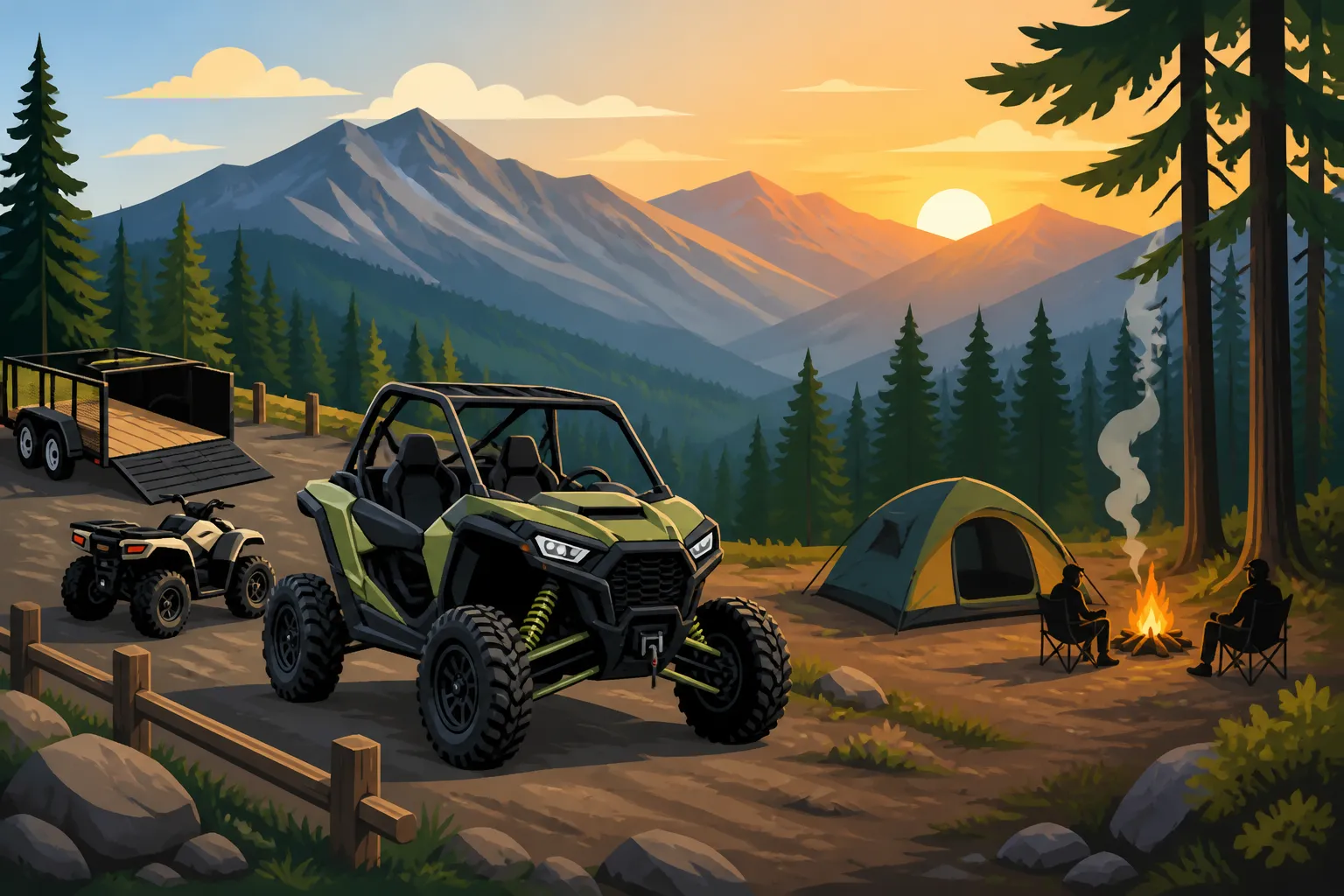
Dispersed Camping Beside a DNR Staging Lot
A late arrival at a Washington DNR staging lot can leave you with an awkward question: can you camp beside the parking area, or do you need to move to a designated campground? The answer depends on the land manager, posted restrictions, and the exact site. This guide explains how to check before you unload, what to bring, and how to leave the area ready for the next ride.
Can You Camp Beside a Washington DNR Staging Lot
A staging lot is not automatically a campsite
A DNR staging lot is primarily a place to park, unload, and access recreation land. It may have room for trailers and machines, but that does not mean overnight camping is allowed there. A sign, gate, closure notice, or posted rule at the site can limit parking hours or prohibit camping, fires, or other activities.
That distinction matters when you roll in after dark. An open gate and an empty parking area are not permission to stay overnight. A lot may be open for daytime trail access while overnight use is restricted, or it may be close to a campground with its own rules. Check the signs at the entrance and throughout the site rather than relying on what another rider did on a previous trip.
DNR recreation areas are not all alike. Some have developed campgrounds or established camping areas, while others are intended for day use or provide only limited facilities. Before planning to sleep beside a staging lot, confirm that overnight camping is allowed at that specific location. Washington DNR Forests Compared is a useful starting point for understanding that recreation settings and facilities differ across Washington.
Check the land manager and the exact site
The word “DNR” does not tell you everything you need to know. A route may pass through state-managed land, federal land, private timberland, or a mix of ownerships. The rules can change as you move from a staging lot onto an access road or trail. An area that looks like one continuous forest on a map may cross several property boundaries.
Look for the name of the land manager on posted signs, maps, or official recreation information. Then check the specific staging lot and any nearby campground or dispersed camping area. If a sign says day use only, do not treat a nearby pullout as a workaround. If the site has a designated camping area, use that rather than setting up in the parking or unloading space.
Digital maps can help you plan, but they do not grant permission to camp. For example, onX Offroad can help riders review routes and terrain before leaving home, but a map layer or a visible clearing is not confirmation that overnight use is allowed. Use onX Offroad as a planning aid, then compare what you see with the land manager’s current information and signs at the site.
Separate trail access from overnight access
A trailhead or staging lot may be a convenient place to begin a ride without being a convenient place to camp. Keep those two questions separate: “Can I ride from here?” and “Can I sleep here?” A valid answer to the first does not settle the second.
This is especially important around busy riding areas. A parked truck and trailer can take up the space another rider needs to unload, and a tent or camp setup can block access even when the lot looks quiet at dusk. If you are unsure, avoid occupying the staging area overnight and choose a campground or other location where camping is clearly permitted. For a broader look at planning around facilities and riding access, see Camping Near Washington ORV Areas.
How to Confirm Camping Is Allowed Before You Go
Check official notices before loading the trailer
Start with the land manager’s information for the specific recreation area, not just a general map pin or an old trip report. Look for camping details, temporary closures, fire restrictions, construction, timber activity, and changes to road or trail access. A place that worked for a previous visit may have different conditions now.
Make a short checklist before leaving home:
- Identify the staging lot and the land manager responsible for it.
- Look for information that specifically addresses overnight camping.
- Check notices for seasonal closures, fire restrictions, and active work.
- Confirm whether a nearby campground requires a separate reservation, pass, or fee.
- Save the location and relevant information for offline use.
- Recheck signs at the entrance when you arrive.
onX Offroad may help you organize routes and spot nearby access points, especially when you are comparing a staging area with a campground. Still, treat it as a navigation tool rather than the final word on camping rules. A mapped road or clearing does not necessarily mean you can drive, park, or camp there.
If official information is unclear, contact the land manager before the trip. A quick question can save a long late-night drive with a tired family and a loaded trailer. Ask about the exact lot or campground by name, whether overnight stays are allowed, and whether any seasonal restrictions apply.
Use maps to understand boundaries, not to assume permission
A map can show why a location needs a closer look. The apparent “space beside the lot” might be a road shoulder, a trail corridor, private timberland, or land managed under different rules. Even if the spot is physically accessible, camping there may not be permitted.
When using onX Offroad or another mapping tool, compare more than one layer if available. Look for property boundaries, roads, recreation points, and route connections, then verify important details with the land manager. Download maps before heading into an area with weak service, but remember that an offline map can become outdated and cannot show every temporary closure.
Pay particular attention to access roads that pass through working forest. A road may be closed during hauling or timber operations, and a gate can change the practical route to a campsite. Washington Trail Closures to Check First and Reading a DNR Recreation Map can help you think through what to verify before setting out.
Know what kind of camping you are planning
“Dispersed camping” generally means camping outside a developed campground, but the term does not mean “camp anywhere.” The rules depend on the land manager and the specific area. A wide gravel shoulder, an open patch next to a staging lot, or an old spur road should not be assumed to be an approved campsite.
A developed campground may have marked sites, toilets, fire facilities, or other services. A dispersed area may have none of those, and it may have restrictions about where vehicles can travel or how long visitors can stay. If you need a predictable place to park a tow vehicle and trailer overnight, a designated campground is often easier to plan around than an uncertain roadside spot.
| Camping option | What to confirm | Common planning concern |
|---|---|---|
| DNR staging lot | Whether overnight parking or camping is allowed | Lots may be intended for trail access and unloading |
| Developed campground | Site availability, vehicle rules, facilities, and any required pass or reservation | A campsite may be separate from the staging area |
| Dispersed camping area | Whether dispersed camping is allowed and where vehicles may go | The area may have few or no services |
| Roadside pullout | Land ownership, posted restrictions, and whether overnight use is allowed | A pullout can be a road feature, not a campsite |
| Private timberland | Permission from the landowner and any access conditions | Public-looking forest roads may cross private property |
Plan a Ride and an Overnight Stay That Work Together
Choose a base camp that fits your group
Your best overnight location depends on more than distance to the trail. Consider whether you are traveling with children, whether you need room to turn a trailer around, how late you expect to arrive, and whether anyone in your group needs a toilet, water, or a quieter place to sleep.
For example, a family arriving at Walker Valley with a trailer and a youth machine may find a designated campground more practical than trying to make a staging lot serve as both parking and camp. A group heading toward Capitol State Forest may want to compare nearby camping options with the particular access point they plan to use. The closest spot on a map is not always the easiest or most appropriate place to stay.
Before committing to a site, think through the morning routine. Can you reach the staging area without driving a road that is closed to your vehicle? Is there enough room to unload safely? Will your camp setup interfere with other visitors? These practical questions can make the difference between an easy start and a frustrating one.
For area-specific trip planning, Camping at a Washington ORV Area and Washington ORV Areas With Vault Toilets can help you compare the kinds of facilities that may matter to your group. Availability and access still need to be checked for the exact destination.
Pack for a site with few services
If you choose a location where camping is allowed but facilities are limited, arrive prepared to be self-sufficient. Bring drinking water, food, lighting, warm layers, and a way to manage waste without relying on services that may not exist. Keep essential gear accessible rather than buried under helmets, riding clothes, and recovery equipment.
Set up camp so it does not spill into parking, unloading, or travel space. A tent, awning, chairs, and cooking gear can quickly spread farther than expected, especially when the ground is uneven. Keep the trailer and tow vehicle positioned so you can leave without moving someone else’s equipment or blocking a road.
Wet weather deserves extra attention in Washington. A site that feels firm on a dry afternoon can turn muddy overnight, and a small low spot may collect water. Avoid driving off established surfaces to find a “better” patch. If your vehicle begins to sink or rut the ground, stop before the problem grows and reconsider where you are parked.
Keep the ride and camp area separate
Machines, fuel, cooking equipment, and sleeping space do not mix well when everything is crowded together. Park machines where they do not block access, keep fuel containers secured, and follow site rules for fires and cooking. Do not assume a fire is allowed just because you find an old ring or ashes; restrictions can change, and an existing fire ring may not mean a current authorization.
Give other campers and riders room to move around. Staging areas can be busy in the morning, even if they were nearly empty at night. Keep voices and engine noise down during quiet hours where they apply, and avoid warming up machines beside tents or occupied vehicles.
If you are riding from camp, make sure the route itself is legal for your machine and registration. Camping permission does not automatically authorize riding on a nearby road or trail. Review [Washington Rules for Riding DNR Land] and Washington Rules for Riding a Forest Road before treating a connecting road as a route to the trailhead.
Leave the Area in Good Shape and Have a Backup Plan
Pack out waste and protect the site
A good overnight stop should not leave evidence that you were there. Pack out food scraps, packaging, and other trash, including small items that are easy to miss in gravel or brush. Do not leave greywater, disposable wipes, or broken gear behind. If a site has toilets or waste facilities, use them according to posted directions; if it does not, be prepared to follow the land manager’s sanitation rules.
Keep vehicles on established surfaces and avoid widening a parking area by driving into vegetation. New tire tracks can damage plants, create erosion, and make a small staging area harder to manage. This is particularly easy to do when a trailer needs a wider turn than expected. If the space does not fit your setup, do not expand it by pushing into the shoulder or forest edge.
Wash mud and plant material off your machine when appropriate, but do it where cleaning is allowed and wastewater will not run into a creek or wetland. If you are visiting more than one riding area, take care not to carry seeds or soil from one place to another. Washing a Machine Before You Leave offers a useful reminder to make cleanup part of the trip rather than an afterthought.
Have a fallback if the lot is closed or full
Do not make a staging lot your only overnight plan, especially if you expect to arrive late, during a holiday weekend, or after a long drive. Identify a legal backup campground or another permitted place to stay before you leave. Save the directions offline and make sure your trailer can reach it.
If you arrive and the lot is full, closed, or clearly marked against overnight use, do not improvise by parking at a gate or blocking a road. Move to your backup location. If the only available option is unclear, contact the land manager or choose a place with explicit camping permission rather than risking a citation, an unsafe parking situation, or a difficult exit in the morning.
A backup plan also helps when weather changes. Heavy rain can make an informal pullout muddy, and a temporary closure can interrupt access to a road or trail. Check notices again before setting out and make sure someone in your group knows the alternate route and overnight destination.
Use a simple decision check before settling in
When you arrive, pause before unloading. Read posted signs, look for barriers or closure notices, confirm that the ground is suitable, and make sure your setup will not interfere with other visitors. If camping permission is not clear, treat that uncertainty as a reason to verify the rules rather than a reason to take a chance.
A practical final check is:
- Is overnight camping allowed at this exact site?
- Is the land manager clear, and have you checked that manager’s rules?
- Are you staying out of roads, trails, gates, and unloading areas?
- Do current closures or fire restrictions affect the area?
- Do you have another legal place to go if the answer changes?
That small pause can prevent a frustrating end to an otherwise great ride. It also helps keep Washington’s staging areas useful for everyone: riders who are unloading before dawn, families returning from the trail, and neighbors who share the surrounding land.
Disclaimer
This article is for general informational purposes only and does not constitute professional advice. Laws, prices and regulations vary by location and change over time. Consult a qualified professional for guidance on your specific situation.