Are ATVs Street Legal in Washington?
It’s a question that plagues nearly every Washington ATV or UTV owner: can I actually ride my machine on the street? The frustration of navigating confusing laws and conflicting information is real, and it often leaves riders wondering if their pride and joy is destined to only see dirt. This guide is here to untangle the complexities of Washington’s off-road vehicle laws, specifically addressing whether your ATV or UTV can legally hit the pavement, under what conditions, and where.
The Short Answer to Street Legality in Washington
The simple "yes" or "no" you might be looking for just doesn't exist when it comes to riding your ATV or UTV on Washington's roads. The reality is far more nuanced, woven into a tapestry of state definitions, required equipment, and local government decisions. It’s a common point of confusion, and frankly, a source of major headaches for riders trying to do the right thing and stay legal.
Why "Street Legal" Isn't a Simple Yes or No
When we talk about "street legal," many people picture a pickup truck or a sedan – a vehicle designed from the ground up for paved roads, highway speeds, and all the safety features that come with it. An ATV or UTV, by its very nature, is primarily an off-road beast. Its wide stance, knobby tires, and suspension are built for dirt, rocks, and mud, not smooth asphalt. Because of this fundamental difference, Washington state doesn't just wave a magic wand and declare all off-road vehicles ready for public streets. There are specific conditions that must be met, and even then, your access to roads is limited.
The biggest hurdle for many riders is understanding that state law allows for some road use for certain machines, but it’s always contingent on local jurisdictions. This means that what's perfectly fine in one county could get you a hefty ticket just across the county line. It's not like getting a driver's license that universally applies everywhere. Instead, you're looking at a patchwork quilt of rules that demands careful research of where you plan to ride. This lack of uniformity is precisely why many riders feel like they're constantly guessing.
The Definition of a "WATV" and Why It Matters
In Washington, the term "ATV" often gets lumped into a broader category called "ORV" (Off-Road Vehicle). However, for road use, there’s a critical distinction: the state specifically recognizes a "WATV" or Wheeled All-Terrain Vehicle. This isn't just semantics; it's the legal gateway to even considering road access. A WATV is generally defined as a motorized vehicle designed for off-road use, not for highway use, and includes ATVs, UTVs, side-by-sides, and sometimes even dirt bikes, provided they meet specific criteria.
To qualify as a WATV and be eligible for potential road use, your machine must first be titled and registered with the Department of Licensing. This means more than just your off-road tab; it involves specific paperwork like the [Titling a WATV in Washington] process and often a safety inspection. Without that WATV designation on your registration, your machine has zero chance of legally touching pavement beyond a quick crossing. Many riders overlook this initial step, assuming their standard ORV registration is enough, only to find themselves ineligible for further steps.
The WATV designation implies that your machine is capable of being equipped with the necessary safety features for road use, even if it wasn't originally manufactured with them. This is where the upgrade process begins, transforming your trail machine into something that can safely interact with other vehicles on public roads.
The Crucial Role of County and City Ordinances
Even if your machine is a fully registered and equipped WATV, you can't just hit any public road. This is perhaps the most frustrating aspect for riders: the decision ultimately rests with local governments. Washington state law dictates how counties and cities can open their roads to WATVs, but it doesn't force them to do so. This means that while the state sets the framework, local communities make the call.
For counties with a population greater than 15,000, they must actively "opt-in" by passing an ordinance to open specific roads. They must then publish a list of these approved roads. Conversely, in smaller, less populated counties (under 15,000 residents), the default is "open by default" for WATVs, unless the county passes an ordinance to "opt-out" and close specific roads. This means that [Washington Counties Over Fifteen Thousand Must Opt In], while [Washington Counties Under 15,000 Open by Default]. This distinction is critical and often trips up riders who assume state-level approval applies everywhere.
City streets have their own separate ordinances. Even if a county opens its roads, a city within that county might choose to keep its municipal streets closed, or only open a very limited number of them. You might be able to ride a county road right up to the city limits, only to find yourself forced to turn around. This local control means that knowing your specific route and checking with the relevant county and city websites is non-negotiable before you ever roll a tire onto pavement.
Understanding Washington's Road Use Categories for ORVs
Washington's laws carve out different types of road access for off-road vehicles, each with its own set of rules and limitations. It's not a one-size-fits-all scenario, and understanding these distinctions is key to staying out of trouble. Many riders mistakenly believe that any road with gravel is fair game, or that if they see someone else riding, it must be legal. Unfortunately, ignoring these categories can lead to serious fines.
Riding on Designated Nonhighway Roads
The most common and widely accepted form of "road" use for ORVs in Washington is on designated nonhighway roads, often found within state forests, national forests, or Department of Natural Resources (DNR) lands. These are typically gravel or dirt roads, sometimes old logging roads, that are specifically managed for both motorized and non-motorized recreation. While they might look like public roads, they fall under a different legal umbrella than county or city streets.
For these roads, your standard off-road tabs, often referred to as [Washington's Off-Road Tab Explained], are usually sufficient. You won't typically need the extensive list of equipment required for street-legal WATVs. These are the roads that connect trail systems, provide access to dispersed camping, or simply allow you to explore vast natural areas. It's crucial, however, to still carry your registration and identification. You can also expect to see signs clarifying whether a road is open to ORV use. Never assume that just because a road looks "unmaintained" it's automatically open to your machine. Always check current maps and regulations for the specific land manager (DNR, Forest Service, etc.).
These nonhighway roads are generally what most riders think of when they picture enjoying their machine off the beaten path, and they represent the vast majority of legal riding opportunities outside of dedicated trail systems. You'll often find these roads winding through areas like [Capitol State Forest Near Olympia, Washington] or [Ahtanum State Forest], providing miles of scenic riding.
Crossing Public Roads: The Quick Dash
There's a specific, limited allowance for ORVs to cross public roads, even if those roads aren't designated as WATV-friendly. This is not about riding on the road for any distance, but merely getting from one side to the other, perhaps to connect two sections of a trail or to access a staging area. It's a pragmatic rule that acknowledges the reality of fragmented trail systems.
The rules for [Washington Rules for Crossing a State Highway] are strict. You must come to a complete stop, yield to all traffic, and cross at approximately a 90-degree angle to the roadway. The crossing must be made at the safest point and in the most direct manner possible. You absolutely cannot ride along the shoulder or use the road as a shortcut to bypass a trail obstacle. Furthermore, the speed limit on the road you are crossing is a critical factor: you cannot cross a highway segment posted at 60 mph or higher. [Crossing a Highway Posted Fifty] is fine, but [Crossing a Highway Posted Between 35 and 60] requires extra caution and adhering to the speed limit restriction.
During these brief crossings, your machine is still expected to have basic lighting for visibility, even if it's not fully street-legal. Think of it as a momentary intersection with traffic where all parties need to see each other clearly. Always be hyper-aware of your surroundings and the speed of oncoming traffic; motorists may not expect an ORV to suddenly appear at the side of the road.
Riding the Pavement: The "WATV" Designation and Its Equipment
This is where the concept of "street legal" truly applies in Washington, but with significant caveats. If your machine is registered as a WATV and you're in a county or city that has specifically opened its roads, then you can ride on paved public roads. However, this comes with a long list of equipment requirements designed to bring your ORV closer to the safety standards of a conventional vehicle.
Beyond the WATV registration and a [Washington Road Use Declaration Form], your machine must undergo a safety inspection. This inspection ensures that your ATV or UTV has all the necessary lights, signals, mirrors, and other components to be safely operated on public roads. This isn't just a recommendation; it's a mandatory step. You'll need specific equipment like working headlights, tail lights, turn signals, mirrors, a horn, and often a windshield or eye protection. Some riders opt for aftermarket kits from companies like SuperATV to ensure their machines meet these detailed specifications, especially for components like [Turn Signals on a Washington Road Machine] and [Mirrors and a Horn for Washington Road Use].
Furthermore, when riding on these approved roads, you are bound by all traffic laws, including speed limits, stop signs, and signals. The maximum speed you can travel on an opened public road is 35 mph, regardless of the posted speed limit for other vehicles. If the posted limit is higher than 35 mph, you generally aren't allowed on that road, even if it's "open." You'll also need a valid driver's license and proof of insurance, just like in a car. All these rules are in place to ensure that when an ORV shares the road with cars, trucks, and motorcycles, it does so as safely as possible.
Equipping Your Machine for Washington Road Use
So, you’ve decided to pursue road legality for your WATV in Washington. This isn't just about sticking a new decal on your fender; it's about making tangible upgrades to your machine to meet specific safety standards. The goal is to make your off-road vehicle as visible and controllable as possible when sharing pavement with traditional traffic. Trying to get around these requirements will only lead to trouble and put yourself and others at risk.
Essential Lighting and Visibility Requirements
Visibility is paramount when you're sharing the road. Your WATV needs to be seen clearly, day or night, and its actions understood by other drivers. This means a full complement of functional lighting.
First, you'll need at least one, but ideally two, functional headlights. These headlights must be mounted between 24 and 54 inches from the ground and emit a white light visible for at least 500 feet. This isn't just about seeing where you're going on a dark trail; it's about being seen by oncoming traffic. Many stock ATV/UTV headlights might be adequate, but for optimal road safety, especially if you plan to ride at dusk or dawn, upgrading to brighter LED units might be a consideration.
At the rear, you'll need at least one tail light that emits a red light visible for 500 feet to the rear. Crucially, you also need a separate stop light (brake light) that activates when you apply the brakes, displaying a brighter red light. This is vital for signaling to vehicles behind you when you're slowing down or stopping. Finally, and perhaps most often overlooked by off-road purists, are turn signals. Your WATV must have both front and rear turn signals, flashing amber or red, clearly visible from front and rear, to indicate your intentions to turn or change lanes. Many riders turn to aftermarket solutions, like universal turn signal kits offered by SuperATV, to get their machines equipped with these necessary indicators. Without these, your ability to signal turns becomes dangerously ambiguous on a shared road.
Mirrors, Horn, and Safety Gear
Beyond lighting, there are other crucial pieces of equipment that bridge the gap between trail machine and road-legal vehicle. These are all about awareness and communication on the road.
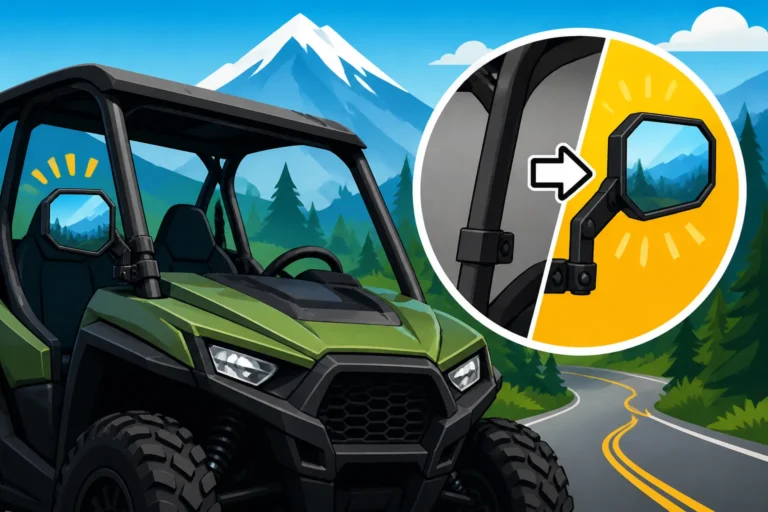
Every WATV intended for road use must have at least one rearview mirror, securely mounted to allow the driver to see at least 200 feet to the rear. While many UTVs come with a center rearview mirror, ATVs often require an aftermarket side mirror attachment. Having two mirrors, one on each side, is often recommended for better peripheral vision, providing a much clearer picture of traffic approaching from behind.
A functional horn is also mandatory. This isn't just for startling wildlife; it's a vital tool for alerting other drivers to your presence or avoiding potential hazards. The horn must be audible under normal conditions for at least 200 feet. It might seem like a small detail, but in a traffic situation, a working horn can be a lifesaver.
Other basic safety gear includes a spark arrester and a muffler system that keeps your machine within legal sound limits. While these are also standard for most trail riding, they become even more critical when operating in proximity to residential areas or other road users. Ensuring your exhaust system is in good repair and meets sound ordinances is part of being a responsible road user.
Beyond the Basics: Helmets, Seatbelts, and Driver Licensing
Just like with a car, operating a WATV on Washington public roads comes with specific requirements for the driver and any passengers. These aren't just equipment-based, but also behavioral and legal.
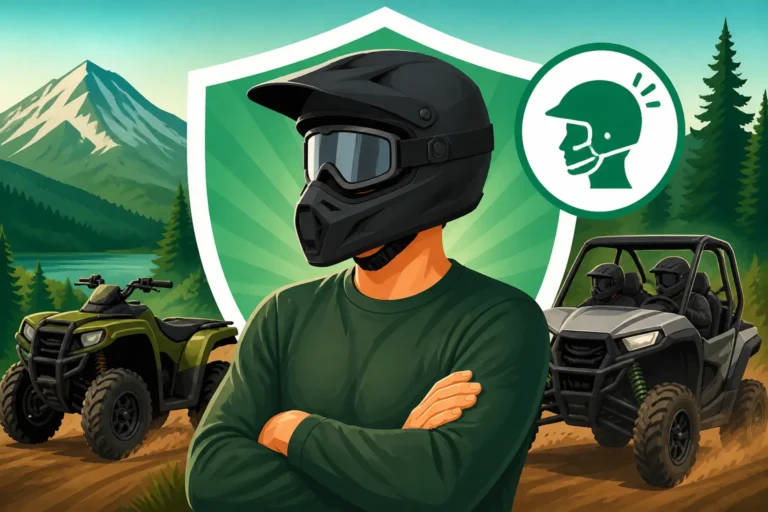
First, the helmet law. While many states have varying helmet rules, [Washington Helmet Law for WATV Riders] mandates that all operators and passengers of a WATV on public roads must wear a securely fastened, approved motorcycle helmet. This applies regardless of age or the presence of a windshield. This is a non-negotiable safety requirement that many riders who are used to trail riding without helmets often forget. It's a critical difference between off-road and on-road operation.
For utility vehicles (UTVs/side-by-sides), all occupants must wear a seatbelt, if the machine is equipped with them (which most modern UTVs are). These seatbelts must be properly adjusted and worn at all times while the vehicle is in motion on public roads. This rule aligns with standard vehicle safety practices.
Finally, the driver. Anyone operating a WATV on a public road must possess a valid driver's license. This isn't an ORV permit; it's a standard driver's license issued by Washington or another state. [Washington Driver License Rules for WATVs] are clear: you need to be a licensed driver. Furthermore, you must carry proof of insurance, as [Washington WATV Insurance Requirements] mandate liability coverage for any WATV operating on public roads. This protects you and others in the event of an accident. Ignoring these personal requirements can lead to citations, fines, and even suspension of your driving privileges, regardless of how perfectly equipped your machine is.
Navigating the Local Landscape: Where You Can Actually Ride on Roads
Even with your WATV perfectly equipped and inspected, and you, the driver, fully licensed and insured, you still can't just pick any road. Washington's unique approach to ORV road access means you need to be hyper-local in your research. This is where most riders get tripped up, thinking state-level permission means open season everywhere.
The "Opt-In" and "Opt-Out" County Rules
As we touched on earlier, the core of Washington's WATV road access lies in local control. Counties with a population over 15,000 must pass specific ordinances to "opt-in" and open their roads. If they haven't done so, or if a road isn't explicitly listed, it's closed to WATVs. For instance, [Snohomish County Ordinance 17-032] is one example of how a county has approached opening specific segments of its road system. These ordinances usually come with specific road lists, sometimes even defining the days or times of access.
Conversely, counties with a population under 15,000 operate on an "opt-out" basis. This means their roads are generally open by default, unless the county has passed an ordinance specifically closing certain roads. This often catches people by surprise, as they assume all roads are closed unless otherwise stated. It’s a subtle but critical difference. For example, smaller, more rural counties might have vast networks of roads open by default, making them popular destinations for WATV enthusiasts.
This dual system means that a road that looks identical in two different counties could have entirely different legal statuses for your WATV. It’s absolutely vital to know the population of the county you're in and whether they operate under an opt-in or opt-out rule.
Finding Approved Roads and Staying Legal
So, how do you find out which roads are open? It requires proactive research, and unfortunately, there isn't one single, statewide map or database. Your best bet is to go directly to the source: the county and city websites.
Most counties that have opted-in (or opted-out, in the case of smaller counties) will publish their WATV ordinances and lists of approved roads on their official government websites. Look for departments related to public works, transportation, or county clerk offices. It's not always easy to find, as sometimes the information is buried deep in meeting minutes or planning documents. However, this is the definitive source of information. You might find specific roads like [Old Owen, Mann and Ben Howard Roads] listed as open in a county ordinance.
A table outlining some common examples:
| Jurisdiction Type | Population Threshold | Default Status | Action Required for Change | Example Roads/Areas |
|---|---|---|---|---|
| County | Over 15,000 | Closed | Must Opt-In (Ordinance) | [Lewis County Ordinance 1286], specific roads in [Pierce County's Unincorporated Roads] |
| County | Under 15,000 | Open | Must Opt-Out (Ordinance) | Roads in Republic, Colville (unless specified closed) |
| City/Town | Any | Closed | Must Opt-In (Ordinance) | [Riding Through Lake Stevens], Riding the Streets of Republic |
| State Highways | Specific Segments | Generally Closed | WSDOT Authorization | Designated crossings, limited segments where authorized |
| Nonhighway Roads | N/A | Open (with ORV tabs) | N/A | Forest Service roads, DNR lands, trail access roads |
Always double-check the date of any ordinance you find, as regulations can change. What was open last year might be closed this year, or vice-versa. There's no substitute for current, local information.
Specific Examples of Open and Closed Areas
Let's look at some real-world examples to illustrate the point. In [Lewis County Ordinance 1286], certain county roads have been opened for WATV use, providing residents and visitors with access to areas like those connecting to trailheads. Similarly, some specific city streets in towns like [Republic, Colville and Kettle Falls] have been opened by local ordinances, allowing riders to pass through or access services. You can even find specific segments, such as [Riding Through Lake Stevens] which allows WATVs on designated municipal streets. These examples highlight that opportunities exist, but they are localized and require specific permission.
However, the opposite is also true. You'll find areas where WATVs are explicitly banned from public roads, even if the surrounding county might have some open sections. A prime example is [Why Long Beach Bans WATVs Outright]. Despite being a popular recreation area, the city has made a clear decision to keep WATVs off its streets, and attempting to ride there could lead to a quick citation. Even areas like the [Discovery Trail Is Closed to Machines], illustrating that even popular recreational paths might have restrictions.
The key takeaway is that you cannot assume. Before you load up your machine and head out, invest the time to research the specific roads, counties, and cities you plan to traverse. A quick phone call to the local sheriff's office or city hall can save you a lot of grief and ensure your WATV adventure remains a fun, legal one. Remember, the onus is always on the rider to know and follow the law, and claiming ignorance won't get you out of a ticket.
Disclaimer
This article is for general informational purposes only and does not constitute professional advice. Laws, prices and regulations vary by location and change over time. Consult a qualified professional for guidance on your specific situation.