Washington Rules for Riding a City Street
It can feel incredibly frustrating when you just want to take your WATV a few blocks down to the store or connect two fantastic trail systems, only to be met with a confusing maze of local rules about riding on city streets in Washington. You've got your machine, you've heard whispers that some cities allow it, but figuring out where and how to legally do it often feels like an impossible puzzle. This guide is here to clear up that confusion, explaining exactly what Washington State law says, what local cities can do, and what you need to know before you ever consider riding your WATV on city pavement.
Understanding Washington's Framework for WATVs on City Streets
Washington State law has a specific framework for Wheeled All-Terrain Vehicles (WATVs), which include your quads, side-by-sides, and even dirt bikes when they meet certain criteria, to be ridden on public roads. However, it's not a free-for-all, especially when it comes to the bustling, often congested, environment of city streets. The state sets the overarching rules, but individual cities hold a significant amount of power in deciding how, or even if, WATVs can operate within their municipal limits.
State Law vs. Local Ordinances
The foundational state law (RCW 46.09.455) gives cities and counties the option to open their roads to WATVs. This is a critical distinction: cities are not mandated to allow WATVs on their streets. Instead, they must proactively pass an ordinance to designate specific streets or segments of streets for WATV use. If a city hasn't passed such an ordinance, then WATV use on its streets is generally prohibited. This is why you'll find a patchwork of rules across Washington, with some towns fully embracing WATV access and others maintaining a strict ban.
Imagine you're planning a weekend ride that involves traversing a small town to get from one forest road to another. You might have heard that the county roads leading into town are open for WATVs, which is fantastic. But then you hit the city limits, and suddenly, you're not sure if you can legally continue. You see other vehicles, sure, but what about your side-by-side? The county's decision to open roads doesn't automatically extend to the city's streets. You absolutely must check the specific city ordinance, because what's allowed just outside the city line might be a ticketable offense inside. This situation is a common source of frustration for riders trying to connect the dots on a longer journey. [Washington Rules for Riding a County Road] might be clear, but a city's approach can be entirely different.
The Critical 35 MPH Speed Limit and Its Implications
Even if a city does pass an ordinance to allow WATVs on its streets, there's a significant statewide restriction that applies: WATVs are generally prohibited from operating on public roads or highways with a posted speed limit greater than 35 miles per hour. This rule is a major factor in determining which city streets are viable for WATV use. Most main arterial roads, busy thoroughfares, and state highways passing through cities will have speed limits well above 35 mph, effectively making them off-limits.
Consider a scenario where you live in a town that has embraced WATV use. You're thrilled you can ride to the local hardware store or meet friends at a diner downtown. However, the quickest route involves a segment of Main Street that's posted at 45 mph. Even if the city has an ordinance allowing WATVs on other streets, that specific 45 mph stretch is still off-limits due to state law. You'd need to find an alternative route, perhaps using residential side streets or designated corridors, to stay within the legal framework. This 35 mph cap is designed with safety in mind, acknowledging the differing dynamics between WATVs and traditional vehicles at higher speeds. It's not just a suggestion; it's a hard limit that law enforcement will enforce. [Washington's 35 mph Road Rule] is truly the ceiling for where you can legally drive your WATV on a city street.
Unlocking Your City: How to Find Local WATV Rules
The biggest hurdle for many WATV enthusiasts wanting to ride city streets in Washington isn't necessarily the state law, but rather the hunt for specific local ordinances. Because each city has the autonomy to create its own rules, there isn't one universal map or website that will tell you where you can and cannot ride. It takes a bit of detective work, but knowing where to look can save you from potential fines and headaches.
Navigating City Hall and Online Resources
The most reliable way to find out if a city allows WATVs on its streets, and if so, which ones, is to go straight to the source: the city itself. Start by visiting the city's official website. Look for sections related to "municipal code," "ordinances," "transportation," or "public works." Many cities will publish their ordinances online in a searchable database. You can often use keywords like "WATV," "ORV," "all-terrain vehicle," or "off-road vehicle" in their site's search function. If you can't find anything definitive online, the next step is to call the city clerk's office or the local police department. These departments are usually well-versed in local traffic laws and can direct you to the specific ordinance or confirm if no such ordinance exists.
Imagine you're visiting Republic, Washington, for a riding trip, known for its incredible natural beauty. You might want to grab supplies from a store in town or simply explore the quaint streets before heading to the trails. Before you even think about firing up your WATV on city pavement, your first move should be to search "Republic, Washington WATV ordinance" online or call the Republic City Hall. Don't assume that just because it's a rural area, city streets are fair game. A common misconception is that if a city doesn't explicitly ban something, it's allowed. With WATVs, it's the opposite: if a city hasn't explicitly opened its streets via ordinance, then they remain closed. [Washington Cities That Allow WATVs on Streets] will have unique approaches that require your diligent research.
Common City Street Restrictions and Designated Routes
When a city does open its streets to WATVs, it's very rare that it allows access to all streets. Most cities will designate specific routes or corridors. These routes are often chosen to connect popular trailheads, allow access to local businesses, or provide a bypass around state highways where WATVs are generally prohibited. You might find that only certain non-arterial roads, residential streets, or routes leading to industrial areas are open. These ordinances will also often include other restrictions that go beyond state law, such as specific hours of operation (e.g., no riding after dark), limitations on noise levels, or even specific requirements for helmet use that might extend to all passengers regardless of age, even when state law might differ slightly for older passengers.
For example, a city might designate a specific loop of streets that allows WATV riders to access the downtown business district for fuel and food, but prohibits them from riding on the main highway that bisects the town. You might also find that while the state allows passengers under certain conditions, a city ordinance could restrict passenger numbers or require specific seating configurations for safety within their more congested areas. Some ordinances might even specify limitations on overall vehicle width to ensure they can safely share narrower city streets. While [Washington Rules for Riding After Dark] are important, a city might impose an earlier curfew for WATV use on its streets. Accessories like specific turn signal kits or wider mirrors, perhaps from brands like SuperATV, can be extremely helpful for complying with these city-specific equipment requirements, ensuring your machine is visibly safe and legal for shared urban spaces.
Gearing Up for City Rides: Legal Requirements and Equipment
So, you've done your homework, and you've found a city that legally allows WATV access on some of its streets. Fantastic! But before you hit the pavement, you need to ensure both you and your machine meet all the necessary state and local legal requirements. This isn't just about avoiding a ticket; it's about safety for yourself, your passengers, and everyone else sharing the road.
Driver Licensing, Registration, and Insurance Essentials
First and foremost, the driver of a WATV on any public road in Washington, including city streets, must possess a valid driver's license. This isn't like riding off-road on designated trails where a license might not be strictly necessary for adults. On the street, you are operating a motor vehicle, and the same licensing rules apply. Your WATV also needs to be properly registered with the Washington State Department of Licensing (DOL), and crucially, it must have the "on-road" tab in addition to the standard off-road tab. This $12 on-road tab is what legally permits your WATV to use designated public roads and city streets. Without it, even if a street is open, you're not legal.
Beyond licensing and registration, insurance is a non-negotiable requirement for WATV use on public roads in Washington. Just like with a car, you must carry proof of liability insurance. This protects you and others in case of an accident. While specific coverage amounts can vary, it's vital to have at least the state-mandated minimums. Riding uninsured on city streets leaves you financially vulnerable and is an easily discoverable offense during a roadside stop. It's often tempting to think, "Oh, I'm just going a few blocks," but those few blocks are exactly where unexpected incidents can occur. Don't let a short trip turn into a long-term financial nightmare. Check out the details of [Washington WATV Registration Cost] and [Washington WATV Insurance Requirements] to ensure you're fully covered.
Mandatory WATV Equipment for Road Legality
Beyond the tabs and insurance, your WATV itself must be equipped to meet specific safety standards for road use. These aren't suggestions; they are legal mandates designed to make your machine visible and controllable in traffic. The equipment list includes:
- Headlamps: At least one, mounted to illuminate the road ahead.
- Tail Lamps: At least one, clearly visible from the rear.
- Stop Lamps: Functioning brake lights.
- Turn Signals: Front and rear, clearly visible and operational.
- Mirrors: At least one rearview mirror, typically on the left side, or two if the vehicle is designed for them.
- Horn: An audible warning device.
- Windshield or Eye Protection: If your WATV doesn't have a windshield, you must wear eye protection (goggles or a face shield).
- Seat Belts: If your WATV (like many side-by-sides) is designed with seatbelts, they must be worn by all occupants.
- Spark Arrester and Muffler: While often associated with trail riding, these are still legal requirements to control noise and prevent fires.
And, critically, everyone riding on a WATV on a city street, whether driver or passenger, must wear a DOT-compliant helmet. This rule applies to all ages, unlike some other states that might exempt adult riders. This is a primary safety measure that cannot be overlooked. For many WATV owners, adding items like turn signals and appropriate mirrors might be aftermarket installations. Companies like SuperATV offer a range of universal and model-specific kits that can help you bring your machine into compliance with these road-legal requirements, ensuring you have all the necessary components. Understanding [Washington Helmet Law for WATV Riders] is crucial for both safety and legality. Similarly, ensuring your machine has a proper [Washington Spark Arrester Requirement] is not just for forest trails but also a general state law for ORVs.
Riding Smart: Best Practices and Enforcement on City Streets
Riding a WATV on city streets, even where permitted, is a privilege that comes with significant responsibility. Unlike a dirt trail where you might only encounter other off-road enthusiasts, city streets are shared with cars, trucks, bicycles, and pedestrians. Understanding what to expect from law enforcement and adopting best practices will ensure a safer, more enjoyable, and legally compliant experience.
What to Expect During a Roadside Stop
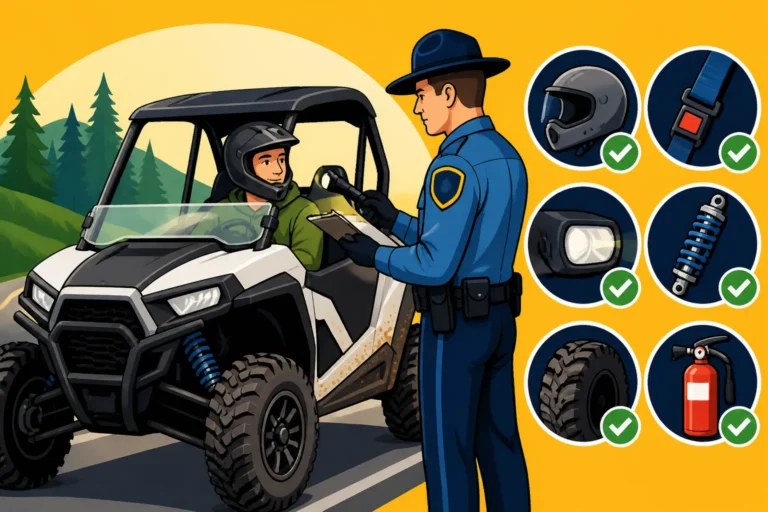
If you're riding your WATV on a city street, you should always be prepared for a potential roadside stop, just as you would in a car. A law enforcement officer, whether local police or a Washington State Trooper, will primarily be looking for compliance with the on-road requirements. They will likely check for:
- Valid Driver's License: Do you have it, and is it current?
- WATV Registration and Tabs: Do you have the current year's off-road tab, and more importantly for street use, the $12 on-road tab? Is your metal tag properly mounted?
- Proof of Insurance: Can you provide a current insurance card?
- Required Equipment: Do your headlamps, tail lamps, stop lamps, turn signals, mirrors, and horn all work? Are you and your passengers wearing DOT-compliant helmets?
- City Ordinance Compliance: Are you on a street specifically designated for WATV use? Is the speed limit 35 mph or less?
Failure to meet any of these requirements can result in citations, fines, or even having your WATV impounded. For instance, riding on an undesignated street or one with a speed limit over 35 mph can lead to a significant fine, much like driving an unregistered vehicle. Ignorance of the local ordinance is rarely an acceptable excuse. Be sure you know [What a Washington Trooper Checks Roadside] to be fully prepared. The penalties can be steep, so understanding [Washington Fines for an Unregistered WATV] or an improperly equipped one is a strong incentive to comply.
Becoming a Responsible Urban WATV Rider
Beyond strict legal compliance, being a responsible and courteous rider in an urban environment is crucial. The ability to ride WATVs on city streets is often the result of community advocacy and careful consideration by local governments. Your actions reflect on the entire riding community. Here are some best practices:
- Be Predictable and Visible: Use your turn signals well in advance, maintain a consistent speed, and avoid sudden maneuvers. Ensure your lights are always on.
- Share the Road: WATVs are often narrower than cars, but that doesn't mean you should try to squeeze past traffic or ride on shoulders unless legally permitted. Adhere to lane markings and respect other road users. [Washington Rules for Riding Two Abreast] are especially important on city streets, as it's generally prohibited.
- Respect Noise Limits: While state law has muffler requirements, local ordinances might have even stricter noise curfews or general nuisance clauses. Be mindful of your engine noise, especially in residential areas.
- Maintain a Safe Distance: Your WATV might handle differently than a car, especially when braking. Leave ample space between yourself and the vehicle in front of you.
- Park Legally: Just like any other vehicle, park your WATV in designated parking spaces and adhere to all parking regulations. Don't block sidewalks or store entrances. If you've accessorized your machine with practical cargo solutions, perhaps from SuperATV, it makes running errands more convenient without needing to carry items precariously.
- Advocate Positively: If you appreciate the ability to ride on city streets, be a good ambassador for the sport. Follow the rules, ride safely, and demonstrate that WATVs can coexist harmoniously with other urban traffic. Your responsible behavior helps maintain and even expand access for all riders.
WATV Road Use Comparison
Here's a quick look at some key differences between typical off-road trail riding and legally riding your WATV on Washington city streets:
| Requirement | City Street Use (Where Permitted) | Off-Road Trail Use (Designated Trails) |
|---|---|---|
| Registration | Required (Off-road tab + $12 on-road tab) | Required (Off-road tab only) |
| Driver's License | Required (Valid WA state driver's license for operator) | Not always required for adults (though recommended for minors with supervision) |
| Insurance | Required (Proof of liability insurance) | Not legally required by state law (but highly recommended) |
| Helmets | Required for ALL riders and passengers (DOT-compliant) | Required for ALL riders and passengers (DOT-compliant) |
| Turn Signals | Required (Front and rear, operational) | Not required |
| Mirrors | Required (At least one rearview mirror) | Not required |
| Horn | Required (Audible warning device) | Not required |
| Max Speed Limit | 35 mph (State law override if city ordinance permits higher speed on a specific street type) | N/A (Trail speed limits apply, often much lower) |
| Road Type | Specific streets designated by city ordinance, speed limit ≤ 35 mph, no state highways | Designated off-road trails on DNR, USFS, or private land with permission |
Disclaimer
This article is for general informational purposes only and does not constitute professional advice. Laws, prices and regulations vary by location and change over time. Consult a qualified professional for guidance on your specific situation.