Washington Golf Cart Street Rules
Navigating the myriad of rules for off-road vehicles on Washington’s public roads can feel like trying to untangle a knotted fishing line, and when you throw golf carts into the mix, it often just adds another layer of confusion. Many folks assume that because a golf cart is slow and often seen in neighborhoods, it must be inherently street-legal for a quick run to the corner store or a neighbor’s house. However, that's rarely the case without jumping through some very specific hoops. This guide is designed to cut through that confusion, explaining exactly what Washington law says about golf carts on streets and roads, what’s required, and where you can actually ride them without a headache or a ticket.
Understanding What a Golf Cart Is in Washington's Eyes
First things first, let's talk about definitions. In Washington, not every small, electric, four-wheeled vehicle is treated the same. The state law has specific categories, and your vehicle's designation dictates where and how you can operate it on public roads. A "golf cart" isn't necessarily a "street-legal golf cart" by default, and it certainly isn't a [Washington Low-Speed Vehicle Rules] (LSV) or a [Washington WATV Road Requirements] (wheeled all-terrain vehicle) just because it has four wheels.
A true golf cart, according to Washington law, is a small, electric-powered vehicle with at least three wheels, designed for carrying golf equipment and players around a golf course. The key here is its design purpose. It’s made for the greens, not the highways. This distinction is incredibly important because it means golf carts aren't held to the same safety and equipment standards as regular passenger cars, or even other categories of recreational vehicles like ATVs and UTVs that might be modified for street use. Most golf carts are designed for speeds typically under 20-25 mph, which immediately places them in a different operational class. You won't find them equipped with the robust safety features or speed capabilities of a vehicle intended for regular traffic, and Washington law acknowledges this by giving them their own specific, and often very restrictive, set of rules for road use.
Golf Cart Versus Low-Speed Vehicle (LSV)
This is where a lot of people get tripped up. Many golf carts look like what some states might call a "street-legal golf cart" or even an LSV, but in Washington, the classification is distinct and carries different implications for road use. A Low-Speed Vehicle (LSV) is a whole different beast. An LSV is specifically manufactured to comply with federal safety standards for low-speed vehicles, meaning it comes from the factory with features like headlights, taillights, turn signals, seat belts, mirrors, a windshield, and a VIN (Vehicle Identification Number) that allows it to be titled and registered. They are typically designed to go between 20 mph and 25 mph.
A golf cart, on the other hand, rarely has all these features straight from the manufacturer, and even if you add them aftermarket (perhaps with parts from a reputable supplier like SuperATV), it usually won't magically transform into a true LSV in the eyes of the law. The designation comes down to how the vehicle was originally manufactured and certified. If your vehicle was built solely for the golf course, it’s a golf cart, regardless of the fancy accessories you bolt on later. Trying to register a converted golf cart as an LSV can be a frustrating and often unsuccessful endeavor, as it requires meeting those federal manufacturing standards, not just having the right lights. It's crucial to know the difference before you ever consider taking your cart off private property.
Where Can Golf Carts Legally Roll on Washington Streets?
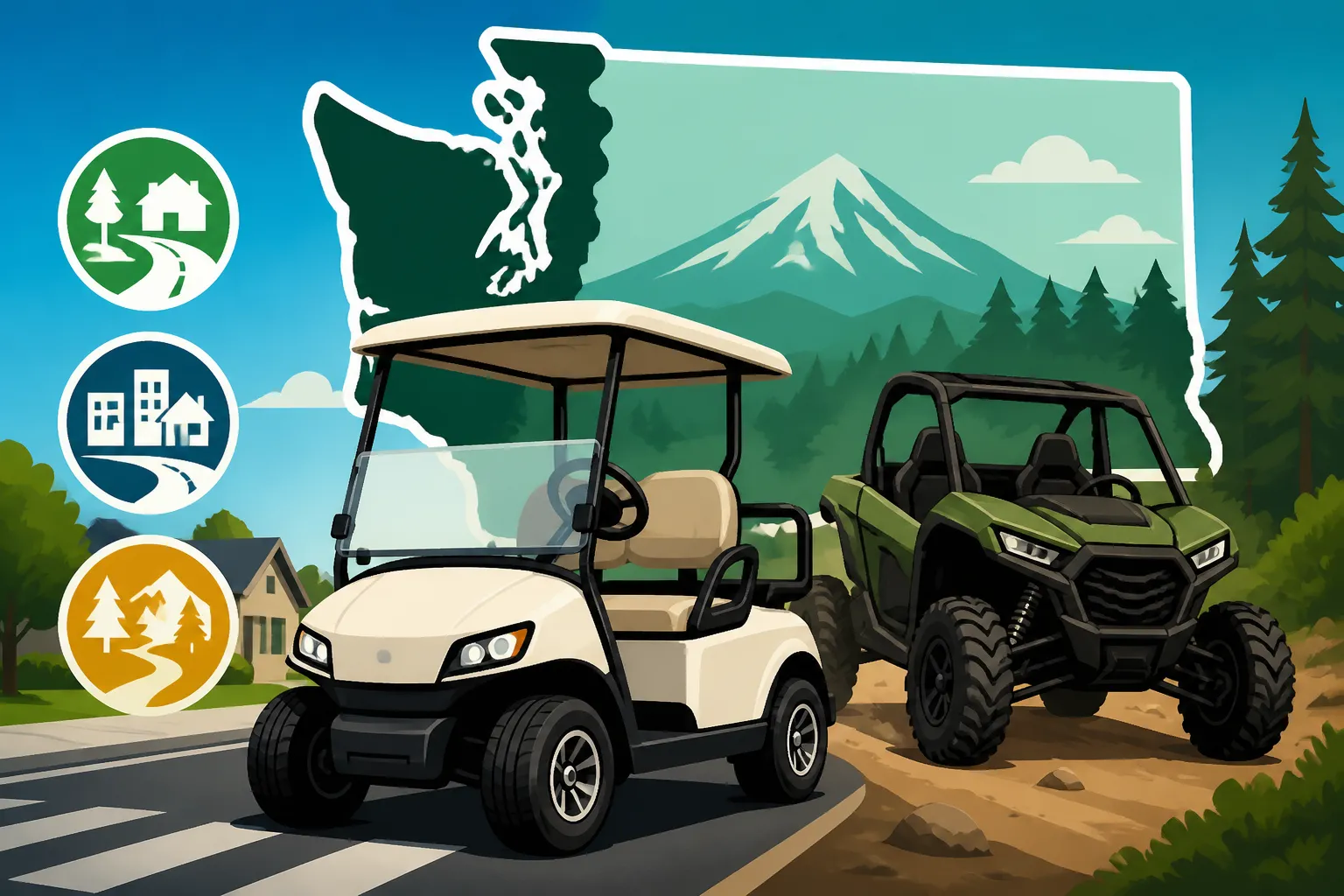
Unlike WATVs, which have a broader framework for road access that includes state-level allowances for certain county roads [Washington Rules for Riding a County Road], golf cart use on public roads in Washington is almost entirely up to local jurisdictions – meaning individual cities and counties. This means there's no blanket "golf carts are street legal everywhere" rule across the state. Instead, you're looking at a patchwork of local ordinances, and the rules can literally change as you cross a city limit line.
The primary condition for a golf cart to be street-legal on a public roadway is that a city, town, or county legislative authority must adopt an ordinance specifically allowing it. Without that local ordinance, your golf cart is generally restricted to private property or designated golf cart paths. Even when an ordinance is in place, it usually comes with very strict stipulations about where you can ride and under what conditions.
Local Ordinances and Designated Areas
Most local ordinances that allow golf carts on public roads will specify very particular areas. This often means only on roads within a certain residential community, a specific section of town, or sometimes even just on specific streets to connect parts of a community to a golf course or local services. These roads are almost always low-speed, low-traffic areas. You won't find golf carts legally cruising down major arterial roads or state highways. The reason is simple: safety. Golf carts are slow, lack the protective features of cars, and can pose a significant hazard on roads with higher speed limits or heavy traffic.
For example, a city might allow golf carts on roads with a speed limit of 25 mph or less, and only during daylight hours. They might even designate specific "golf cart routes" that drivers must stick to. It's not uncommon for these ordinances to also stipulate that the driver must possess a valid driver's license. Before you ever consider taking your golf cart onto a public road, your first step must be to check with your local city or county government’s planning or transportation department to see if such an ordinance exists, and if so, what its exact parameters are. Assuming you can ride based on what you’ve seen in other states or even neighboring towns is a recipe for a costly citation.
Essential Equipment for Washington Road-Legal Golf Carts
Even if a local ordinance permits golf carts on certain roads, your cart isn't ready to roll out of the garage without some modifications. Washington law, and by extension, any local ordinance, will require specific safety equipment to ensure the golf cart is reasonably visible and operable for limited road use. Think of it like a minimum safety checklist for any vehicle sharing public space. This isn't about making your golf cart a race machine, but ensuring it can be seen and operated predictably alongside other, much larger vehicles.
These requirements are typically aimed at basic visibility and operational safety, similar in spirit to what's expected for other low-speed vehicles, though usually not as stringent as for a full-fledged WATV. You might even find yourself looking at aftermarket parts designed for UTVs, like those from SuperATV, to ensure your golf cart meets the necessary standards for lighting and mirrors, even if they aren't specifically golf cart branded.
Mandatory Safety Features and Gear
To be legally operated on a public road in Washington, even where permitted by local ordinance, a golf cart must generally be equipped with the following:
- Headlights: You need at least one, but usually two, functional headlights that cast a visible beam for a specified distance. If you plan on any dusk or dawn riding, this is non-negotiable.
- Taillights: At least one, but preferably two, red taillights visible from a certain distance to the rear. This is crucial for being seen by vehicles approaching from behind.
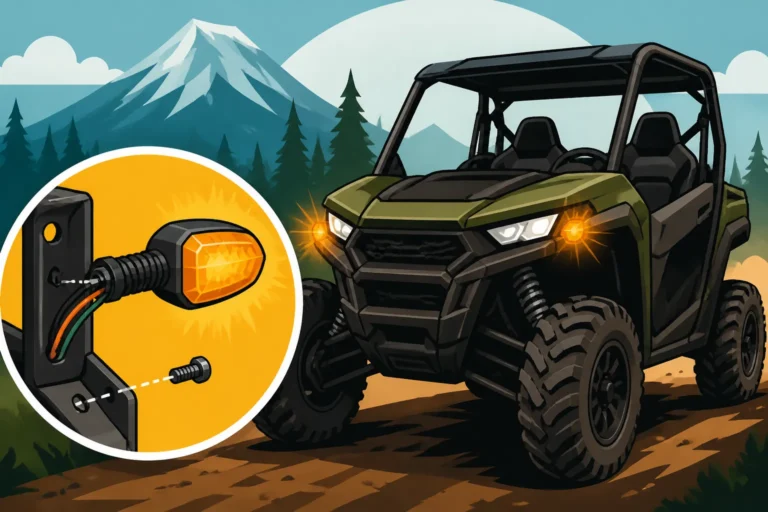
- Turn Signals: Functional front and rear turn signals are usually required. Signaling your intentions is vital for safety on any public road.
- Stop Lamps: When you hit the brakes, a red stop lamp (or lamps) needs to illuminate to warn following traffic.
- Mirrors: You’ll need at least one rear-view mirror, and often a left-side mirror as well, allowing you to see traffic approaching from behind and to the side. For wider carts, two mirrors might be a good idea. Brands like SuperATV offer universal mirror kits that can often be adapted for golf carts.
- Reflectors: Additional reflectors (red to the rear, amber to the front/sides) can enhance visibility, especially at night or in low-light conditions.
- Brakes: A properly functioning braking system capable of stopping the vehicle safely.
- Horn: A horn that can be heard at a specified distance, to alert pedestrians or other drivers. [Does Washington Require a Horn on an ORV?] Yes, and golf carts are no exception if riding on roads.
- Tires: Tires that are in good condition and safe for road use.
- Seat Belts: While not always explicitly required for golf carts in every local ordinance, many jurisdictions will mandate seat belts for driver and passengers, especially if the cart has been modified to carry more than just two people.
- Windshield: A non-shattering windshield is often required, or at minimum, eye protection for the operator. [Washington Windshield or Goggle Rule] for WATVs offers a good parallel here.
It's important to remember that these are general requirements. The specific details, such as light intensity or mirror placement, might be outlined in the local ordinance itself. Always check the exact wording of the local law before assuming your cart is compliant.
Comparing Road Rules: Golf Carts, LSVs, and WATVs in Washington
Understanding the distinct categories of vehicles allowed on Washington roads can prevent a lot of headaches and fines. While they all share some common ground in terms of safety equipment, their legal definitions, registration processes, and permitted operating areas are quite different. This is often where riders make assumptions, especially when they see a modified UTV that looks a lot like a beefed-up golf cart, or vice-versa. Let's break down the key differences.
Golf carts are at the most restrictive end of the spectrum for road use, followed by LSVs, and then WATVs, which generally have the broadest (though still limited) road access under state law. This table helps summarize the main points of distinction for clarity.
| Feature / Vehicle Type | Golf Cart | Low-Speed Vehicle (LSV) | Wheeled All-Terrain Vehicle (WATV) |
|---|---|---|---|
| Primary Purpose | Golf course transit | Neighborhood/community short-distance travel | Off-road recreation (trails, dunes) |
| Manufacturing | Designed for golf courses | Federally certified to meet LSV safety standards (FMVSS 500) | Designed for off-road use; can be modified for road use |
| Speed Range | Typically < 20-25 mph | 20-25 mph (by definition) | Varies widely, often 40-70+ mph (limited to 35 mph on most open roads) |
| Road Legality | Only by specific local (city/county) ordinance on designated, low-speed roads | Can be street-legal on roads 35 mph or less (unless restricted by local ordinance) | State law allows on county roads 35 mph or less if county opts-in; state highways generally for crossing only [Washington Rules for Getting Across a Road] |
| Registration/Title | Generally not titled or registered with the state (unless converted and registered as LSV or WATV, which is rare for a golf cart) | Must be titled and registered with WA DOL; requires street-legal equipment | Must be titled and registered with WA DOL; requires off-road tab, and on-road tab for road use |
| Equipment Req. | Head/taillights, turn signals, stop lamps, mirrors, horn, brakes (as per local ordinance) | Full DOT-approved street-legal equipment (lights, signals, mirrors, horn, seatbelts, VIN) | Full street-legal equipment (headlights, taillights, turn signals, mirrors, horn, seatbelts, windshield/eye protection, DOT tires) [Washington WATV Road Requirements] |
| Driver License | Usually required (valid driver's license) | Required (valid driver's license) [Washington Driver License Rules for WATVs] | Required (valid driver's license) |
| Insurance | Check local ordinance; often not required (but always recommended) | Required (liability) | Required (liability) for on-road use [Washington WATV Insurance Requirement] |
| Helmet Law | Generally no specific helmet law | Generally no specific helmet law | Required for riders and passengers under 16, and generally recommended for all [Washington Helmet Law for WATV Riders] |
The Nuances of Road Access
The biggest takeaway from this comparison is that a golf cart's journey from the green to the street is often a much harder and more localized path than that of an LSV or a WATV. An LSV, by its very nature and federal certification, is designed for limited road use and often has an easier time gaining access, provided the road speed limit is 35 mph or less and no local ordinance explicitly bans them. WATVs, while designed for off-road, have specific state laws ([Washington Rules for Riding a County Road]) that allow them on certain county roads if a county has opted into the program and equipped the machine correctly.
Golf carts, however, rely entirely on specific local legislative action. This means that your golf cart might be perfectly legal to drive on a street in one planned community in Olympia, but just a few miles away, in an unincorporated area of Thurston County, it could be illegal on an identical stretch of road unless that county has its own specific ordinance. This fragmented approach means riders absolutely must do their homework at the hyper-local level. Adding accessories for visibility and safety from a company like SuperATV is a good start, but it won't supersede the fundamental requirement of a local ordinance. Without that, even the most tricked-out golf cart is just a very nice machine for private property.
Disclaimer
This article is for general informational purposes only and does not constitute professional advice. Laws, prices and regulations vary by location and change over time. Consult a qualified professional for guidance on your specific situation.