Washington Fire Restrictions That Close Trails
A fire restriction does not always mean the same thing as a trail closure. For Washington ATV and UTV riders, the difference matters: an area may stay open while campfires or other activities are limited, or access may be shut altogether. Here’s how to tell what a notice means, where to check before a ride, and what to do when conditions change.
Fire restrictions and trail closures are different
A fire restriction limits activities that could start or spread a fire. Depending on the land manager and current conditions, that might mean no campfires, limits on smoking, or rules for operating equipment that could create sparks. A restriction may apply across a large area even if its trails remain open.
A trail or area closure is different: it restricts access to some or all of the affected land. Officials may close a trail because of high fire danger, an active wildfire, firefighting work, or the risk that riders could interfere with emergency crews. A closure can apply to a specific route, staging area, road, or wider recreation area. It may also change as conditions develop.
The wording of the notice matters. “Fire restrictions in effect” does not automatically mean every trail is closed, while “area closed” should not be treated as a warning you can choose to ignore. Read the full notice for its boundaries, effective period, and specific rules. If it is unclear whether your intended route is affected, contact the land manager before setting out.
| Notice or condition | What it may mean for your ride | What to check |
|---|---|---|
| Fire restrictions | Riding may continue, but certain activities or equipment may be restricted | The listed restrictions and which land they cover |
| Trail closure | The named trail or route is off limits | Closure boundaries and any signed detours |
| Area closure | Access to a broader recreation area may be prohibited | Whether staging areas, roads, and connecting trails are included |
| Active wildfire or firefighting activity | Access can be limited or change quickly | Current agency alerts, signs, and instructions from staff |
| No current closure listed | The route may be open, but conditions can still change | Same-day alerts and posted notices at the entrance |
Washington has a mix of public and private land, and different agencies manage different areas. A notice from one land manager may not describe the rules for a neighboring property. For example, an open route on one side of a boundary does not mean a closed route on the other side is available as a way through. Check the land manager responsible for each part of your planned ride, rather than relying on a map alone.
For a broader overview of access limits and closures, see Washington Rules for Riding During Fire Season and Washington Fire Closures That Shut Trails. Those topics complement the basic rule here: a permit, registration, or pass does not cancel a closure.
How to check whether your route is open
Start with the agency that manages the land. Washington Department of Natural Resources land, national forests, Bureau of Land Management land, and state parks may have separate notices and recreation information. Even within one general riding region, the agency responsible for a trail can change at a boundary. Confirm the owner or manager of the route instead of assuming one agency’s update covers the whole area.
Before loading the machine, check the route’s official alerts and any closure map or notice provided by the land manager. Look for the date of the update, the affected trail names, the mapped boundary, and what the closure actually prohibits. A short post may link to a more detailed order; read that document if the first notice leaves room for doubt.
Then check again on the day of the ride. Fire danger, wind, smoke, and firefighting operations can change quickly. A route that was open when you planned the trip may be closed by the time you arrive. If the agency provides alerts or a phone contact, use them when the online information is incomplete. A third-party map or a rider’s recent social post can be useful context, but neither replaces the current direction from the land manager.
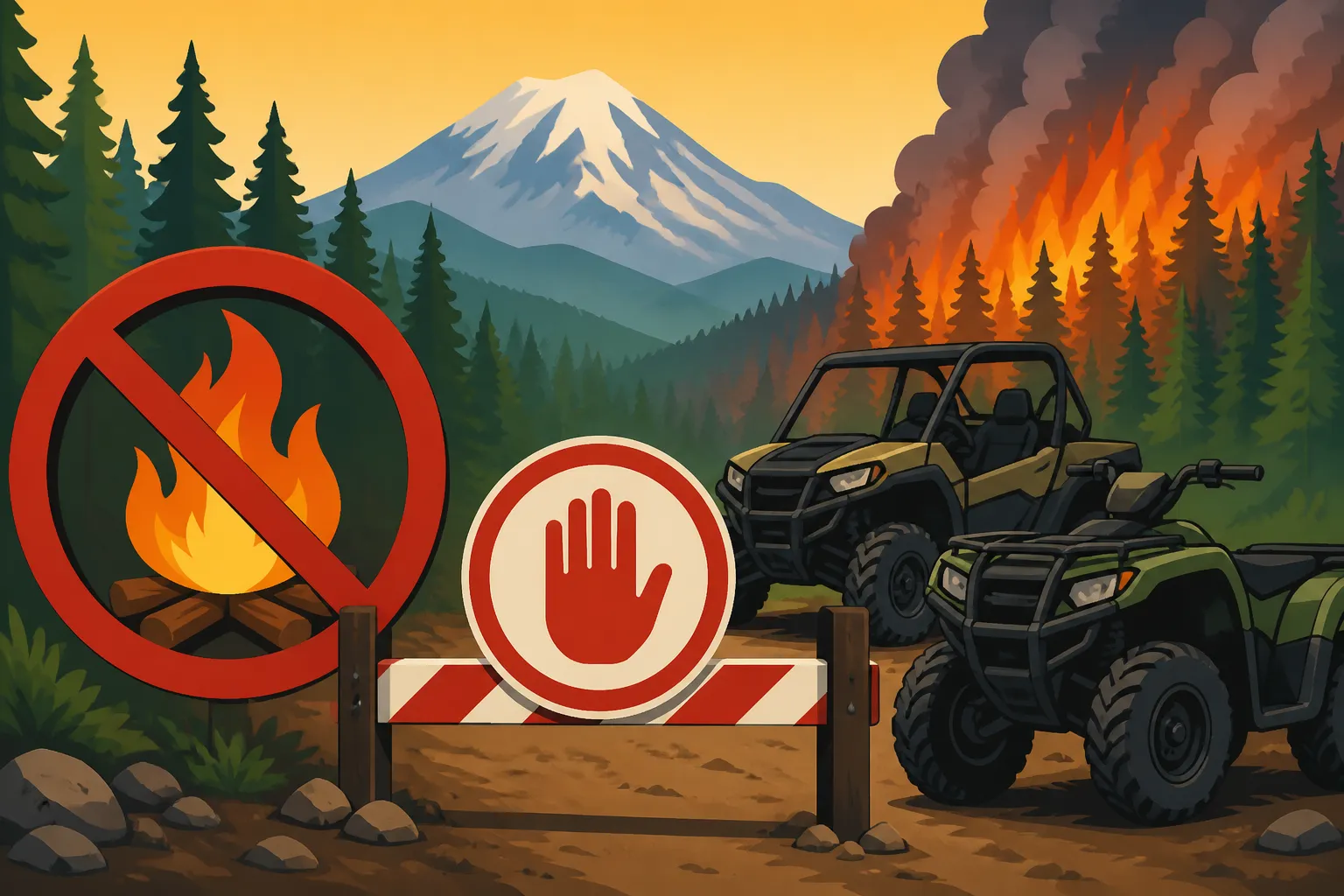
At the trailhead, pay attention to gates, signs, barriers, and staff instructions. An old map may still show a road or trail that is temporarily closed. A route drawn on a map is not proof of current access, and removing or bypassing a barrier does not make a closed route legal to ride. If signs conflict with an online map, follow the posted closure and ask the managing agency to clarify.
A useful pre-ride check is:
- Identify the agency or landowner for every section of the route.
- Check current fire restrictions and closure notices from those managers.
- Confirm whether the notice covers your trail, access road, staging area, or destination.
- Check again before departure and read signs when you arrive.
- Keep an alternate route ready, but verify that it is open too.
If you ride across multiple kinds of land, do not assume that one pass or permit provides access everywhere. The Discover Pass and Washington Riders explains where that pass applies; it is not permission to enter a closed area. Similarly, Washington Rules for Riding Federal Land is a useful starting point for understanding why federal land may have its own rules and notices.
Why officials may close trails during fire conditions
A closure may be preventive, not a sign that flames are already nearby. Dry vegetation, hot conditions, wind, and other local factors can raise the chance that a small ignition will become difficult to control. Land managers may restrict use or close access before a fire starts to reduce risk and protect people, property, natural resources, and emergency response routes.
An active wildfire can create additional reasons to keep riders out. Fire crews may need roads and staging areas, smoke can reduce visibility, and conditions can shift faster than a trail user can safely react. A route may also be closed because fire has damaged it or because officials need to assess hazards before reopening it. Burned trees, unstable ground, and damaged infrastructure can remain dangerous after the visible fire activity has moved on.
The closure boundary may not match what you can see from your machine. A fire that appears distant may still affect a road or trail through smoke, wind shifts, or firefighting activity. Do not use your own estimate of danger to overrule an official closure. If the notice says access is prohibited, choose another legal area and return only when the land manager reopens it.
Restrictions can also cover conduct beyond the trail itself. A riding destination may have rules about fires, smoking, or equipment use, even when motorized routes remain open. Read the specific order rather than relying on a general assumption such as “the trail is open, so everything is allowed.” For equipment-related limits, see Washington Fire Restrictions That Close Trails and Washington Fire Restrictions That Close Trails—but use the responsible agency’s current order for the actual rules at your destination.
Riding responsibly when restrictions are in place
If the route is open under a fire restriction, follow the listed limits exactly. Do not start a fire where it is prohibited, and do not assume a rule applies only at a campground or only to people on foot. The order may cover a broader area or particular activities. When the language is unclear, ask the land manager rather than guessing.
Keep the machine in good working order and use it only where permitted. A spark-related concern can be especially important during dry conditions, but riders should not invent their own exception or rely on a modification as permission to use a closed area. Check any applicable equipment requirements separately; Washington Spark Arrester Requirement covers one topic riders may need to consider on public land. A compliant machine still cannot enter a closed trail.
Make a flexible plan. Choose an alternate riding area before you leave, check its restrictions too, and be prepared to turn around if a sign or official directs you to do so. Avoid trying to ride around a closure by using an unmarked track, private land, or a road that is not open to your machine. If your route depends on a connecting road, verify that connection rather than assuming it is available.
If smoke or visible fire affects your ride, leave the area in a safe, lawful way and follow instructions from emergency personnel. Do not stop in a location that blocks access, and do not approach a fire to take a closer look. If you encounter a new hazard or a closure sign that is not reflected in the information you checked, treat the sign as current and report the discrepancy to the managing agency when you can do so safely.
Permits and reciprocity are separate from fire access decisions. An out-of-state registration, temporary permit, or valid land pass can satisfy a specific administrative requirement, but it does not authorize entry where access is closed. Riders visiting from elsewhere can review Washington ORV Reciprocity With Other States and Washington Temporary ORV Permit for a Visitor, then check the fire status and local land rules independently.
The practical approach is straightforward: verify the land manager, read the current notice, check again on ride day, and respect any closure on the ground. That takes a little planning, but it is better than hauling a machine to a closed trailhead or risking a citation and a dangerous encounter with fire crews.
Disclaimer
This article is for general informational purposes only and does not constitute professional advice. Laws, prices and regulations vary by location and change over time. Consult a qualified professional for guidance on your specific situation.