Washington Minimum Age to Ride Public Land
Washington does not set one simple minimum age that makes every ATV or UTV ride on public land legal. The key statewide rule is that riders under 16 need a licensed adult accompanying them, but machine size, land access, permits and road use can add separate limits. Here’s how to check whether a young rider and machine are ready for a specific ride.
The age rule for riding public land
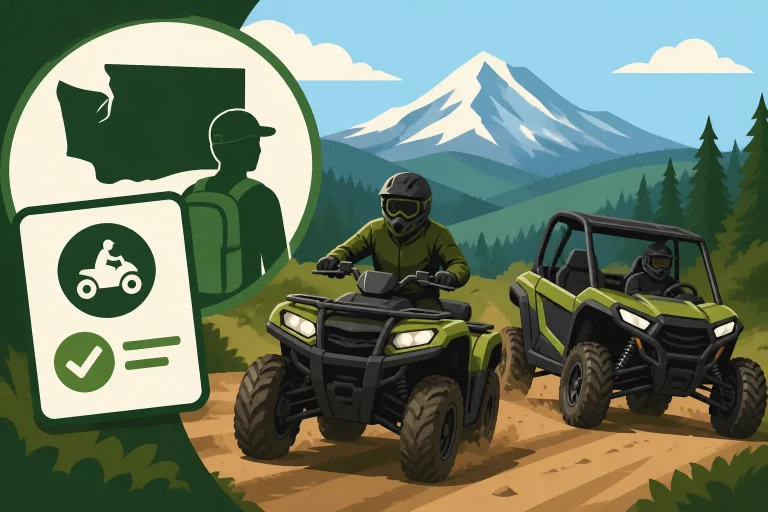
For off-road riding on Washington public land, a person under 16 must be accompanied by an adult who is at least 18 and holds a valid driver license. The rule applies to young riders using ATVs, UTVs and other off-road vehicles on public lands; it is not simply a rule for children below a particular age.
That means a 15-year-old is still under the supervision rule. Turning 15 does not remove it. Once a rider is 16, this specific age-based requirement no longer applies, but other rules remain: the rider must still be allowed to operate that machine, and the route must be open to it.
The safest practical interpretation is for the adult to ride with the young rider and remain close enough to supervise. An adult waiting at a distant parking area should not be assumed to satisfy the requirement. If the land manager has a more specific definition of accompaniment or supervision, follow that direction. More detail is available in Washington’s Supervision Rule for Riders Under 16 and Who Counts as a Licensed Adult Riding Alongside.
The adult’s role does not automatically make every ride legal. The adult should be able to supervise the child, the machine must be suitable for the rider, and the route must be open to that vehicle. A parent’s permission, a safety class or a signed waiver does not replace the state’s supervision requirement.
| Situation | What the age rule means | What else to check |
|---|---|---|
| Rider under 16 on an off-road trail | A licensed adult at least 18 must accompany the rider | Route access, vehicle rules, registration or permit, and site rules |
| Rider age 16 or older on an off-road trail | The under-16 accompaniment rule no longer applies | All other riding and access requirements still apply |
| Rider under 16 on a public road | Adult accompaniment does not grant permission to drive on the road | Driver-license and road-use requirements |
| Rider on private property | The public-land age rule may not apply in the same way | Landowner permission and any applicable safety or vehicle rules |
There is not one universal minimum age that answers every case. A child’s age is only one part of the decision. A young rider also needs to be able to reach and operate the controls, understand how to stop and steer, and handle the terrain without being carried beyond their ability. A machine’s manufacturer guidance and the land manager’s rules may impose additional limits.
Check the land and route before loading up
“Public land” covers places managed by different agencies and entities. A trail in a state forest, a route in a national forest, a county road, a recreation area and a private timber road can all have different access rules. A route shown on an old map may also be closed or restricted now.
The supervision rule is a starting point, not an all-access pass. Before the trip, identify who manages the riding area and check the current rules for the exact trail or road. Confirm that motorized riding is allowed, that the particular vehicle type can use the route, and that any seasonal closures or restrictions do not apply. For state-managed routes, see Washington Rules for Riding DNR Land; for federal forest routes, see [Washington Rules for Riding a National Forest].
Pay attention to restrictions that are not about age. Some routes exclude certain vehicle widths or types. Others close for weather, fire danger, maintenance or timber work. A young rider who meets the supervision requirement still cannot ride on a closed trail or take a machine onto a route that does not allow it.
Permits and registration are separate from age. A Washington-registered machine may need the appropriate off-road registration for public-land use. A visitor should check whether their home-state registration is accepted for the planned ride or whether a Washington permit is needed. Washington ORV Permits Explained and Washington ORV Reciprocity With Other States explain why the right paperwork depends on the machine’s status and the rider’s circumstances.
A parking pass is also different from vehicle registration or an ORV permit. A pass required at a trailhead may cover parking access, but it does not by itself authorize riding a machine on a trail. Check the land manager’s requirements for both the vehicle and the tow vehicle or parking space.
Use current information from the agency or land manager responsible for the area. If a posted sign and an older online map appear to conflict, do not assume the map controls. Contact the manager or choose a route whose access rules are clear before leaving home.
Public roads are a separate question
Permission to ride off-road does not automatically authorize a young person to ride on pavement. Washington’s public-road requirements are different from its public-land trail rules. A road-registered WATV may be allowed on certain roads, but the operator must meet the requirements for road use. The under-16 accompaniment rule does not substitute for a driver license where one is required.
This matters when a trail route uses a road for a short connector, when a rider needs to travel between two trail sections, or when a staging area is reached by a public road. Do not assume that a licensed adult riding beside a child makes the child’s road operation legal. Check the road-specific rules and the route’s approved status before using it. Washington Driver License Rules for WATVs and Washington Rules for Getting Across a Road cover distinct issues that are easy to confuse.
A crossing is not necessarily the same as riding along a road, but crossing rules can depend on the road and the location. Use only a crossing allowed by the applicable rules and follow posted signs. If the planned route requires a young rider to travel along a public road, find a legal alternative or have an eligible adult operate the road-going machine.
The same caution applies to UTVs and side-by-sides. A vehicle with seat belts, a roll cage or road equipment does not become legal for a young person to drive on public pavement just because an adult is present. Road authorization, vehicle equipment and driver eligibility each need to be checked separately.
Plan a safer ride for a young operator
A legal ride can still be a poor match for a child’s skills. Before heading out, assess the rider and machine together. A child should be able to operate the controls comfortably, turn and stop predictably, and understand instructions such as slowing down, staying on the route and stopping when visibility is limited. If the rider cannot manage the machine without help, choose a smaller machine or postpone the ride.
A practical pre-ride check:
- Confirm the rider’s age and supervision. If the rider is under 16, arrange for an accompanying adult who is at least 18 and has a valid driver license.
- Confirm the machine is appropriate. Check the manufacturer’s guidance, the rider’s ability to control it and any age or vehicle restrictions set by the riding area.
- Verify the route. Make sure it is open to motorized use and suitable for the machine’s type and size.
- Check registration and permits. Confirm the machine has the paperwork required for the land and planned use. A visitor should check reciprocity rather than assume an out-of-state sticker is accepted.
- Separate trail riding from road use. Do not treat adult supervision as permission for a young rider to operate on a public road.
- Prepare for the conditions. Use required protective equipment, inspect the machine and carry what the group needs to manage a delay or minor problem.
Keep the adult involved throughout the ride, not just at the trailhead. Young riders may need help judging speed, visibility, mud, loose gravel, steep grades and changing conditions. Choose a route that leaves room to stop and regroup, and set clear expectations about spacing and staying on the designated route.
If the plan includes a rental, ask the rental provider about its minimum age and supervision policy before booking. A provider may set conditions beyond the state’s general public-land rule, and a waiver does not override public-road or land-access requirements. Riding a Rented WATV on Washington Public Land is a useful companion when a rental is part of the plan.
The straightforward takeaway: a rider under 16 needs a licensed adult accompanying them to ride an off-road vehicle on Washington public land, but that does not settle every question. Check the route, machine, paperwork and road access separately, and follow any stricter site or provider rules.
Disclaimer
This article is for general informational purposes only and does not constitute professional advice. Laws, prices and regulations vary by location and change over time. Consult a qualified professional for guidance on your specific situation.