Showing Tabs and a License
Navigating the world of Washington ATV and UTV riding can sometimes feel like a maze, especially when it comes to understanding what specific documents you need to have on hand. It's not uncommon to hear stories from fellow riders who’ve been stopped by law enforcement, only to find themselves fumbling through a muddy saddlebag, unsure if they even have the right paperwork. This guide is here to clear up that confusion, breaking down exactly what tabs, licenses, and other crucial documents you'll want to carry with you whenever you head out on the trails or hit a street-legal road in Washington.
The Essentials: Tabs and Registration
When you're out enjoying the stunning scenery Washington has to offer on your ATV or UTV, the last thing you want is a legal snag. The most fundamental pieces of identification for your machine are its registration tabs and the accompanying registration card. These aren't just suggestions; they are legal requirements that show your machine is properly documented and allowed to be on public lands or roads.
Understanding Washington's Tab System
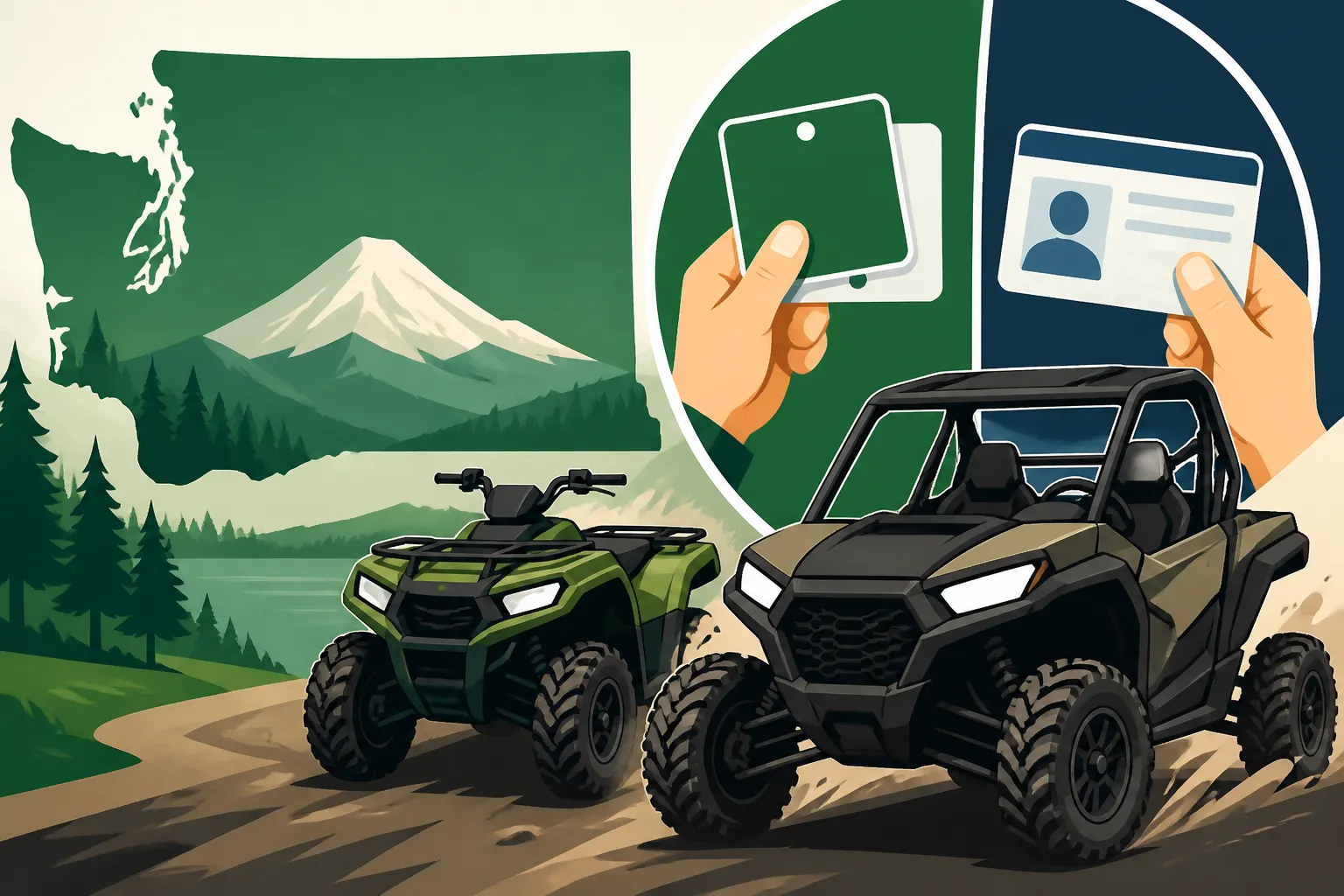
Washington State employs a dual tab system for off-road vehicles, which can sometimes be a source of confusion for new and even experienced riders. Essentially, you can purchase an "off-road" tab, a "on-road" tab, or both, depending on where you plan to ride. The off-road tab, often green, signifies your machine is registered for use on designated non-highway vehicle routes and trails. This is the baseline registration for any ORV operating on state, federal, or local government land. You can delve deeper into what this entails by checking out [Washington's Off-Road Tab Explained].
If you intend to take your WATV onto approved public roads and city streets, you'll need the "on-road" tab in addition to your off-road registration. This additional tab, typically blue, permits your machine to be ridden on public roadways that have been explicitly opened to wheeled all-terrain vehicles. Without this specific tab, even if your machine has all the street-legal equipment, you are not authorized to ride on public roads. Understanding [Washington's On-Road Tab Explained] is key to staying compliant. Both tabs are physical decals that adhere to your machine, usually visible on the fenders, and they are renewed annually, typically expiring on the anniversary of your initial registration. These tabs are your machine's visible proof of registration, signaling to anyone, especially law enforcement, that you're playing by the rules.
The Registration Card: Your Proof of Ownership and Compliance
While the colorful tabs on your fender are the immediate visual cue, the true proof of your machine's registration lies in the paper registration card. This small document is like your machine's ID card, containing critical information such as the Vehicle Identification Number (VIN), the name and address of the registered owner, the machine's make, model, and year, and the expiration date of your current registration. It’s absolutely vital to have this physical card with you whenever you’re operating your ATV or UTV on public lands, whether on a forest trail or a paved county road.
The legal requirement to carry this document is non-negotiable. If a park ranger, sheriff’s deputy, or state trooper stops you, they will ask for it. Not being able to produce it can lead to delays, fines, or even a citation. Think of it as your driver's license for your vehicle – you wouldn't drive your car without it, and the same principle applies here. This card proves that your machine is properly registered and that you are the rightful owner or have permission to operate it.
Given the dusty, wet, and often rugged environments we ride in, keeping that paper registration card safe and dry is a real challenge. Many riders find creative solutions, from sealing it in a Ziploc bag tucked into a secure compartment to using waterproof document holders designed for outdoor gear. Some even laminate a copy (while keeping the original pristine at home) or store it in a dedicated SuperATV cargo box that offers robust protection against the elements. The goal is to make sure it's legible and easily accessible, even after a full day of splashing through puddles or kicking up dust. No one wants a soggy, unreadable document when a law enforcement officer asks for it. For more tips on keeping your documents safe, check out [Keeping a Registration Card Dry on a Wet Ride].
The Metal Tag: A Permanent Identifier
Beyond the annual tabs, Washington also requires a metal license plate-like tag for your WATV. This isn't just a fancy accessory; it's a critical, more permanent identifier for your off-road vehicle. Unlike the yearly paper tabs that you replace annually, the metal tag is designed to last for seven years. It features your machine's unique ORV registration number, making it a crucial component for identification and tracking by law enforcement and land managers. This metal tag should be securely mounted to the rear of your machine, in a clearly visible location, where it won't be easily obscured by mud, gear, or your riding position. The specific requirements for its placement are detailed in [Where the Metal Tag Mounts].
The purpose of this metal tag is twofold: it provides a durable, long-lasting identifier for your machine, which is especially important in cases of theft or recovery, and it serves as a readily visible means for officials to quickly verify your registration status without having to get close enough to read the smaller fender decals. While the yearly tabs indicate current registration, the metal tag ties your machine to its history within the Washington Department of Licensing system. If your metal tag becomes damaged, unreadable, or lost within its seven-year lifespan, it must be replaced. This replacement process is typically straightforward and significantly less costly than initial registration, ensuring your machine always has a clear, physical identifier. Understanding [The Washington Metal Tag Explained] will give you a full picture of its importance.
Driver Licensing Requirements for On-Road Use
This is where things can get a little tricky and often trip up riders. While you don't need a driver's license to operate an ATV or UTV on designated off-road trails in Washington (though safety courses are highly recommended!), the rules change dramatically the moment your tires touch a public, approved roadway.
What Washington Requires of an Adult Rider
If you plan to ride your WATV on public roads that have been opened for their use, having a valid driver's license is an absolute must. This isn't an option; it's a non-negotiable legal requirement. The logic here is simple: if you're operating a motor vehicle on a public road, you need to be a licensed driver. Your ORV tabs, even the on-road variety, are simply vehicle registration; they do not grant you driving privileges. This means holding a valid, unexpired driver's license issued by Washington State or any other state that is recognized for driving privileges.
A standard driver's license is sufficient; you don't typically need a commercial driver's license (CDL) or a motorcycle endorsement specifically for operating a WATV on a public road, assuming your machine meets all other street-legal criteria. The key is simply possessing that valid license in your wallet, ready to present if you encounter law enforcement. Riding on a public roadway without one, even if you have all the proper machine equipment and tabs, will lead to a citation for operating a motor vehicle without a valid license. This is a common mistake riders make, assuming that because it's an "off-road vehicle," the same rules for a car don't apply. For a comprehensive overview, read [A Valid Driver License on a Washington Road]. It is your responsibility as the operator to ensure you meet all personal licensing requirements before heading onto any paved public surface.
Rules for Riders Under 16
For riders under the age of 16, the rules around driver licensing and public road access are even stricter in Washington. Simply put, minors generally cannot operate a WATV on public roads, even if they have taken a safety course or are under adult supervision. Washington law restricts the operation of wheeled all-terrain vehicles on public highways by individuals under 16 years of age, regardless of whether the road is approved for WATV use. This means that while a younger rider might legally be able to ride their machine on designated off-road trails (with appropriate supervision, of course), those privileges do not extend to public roads or streets.
This distinction is critical for parents and guardians to understand. Sending a 15-year-old out on a county road, even one that's open to WATVs, is a violation of state law and can result in significant fines and legal trouble. The intention behind this rule is primarily safety, recognizing the unique challenges and risks associated with operating these machines in a mixed-traffic environment. For designated trails and private property, the rules for minors are different and often revolve around direct adult supervision. However, for any public roadway, the answer is a clear "no" for anyone under 16. It's important to be fully aware of [Washington Rules for Riders Under 16] to ensure both safety and compliance. These age restrictions are taken seriously by law enforcement, and ignorance of the law is not considered a valid excuse.
What to Expect During a Roadside Check
It's a moment every rider hopes to avoid but should always be prepared for: being stopped by law enforcement. Whether on a rural gravel road or a busy forest trail, knowing what to do and what to expect can make a potentially stressful situation much smoother.
Common Scenarios for a Stop
Law enforcement officers, whether they are State Troopers, county sheriffs, or DNR rangers, are tasked with ensuring everyone is riding safely and legally. There are several common reasons why you might be pulled over while operating your WATV. The most frequent scenario is often related to a visible violation of registration or road use. This could be riding on a paved road that isn't designated for WATV use, having missing or expired tabs, or lacking the specific on-road tab when on pavement. An officer might also pull you over if your machine appears to have equipment violations, such as missing mirrors, turn signals, or a horn when on a road, or if you're not wearing a helmet where required.
Other reasons could include unsafe operation, such as riding in a way that suggests impairment, excessive speed, or riding two abreast where prohibited. Sometimes, it might be a general safety check, especially in popular riding areas, where officers simply want to ensure compliance. Regardless of the reason, the key is to react calmly and cooperatively. Remember, these officers are there to enforce public safety and regulations. A good understanding of [What a Washington Trooper Checks Roadside] can help you anticipate their concerns and ensure you're prepared. Ignoring signals to stop, or attempting to evade an officer, will only escalate the situation and lead to much more severe consequences than a simple document check.
Presenting Your Documents Smoothly
When an officer signals you to stop, the first and most important step is to do so safely and promptly. Find a clear, safe spot to pull over, turn off your engine, and keep your hands visible. Officers are trained to be cautious, so sudden movements can be misinterpreted. When they approach and ask for your license, registration, and proof of insurance, you want to be able to produce these documents without a fuss. This is where pre-ride preparation really pays off.
Before every ride, especially if you anticipate being on public roads, take a moment to ensure all your documents are neatly organized in a waterproof pouch or a secure compartment on your machine. Many riders find that a small, dedicated bag or a specific section within a SuperATV cargo box keeps everything together and protected. Knowing exactly where your documents are stored saves you from fumbling, which can appear suspicious or disorganized. Hand over the requested documents clearly and calmly. If you have questions about the stop, ask them politely after you have provided your identification. Not having your documents, or having them in an unreadable condition, can lead to a citation for specific offenses, separate from any initial reason for the stop. Being prepared and respectful goes a long way in making a roadside encounter quick and uneventful. For more information, refer to [Which Paperwork You Must Carry While Riding].
Beyond Tabs and Licenses: Other Important Documents & Gear
While your tabs and driver's license (for road use) are foundational, there are other pieces of documentation and equipment that are legally required or highly recommended to ensure you're fully compliant and prepared for any situation Washington might throw at you.
Proof of Insurance for Road-Legal Machines
This is another critical distinction that often catches riders off guard. While operating an ATV or UTV exclusively on designated off-road trails in Washington does not typically require you to carry vehicle insurance, the rules shift dramatically once you decide to register your machine for public road use. If your WATV has the "on-road" tab and you're riding it on public roads, then proof of liability insurance is mandatory. This mirrors the requirement for any other motor vehicle operating on Washington's public highways.
Think about it: if you were involved in an accident with another vehicle on a public road, the liability coverage is there to protect both you and the other party. Without it, you could face significant financial hardship. Therefore, if you've gone through the effort of equipping your machine for street legality and obtained the on-road tab, you must also secure and carry proof of insurance. This could be an insurance card from your provider, either a physical copy or an electronic version on your phone, though a physical copy is often preferred in areas with spotty cell service. Be aware of [Washington WATV Insurance Requirements] and the potential costs by looking at [Washington ATV Insurance Cost per Year], as it's a non-negotiable part of road-legal riding. Always check with your insurance provider to ensure your policy specifically covers WATV use on public roads.
Helmet and Safety Equipment Compliance
Beyond documentation, Washington law also dictates specific safety equipment requirements, especially for those venturing onto public roads. The most prominent is the helmet law. For any WATV operator or passenger on a public road in Washington, wearing an approved helmet is mandatory, regardless of age. This isn't just a suggestion for your own protection; it's a legal requirement that will be enforced by law enforcement. Violating this rule can result in a significant citation and fine.
But the equipment requirements don't stop there for street-legal machines. To qualify for on-road use, your WATV typically needs to be outfitted with components like turn signals, mirrors, a horn, headlights, tail lights, and brake lights, among other things. These are all designed to make your machine visible and safe to operate in traffic. For example, having a proper windshield, perhaps from SuperATV, is crucial for visibility and protection, or you must wear eye protection. Neglecting any of these items means your "street-legal" machine isn't actually compliant, and you could be pulled over and cited for equipment violations. Understanding [Equipment a Washington WATV Needs on a Road] and [Washington Helmet Law for WATV Riders] is crucial for ensuring you meet all necessary standards before you ever leave the driveway for a road ride.
When a Temporary Permit Is Your Only Document
There are specific situations where you might find yourself riding in Washington with only a temporary permit, particularly if you're a visitor from another state without a reciprocal ORV registration program, or if you've recently purchased a machine and are within the 15-day window to complete permanent registration. Washington offers a temporary ORV use permit that allows you to ride on designated off-road trails. This permit is valid for 60 days and costs a modest fee. It’s a lifesaver for those who want to experience Washington's trails without committing to a full year of registration or for out-of-state riders whose home state registration isn't recognized here.
However, it's absolutely vital to understand the limitations of this temporary permit. Crucially, [Why a Temporary Permit Is Trail Only] – it does not grant you any privileges to ride on public roads. The temporary permit is strictly for off-highway use. If you are operating under a temporary permit, you must carry the physical permit itself, along with any other required personal identification. Just like with a permanent registration card, keeping this temporary permit safe and dry is important. It serves as your official permission to be on the trails for that specified period. While it offers flexibility, always remember its trail-only restriction to avoid legal issues. For more details on this option, refer to [Washington's Temporary ORV Use Permit].
Documents Required for Riding Your WATV in Washington
| Riding Location | Required Documents | Notes |
|---|---|---|
| Designated Trails (Off-Road) | – Washington ORV Registration Tabs (Off-Road) | Visible decals on machine. |
| – Physical Washington ORV Registration Card | Must be carried on person or in machine. | |
| – ORV Metal Tag | Affixed to rear of machine. | |
| – Temporary ORV Use Permit (if applicable) | Carried instead of permanent registration, for 60 days. | |
| Approved Public Roads (On-Road) | – All Off-Road Requirements (Tabs, Reg Card, Metal Tag) | Baseline for all riding. |
| – Washington ORV Registration Tabs (On-Road) | Additional visible decal. | |
| – Valid Driver's License | Required for operator (16+ years old). | |
| – Proof of Liability Insurance | Physical or electronic copy. | |
| – Helmet | Mandatory for operator and all passengers. | |
| – Street-Legal Equipment (Turn Signals, Mirrors, Horn, Lights, etc.) | Machine must be properly equipped. |
Disclaimer
This article is for general informational purposes only and does not constitute professional advice. Laws, prices and regulations vary by location and change over time. Consult a qualified professional for guidance on your specific situation.