Why Federal Sites Refuse a Washington Discover Pass
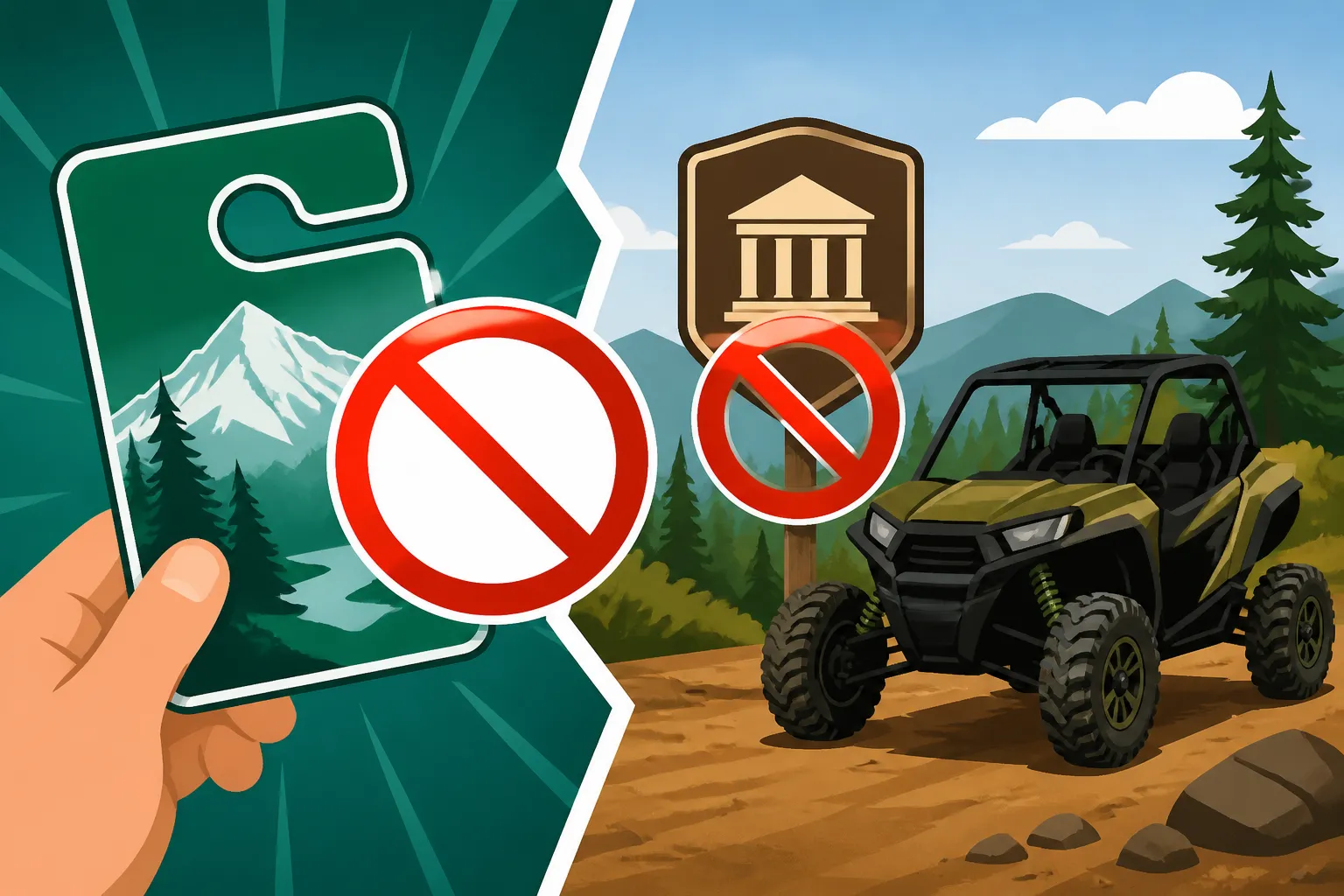
A Washington Discover Pass can be valid and still be the wrong pass at a federal trailhead. That is because the pass is for certain state-managed recreation sites, while federal agencies set their own access and fee rules. Here’s how to tell which land manager controls the place you’re visiting, what a federal pass may cover, and what to check before unloading your ATV or UTV.
Why a Discover Pass does not cover federal sites
The Discover Pass is a Washington state pass. It provides access to qualifying recreation sites managed by Washington State Parks, the Department of Natural Resources, and the Department of Fish and Wildlife. It does not act as a general parking or recreation pass for every public site in Washington.
Federal land is managed under a different system. The U.S. Forest Service, Bureau of Land Management, National Park Service, and other federal agencies may set their own rules for parking, day use, permits, and off-road vehicle access. A pass issued for one system does not automatically satisfy a fee in another.
The distinction is about who manages the site, not how close it is to a state park or whether it feels like a public recreation area. A federal trailhead can be near a state-managed forest, and a road trip may pass through both. If a federal agency operates the parking area, a Discover Pass may not pay the fee there.
That also explains why two nearby trailheads can have different requirements. One might be on state-managed land and require a Discover Pass; another might be on federal land and require a different pass, a site-specific fee, or no pass at all. The land manager’s rules control.
| Where you are going | Who may manage the site | What to check |
|---|---|---|
| State park or state-managed recreation area | Washington State Parks, DNR, or Fish and Wildlife | Whether a Discover Pass is required for vehicle access |
| National forest trailhead or recreation site | U.S. Forest Service | Whether the site requires a federal recreation pass or another fee |
| BLM recreation area | Bureau of Land Management | Whether the specific location charges for parking or day use |
| National park or other federal site | National Park Service or another federal manager | Site admission, vehicle, and recreation rules |
| A boundary area or shared access point | More than one land manager may be involved | Which agency operates the actual parking area and route |
A place may also be free to visit even though it is federal. “Federal land” does not mean “fee required.” Some sites charge for parking or day use; others do not. The only safe assumption is that you need to check the rules for the exact trailhead, campground, or recreation area you plan to use.
For a broader explanation of where the state pass applies, see The Discover Pass and Washington Riders and Do You Need a Discover Pass to Ride in Washington?. Those questions are separate from whether a federal site requires its own pass.
What federal passes may cover, and what they do not
Federal recreation passes are not all interchangeable. Some federal sites accept a federal interagency recreation pass for certain entrance or standard amenity fees. Other sites use a different pass, charge separately, or have no fee. Acceptance can depend on the managing agency, the exact location, and the type of fee.
In Washington, visitors often encounter Forest Service recreation areas and sites managed by other federal agencies. A pass that works at one location may not cover every federal trailhead or activity. Read the site’s posted instructions rather than relying on the pass name alone.
A federal recreation pass generally should not be treated as a substitute for every permission a rider needs. It does not, by itself, register an ATV or UTV, authorize riding on a closed road, or grant access across private property. Nor should you assume it replaces a state Discover Pass where a state-managed site requires one.
Think of the requirements as separate layers:
- Parking or day-use access: A site may require a pass or fee for the vehicle parked at a recreation area.
- Vehicle registration or tabs: Your machine may need the appropriate registration for where and how you ride.
- Trail or area authorization: A land manager may restrict motorized use to designated routes or require an additional permit.
- Road and trail rules: A pass does not make a closed route legal to ride, or make an otherwise prohibited machine eligible for access.
For example, buying an accepted federal recreation pass may take care of a parking fee at a participating federal site. It does not mean every trail in the surrounding forest is open to ATVs, that every vehicle width is allowed, or that your Washington registration is sufficient for every kind of use. Check the route rules independently. [Washington Rules for Riding a National Forest] and [Washington Rules for Riding BLM Land] cover the land-use side of the question.
The same separation applies to a state pass. A Discover Pass may satisfy the applicable vehicle-access requirement at a qualifying state site, but it is not an ORV tab and does not register the machine. For a Washington ATV or UTV, it helps to think of the pass as permission for a particular kind of site access, not as a general riding permit.
A pass for the site is not a pass for the machine
Riders sometimes use “permit,” “tab,” and “pass” as if they mean the same thing. They do different jobs:
- Registration tabs identify a registered machine and relate to its authorized use.
- A recreation pass may cover vehicle parking or entry at a particular kind of site.
- A trail permit or area authorization may govern whether a machine can use a route or recreation area.
- A road-use designation determines whether a route is open to the machine under the applicable rules.
A machine can have current registration and still need a site pass for the truck or trailer parked at the trailhead. Conversely, the truck can display a valid recreation pass while the ATV itself lacks required registration or is being ridden on a closed route.
If you ride on both state and federal land during the same outing, you may need to satisfy more than one agency’s rules. That does not necessarily mean you need to buy every pass you hear about. It means you should identify the agencies and locations involved, then determine which requirements apply to each part of the trip.
How to check the rules before you load up
The simplest way to avoid a parking citation or an unplanned trip back to town is to verify the exact destination, not just the broad area name. A forest, recreation complex, or riding region can include land managed by several agencies, and the nearest lot may not have the same rules as the route you plan to ride.
Use this process before leaving:
- Pinpoint the parking area. Identify the actual staging lot or trailhead you will use. A general search for a forest name may return several entrances with different managers.
- Find the land manager. Look for the agency responsible for the parking area and the route. Check the agency’s official recreation page, map, or posted notice.
- Check the pass or fee requirement. Confirm whether the lot requires a Discover Pass, a federal recreation pass, a site-specific payment, or no pass. Make sure the answer applies to your chosen location.
- Check the machine rules separately. Confirm that motorized use is allowed on your intended trail or road and that your machine meets any applicable requirements.
- Review current alerts. Closures, construction, fire restrictions, weather damage, and seasonal limits can change access even when an older map shows a route.
- Save the information for the trip. Keep the site name, managing agency, and any pass instructions available offline in case cell service is poor.
The location where you park is especially important. A rider may unload at a state-managed staging area, ride an authorized route, then enter or approach land managed by another agency. The requirements can change as the route crosses a boundary. Do not assume that the pass displayed at the staging lot covers every parcel along the ride.
Maps can help you spot boundaries, but they are not always enough to settle a current fee or closure question. Use them to understand the layout, then confirm the operational details with the agency that manages the site. Washington Trail Maps From DNR is useful for state-managed recreation planning, while federal locations should be checked with their managing agency.
A practical planning note can be short:
- Trailhead or staging area name
- Managing agency
- Pass or payment required for parking
- Route access rules for your machine
- Current closure or seasonal information
- Backup location if the planned access point is closed
That record is more useful than a photo of a pass by itself. It tells you where the pass applies and what else you checked.
Federal trailheads, state sites, and confusing boundaries
Some of the most confusing situations happen where public lands meet. A rider may see a state recreation sign on the drive in, park near a federal road, and assume the Discover Pass covers the whole area. But signs for one nearby site do not establish the rules for another parking area.
The same problem can arise at a shared access point. One agency may manage the road, another may manage the trailhead, and a local partner or concessionaire may operate a facility. In those cases, look for the instructions posted for the specific lot or contact the agency named on the site information. If the information is unclear, do not treat the Discover Pass as a universal fallback.
When a site has a fee station or posted payment instructions, follow those instructions even if you already own a different pass. If you believe your pass should be accepted, confirm that with the managing agency before leaving the vehicle. A pass that is valid in one part of a recreation area may not be valid in another.
Federal sites can also use different types of fees. An entrance fee, parking fee, campground charge, and permit for a special activity are not necessarily covered by the same pass. Check the wording carefully. A pass described as covering certain day-use fees should not be assumed to cover camping, a reservation, or a separate permit.
This is why advice from another rider can be misleading. Someone may say, “We never pay at that forest,” when they mean a different entrance, a different parking lot, or a trip made under different conditions. Treat informal recommendations as a starting point, not as confirmation of today’s rules.
For a visit to a specific federal riding area, check the site’s official information before departing. For example, [Why Evans Creek Needs a Northwest Forest Pass] explains why that location’s pass requirements should be considered separately from the Washington Discover Pass. The Northwest Forest Pass is not a blanket pass for all federal land, either; its use depends on the location and fee rules.
If you plan to combine state and federal riding areas, make a short stop-by-stop list. It can prevent buying a pass you do not need while also avoiding the assumption that one pass covers the entire weekend. Washington ORV Permits Explained and Washington ORV Reciprocity With Other States address other kinds of riding authorization that are separate from parking access.
Common mistakes and a quick pre-ride check
The most common mistake is buying or displaying a Discover Pass and assuming it covers all public land in Washington. It does not. The second is assuming the opposite: that every federal location requires a paid pass. Many sites may not charge a fee, and requirements vary by site.
Other avoidable mistakes include:
- Checking the region but not the trailhead. A large riding area may have multiple access points and different managers.
- Confusing the truck’s pass with the ATV’s registration. The pass may relate to the parked vehicle; machine registration and route authorization are separate.
- Assuming a federal pass covers every federal agency. Acceptance depends on the site and the kind of fee.
- Relying on an old photo of a sign. A fee arrangement, closure, or access route may have changed.
- Assuming a pass covers camping or special activities. These may have separate payment or reservation requirements.
- Treating an open road as an open trail. Road access and off-road trail access are different questions.
- Parking across a boundary without noticing. A lot and the route beyond it may be managed differently.
It is worth keeping pass paperwork dry, especially on a wet or muddy ride. A small waterproof document pouch can protect a receipt, registration, or printed directions. If you shop for one on Amazon, choose a size that fits the documents you actually carry and secure it so it cannot come loose. Amazon is also one place riders may look for a simple clear sleeve, but a sleeve does not change which pass a site accepts.
Some riders keep paper copies of key trailhead information in the tow vehicle in case a phone battery dies or reception disappears. If you use Amazon to find a map case or document pouch for that purpose, check that it closes securely and can be removed without leaving loose gear in the cab. The useful part is having the correct agency information at hand, not the brand of the storage item.
A final check before unloading should answer these questions:
- Who manages this exact parking area?
- Does the site require a pass or payment, and which one?
- Is my intended ATV or UTV route open to motorized use?
- Are there separate registration, permit, or equipment rules?
- Have I checked for current closures and seasonal restrictions?
- Do I know what to do if the planned trailhead is closed?
If you do not know the answer to the first two questions, pause before assuming that the Discover Pass is enough. Confirm the site’s instructions, then display or pay for the pass the managing agency requires. Washington Trail Closures to Check First can help with the separate but equally important task of checking access conditions before a ride.
The practical rule is straightforward: use a Discover Pass where Washington state rules require it, and follow the federal site’s own fee and access instructions on federal land. Keep parking access, machine registration, and trail permission separate in your planning. That approach is less confusing than trying to find one pass that works everywhere, because no single pass should be assumed to do every job.
Disclaimer
This article is for general informational purposes only and does not constitute professional advice. Laws, prices and regulations vary by location and change over time. Consult a qualified professional for guidance on your specific situation.