Can an 18-Year-Old With a License Supervise?
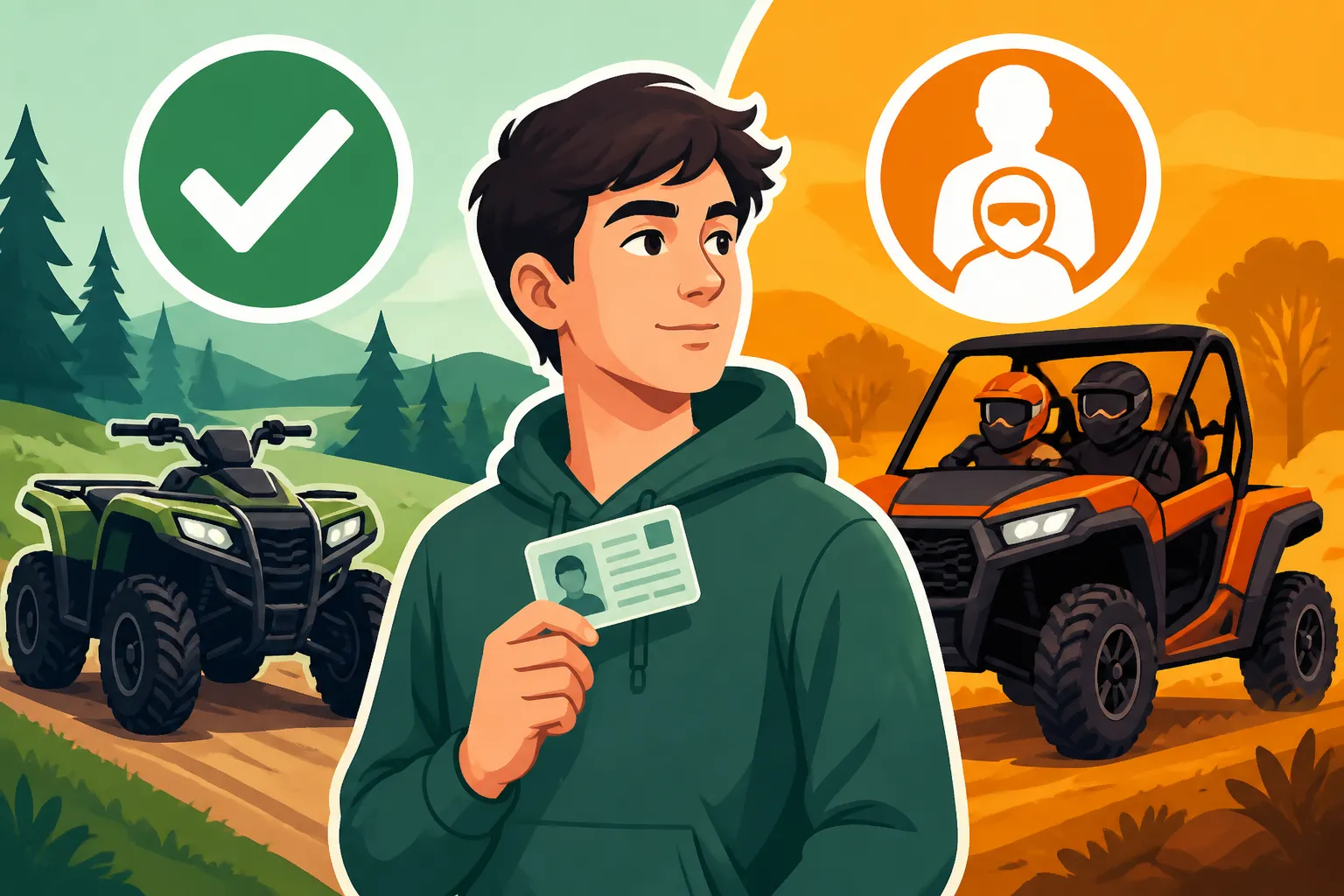
An 18-year-old with a valid driver license may generally supervise a younger rider under Washington’s off-road rules. But age and a license are only part of the answer: the adult must provide the required supervision, and the youth still has to follow rules for the machine, location and type of riding.
The short answer: Usually yes, with conditions
For riding an off-road vehicle on public land, Washington’s supervision rule generally allows a rider under 16 to be accompanied by a person who is at least 18 and holds a valid driver license. That means an 18-year-old can qualify; the supervising adult does not necessarily have to be the child’s parent.
The key is that the adult must actually supervise the ride. A license in the supervising person’s wallet does not, by itself, satisfy the rule if that person is elsewhere, has left the group or cannot keep the youth under supervision. The practical meaning of accompaniment matters, so check What Direct Supervision Means and Who Must Ride Alongside a Fifteen-Year-Old before planning a ride.
This rule concerns a young person operating an off-road vehicle under supervision. It does not give the young rider the same legal status as a licensed driver, and it does not automatically permit riding on public roads. A road-registered machine, an adult riding nearby and a legal off-road trip are separate questions.
| Situation | Does an 18-year-old with a valid license help? | What to keep in mind |
|---|---|---|
| A rider under 16 on a public off-road route | Generally, yes, if the adult provides the required supervision | Check the land manager’s rules and any rider or machine restrictions |
| A rider under 16 operating on a public road | No, not as a substitute for the rider’s own eligibility | Adult supervision does not supply the young rider with a driver license |
| A ride on private property | It may be relevant, but public-land rules may not be the only rules involved | Get the landowner’s permission and consider any applicable local requirements |
| A machine that is not allowed on a particular trail | No | Adult supervision cannot make a prohibited machine eligible for that route |
If the adult is exactly 18, they meet the age threshold generally described in the supervision rule. They still need a valid driver license and must be present and attentive in the way the rule requires. A learner’s permit, an expired license or a license that is suspended should not be treated as equivalent to a valid driver license.
The main practical point is simple: an 18-year-old may be a qualifying supervisor for off-road riding, but that qualification does not override other rules. The youth’s age, the type of vehicle, the place of operation and any special land restrictions all matter.
What “supervise” means on a ride
Supervision should be treated as an active responsibility, not a box to check before leaving the staging area. The adult needs to accompany the young rider and be able to monitor what is happening. Riding in the same group, keeping the youth within view and being close enough to respond are sensible ways to make that supervision meaningful.
Do not assume that the adult can satisfy the requirement by following far behind, waiting at camp or telling the child to call if there is trouble. If the group separates, communication drops out or the younger rider goes beyond the adult’s ability to supervise, the arrangement may no longer meet the rule’s purpose. For the legal details, see Washington’s Supervision Rule for Riders Under 16 and What Direct Supervision Means.
Before the ride, agree on how the group will stay together. Choose a pace the younger rider can manage, set clear rules for stops and turns, and make sure the young rider knows not to go ahead or take a side trail without permission. If the adult is supervising more than one youth, think carefully about whether they can reasonably keep track of everyone on the route.
A responsible plan also accounts for the supervisor’s own condition. The adult should not be distracted, impaired, or so occupied with navigating, filming or managing another machine that they cannot pay attention to the child. The legal minimum is not a substitute for good judgment: a route that is too difficult for the youth may be a poor choice even when a licensed adult is present.
Who can serve as the adult
The supervising person generally needs to meet both parts of the standard: be at least 18 and hold a valid driver license. The person does not need to be the rider’s parent simply because they are supervising, unless another applicable rule or specific situation requires a parent or guardian’s involvement.
A family friend, relative or other responsible adult may therefore be a possible supervisor if they meet the eligibility requirements and actually accompany the rider. Still, a parent or guardian should make sure the adult understands the responsibility and knows the machine, route and emergency plan.
Do not rely on a vague claim that someone is “licensed.” If there is any doubt about the person’s license status or whether the supervision arrangement qualifies, confirm the requirement before the trip. The young rider should not be sent out on the assumption that an adult’s age alone is enough.
What supervision does not authorize
A supervising adult cannot make an otherwise prohibited ride legal. They cannot turn a closed route into an open one, waive a machine-width restriction, grant access to private land or replace a required permit. The group must still follow the rules for the specific riding area.
Nor should supervision be confused with instruction or training. An adult may teach the youth how to use the controls and ride safely, but completing a lesson does not necessarily change the legal age or supervision requirements. Review [Washington Minimum Age to Ride Public Land] for related age questions.
Public roads are a separate issue
The most important distinction is between riding an off-road route and operating on a road. A Washington WATV may be eligible for certain road use when it meets the applicable requirements and the road is open to that use. That does not mean every rider is eligible to operate it on pavement.
An adult’s driver license belongs to the adult. It does not transfer to a young rider sitting on another machine, riding as an operator of a side-by-side or following the adult on a quad. Where a valid driver license is required of the operator, having a licensed adult accompany the youth does not replace that requirement. See Washington Driver License Rules for WATVs for the road-use distinction.
This is why a family should not treat “the machine has road tabs” as the end of the check. Registration and equipment are one part of road eligibility; the rider’s own legal ability to operate is another. A route that connects two trail areas may include a road segment, but the connecting segment still has its own rules.
A supervising adult should plan a route that does not depend on the younger rider operating on a public road unless the youth is independently eligible to do so. That includes being cautious about short connectors, neighborhood streets, road shoulders and crossings. A short distance does not automatically create an exception.
Road crossings and mixed routes
A route can be mostly off-road and still include a road crossing or a public-road connector. Do not assume the adult can ride ahead, cross and then wave the younger rider through. Crossing rules and eligibility are distinct from supervision, and the young rider’s age can matter even when the crossing takes only a moment.
Check the rules for the exact road and route before departure. Some roads may be closed to WATVs altogether, while others may be open only under stated conditions. If the route’s legal status is unclear, choose an alternative rather than counting on an adult’s presence to solve the problem. Washington Rules for Crossing a State Highway explains why a crossing is not the same as permission to ride along the road.
A machine’s tabs also do not settle the question of whether a particular road is open. Local road access can vary, and a machine permitted on one route may be barred from another. Confirm current access information with the relevant local authority or land manager.
Check the machine, land and rider before leaving
Supervision is only one part of a lawful and suitable ride. Before loading, check the requirements for the young rider, the machine and the land where the group plans to ride. Rules can differ between a public trail system, a state-managed recreation area, a federal site, private property and a road.
A useful pre-ride check includes:
- Confirm the rider’s age and the supervision arrangement. Make sure the adult is at least 18, holds a valid driver license and will accompany the youth as required.
- Confirm the machine is allowed. Check that its type and width are suitable for the route. A trail system may exclude certain vehicles even if they are properly registered.
- Check route access. Look for current closures, seasonal restrictions, road limits and any rules specific to the land manager.
- Carry required documents and permits. Registration, an applicable permit or a recreation pass may be required, depending on where you ride. A supervisor does not replace a machine’s paperwork.
- Match the route to the young rider. Consider the rider’s experience, the machine’s size and weight, surface conditions, weather and the availability of places to stop.
- Set a group plan. Agree on speed, spacing, signals, regrouping points and what to do if someone becomes separated.
Some riding areas impose requirements beyond the general state supervision rule. They may restrict age, machine type, route use or access during particular conditions. A land manager’s rule can affect whether a route is available even when the general state rule would allow a supervised youth to ride elsewhere.
Public land, private land and roads are not interchangeable
“Public land” is not one single riding environment with one set of conditions. A trail may be managed by a state agency, a federal land manager or another entity, and each may have route-specific rules. A road crossing through public land may also be governed differently from a designated off-road trail.
On private property, the landowner’s permission is essential. Do not assume that private land is automatically exempt from every law or that permission to ride removes the need for safe supervision. The landowner may set additional limits, and local requirements may still be relevant.
For visitors riding with a machine registered elsewhere, reciprocity is another separate question. A home-state registration or permit may or may not satisfy Washington requirements in a particular setting. Check Washington ORV Reciprocity With Other States rather than assuming the supervisor’s Washington license resolves the machine’s registration status.
The adult’s responsibility goes beyond meeting the minimum
The supervising adult should know the machine’s controls, understand its limits and be prepared to help if the rider has trouble. A new rider on an unfamiliar machine may need close instruction and a very easy route. A teenager who has ridden before may still need supervision if the law or land rules require it.
Choose a machine the youth can control comfortably. They should be able to reach the controls, steer, stop and get on and off safely. A machine that is too heavy or powerful can be difficult for a young rider to manage, especially on uneven ground. Adult supervision cannot compensate for a poor fit.
Protective equipment and communication matter too. Make sure the rider wears suitable protective gear, understands trail etiquette and knows what to do if the machine stalls or the group stops. Carry a basic repair and first-aid plan appropriate to the trip, and do not ride beyond the group’s ability to return safely.
Common mistakes to avoid
A frequent mistake is treating an 18th birthday as a complete qualification. The person must also have a valid driver license and provide the required accompaniment. An adult who is old enough but not licensed does not meet the same standard; a licensed adult who is not actually supervising may not either.
Another mistake is assuming the rule applies identically everywhere. An off-road trail, private property and public road are different settings. So are a standard ATV, a WATV configured for road use and a side-by-side subject to route or width restrictions. Check the relevant rules for the actual machine and location rather than relying on a general statement about “ATVs.”
Families also sometimes confuse a youth’s ability to ride with a legal entitlement to ride any route. A child may be permitted to ride under supervision on an appropriate off-road route but still be unable to operate the same vehicle on a public road. Registration, safety equipment and adult supervision do not erase that distinction.
Finally, do not assume that the adult can solve a paperwork or access problem. A supervising person cannot provide missing registration, make an expired permit current, open a closed trail or grant permission to cross private land. Those issues need to be handled separately.
If the plan involves an unfamiliar route or a close call on age or eligibility, check with the agency or land manager responsible for the location before setting out. Keep the riding plan simple: confirm the adult qualifies, stay on routes open to the machine and rider, and do not use road segments the young operator is not allowed to ride.
Frequently Asked Questions
Can an 18-year-old supervise a 15-year-old riding an ATV in Washington?
Generally, yes, for off-road riding when the adult is at least 18, has a valid driver license and provides the required supervision. Check the particular land manager’s rules and the route’s access conditions.
Does the supervising adult have to be a parent?
Not necessarily. The general supervision requirement is based on the adult’s age, license and role, rather than automatically requiring a parent. A parent or guardian should still choose a responsible adult and make sure the person understands the arrangement.
Can a licensed 18-year-old make it legal for a child to ride a WATV on a public road?
No. Adult supervision does not give the child a driver license or replace any requirement that the operator be independently eligible to ride on a road. Check the rules for the particular road and the young rider.
Can the adult supervise from a different machine?
The adult should accompany the rider and provide real, active supervision. Do not assume that being somewhere on the same route is enough. Check Who Must Ride Alongside a Fifteen-Year-Old for the practical meaning of riding together.
Disclaimer
This article is for general informational purposes only and does not constitute professional advice. Laws, prices and regulations vary by location and change over time. Consult a qualified professional for guidance on your specific situation.