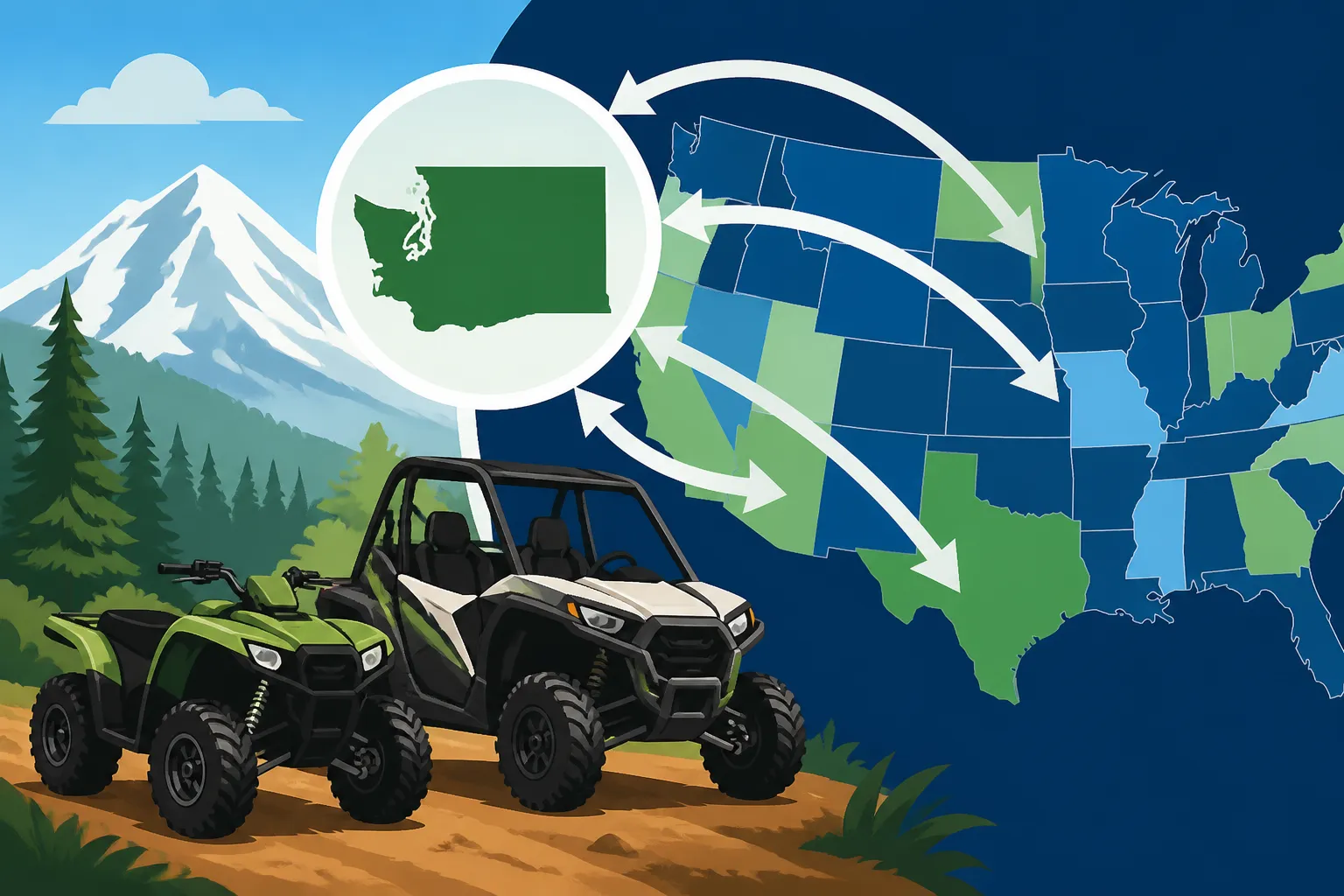
Washington ORV Reciprocity With Other States
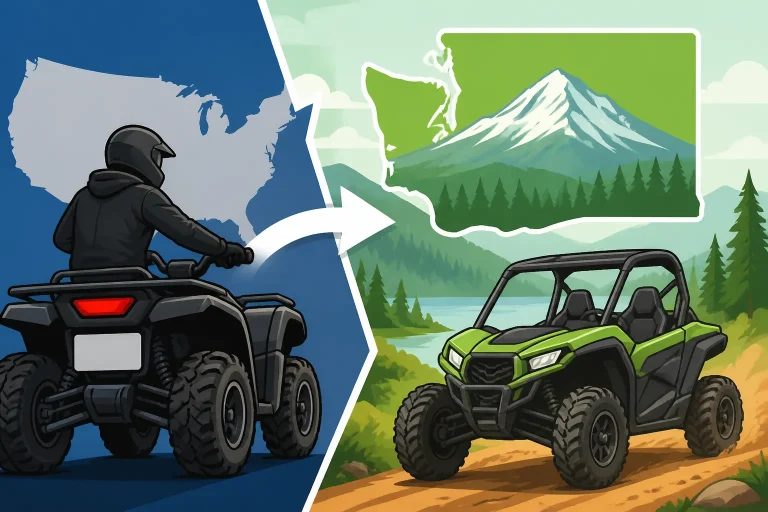
A machine registered at home does not automatically have permission to ride everywhere in Washington. Reciprocity can help visitors avoid unnecessary Washington registration, but it has limits: it depends on the machine, the home state’s rules, the type of riding, and the land you plan to use. This guide explains what to check before you load up, and when a Washington permit may be needed.
What reciprocity means for an out-of-state ORV
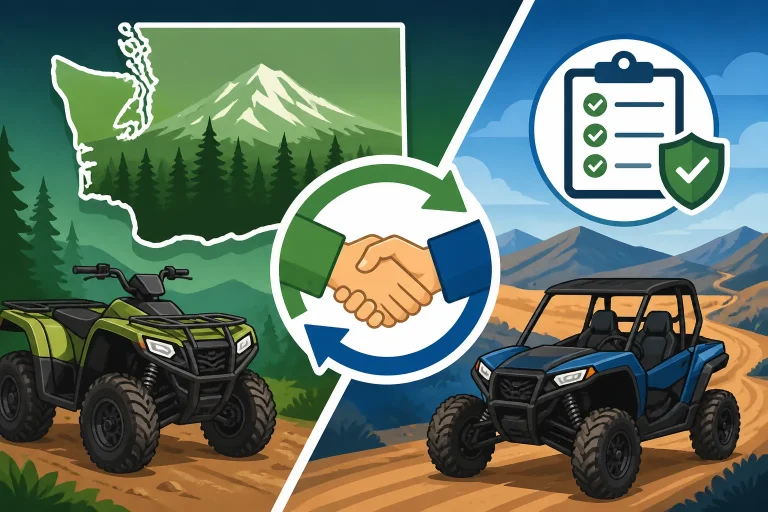
Reciprocity is an arrangement under which Washington recognizes certain off-road vehicle credentials issued by another state. If your machine is properly registered or permitted at home and your situation qualifies, you may be able to ride it off-road in Washington without obtaining the equivalent Washington registration first.
That does not mean every home-state sticker is accepted everywhere, or that an out-of-state registration works like a road license. Reciprocity is limited to the kind of use and credential covered by the applicable rules. It also does not replace trail access requirements, land-use permissions, or local restrictions.
The practical question is not simply, “Does Washington have reciprocity?” It is:
- What credential does your home state require for this machine?
- Is that credential valid for the machine and rider?
- Does Washington recognize it for the riding you plan to do?
- Are you riding off-road, on a public road, or across a road?
- Does the land manager require a separate pass or permit?
Washington’s system distinguishes off-road registration from road use. The off-road tab is associated with riding off-road where permitted. On-road use involves a separate set of requirements and is not granted just because your machine has a registration from another state. The details of Washington’s own credentials are explained in Washington’s Two-Tab System and Washington Off-Road Tab Explained.
A visitor with a valid home-state ORV credential should not assume it gives permission to ride on a Washington street, county road, or highway. Road use is governed separately, including by the road’s posted speed, the local jurisdiction’s rules, and the machine’s equipment. For that side of the question, see Washington Road Reciprocity and Its Conditions and What Washington Requires of an Out-of-State Rider.
Reciprocity is about the machine’s off-road status
Reciprocity generally concerns whether Washington accepts an out-of-state credential for off-road operation. It does not decide whether your vehicle is allowed on a particular trail, forest road, beach, or private timber road.
A valid credential cannot override a closure sign, a width restriction, a seasonal closure, or a landowner’s access rules. A machine can be properly registered and still be prohibited from a specific route. Before traveling, check the riding-area rules as well as the registration rules.
The credential also needs to match the machine. A permit for one ATV does not necessarily cover a second ATV, a side-by-side, or a borrowed machine. If you are traveling with several vehicles, check each one individually rather than assuming one sticker or document covers the whole trailer.
Reciprocity does not equal a universal exemption
A visitor may still need a temporary Washington permit if the home state does not issue an equivalent registration or permit, if the machine has no qualifying home-state credential, or if the visitor’s circumstances fall outside the reciprocity rules.
The exact result depends on the facts and current requirements. For a closer look at the conditions, see Washington Reciprocity for Off-Road Use and When Washington Reciprocity Does Not Cover a Visitor. If you are uncertain whether a home-state document qualifies, confirm before riding rather than relying on a seller’s description, a forum post, or another rider’s experience.
Check your home-state paperwork before leaving
The safest starting point is the agency or office that handles ORV registration in your home state. Ask what credential is required for your exact machine and whether it is valid outside that state. Then confirm Washington’s current treatment of that credential.
Do not rely only on the presence of a sticker on the fender. It may be expired, issued for a different use, or tied to a different vehicle. Keep the supporting paperwork with you, and make sure the vehicle identification number on the documents matches the machine.
Use this checklist for every ORV in the group:
- Identify the machine. Note whether it is an ATV, side-by-side, dirt bike, youth machine, or another type of ORV. Record the VIN and check that it is legible.
- Confirm the home-state credential. Verify that the registration or permit is current and applies to that machine.
- Ask whether it is accepted in Washington. Confirm the current reciprocity conditions with the relevant Washington licensing or recreation authority.
- Separate off-road use from road use. Do not assume the home-state credential authorizes pavement use in Washington.
- Check the riding location. Confirm that the route is open to your machine and that you have any required land-access pass.
- Carry the documents. Bring the registration or permit, proof of ownership if available, and any temporary permit you obtain.
If you bought a machine shortly before your trip, confirm that the registration has actually been transferred or issued in your name. A bill of sale can help explain ownership, but it may not replace an active ORV credential. Washington’s own process for a visitor without qualifying home-state registration is covered in [Washington Temporary ORV Permit for a Visitor].
What to ask the home-state agency
Ask specific questions rather than asking only whether “the sticker works out of state.” For example:
- Is this credential an ORV registration, a trail-use permit, or something else?
- Does it apply to the machine’s current owner?
- Is it valid for use outside the issuing state?
- Does the registration cover off-road use only, or is there also road authorization?
- What proof should the rider carry?
- Does a temporary or dealer-issued credential qualify?
- Does the credential expire during the planned trip?
If the credential is a state park permit or a land-access pass rather than an ORV registration, say so clearly. Those documents serve different purposes. A park pass may grant access to a facility or parking area without registering the machine for operation.
Check the VIN and ownership details
A mismatched VIN can turn a routine roadside check into a frustrating delay. Compare the VIN on the frame or manufacturer label with the registration document before traveling. If the number is hard to read, damaged, or inconsistent with the paperwork, get it resolved before the trip.
Also confirm that you have authority to bring the machine into Washington. If it is borrowed, rented, leased, or owned by a club or business, carry any permission or rental paperwork that explains who is responsible for it. For rental-specific considerations, see Washington Rules for a Rented Machine.
A waterproof document pouch can keep paperwork readable after rain, mud, or a creek crossing. If you buy one through Amazon, choose a design that closes securely and fits the documents you actually need; the pouch itself does not prove the credential is valid. Keep a backup copy somewhere separate from the original, such as in the tow vehicle.
When a Washington temporary ORV permit may be needed
If your home state does not issue a qualifying ORV registration or permit, or your machine is not covered by an applicable reciprocity arrangement, you may need a Washington temporary ORV permit for off-road riding. This is particularly relevant to visitors whose home state does not require the same kind of ORV credential.
A temporary permit is not a blanket substitute for every Washington registration or road-use requirement. It applies to the use described by the permit and does not automatically make the machine legal on public roads. Confirm the current eligibility rules, validity period, and application process with the official Washington source before your trip. The temporary permit’s purpose and limits are discussed in What a Visitor With No Home-State Registration Buys and Why a Temporary Permit Is Trail Only.
Do not wait until you reach a trailhead to find out whether you need one. A remote riding area may have limited cell service, and a permit kiosk or licensing office may not be nearby. Work it out while you still have time to correct a paperwork problem.
Situations where a temporary permit is worth checking
A temporary permit may be relevant if:
- Your home state does not require ORV registration.
- Your machine has no current home-state credential.
- You have an out-of-state sticker but cannot confirm that it qualifies for Washington reciprocity.
- You are bringing a newly purchased machine whose registration is not yet complete.
- You are a visitor using a machine with paperwork issued for a different owner or purpose.
These are prompts to verify the rule, not an automatic determination that you need a permit. A state may have different requirements for different classes of vehicles, and a credential that is valid for one kind of ORV may not cover another.
Understand what the temporary permit does not do
A temporary off-road permit does not, by itself, establish that the machine meets Washington’s requirements for on-road operation. It also does not make a closed or restricted trail open, provide permission to cross private land, or replace a land manager’s pass.
Treat it as one part of your trip paperwork. You may need a separate pass for parking or site access, and the route itself may impose restrictions on machine width, season, sound, spark arresters, or rider age. If the plan includes pavement, check the road-use rules separately rather than treating the temporary permit as a road tab.
The permit is also connected to the machine it was issued for. Do not assume it can be moved to a friend’s ATV or shared among several vehicles. Confirm the identification and transfer rules before using it, especially if your group’s vehicle lineup changes after you apply.
Off-road reciprocity does not grant road access
This is one of the most important distinctions for visitors: being allowed to ride off-road under reciprocity does not automatically authorize riding on public pavement.
Washington road access for off-road vehicles is controlled by separate requirements. A road may be open to a qualifying vehicle only if the relevant jurisdiction has authorized it and the machine and rider meet applicable conditions. A home-state plate, sticker, or registration does not turn every Washington road into a legal connector between trails.
Even a short pavement connection deserves a separate check. A rider may be tempted to use a few blocks of road to reach a gas station, campground, or trailhead. If the road is not legally open to the vehicle or the machine does not meet the required road-use conditions, the fact that it is registered at home does not fix the problem.
For Washington-specific road requirements, start with Washington’s Road Use Declaration and Washington Road Use Declaration Form. Then check the local road list and any applicable equipment and rider rules. Depending on the route, this may involve a county, city, or state highway authority.
Three different questions to answer
Before riding a machine on pavement, answer each question separately:
| Question | What it tells you | What reciprocity does not guarantee |
|---|---|---|
| Is the machine registered or permitted for off-road use? | Whether its off-road credential is current and recognized | That it may be ridden on a road |
| Is this particular road open to the vehicle? | Whether the jurisdiction permits ORV use on that route | That every road connecting open routes is also open |
| Does the machine and rider meet road-use conditions? | Whether the vehicle’s equipment and the rider’s qualifications meet applicable rules | That a home-state credential substitutes for Washington road requirements |
Road rules can vary by jurisdiction and route. A road open to one type of ORV may have conditions that do not apply on another road. A road shown as open on an old map may have since been closed or changed. Check current official information rather than planning around a route someone rode years ago.
Highway crossings are not the same as road riding
A limited crossing may be treated differently from traveling along a road. Do not infer from a permitted crossing that you can ride down the highway or use an adjacent shoulder. Confirm the exact crossing location and conditions, and follow posted directions.
Likewise, private forest roads and timber roads are not automatically public roads. A gate, road sign, or map line does not necessarily grant public access. Landowner permission and current access notices matter. Review Washington Rules for Riding a Forest Road if your planned route uses forest roads, and check the specific land manager’s guidance.
If your trip requires a pavement connection, build a legal route before unloading. If you cannot confirm that the connecting road is open and that the machine qualifies, use a trailer or tow vehicle to move between riding areas.
A registration is not a trail pass or land-access permission
Visitors sometimes have valid machine paperwork and still arrive without the pass needed for the site. That is because vehicle registration and land access answer different questions.
A registration or permit concerns the vehicle’s operating status. A land pass or site fee concerns access to a particular property, trailhead, or recreation area. A Discover Pass, Northwest Forest Pass, or other land-manager credential may be required for parking or access depending on where you go. Some locations use different passes, and some do not require one. Check the official information for each destination instead of buying a pass based on a general assumption.
For a useful overview of where a Discover Pass may apply, see Do You Need a Discover Pass to Ride in Washington?. If the trip includes federal land, use the guidance in [Washington Rules for Riding Federal Land]. For state land, check the relevant agency’s rules, including [Washington Rules for Riding DNR Land].
Plan by riding area, not just by state
A trip can involve several land managers in a single day. You might park at a state-managed trailhead, ride onto a route managed under different rules, and then reach an area where access is restricted. Your home-state registration does not settle any of those land-use questions.
For each planned riding area, check:
- Who manages the trailhead and route.
- Whether a parking pass or recreation permit is required.
- Whether the trail is open for the season.
- Which machine types and widths are allowed.
- Whether a sound limit or spark-arrester requirement applies.
- Whether the route crosses private, tribal, or restricted land.
- Whether temporary closures or active work affect access.
Use current maps and notices from the land manager. A downloaded map can be useful where cell service is weak, but it may not reflect a new closure. Check alerts shortly before departure and again before setting out from camp.
Keep documents accessible and protected
Carry the vehicle credential where you can retrieve it without emptying a muddy cargo box. If the registration must be carried on the machine, follow the applicable instructions and protect it from water and abrasion. Keep any trail pass or parking credential in the format accepted at that location.
A document pouch purchased through Amazon or another retailer can be useful for protecting a paper registration, but check that it stays sealed and does not interfere with safe operation. Do not attach paperwork where it can obstruct controls, become entangled, or fall off. Carry a backup copy in the tow vehicle, but do not assume a photo replaces the original if the rules require a physical document.
For a group trip, make a separate document set for each machine. A stack of registrations for several similar-looking ATVs is easy to mix up at a staging area. Label your own copies with the machine’s make and VIN, while keeping originals intact.
Common visitor situations and how to handle them
The right answer often depends on how you acquired the machine, who owns it, and what kind of credential it carries. These examples help frame the questions to ask.
Your machine is registered in a state with an ORV program
Confirm that the registration is current, belongs to the machine, and qualifies under Washington’s reciprocity conditions. Carry the registration document and make sure the sticker or decal is displayed as required by the issuing state.
Then check the destination’s land-access rules. Reciprocity may address the vehicle credential, but it does not guarantee access to every Washington trail. If you plan any road riding, verify the road separately.
Your home state does not require ORV registration
Do not assume that no registration at home means no paperwork in Washington. Check whether Washington requires a temporary permit for your situation. If one is needed, arrange it before riding and verify which machine it covers and how long it is valid.
This situation is a common reason to review [Washington Temporary ORV Permit for a Visitor]. Bring proof of ownership and the machine’s identification details in case they are needed to complete the process.
You bought a machine shortly before the trip
A sales receipt or bill of sale may show that you own the machine, but it does not necessarily establish that it has a valid ORV credential. Ask whether the seller’s registration can be transferred, whether a new credential has been issued, and what documentation is accepted while that process is underway.
If the machine was bought privately, review [Buying a Used WATV in Washington] for Washington-specific ownership and paperwork issues. The rules for a purchase completed in another state may differ, so check both the issuing state and Washington requirements.
You are borrowing a friend’s machine
Confirm that the machine’s credential is current and that the owner has given you permission to use it. Make sure you can identify which paperwork belongs to that exact vehicle. A friend’s registration does not automatically cover another machine in the group.
If the machine is registered in someone else’s name, ask whether the rider needs written authorization or other documentation. This matters especially if the machine is being transported across state lines or used under a temporary permit with restrictions tied to one vehicle.
You are renting an ATV or side-by-side
Ask the rental company which credentials are on the machine and what routes are permitted. Do not assume that a rental’s paperwork authorizes you to ride on every public road or trail. The rental company may limit where the machine can be operated, and land managers may still require separate access credentials.
Confirm who is responsible for permits, passes, safety equipment, and roadside requirements before signing. Keep the rental agreement accessible, and follow the company’s instructions on where the machine may be ridden.
Your group includes machines with different paperwork
Make a simple checklist for every vehicle. One rider may have a home-state ORV registration, another may need a Washington temporary permit, and a third may be riding a rental with its own documentation. A group leader’s paperwork does not cover the whole group.
Write down each machine’s VIN, credential type, expiration date, and the name of the rider or owner responsible for it. Have one person check that all the vehicles are accounted for before the group leaves camp. This small step can prevent a rider from being stranded when another vehicle’s paperwork turns out not to apply.
A practical pre-trip checklist
Use this process a few days before departure, not at the trailhead:
- List every machine. Include ATVs, side-by-sides, dirt bikes, and youth machines. Note the VIN and owner for each.
- Verify every home-state credential. Confirm it is current and applies to the machine and its intended use.
- Confirm reciprocity with Washington. Ask the appropriate official office about the credential and vehicle type. Save the answer or relevant official guidance.
- Arrange a temporary permit if needed. Verify eligibility, timing, duration, and whether the permit is machine-specific.
- Decide whether pavement is part of the route. If it is, check the road, jurisdiction, machine requirements, and rider requirements separately.
- Check land access. Confirm required passes, fees, permissions, and current closures for each riding area.
- Pack the paperwork. Carry the required documents in a protected, accessible place and keep a backup copy in the tow vehicle.
- Recheck conditions before leaving. Road lists, closures, fire restrictions, and trail conditions can change.
A waterproof storage pouch and spare copies can be helpful, but they are only practical accessories. Amazon listings and retailer descriptions are not official confirmation that a particular registration, permit, or document format meets Washington requirements. Treat the issuing agency and relevant Washington authority as the source for the rule.
If the plan changes during the trip, reassess the route. A new riding area may have a different land manager, pass requirement, road connection, or seasonal restriction. Do not stretch reciprocity into permission for a use it was never meant to cover.
The simplest rule to remember is this: verify the machine credential, the route, and the land access separately. A valid out-of-state ORV registration may satisfy one part of the trip, but it does not automatically satisfy the others. When the answer is unclear, confirm it before riding rather than taking a chance on a citation, denied access, or an avoidable trip back to the trailer.
Disclaimer
This article is for general informational purposes only and does not constitute professional advice. Laws, prices and regulations vary by location and change over time. Consult a qualified professional for guidance on your specific situation.