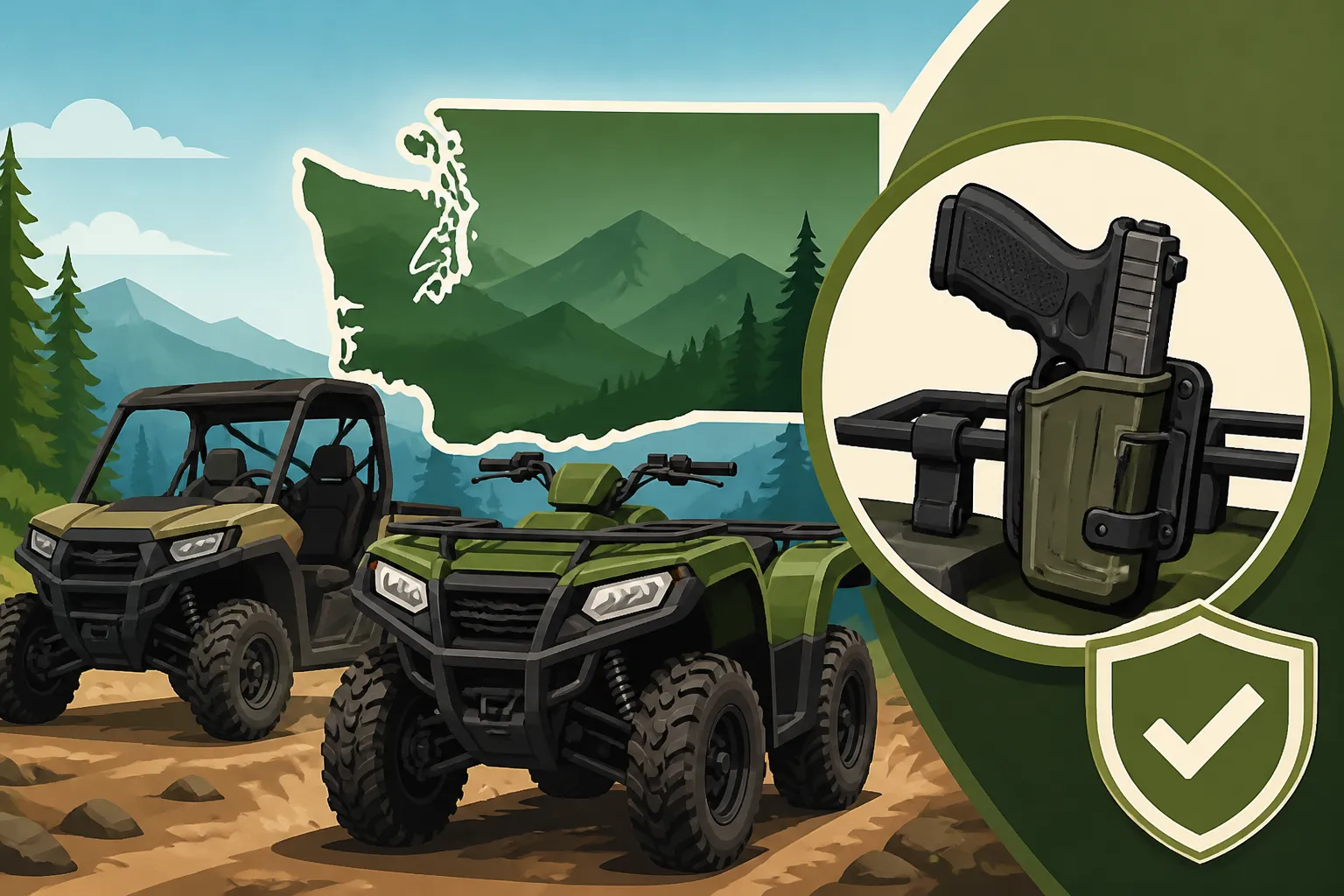
Washington Rules for Carrying a Firearm on a WATV
It's completely understandable to want to carry a firearm when you're out riding your All-Terrain Vehicle (WATV) or Utility Terrain Vehicle (UTV) in Washington's vast backcountry. Whether it's for personal protection, hunting, or just peace of mind in remote areas, many riders feel safer with a firearm. However, the rules around carrying guns on a machine can feel like a tangled mess of state laws, federal regulations, and specific land manager policies, leaving many of us scratching our heads. This guide is here to untangle that knot, offering clarity on what you need to know to legally and safely carry a firearm on your WATV in Washington state.
The Foundations of Firearm Carry in Washington State
Before we even get to strapping a rifle to your side-by-side, it's crucial to understand the fundamental laws governing firearm possession and carry in Washington state. These overarching rules apply whether you're walking down a city street, driving your car, or out on the trails. Misunderstanding these basics is often where riders run into trouble.
Open Carry vs. Concealed Carry General Principles
Washington is generally considered an "open carry" state for handguns for individuals 18 years or older who are not otherwise prohibited from possessing a firearm. This means that if you're legally allowed to own a handgun, you can typically carry it openly in public without a special permit. Think of it as carrying a handgun in a visible holster on your hip. For long guns (rifles and shotguns), the rules are even less restrictive; they can also generally be carried openly. The key here is "openly" – the firearm must be visible. If it's tucked away or covered, that's where the definition can shift to "concealed."
Concealed carry, on the other hand, refers to carrying a firearm in a manner that isn't readily visible to the ordinary observation of another person. For a pistol to be carried concealed, you generally need a Concealed Pistol License (CPL) issued by Washington state. This license allows you to carry a handgun hidden from view, whether in a pocket, bag, or under clothing. Without a CPL, carrying a pistol concealed is generally unlawful, even if you could carry it openly. When it comes to long guns, the concept of "concealed carry" doesn't quite apply in the same way; they're generally not carried concealed on a person, but rather transported in a case or rack. The distinction between open and concealed becomes particularly important when you consider how your firearm is stored or mounted on your WATV and whether it's easily visible to others.
Restrictions on Firearm Carry in Specific Locations
While Washington state has fairly permissive gun laws, there are definite "no-go" zones where carrying a firearm, even openly or with a CPL, is prohibited. These restrictions are critical to understand, as some might intersect with areas where you ride your WATV. For instance, firearms are generally not allowed in federal buildings, courthouses, public schools (with some exceptions for CPL holders picking up/dropping off students), and areas posted with signage prohibiting firearms, such as certain private businesses or parts of specific public events.
Additionally, certain state and national parks might have their own regulations. While many state parks allow firearms consistent with state law, federal lands like National Parks generally prohibit firearms inside federal facilities (visitor centers, restrooms) and often have stricter rules regarding loaded firearms in vehicles. Even on lands managed by the Department of Natural Resources (DNR) or the U.S. Forest Service (USFS), which are popular for WATV riding, specific administrative rules might come into play, especially regarding hunting or target shooting restrictions. It's always best practice to check with the specific land management agency for the area you plan to ride in, as a quick call can prevent a significant legal headache. These restrictions are in place to ensure public safety, and ignorance of the law is never an excuse.
How WATV Use Intersects with Firearm Laws
Now that we've covered the basics of firearm carry in Washington, let's get into the specifics of how these laws apply when you're out on your WATV or UTV. The way you transport, store, and carry your firearm on your machine can have significant legal implications depending on where you're riding and how the firearm is presented.
Riding on Public Lands DNR, USFS, BLM
Riding your WATV often takes you onto a patchwork of public lands, each with its own managing agency and, sometimes, slightly different rules. On Department of Natural Resources (DNR) lands, which comprise many popular motorized trail systems, state firearm laws generally apply. This means open carry is typically permissible, and concealed carry of a pistol requires a valid [Washington ORV Permits Explained]. However, DNR also manages trust lands, and specific rules might apply for activities like target shooting.
Federal lands, such as those managed by the U.S. Forest Service (USFS) or the Bureau of Land Management (BLM), generally follow state and federal law. In Washington, this typically means you can carry firearms on these lands in accordance with state open and concealed carry laws. However, it’s always wise to remember that National Forest Service roads are often subject to different rules than trails. Additionally, while you can often transport firearms on these lands, specific prohibitions might exist regarding discharging them within certain distances of developed recreation sites, roads, or residences. Always consult specific local forest or district rules. The golden rule here is that while many areas allow firearm carry, you must remain compliant with all state and federal laws, especially regarding CPLs and any restrictions related to hunting seasons or designated wilderness areas where motorized vehicles and firearms might be further restricted. [Washington Rules for Riding Federal Land] provides more context on general rules for these areas.
Transporting a Firearm on a WATV
The practical reality of transporting a firearm on a WATV requires careful consideration for safety, legality, and the longevity of your equipment. For long guns like rifles and shotguns, the most common and safest method is to use a dedicated gun scabbard or rack designed for ATVs and UTVs. These systems are engineered to secure the firearm, protect it from the elements (dust, mud, rain), and prevent accidental discharge due to vibration or bumps. Many riders opt for rigid cases that completely enclose the firearm, especially valuable ones, providing superior protection and often making them less visible, which is a consideration for "open" versus "concealed" transport.
When transporting a long gun on your WATV, it is generally recommended, and often legally required in certain contexts (like across specific public roads or within certain vehicles), that the firearm be unloaded. This typically means no rounds in the chamber and, ideally, no magazine inserted. A high-quality gun rack or case from a company like SuperATV can make a huge difference here, ensuring your rifle stays put even on the roughest trails. For handguns, if you have a CPL, carrying it concealed on your person is usually the most straightforward option. If you plan to carry it on the WATV itself, an open holster securely mounted to the machine, or a secure, visible case, would typically suffice if you meet open-carry requirements. The key is that the firearm must be secured in a way that it won't fall off, accidentally discharge, or become an obstruction during operation. Always keep the muzzle pointed in a safe direction and the trigger guard protected.
Firearm Carry and Road Riding
One of the unique aspects of Washington's WATV laws is the option to make your machine street-legal by adding an on-road tab. This opens up entirely new questions about firearm carry. When your WATV is operating on a public road or highway, it falls under the same transportation laws as any other motor vehicle. This means that rules regarding carrying firearms in vehicles become highly relevant.
In Washington, for example, it is generally lawful to carry a loaded pistol concealed in a vehicle if you possess a valid CPL. Without a CPL, a loaded pistol must generally be carried openly in the vehicle, or if concealed, it must be unloaded and in a secure wrapper or container. For long guns, the rules can be a bit more nuanced. Generally, long guns transported in a vehicle on a public road must be unloaded, meaning no rounds in the chamber. They should also be secured to prevent them from becoming a projectile in a crash. A secure gun rack or case on your WATV is not just for off-road protection but also for compliance on public roadways. This is where a good, sturdy rack system, perhaps from SuperATV, becomes a versatile accessory, allowing you to legally and safely transport your firearm whether you're on a remote forest trail or a county road. Ignorance of these road-specific rules, especially during a traffic stop, can lead to serious legal consequences, so understanding [Washington WATV Road Requirements] is paramount.
Hunting, Self-Defense, and Legal Considerations
Carrying a firearm on your WATV isn't always just about transport; it's often tied to specific intentions like hunting or personal defense. Understanding the legal nuances for each is crucial to staying on the right side of the law.
Carrying for Hunting Purposes
Many WATV riders use their machines to access prime hunting grounds, but it's vital to remember that in Washington state, it is generally illegal to hunt from a motorized vehicle. This means you cannot discharge a firearm from your WATV while it's running, or even immediately after turning it off, if you're still within the machine. The WATV is a means of transportation to get to your hunting spot, not a hunting blind or platform. You must dismount the vehicle, move a reasonable distance away, and position yourself to ethically and legally take game.
However, WATVs are perfectly legal and incredibly useful for retrieving downed game. Once you've harvested an animal and it's lawfully tagged, you can often use your WATV to transport the carcass back to your camp or vehicle. When doing so, your firearm should again be unloaded and securely transported, ideally in a scabbard or case. Always double-check the Washington Department of Fish and Wildlife (WDFW) regulations for the specific hunting season and Game Management Unit you're in, as rules can vary, particularly regarding weapon types, seasons, and permissible retrieval methods. For detailed information on this, you'll want to review [Washington Rules for Hunting From a Machine]. Adhering to these regulations is not only a matter of legality but also of ethical hunting practice.
Carrying for Self-Defense
The decision to carry a firearm for self-defense while riding your WATV is a deeply personal one, and thankfully, Washington state law generally supports an individual's right to self-defense. If you're legally allowed to possess a firearm and carry it in accordance with state law (e.g., openly, or concealed with a CPL), then the general principles of self-defense apply in remote areas just as they would elsewhere. This means that if you reasonably believe you are in imminent danger of bodily harm or death, you may use a proportionate amount of force, including lethal force, to defend yourself.
However, carrying for self-defense isn't a license to disregard firearm laws. All the rules we've discussed about open vs. concealed carry, and restrictions in certain areas, still apply. Carrying a loaded pistol concealed on your person while riding requires a valid CPL. If you don't have one, the pistol would need to be carried openly. For long guns, they are generally carried for defense in the same manner as for hunting: unloaded and securely cased or racked on the machine. The remote nature of many WATV trails means you might be hours from help, making self-defense a legitimate concern for many riders. Just ensure that your chosen method of carry aligns with Washington's laws to avoid legal complications should you ever need to use or display your firearm.
Avoiding Common Mistakes and Misinterpretations
Navigating firearm laws can be tricky, and some common mistakes can land WATV riders in hot water. One prevalent error is misunderstanding the "loaded" definition, especially for long guns. In Washington, a long gun is generally considered "loaded" if there is a round in the chamber. Many assume "loaded" means a magazine inserted. However, for transportation purposes in vehicles (and by extension, often WATVs on roads), the chamber must be empty. Another common mistake is neglecting to verify local rules. While state and federal laws provide a baseline, specific counties or cities might have ordinances that impact firearm carry, especially on their roads or in designated recreational areas. Always check.
Furthermore, riders sometimes fail to adequately secure their firearms. A gun bouncing around unsecured on a WATV is not only dangerous (risk of accidental discharge, damage) but could also be interpreted as negligence by law enforcement. Investing in proper carrying solutions, like robust gun boots or racks, is essential. Finally, always carrying your CPL (if you have one) and your WATV registration ([Carrying the Registration in the Machine]) and proof of ownership is crucial. Being prepared and informed is your best defense against unintended legal issues. Remember, your WATV is a vehicle, and firearm rules regarding vehicles often differ from pedestrian carry.
Practical Gear and Best Practices for WATV Firearm Carry
Having the right gear and adopting safe practices are just as important as knowing the law when it comes to carrying a firearm on your WATV. The rugged environment of off-road riding demands equipment that can withstand vibrations, dust, water, and potential impacts, all while keeping your firearm secure and accessible.
Choosing the Right Carrying Gear
When selecting gear for carrying a firearm on your WATV, durability and security are paramount. For long guns, a quality gun scabbard or boot is indispensable. These typically mount securely to the rack or frame of your ATV or UTV and provide a dedicated, protected space for your rifle or shotgun. Look for models that are weather-resistant, with features like padded interiors to protect the finish of your firearm and secure straps or closures to prevent it from bouncing out on rough terrain. Some scabbards are open at one end, allowing quick access, while others are fully enclosed for maximum protection.
Many riders find that modular systems work best, allowing them to adapt their carry setup to different firearms or riding conditions. Brands like SuperATV offer a range of universal gun racks and specific UTV gun mounts that can be invaluable. Their products are often designed with robust materials to withstand the rigors of off-road use, ensuring your firearm remains safe and stable. For pistols, secure holsters that attach to your person (if concealed with a CPL) or to the WATV itself (if openly carried) are necessary. Avoid simply tossing a firearm into a storage box unless it's in a fully secure, locked case. A proper mount prevents damage, loss, and accidental discharge, making your ride safer for everyone.
Safety Tips for Carrying on a WATV
Beyond the legal requirements, adhering to fundamental firearm safety rules is critical when carrying on your WATV. Always treat every firearm as if it's loaded. This means never pointing the muzzle at anything you don't intend to shoot, even when mounted on your machine. When selecting and installing a gun rack or scabbard, pay close attention to the muzzle direction. It should ideally point away from the rider and passengers, and also away from critical machine components like fuel tanks.
Before heading out, double-check that your firearm is securely mounted. Vibrations from riding can loosen straps and bolts, so a quick inspection before each trip is a good habit. Consider carrying a chamber flag for unloaded firearms, especially when in staging areas or around other riders, to visually indicate an empty chamber. If you must load or unload your firearm on the trail, always do so in a safe direction, away from people and vehicles, and on stable ground. And finally, always be aware of your surroundings, both for potential threats and for regulations. When riding with others, communicate that you are carrying a firearm so everyone is aware and can practice appropriate safety.
Summary of Firearm Carry on a WATV in Washington
Here's a quick overview of how different carry methods typically interact with common WATV scenarios in Washington state. This table provides general guidance, but always verify specific details with land managers and local ordinances.
| Carry Method | On-Person (Concealed Pistol) | On-Person (Open Pistol) | On-WATV (Open Long Gun) | On-WATV (Cased Long Gun) |
|---|---|---|---|---|
| Requirements | Valid CPL | 18+, Legal to Possess | 18+, Legal to Possess | 18+, Legal to Possess |
| Public Land (DNR, USFS, BLM) | Generally Permissible | Generally Permissible | Generally Permissible* | Generally Permissible* |
| Public Roads (Street-Legal WATV) | Permissible (CPL) | Generally Permissible (Visible) | Unloaded, Secured, Visible | Unloaded, Secured, Visible/Concealed |
| Hunting Activity | Permissible (not for hunting) | Permissible (not for hunting) | Unloaded for transport, not for shooting | Unloaded for transport, not for shooting |
| Safety Best Practices | Secure holster, trigger discipline | Secure holster, trigger discipline | Muzzle direction, secure mount | Muzzle direction, secure mount, weather protection |
| Common Mistakes | No CPL, accidental exposure | Accidental concealment | Loaded chamber during transport, unsecured | Loaded chamber during transport, unsecured |
*Note: For long guns on WATVs, "open" means clearly visible in a scabbard or rack, and "cased" means fully enclosed. In all scenarios, transporting a long gun on a public road usually requires it to be unloaded (empty chamber).
Whether you're exploring the [Capitol State Forest Near Olympia, Washington] or traversing [Ahtanum's Green Dot Roads in Washington], having a clear understanding of firearm regulations is paramount. Being a responsible WATV rider means not only knowing how to operate your machine safely but also respecting the laws that govern firearm carry. Take the time to educate yourself, invest in the right gear, and always prioritize safety, and you'll be well-prepared for whatever adventures Washington's diverse landscape throws your way.
Disclaimer
This article is for general informational purposes only and does not constitute professional advice. Laws, prices and regulations vary by location and change over time. Consult a qualified professional for guidance on your specific situation.