Washington Rules for Towing With a WATV
Many Washington ATV and UTV owners find themselves wondering about the dos and don'ts of using their machines to pull a trailer, haul equipment, or even recover another vehicle. The rules aren't always crystal clear, especially when you factor in different types of terrain and whether you're on public roads or designated trails. This comprehensive guide will untangle the specifics of towing with a Washington Wheeled All-Terrain Vehicle (WATV), helping you understand the legalities, safety considerations, and necessary equipment so you can tow responsibly and confidently across our beautiful state.
Understanding What "Towing" Means for Your Washington WATV
It's easy to think of "towing" as simply attaching something to the back of your quad or side-by-side and driving off. However, in Washington, the definition and the rules that apply can change dramatically depending on what you're towing, where you're towing it, and even the capabilities of your machine. Understanding these nuances is crucial to staying safe and legal.
What Can a WATV Legally Tow?
When we talk about what a WATV can tow, we're really looking at two things: the physical capability of your machine and the legal restrictions of the land you're on. Physically, modern WATVs, especially side-by-sides, are often equipped with robust hitch receivers, making them quite capable of pulling various loads. You might use your machine to pull a small utility trailer loaded with firewood or camping gear for a weekend trip. Some riders even use them to move small boat trailers around their property or to access remote fishing spots. Agricultural applications are also common, where WATVs can pull spreaders, small cultivators, or specialized farm implements on private land. Then there are those situations where you might need to recover a stuck buddy's machine from a ditch or haul a disabled ORV back to camp.
However, the "legally tow" part is where things get a bit more complex. While your machine might physically handle a load, the state of Washington has different expectations for towing on public roads versus designated off-road trails or private property. Your WATV's design plays a significant role here; a utility-focused UTV, for example, will almost always have a higher manufacturer-rated towing capacity than a sport ATV. While aftermarket accessories, like a heavy-duty hitch receiver from a reputable brand like SuperATV, can certainly enhance your machine's ability to connect to various trailers, it's vital to remember that these upgrades don't magically increase your WATV's overall towing capacity beyond what the manufacturer intended. Always check your owner's manual for specific limits, as exceeding them can lead to dangerous situations and significant wear and tear on your machine.
Towing on Designated Off-Road Trails and Public Lands
When you're out on the vast network of [Washington's Off-Road Vehicle Rules Explained] on public lands – think DNR forests like Capitol State Forest or even managed federal lands – the rules for towing are generally more relaxed than on paved roads. Here, common sense, trail etiquette, and environmental responsibility often take precedence. The primary goal is usually to transport gear for camping, hunting, or trail maintenance without damaging the trails or creating hazards for other riders. You might pull a small trailer with tools for clearing fallen trees or supplies for an extended stay in the backcountry.
However, "more relaxed" doesn't mean "no rules." Many trails, especially those designated for single-track or narrow ORVs, might have width restrictions that a WATV with a trailer would easily exceed. Imagine trying to navigate a tight, winding trail with a wide utility trailer in tow; it simply wouldn't work and could damage the trail edge or block other riders. It's always a good idea to consult trail maps and local regulations for the specific area you plan to ride. For instance, [Washington Rules for Riding a Forest Road] or [Washington Rules for Riding a Logging Road] might specify certain limits or restrictions, especially if there's active logging or other industrial use in the area. Some organized riding events or specific ORV parks might also have their own explicit rules regarding towing, so checking with event organizers or park management beforehand is always a smart move. Always prioritize the safety of yourself, your passengers, and fellow trail users when deciding what and how to tow in these environments.
Navigating Washington's Rules for Towing on Paved Roads
Taking your WATV onto paved public roads is already a complex topic in Washington, and adding a trailer into the mix introduces another layer of considerations. This isn't like towing with your pickup truck; there are specific rules and equipment requirements that differ significantly from off-road use.
When Your WATV is Street Legal and What That Means for Towing
The most critical distinction for towing on public roads is whether your WATV is truly "street legal" in Washington. Simply owning a WATV, or even having an off-road registration tab, does not automatically grant you permission to drive it – let alone tow with it – on city streets or county roads. For your WATV to be considered street legal, it must meet a specific set of equipment requirements, pass a safety inspection, and be properly registered with both the standard off-road tab and the additional on-road tab. You can find detailed requirements in resources like [Washington WATV Road Requirements]. If your machine only has the off-road tab, you are generally restricted to designated off-road trails and private property, and cannot use it for routine travel or towing on public paved roads. Ignoring this distinction can lead to significant fines and penalties, as detailed in [Washington Fines for Illegal WATV Road Use].
Furthermore, even if your WATV is fully street legal, you can only operate it on paved roads within counties and cities that have explicitly opted in to allow WATV use. Not all jurisdictions in Washington permit WATVs on their roads. It's crucial to consult lists like [Washington Counties That Allow WATVs on Roads] and [Washington Cities That Allow WATVs on Streets] to confirm where you can legally ride. Even then, most open roads have a speed limit for WATVs of 35 mph, a restriction that becomes even more critical when you're towing a load. This lower speed limit, combined with the often-limited braking power of a WATV compared to a full-sized vehicle, means that towing on public roads requires an abundance of caution and strict adherence to all traffic laws. Attempting to tow a significant load at speed can quickly become extremely hazardous.
Essential Equipment for On-Road Towing with a WATV
When your street-legal WATV is pulling a trailer on a public road, you are essentially operating a combination vehicle, and the legal and safety requirements ramp up considerably. It’s not just about hooking up; it’s about making sure your entire setup is compliant and safe for everyone on the road.
Firstly, a properly rated hitch and ball are non-negotiable. This means ensuring your hitch receiver (whether factory-installed or an aftermarket addition from a company like SuperATV) and the hitch ball are both rated to handle the gross weight of your loaded trailer. Mismatched or undersized components are a recipe for disaster. Secondly, trailer brakes become a critical safety feature, especially for heavier loads. While light utility trailers might not always have them, many states, including Washington, have specific weight thresholds where trailer brakes become legally mandatory. If your trailer has brakes, they absolutely must be in good working order.
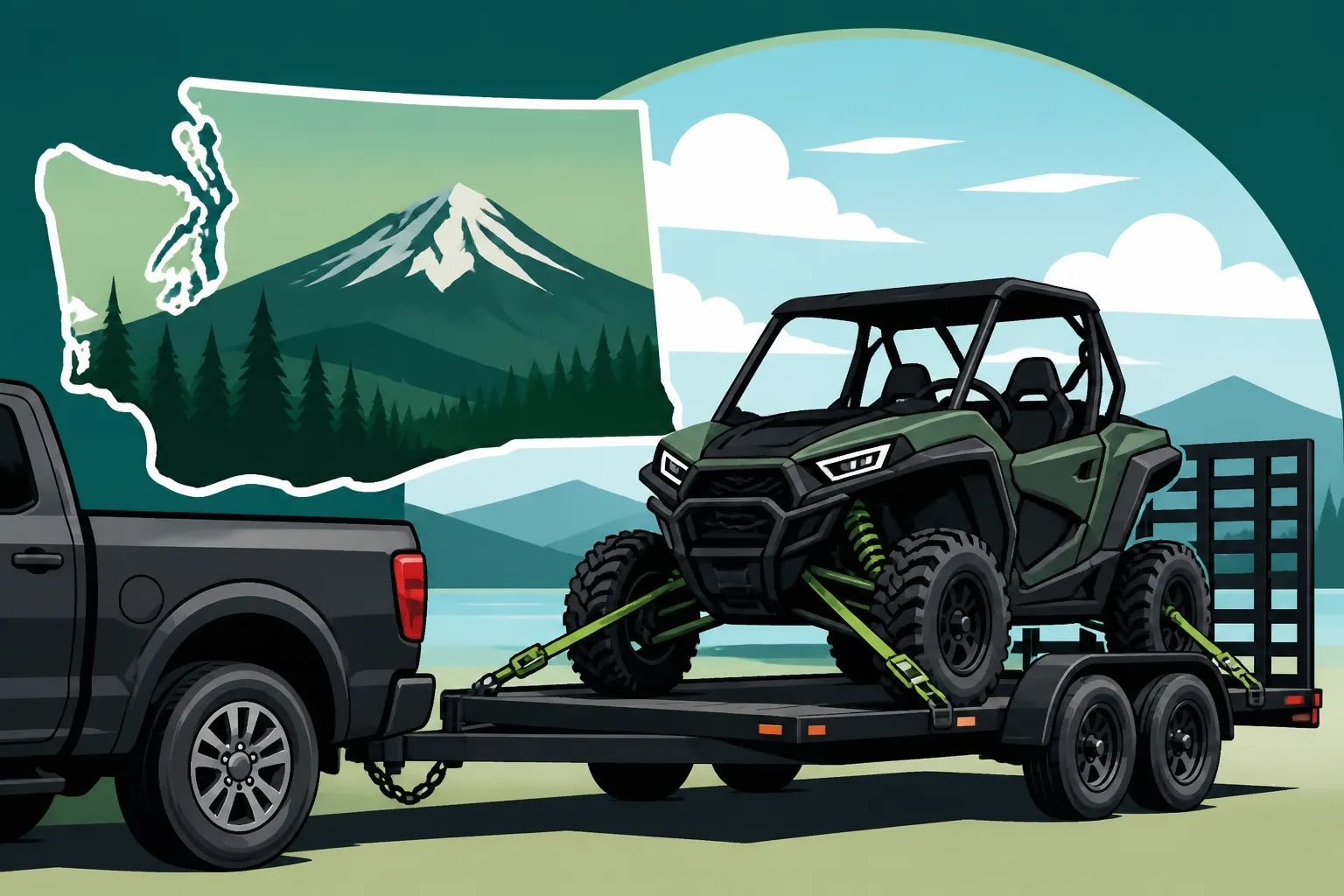
Third, and perhaps most visibly, is lighting. On public roads, your trailer must have functional tail lights, brake lights, and turn signals. If your trailer is wide or long enough to obscure your WATV's own lighting, then trailer lights are not just a good idea; they are usually a legal requirement. Think about how difficult it would be for a driver behind you to see your intentions if your WATV's turn signals or brake lights are blocked. [Washington Lighting Requirements for WATVs] and [Washington Turn Signal Requirements] apply not only to your WATV but often extend to the trailer it's pulling when on public roads. Fourth, safety chains are a mandatory safeguard. In the event of a hitch failure, these chains are designed to keep the trailer connected to your WATV, preventing it from becoming a runaway hazard. They must be crossed under the tongue of the trailer and securely attached to the WATV's frame or dedicated attachment points. Finally, cargo securement cannot be overlooked. Any load you're towing must be properly tied down and secured to prevent it from shifting, falling off, or otherwise creating a road hazard. This means using appropriate straps, nets, or covers. Taking these precautions isn't just about avoiding a ticket; it's about protecting yourself and others from potentially serious accidents.
| Aspect | Off-Road/Trail Towing | On-Road Towing (Street Legal WATV) |
|---|---|---|
| WATV Legality | Off-road tab sufficient. | Both Off-road and On-road tabs, plus street-legal equipment. |
| Road Access | Designated ORV trails, private land, permitted forest roads. | Open county/city roads (if opt-in), 35 mph limit. |
| Trailer Lights | Often not legally required, but highly recommended for safety. | Required if trailer obscures WATV lights, or for general road safety. |
| Trailer Brakes | Recommended for heavy loads, not always legally mandated. | Required for heavier trailers (check specific weight thresholds). |
| Safety Chains | Recommended. | Mandatory on public roads. |
| Towing Capacity | Adhere strictly to manufacturer limits. | Adhere strictly to manufacturer limits, factor in road conditions. |
| Speed Limit | Controlled by terrain, conditions, and safety. | Max 35 mph on open roads. |
| Load Securement | Essential for preventing hazards and damage. | Legally required for all cargo. |
Safety Best Practices and Capacity Limits When Towing
Towing with any vehicle demands respect for its limits and an understanding of safe operating procedures. When you're dealing with a WATV, which inherently has a lighter footprint and different handling characteristics than a truck, these considerations become even more paramount. Ignoring them isn't just risky; it can be downright dangerous.
Understanding Your WATV's Towing Capacity
This is arguably the single most critical factor when planning to tow with your WATV. Every manufacturer specifies a maximum towing capacity for their machines, and this number is not a suggestion—it's a hard limit. Exceeding this limit can have dire consequences: you risk losing effective braking power, compromising steering control, and putting immense strain on your machine's engine, transmission, and suspension components. Imagine trying to stop a heavy trailer rolling downhill with a machine that's not designed to handle that much momentum; it's a recipe for loss of control. Over time, consistent overloading will also accelerate wear and tear, leading to costly repairs and a shortened lifespan for your WATV.
Beyond the overall weight, understanding "tongue weight" is crucial. This refers to the downward force exerted by the trailer's tongue on the hitch of your WATV. Too much tongue weight can cause your WATV's rear suspension to squat excessively, lifting the front wheels and reducing steering control. Too little tongue weight can lead to trailer sway, where the trailer wags uncontrollably behind you, making the entire setup unstable and extremely dangerous. Proper weight distribution on the trailer is key to achieving the correct tongue weight. For example, when loading a utility trailer with firewood for a trip to [Washington Rules for Riding to a Trailhead], always try to center the heaviest items slightly forward of the trailer's axle. Always consult your WATV's owner's manual for specific tongue weight recommendations, which are just as important as the overall towing capacity.
Loading, Balance, and Braking Considerations
Once you understand your machine's limits, the next step is to load your trailer properly. Weight distribution is a science in itself. Ideally, you want about 10-15% of the total trailer weight (including cargo) to be pressing down on the hitch. Loading too much weight towards the rear of the trailer can cause severe instability and sway, making your WATV feel squirrelly and difficult to control. Conversely, too much weight forward can cause the WATV's front end to lift, reducing traction for steering and braking. Distribute cargo evenly from side to side and secure everything thoroughly to prevent shifting during transit. Even a slight shift in a heavy load can alter the balance of your entire setup.
When towing, your braking distance will increase dramatically. This is a non-negotiable reality. Your WATV's brakes are designed for the machine's weight plus a rider or two, not for an additional thousand pounds (or more) behind it. This is why the 35 mph speed limit for WATVs on open roads is especially critical when towing; it provides a larger margin for error and a greater chance to stop safely. On challenging terrain, such as steep inclines or declines, loose gravel, or slick mud, you'll need to use lower gears to help control your speed and provide engine braking. Don't rely solely on your wheel brakes in these conditions. Furthermore, always ensure your visibility isn't compromised by your trailer or load. If your trailer is wide enough to block your mirrors, consider adding mirror extensions to maintain a clear view of what's behind you. Remember, [Washington Helmet Law for WATV Riders] also applies, and proper eye protection is always recommended, especially when towing where debris could be kicked up.
Pre-Ride Checks and Maintenance
Before you even think about hitting the trail or road with a trailer in tow, a thorough pre-ride check is essential. This isn't just a quick glance; it's a systematic inspection of all critical components. Start with the hitch connection: ensure the hitch ball is correctly sized, securely fastened, and properly lubricated. Check that your safety chains are crossed and attached, and that any electrical connections for trailer lights are working correctly. Inspect the tires on both your WATV and the trailer for proper inflation, tread wear, and any signs of damage. Make sure all lug nuts are tight. Verify that the trailer's brakes (if equipped) are functional. Beyond the hitch, check your WATV's fluid levels (engine oil, brake fluid), and test all your machine's lights and brakes.
Towing puts significant additional strain on your WATV's engine, transmission, suspension, and braking system. This means that regular and diligent maintenance becomes even more critical. Keep an eye on your brake pads for accelerated wear, inspect your suspension components (shocks, bushings) for fatigue, and pay attention to your drivetrain for any unusual noises or vibrations. Consider using heavy-duty aftermarket parts, perhaps from SuperATV, if you frequently tow substantial loads or ride in demanding conditions. These components are often designed to withstand greater stress and provide enhanced durability. By being proactive with your checks and maintenance, you can significantly reduce the risk of breakdowns and accidents, ensuring that both you and your gear arrive safely at your destination.
Disclaimer
This article is for general informational purposes only and does not constitute professional advice. Laws, prices and regulations vary by location and change over time. Consult a qualified professional for guidance on your specific situation.