Crossing a Washington Highway Posted Between 35 and 60
Navigating Washington's intricate rules for riding your WATV or UTV can feel like trying to untangle a ball of fishing line after a big catch. One minute you're enjoying a beautiful backroad, the next you're faced with a major highway and wondering if you're even allowed to get to the other side without breaking the law. It’s incredibly frustrating when you just want to connect two perfectly legitimate riding areas, but a state highway stands in your way. This guide will cut through the confusion and explain exactly when and how you can legally cross a Washington highway posted between 35 and 60 mph.
The Nuance of Washington's Highway Crossing Rules
Washington state has made a real effort to create opportunities for WATV and UTV riders, but the laws can be a labyrinth, especially when it comes to mixing off-road vehicles with on-road traffic. It’s not simply a matter of "street legal" or "not street legal"; there are specific provisions that address how and when an off-road vehicle can interact with the broader road network. Understanding these nuances is key to staying legal and, more importantly, safe.
Why Speed Limits Matter for ORV Access
The speed limit posted on a road is perhaps the single most important factor in determining whether your WATV can even be on it, let alone cross it. For general travel on a public road, Washington law, as detailed in [Washington WATV Road Requirements], typically restricts WATVs to roads with a posted speed limit of 35 mph or less, provided the county or city has specifically opened those roads. This 35 mph rule is about continuous travel along a road. However, the game changes when we talk about crossing a highway. A highway posted at 40 mph or 55 mph might be completely off-limits for riding along, but there's a specific, narrow exception for getting from point A to point B across it. This distinction is crucial because misinterpreting it can lead to hefty fines and a ruined ride. It’s not just an arbitrary number; it’s a direct reflection of the perceived safety risk of mixing slower-moving WATVs with faster-moving traffic.
When you're out riding, especially in rural areas where trail systems often bump up against paved roads, you'll encounter all sorts of speed limits. You might be cruising along a charming county road posted at 25 mph, completely within your rights, only to find it dead-ends into a state highway posted at 45 mph. Your natural instinct is to get to the trail on the other side, but you can't just assume it's okay. The law carves out specific scenarios for crossing, and those scenarios are very much tied to the posted speed limit of the road you intend to traverse. Without these specific allowances, the only way to get across would be to load your machine onto a trailer, which defeats the purpose of being able to connect trails.
The Difference Between Riding and Crossing
This distinction might seem obvious, but it’s often where riders get into trouble. "Riding" a road implies traveling longitudinally along it for some distance, even if it's just a few hundred feet. "Crossing," on the other hand, is generally defined as moving from one side of a road to the other in the most direct and expeditious manner possible. Washington law is quite clear that the privileges granted to WATVs on certain public roads do not automatically extend to all state highways. [Washington's Off-Road Vehicle Rules Explained] highlights this point by separating out general road access from specific crossing provisions.
Think of it this way: if you’re riding a county road that suddenly meets a state highway, and there's another county road or a forest trail directly across, a crossing would mean going straight over, perpendicular to the flow of traffic, to reach the other side. This is fundamentally different from turning onto that state highway and traveling a quarter-mile down the shoulder, even if you intend to get off at the next turn. That would be "riding," and if the highway is posted above 35 mph, it's generally not allowed unless it's a specific segment designated by a county as part of its ORV network – which is rare for high-speed state highways. The intention is to allow riders to bridge gaps in trail systems, not to enable them to use state highways as general travel corridors.
Understanding the 35-60 MPH Highway Crossing Provision
It's a common point of frustration: you're on a legal trail, and another legal trail is just on the other side of a state highway posted at 45 mph. Your intuition might tell you that you should be able to cross, but the specific legal framework is what truly matters. Fortunately, Washington law does provide a lifeline here, but it comes with strict conditions that every rider needs to know by heart.
The Specifics of RCW 46.09.455(10)
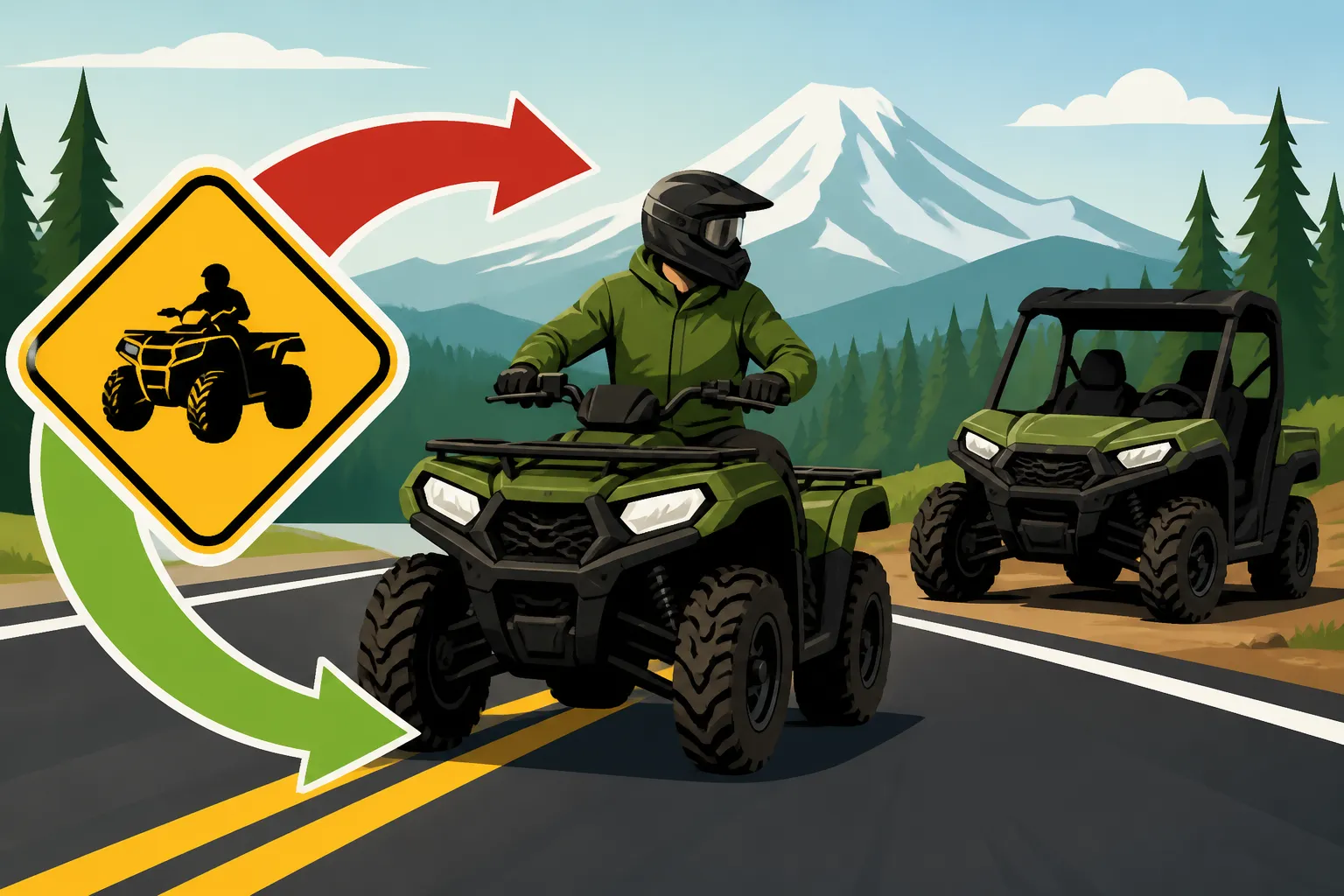
This particular section of Washington law is your best friend when it comes to highway crossings that aren't on low-speed roads. RCW 46.09.455(10) explicitly states that an off-road vehicle may cross a public road or highway with a speed limit between 35 and 60 mph, but only if the crossing is made at an angle of approximately 90 degrees to the direction of the roadway. You must stop completely before crossing, yield the right-of-way to all oncoming traffic, and make the crossing in the safest and most direct manner possible. This isn't a free pass; it's a highly conditional allowance designed to minimize conflict with regular road traffic.
What does "approximately 90 degrees" mean in practice? It means you shouldn't be making a sweeping turn onto the highway and then immediately off it. You need to approach the highway, stop, ensure the coast is clear, and then drive straight across to the other side. The "safest and most direct manner" part is also crucial. This isn't the time for sightseeing or taking an indirect route. It's about getting from one side to the other as quickly and safely as possible. Think of it as a momentary interruption to highway traffic, not an integration into it. This provision recognizes the reality of fragmented trail systems and offers a pragmatic solution for riders, but it places the onus squarely on the rider to execute the crossing with extreme care.
Safety First: What You MUST Consider When Crossing
Even with legal permission, crossing a highway, especially one with traffic moving at 35 to 60 mph, is inherently risky. Safety must be your absolute top priority. First and foremost, visibility is critical. Wear bright clothing, make sure your headlights and taillights are on and fully functional, even in broad daylight. This is where quality aftermarket accessories can really make a difference. Components from companies like SuperATV, for instance, offer robust lighting solutions that can significantly enhance your presence on the road, even for brief moments. You need to be seen, and you need to be seen early by approaching vehicles.
Before you even think about starting your crossing, come to a complete stop at the edge of the pavement. Look both ways, and then look again. Wait for a truly clear gap in traffic – not just a gap you think you can make it through, but one that provides ample time for you to accelerate, cross the lanes, and clear the roadway without making any drivers slam on their brakes. Remember, drivers on a highway aren't expecting a WATV to suddenly appear in front of them. It's your responsibility to not only yield the right-of-way but to ensure you're not creating a hazardous situation. Also, be mindful of your machine's acceleration capabilities; some WATVs are quicker than others, and you need to know what your machine can do in a pinch. Finally, ensure you and any passengers are wearing proper helmets. [Washington Helmet Law for WATV Riders] mandates this for a reason – protect your head.
Equipment and Driver Requirements for Highway Crossings
Just because you're only crossing a highway doesn't mean you can skimp on the necessary equipment or disregard driver licensing laws. The moment your wheels touch a paved public road, even for a split second, you become subject to certain regulations designed for on-road safety. This is a critical point that many riders overlook, assuming that because it's "just a crossing," the full suite of street-legal requirements doesn't apply. They do.
Essential WATV Equipment for Road Use (Even Crossings)
To legally and safely cross any public road or highway in Washington, your WATV needs to be equipped with specific features. These aren't suggestions; they are legal mandates. At a minimum, you'll need:
- Headlights: Capable of illuminating the road for a sufficient distance.
- Taillights: Clearly visible from the rear.
- Brake Lights: Functioning properly when the brakes are applied.
- Reflectors: On the front and rear, and often on the sides.
- Horn: A working horn to alert others.
- Mirrors: At least one mirror, typically on the left side, allowing you to see traffic approaching from the rear. Many riders opt for a full mirror kit from a brand like SuperATV for enhanced visibility.
- Turn Signals: Even though you're crossing perpendicularly, having working turn signals to indicate your intention to enter or exit the road is a wise safety measure, and often a legal requirement if you possess a "road tab" for any part of your ride.
It's a good practice to ensure all of your machine's lighting and signaling systems are in top working order before any ride that might involve public road interaction. [Washington Lighting Requirements for WATVs] spells out the specific needs for various types of lights and signals. You want to avoid any situation where a law enforcement officer pulls you over, even after a brief crossing, only to find a non-compliant machine. Imagine the frustration of getting a ticket not for illegally crossing, but for a burnt-out taillight! A quick pre-ride check can save you a lot of hassle.
Rider Licensing and Age Restrictions
Another non-negotiable aspect of any WATV operation on public roads, including crossings, is the driver's license requirement. If you are operating a WATV on a public road in Washington, even just to cross it, you must possess a valid driver's license. This applies to everyone, regardless of whether you have an off-road tab, an on-road tab, or both. This is not a negotiable point, and law enforcement takes it seriously. An unlicensed driver operating a vehicle on a public roadway is a clear violation, regardless of the brevity of the road exposure.
For younger riders, the rules become even stricter. [Washington Minimum Age to Ride a Road] clearly states that generally, a person must be at least 16 years old and possess a valid driver's license to operate a WATV on roads open to ORV use. Even for crossings, this rule typically holds. If a minor rider needs to cross a highway, they generally need to be supervised by a licensed adult, and often the adult needs to be operating their own machine in close proximity. Always double-check the current regulations regarding minors and road access before planning any route that involves public roads, even short crossings. The goal is to ensure that anyone operating a vehicle in traffic has demonstrated a basic level of competence and understanding of traffic laws.
Where Crossings Are Commonly Encountered and Why
Understanding the rules is one thing, but knowing where you're likely to apply them in real-world riding scenarios is another. Washington's diverse landscape means WATV riders often find themselves needing to connect trails across various types of public roads, and state highways are a frequent barrier.
Connecting Trail Systems and Rural Roads
Washington is blessed with vast tracts of public land, including state forests managed by the DNR and federal lands managed by the US Forest Service. These areas often contain extensive trail networks. However, these networks aren't always contiguous. Sometimes a county road will lead you right up to a state highway, and then a continuation of your trail, or another exciting riding area, will be directly across it. This is a very common scenario in places like the foothills of the Cascades or the forested areas of Western Washington. For example, you might be riding through a segment of Capitol State Forest, following a DNR trail, only to hit State Route 8 or another state highway that cuts through the forest. The only way to continue your ride on the other side is to execute a legal crossing.
Local governments, like Lewis County with its [Lewis County Ordinance 1286], have made efforts to open up certain county roads for WATV use, creating a patchwork of accessible routes. However, these opened county roads frequently intersect state highways, which are under the jurisdiction of the Washington State Department of Transportation (WSDOT). The crossing provision in the law is designed precisely for these moments, allowing riders to bridge these gaps without having to trailer their machines for a mere few yards. It’s about creating a more cohesive riding experience for enthusiasts who are committed to exploring the state's natural beauty on their machines. The frustration arises when you know there's more trail, but a segment of pavement separates you.
Areas Where Confusion Can Reign
While the law attempts to be clear, real-world conditions can sometimes blur the lines, leading to confusion for riders. One common area of misunderstanding is distinguishing between a genuine state highway crossing and accidentally "riding" a segment of a state highway that you assume is a county road. Sometimes a state highway might briefly narrow or change character, feeling more like a local road. Riders might think, "Oh, this must be a local road, it's fine," when in reality, it's still a state route with higher speed limits and different rules.
Another point of confusion can arise around the term "highway." Some riders might only think of major interstates, but state routes, even two-lane roads in rural areas, are still considered highways and fall under these crossing regulations. It’s absolutely vital to know exactly what kind of road you're on, and what its posted speed limit is. Consulting up-to-date maps and, where available, county-specific WATV route guides is highly recommended. [The Department of Licensing and Washington ORVs] provides resources that can help clarify these distinctions. When in doubt, it’s always better to err on the side of caution. If you are uncertain about a road's status or speed limit, assume it is not open for WATV travel or crossing, and seek an alternative route. This careful approach can save you from an unexpected citation.
Penalties for Illegal Highway Use and How to Avoid Them
The thrill of riding is fantastic, but the financial and legal pain of a citation for illegal road use can quickly dampen any fun. Washington law enforcement takes vehicle code violations seriously, and ignorance of the law is rarely a valid excuse. Understanding the potential consequences and taking proactive steps to avoid them is paramount for any responsible WATV owner.
The Cost of Misunderstanding the Rules
Let’s be blunt: the penalties for illegally riding or crossing a highway can be substantial. A citation for operating an unregistered or non-compliant off-road vehicle on a state highway can lead to significant fines, often in the hundreds of dollars. Beyond the direct financial hit, you could face other consequences. Depending on the nature of the violation and your driving record, it might even lead to points on your driver's license or an increase in your insurance premiums. In some cases, if the machine is deemed highly non-compliant or if you're repeat offender, your WATV could even be impounded, leading to further costs for towing and storage on top of your fines. [Washington Fines for Illegal WATV Road Use] gives a good overview of the monetary impact.
Imagine you're out for a weekend ride, feeling great, and you decide to take a shortcut across a 45 mph highway because you "thought it was okay." A state patrol trooper sees you, pulls you over, and issues a ticket. Now, what was supposed to be a fun, relaxing day has turned into a costly legal headache. The time spent dealing with court appearances, paying fines, and potentially retrieving an impounded machine far outweighs the few minutes you might have saved by taking an illegal shortcut. It’s a harsh lesson, but one that many riders have learned the hard way. It also reflects poorly on the WATV community as a whole, potentially jeopardizing future efforts to expand legal riding opportunities.
Best Practices for Staying Legal and Safe
To avoid these costly lessons, a few best practices should become second nature. First, plan your routes meticulously before you leave home. Don't just rely on memory or vague directions. Use detailed maps, both paper and digital, and cross-reference them with official county and DNR ORV maps. Many counties that have opened roads for WATV use publish lists or maps of these approved routes. Checking [Finding a County's Approved Road List] is an excellent starting point. If your planned route involves any road segments or crossings, confirm their legality for WATV use and the specific conditions that apply.
Second, always err on the side of caution. If you're unsure whether a road segment is open, or if a highway crossing is permitted under your specific circumstances, assume it's not. Turn around, find an alternative route, or load your machine onto a trailer if absolutely necessary. It's always better to be safe and legal than to risk a citation. Third, ensure your machine is fully compliant with all equipment requirements for road use, even for crossings. Check your lights, horn, and mirrors regularly. Finally, stay vigilant while riding. Be aware of signage, posted speed limits, and traffic conditions. Your machine needs to be legal, you need to be legal, and your actions need to be safe. By following these guidelines, you can ensure your Washington WATV adventures remain fun, memorable, and free of legal trouble.
Disclaimer
This article is for general informational purposes only and does not constitute professional advice. Laws, prices and regulations vary by location and change over time. Consult a qualified professional for guidance on your specific situation.