Which Washington Highway Segments Allow ORVs
It's one thing to equip your trusty quad or side-by-side with all the required safety gear, get your tabs in order, and feel ready to hit the pavement. But then you’re staring down a state highway, wondering: can I actually ride my WATV on this? The rules for operating Washington's Wheeled All-Terrain Vehicles (WATVs) on public roads can be incredibly confusing, especially when you step up from local county roads to state highways. This guide is here to untangle the specific regulations and help you understand precisely which Washington highway segments allow ORV use, and under what conditions.
Understanding the Baseline: State Highways are Generally Closed
Let's cut right to it: the vast majority of Washington's state highways are not open for general WATV travel. This can be a huge source of frustration for riders who've gone through all the effort to make their machine street-legal, only to find their options severely limited on arterial roads. You might have added turn signals, mirrors, a horn, and even a windshield – maybe even some heavy-duty accessories from a brand like SuperATV – all in preparation for road riding, only to discover that the state highway that connects two of your favorite trailheads is still off-limits.
The Default Position for State Routes
Think of state highways as primarily designed for traditional vehicles: cars, trucks, and motorcycles. The legislative intent behind Washington's WATV road laws primarily focused on opening up local access to trail systems and allowing movement between private properties or small communities, particularly in rural areas. State highways, by their nature, are often higher speed, higher volume routes that were never envisioned as regular thoroughfares for ORVs. This means that if you don't see specific signage or have verified information that a particular state highway segment is open, you should always assume it is closed to WATV travel. It's the safest assumption and one that will keep you out of trouble.
When counties and cities decide to open their roads, they go through a specific local process, often involving public hearings and official ordinances. State highways, however, fall under the purview of the Washington State Department of Transportation (WSDOT) and require a different, more stringent process to be designated for WATV use. This distinction is crucial because simply having your machine be road-legal for county roads doesn't automatically grant you access to state routes. It’s like having a fishing license for freshwater lakes; it doesn't automatically mean you can fish in the ocean without checking specific saltwater regulations.
Why State Highways Are Different from Local Roads
The distinction between state highways and county or city roads isn't just a bureaucratic one; it's rooted in design, speed, and safety considerations. State highways typically have higher posted speed limits, often exceeding the 35 mph threshold that is a common benchmark for ORV road access in Washington. They also carry a greater volume of traffic, and the traffic often moves at higher speeds. Introducing slower-moving WATVs onto these routes can create significant safety hazards, both for the ORV riders and for other motorists.
Furthermore, state highways often lack the shoulders or alternate pathways that some county roads might offer, which could otherwise provide a safer buffer for WATVs. The engineering and design of these roads are fundamentally different. They're built for efficient, high-speed movement of conventional vehicles, not for the more varied operational characteristics of ORVs. This is why the state requires specific, detailed authorization from WSDOT for any segment of a state highway to be opened. Without this explicit approval, even if your machine is fully [Washington WATV Road Requirements] compliant, you're not permitted to ride along a state highway. The rules for [Washington Rules for Riding a County Road] are much more permissive due to these inherent differences in road design and use.
Specific Exceptions: Segments Explicitly Opened to ORVs
While the general rule is that state highways are closed, there are indeed specific, limited exceptions. These aren't widespread, open invitations to ride state routes freely; rather, they are highly specific segments where WSDOT has given explicit authorization. These exceptions are usually made to bridge gaps between open county roads, connect trail systems, or provide access to essential services in very specific, often remote, locations where no other practical alternative exists.
The Limited Scope of Permitted Highway Sections
When a state highway segment is opened to ORVs, it's typically for a very short distance, often just a few hundred feet or a mile or two. These segments are not meant for recreational cruising on the highway, but rather as necessary connectors. Imagine you're on a fantastic trail system, and to get from one section to another, or to reach a small town for gas and supplies, you need to traverse a brief stretch of a state route. That's the kind of scenario these exceptions are designed to accommodate.
These authorized segments are not always immediately obvious, and you won't necessarily see a large "ORV Friendly" sign. Riders need to do their homework. This often involves checking WSDOT's official guidance and county ordinances that might specifically reference state highway segments as part of a larger network of open roads. It's critical to understand that even on an open segment, all the usual rules for street-legal WATVs apply, including helmet laws, lighting requirements for [Washington Rules for Riding After Dark], and carrying your registration. Companies like SuperATV offer a range of lighting kits and turn signals that would be essential for making your machine visible and compliant on any paved road segment.
Identifying Authorized Segments Through WSDOT Guidance
So, how do you actually find out which state highway segments are open? This is where it gets a little tricky, as there isn't one central, easily searchable map that covers every single authorized segment statewide. WSDOT issues guidance and permits for these segments, often in response to requests from local jurisdictions or in conjunction with their own highway projects.
The key is often found in the county or city ordinances themselves. When a county or city "opts-in" to allow WATV use on its roads, it might explicitly identify small segments of state highways that connect its open road network. You'll need to consult the specific ordinance for the county you plan to ride in. WSDOT also publishes an annual list or guidance documents, which can be found on their official website. This guidance will outline which specific state highway routes or portions thereof have been authorized for WATV use. Always cross-reference this information with local ordinances to ensure you have the most up-to-date and accurate picture of where you can legally ride. Relying on anecdotal evidence or outdated maps can lead to fines for [Washington Fines for Illegal WATV Road Use].
The Critical Role of WSDOT Authorization
For any state highway segment to be legally accessible to WATVs, it requires explicit authorization from the Washington State Department of Transportation (WSDOT). This isn't a casual process; it involves careful review of safety, traffic patterns, and the specific needs of the local community. It underscores the state's cautious approach to integrating ORVs onto its primary transportation arteries.
How State Highway Segments Get Opened
The process typically begins with a local jurisdiction – a county or a city – identifying a need for a specific state highway segment to be opened to ORV traffic. Perhaps a crucial connection between two open county roads involves a short stretch of State Route 12, or access to a popular trailhead is cut off by a state highway with no other viable detour. The local jurisdiction would then petition WSDOT, presenting a detailed case for why that segment should be opened. This petition would likely include safety analyses, proposed signage, and a demonstration that the segment's speed and traffic volume are compatible with WATV use.
WSDOT then reviews the request, considering factors such as:
- The posted speed limit of the segment (typically, segments with speed limits above 35 mph are highly scrutinized).
- The average daily traffic volume.
- The presence of adequate sightlines and shoulder space.
- Alternative routes available to WATV riders.
- The impact on the safety of other motorists.
If WSDOT approves the request, they issue an authorization, which might include specific conditions, such as required signage, time-of-day restrictions, or specific equipment mandates beyond the general [Washington WATV Road Requirements]. This detailed evaluation ensures that any decision to open a state highway segment is made with public safety as the paramount concern.
Limitations on WSDOT's Authority and Public Process
It's important to understand that even WSDOT has limitations on what state highway segments they can open. For instance, segments that are part of the interstate highway system are strictly off-limits to ORVs, regardless of local requests. The federal regulations governing interstates generally prohibit such use. Additionally, WSDOT is unlikely to authorize ORV use on high-speed, multi-lane highways or those with particularly complex intersections, simply due to the inherent safety risks.
The process often involves a public input phase, where local citizens, law enforcement, and other stakeholders can provide feedback on proposed changes. This ensures transparency and allows for community concerns to be heard. After authorization, WSDOT may require specific signage to clearly delineate the start and end of the authorized ORV segment. As a rider, you are responsible for knowing these boundaries. Just because you see one [Washington Highway Segments That Allow ORVs] sign doesn't mean the entire state route is open. The [Washington Road Use Declaration] form is crucial for registering your machine for road use, but it doesn't automatically unlock all roads; specific authorizations are still needed.
Navigating Intersections and Crossing State Highways
Even where you can't ride along a state highway, there are provisions for crossing them. This is a vital distinction, as many riders need to cross a state route to get from one open county road to another, or to access a staging area for trails. Understanding the rules for crossing is just as important as knowing where you can ride.
The "Crossing Only" Rule and Its Parameters
Washington law explicitly allows for WATVs to cross state highways under specific conditions, even if riding along that highway segment is prohibited. This "crossing only" rule is designed to provide practical connectivity for riders without compromising the primary function and safety of the state highway. The key here is the intent: you are crossing the highway to continue your journey on an adjacent, open road, not to travel down the highway itself.
When crossing, you must do so at approximately a 90-degree angle to the highway, minimizing the time your machine spends in the travel lanes. This isn't the time to dawdle or take a scenic detour across the median. You should treat it like any other intersection, yielding to traffic, and ensuring the crossing is safe and clear. Many riders opt for visible safety flags or additional lighting, like those offered by SuperATV, to increase their visibility to oncoming traffic, especially at busy intersections. This quick, decisive crossing is a fundamental part of the [Washington Rules for Crossing a State Highway].
Understanding Speed Limits for Safe Crossings
The posted speed limit of the state highway plays a significant role in determining how you can cross it. Washington law generally allows crossings of state highways where the posted speed limit is 60 miles per hour or less. If the highway segment you need to cross has a posted speed limit above 60 mph, then ORV crossings are typically prohibited. This limitation is a direct safety measure, acknowledging the increased risk associated with slower-moving ORVs entering high-speed traffic lanes.
Here’s a breakdown of the implications:
| Posted Highway Speed Limit | ORV Crossing Allowed? | Conditions/Notes |
|---|---|---|
| 35 mph or less | Yes | Most permissive; often found in small towns or rural areas. |
| 36-60 mph | Yes | Allowed, but exercise extreme caution; yield to all traffic; cross at 90-degree angle. |
| Above 60 mph | No | Generally prohibited due to safety concerns related to high-speed traffic. |
Always be vigilant and ensure you have a clear line of sight in both directions before attempting to cross any state highway. Even if the speed limit allows it, if traffic is heavy or visibility is poor, it's safer to wait for a clear opening. This rule emphasizes that while access is granted, rider responsibility for safety remains paramount.
Essential Equipment and Rider Conduct for Highway Use
Making your WATV street-legal for any public road use in Washington involves a specific set of equipment requirements, and these absolutely apply when you're riding on authorized state highway segments or crossing them. Beyond the machine itself, your conduct as a rider is equally important to ensure safety and compliance.
Mandatory Gear for Road-Legal WATVs
To be considered road-legal in Washington, a WATV must meet several equipment standards. This isn't just a suggestion; it's the law, and failure to comply can lead to citations. When you’re on a state highway, even for a short, authorized segment, you become a part of the larger traffic flow, and your machine needs to be visible and controllable like any other vehicle.
Here’s a quick rundown of the essential equipment:
- Headlights: At least one, capable of illuminating objects at least 200 feet ahead. Required to be on if riding after dark or in conditions of reduced visibility.
- Taillights: At least one, emitting a red light visible from at least 500 feet to the rear.
- Brake Lights: Red or amber, visible from 100 feet.
- Turn Signals: Required on both front and rear. Many riders add aftermarket turn signal kits from companies like SuperATV to ensure high visibility and durability.
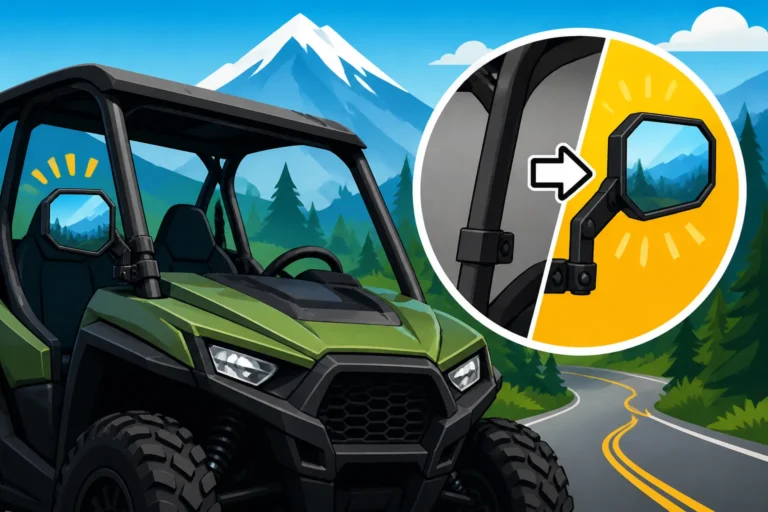
- Mirrors: At least one mirror, securely attached to the left side of the machine, that reflects a view of the highway for at least 200 feet to the rear. Many choose to install two for better situational awareness.
- Horn: A working horn, audible from a distance of at least 200 feet.
- Muffler & Spark Arrester: Your exhaust system must have a muffler that keeps noise levels within legal limits and a spark arrester to prevent wildfires.
- Tires: DOT-approved tires are generally required for road use.
- Windshield or Eye Protection: Riders must have a windshield or wear appropriate eye protection like goggles or a face shield.
- Seat Belts: If your WATV is equipped with seat belts (common on side-by-sides), they must be worn by all occupants.
- Brakes: Functional brake systems on all wheels.
- License Plate Light: To illuminate your license plate if riding after dark.
These requirements ensure your machine is both safe to operate on pavement and visible to other road users, which is critical, especially on state highways where traffic speeds can be higher. Getting a [Washington WATV Safety Inspection Cost] can help ensure your machine is up to snuff.
Rider Behavior and Safety on Shared Pavement
Beyond the equipment, your behavior as a rider is paramount. Operating a WATV on a state highway segment means sharing the road with vehicles that are often much larger, faster, and less accustomed to seeing ORVs.
- Stay to the Right: Always ride as far to the right of the roadway as safely possible, allowing faster traffic to pass.
- Single File: [Washington Rules for Riding Two Abreast] generally prohibit riding side-by-side on public roads, including state highway segments. Always ride in single file.
- Follow Traffic Laws: All standard traffic laws apply, including speed limits, stop signs, traffic lights, and yielding to pedestrians.
- No Stunt Riding: Save the wheelies and donuts for designated off-road areas. Public roads are not the place for aggressive or dangerous riding.
- Wear a Helmet: [Washington Helmet Law for WATV Riders] mandates that all riders and passengers wear a DOT-compliant helmet, regardless of age, when operating on public roads. This is non-negotiable for your safety.
- Valid Driver's License: The operator of a WATV on public roads must possess a valid driver's license.
- Insurance: While not always required for off-road-only use, if you are riding your WATV on a public road, including state highway segments, you generally need to carry liability insurance. [Washington WATV Insurance Requirements] specifies what you need.
By adhering to these rules, you not only ensure your own safety but also contribute to a positive perception of WATV riders, which can be crucial for maintaining access to road networks. Always be predictable, visible, and courteous to other road users.
Planning Your Route: Integrating Highway Segments Into Your Ride
The reality of riding a WATV on Washington state highways is that it's about strategic, limited integration rather than open-ended travel. You'll use these specific, authorized segments to connect the dots between more extensive off-road opportunities or to access critical services, not for long-distance touring. Planning your route meticulously is key to a smooth and legal ride.
Checking Local Ordinances and State Resources
Before you even load your machine onto the trailer, your first step should always be thorough research. This means going beyond just looking at a general map.
- County and City Websites: Visit the official websites of the counties and cities where you plan to ride. Look for their "ORV," "WATV," or "Off-Road Vehicle" ordinances. These documents are where local jurisdictions publish their decisions to open roads, and they are also where specific state highway connections, if authorized, will often be referenced. For instance, [Snohomish County Ordinance 17-032] specifies roads open in that area, and might include highway segments that connect to them.
- WSDOT Official Guidance: Periodically check the Washington State Department of Transportation website for their latest guidance on ORV access on state routes. They may have maps or lists of authorized segments.
- DNR and Forest Service Maps: If you're heading to a specific riding area like Capitol State Forest or Reiter Foothills, check the Department of Natural Resources (DNR) or Forest Service maps. These maps often show which roads are open for various uses and may indicate where state highway crossings or short riding segments are necessary.
- Local Riding Clubs: Connect with local ORV riding clubs. Members often have the most up-to-date, real-world information on road access, recent closures, and local nuances. They can be an invaluable resource.
Remember, laws and ordinances can change, so always verify the information, especially if it's been a while since your last ride in a particular area. It’s better to spend a little extra time on planning than to receive a citation or, worse, be involved in an accident. Planning ensures you know [Where to Ride an ATV in Washington] legally.
The Reality of Limited Pavement Access
Ultimately, integrating state highway segments into your WATV route means accepting the reality of limited pavement access. You won't be able to just hop on any state highway and ride for miles. The vision for WATV road use in Washington is to facilitate access to trails and services, not to create an alternative highway system for ORVs.
Consider a scenario: you're planning a ride in the Gifford Pinchot National Forest, and you need to get from one section of forest roads to another. Your map shows a short, two-mile stretch of State Route 12 connecting two gravel roads that are open to WATVs. After checking the county ordinance and WSDOT guidance, you confirm that this specific two-mile segment of SR 12, with a posted speed limit of 35 mph, is indeed authorized for WATV use. This is where your planning pays off. You'll ride that segment carefully, adhering to all traffic laws, with all your required gear, and then transition back onto the forest roads.
It’s crucial to keep your expectations realistic. Your street-legal WATV opens up many possibilities for connecting trails and accessing small towns, but state highways remain a highly restricted environment. View them as necessary bridges, not primary routes. Always carry your [Washington WATV Registration Paperwork] with you, along with your driver's license, whenever you're on public roads. By understanding these limitations and planning accordingly, you can enjoy your WATV safely and legally across Washington's diverse landscape.
Disclaimer
This article is for general informational purposes only and does not constitute professional advice. Laws, prices and regulations vary by location and change over time. Consult a qualified professional for guidance on your specific situation.