Why a Posted Limit Decides Washington Road Access
It's incredibly frustrating, isn't it? You've got your Washington off-road vehicle (WATV), maybe a quad or a side-by-side, all gassed up and ready to hit the trails, but you’re constantly second-guessing whether you can legally even get to the trailhead, or connect two trail segments, by riding on the road. The rules around road access for these machines in Washington State can feel like a tangled mess of regulations, especially when it comes to posted speed limits. This guide is here to untangle that knot, helping you understand precisely how speed limits dictate where and how your WATV can legally travel on public roads, saving you from potential fines and confusion.
Understanding Washington's WATV Road Access Laws
Washington State has a unique approach to allowing WATVs on public roads, and at its heart is the posted speed limit. It’s not simply a matter of having the right tabs and equipment; the very nature of the road you wish to ride on, as defined by its speed limit, is the primary gatekeeper. This often leads to a lot of head-scratching for riders who just want clear, straightforward answers. You might be staring at a county road map, seeing what looks like a perfect connection between two trail systems, only to realize the posted speed limit makes it a no-go for your machine. It’s a reality that can quickly turn excitement into exasperation.
The state's framework for WATV road access is designed to balance the recreational desires of riders with public safety. The thinking is that lower-speed roads are inherently safer for WATVs, which typically don't accelerate or handle like conventional cars or trucks. This distinction is crucial, as it sets the stage for every decision a county or city makes about opening their roads. Without a clear understanding of these foundational principles, you're essentially riding blind, risking a run-in with law enforcement and the subsequent hassle that comes with a citation. We all want to explore, but doing it legally and safely is paramount.
The Role of State Law in Local Road Access
The Washington State Legislature laid down the groundwork for WATV road access, essentially giving counties and cities the power to decide which of their roads are suitable for these machines. However, this power isn't limitless; it's constrained by the very speed limits we're discussing. The state law sets the fundamental parameters, often referred to as [Washington's 35 mph Road Rule], which local jurisdictions must adhere to. This means that while a county might want to open a particular road, if that road's posted speed limit exceeds certain thresholds, state law prohibits it. This hierarchy means that local ordinances can be more restrictive than state law, but never less.
For example, a county council might receive numerous requests to open a scenic country road that connects popular recreation areas. If that road, however, has a 45 mph speed limit, the council's hands are tied by state statute. They simply cannot open it for general WATV use, regardless of how much public support there is. This can be a tough pill to swallow for local rider groups who have put in the effort to advocate for access. It’s not that the local government is being uncooperative; it's that they are bound by the framework established at the state level. Understanding this dynamic helps riders focus their efforts on advocating for access on roads that actually can be opened, rather than spinning their wheels on impossible routes.
Why Speed Limits Are the Defining Factor
You might wonder why speed limits, specifically, are such a critical element in this equation, rather than, say, road width or traffic volume. The simple answer is safety. WATVs, by their design, typically have a higher center of gravity, shorter wheelbases, and different steering characteristics compared to traditional cars. While some utility task vehicles (UTVs) are getting more sophisticated with their road manners, an all-terrain vehicle (ATV) especially is built for off-road environments, not high-speed pavement. The risk of rollover, particularly in an emergency maneuver, increases significantly at higher speeds.
Beyond the physics of the machine itself, the interaction with other vehicles is a major concern. A WATV traveling 35 mph on a road where cars are moving at 55 mph creates a substantial speed differential, increasing the likelihood of accidents. Think about how unnerving it can be to encounter a slow-moving farm vehicle on a fast road; the principle is similar here. By limiting WATVs to lower-speed roads, Washington aims to minimize these dangerous interactions and create a more predictable environment for all road users. It's about reducing risk for everyone on the asphalt, ensuring that the fun of off-road riding doesn't spill over into serious accidents on the pavement.
The 35 MPH Threshold: Why It Matters So Much
When it comes to riding your WATV on public roads in Washington, the 35 mph posted speed limit isn't just a suggestion; it's a hard line in the sand. This is the golden rule, the primary benchmark that determines whether a county or city can even consider allowing WATVs on a specific road. If a road segment has a posted speed limit of 35 mph or less, it can be designated for WATV use by local ordinance. If it's posted higher than that, it generally cannot, except for very specific crossing scenarios. This makes checking the speed limit signs paramount before you even think about putting tires on the pavement.
Many riders find this rule limiting, especially when a perfectly good, low-traffic road might be posted at 40 mph and thus off-limits. It means that planning your routes isn't just about finding the shortest path; it's about finding the slowest legal path. This is a common source of frustration, as you might have to take a longer, more circuitous route on a series of open 35 mph roads, rather than a direct shot on a 40 mph road that feels just as safe. But regardless of how it feels, the 35 mph rule is deeply embedded in Washington's WATV legislation.
The Default: Roads Under 35 MPH
For counties with a population under 15,000, Washington law actually creates a sort of "default open" scenario for WATVs on roads with a speed limit of 35 mph or less, unless the county specifically designates them as closed. This is a huge benefit for riders in more rural parts of the state, as it means many county roads are open by default, rather than requiring a specific ordinance to open them. Imagine living in a small, eastern Washington county where the county road system is a network of gravel and low-speed paved routes. In these areas, the assumption is that if the speed limit is 35 mph or lower, your WATV is welcome unless marked otherwise. This significantly streamlines access and reduces the red tape for local riders.
This default-open status for [Washington Counties Under 15,000 Open by Default] doesn't mean you shouldn't do your homework. It's always a good idea to check with the county's public works department or website to see if they maintain a list of closed roads, or if there are any specific local exceptions. Even in these "open by default" areas, some roads might be unsuitable due to unique hazards, traffic patterns, or other local considerations, and the county retains the right to close them. Always confirm the specifics before you ride, because even a default rule has its exceptions, and ignorance of a closure is rarely an excuse that flies with a Washington Trooper.
When Roads Need a Specific Ordinance to Open
In contrast, for counties with a population of 15,000 or more, or for any city within the state, roads with a 35 mph or less posted limit are not automatically open. These jurisdictions must pass a specific ordinance to open designated roads for WATV use. This means you won't find yourself riding through [Pierce County's Unincorporated Roads] or [Riding Through Lake Stevens] without the local government having specifically decided to allow it. This process often involves public hearings, traffic studies, and a lot of discussion about safety and community impact. It's a much more deliberate and often slower process to gain access.
This distinction between larger and smaller jurisdictions highlights the varying concerns associated with WATV use. In more populous areas, there's generally more vehicle traffic, more pedestrians, and often more resistance from residents concerned about noise or safety. The ordinance process allows for these concerns to be heard and addressed, potentially leading to specific restrictions on hours of operation, types of machines allowed, or even specific routing to avoid sensitive areas. It's a compromise, often, to get any access at all, but it means that when a road is opened in one of these areas, it's typically been well-vetted and comes with clear guidelines. Always look for signage or a published list from the local government indicating which roads are open.
Navigating Roads Between 35 and 60 MPH: The Exception and the Rule
While the 35 mph threshold is the primary determinant for riding on a road, Washington law does provide a crucial exception for WATVs when it comes to crossing certain higher-speed roads. This distinction is incredibly important because it allows riders to bridge gaps in trail systems or access other open roads without necessarily being able to cruise down a faster highway. However, this exception comes with its own set of strict rules and limitations, designed to minimize risk on these more dangerous road segments. It's not a free pass to drive on the highway, but a carefully controlled maneuver.
The thought of pulling out onto a road where cars are traveling at 50 or 55 mph can be daunting, and for good reason. The speed differential is significant, and the consequences of an error can be severe. This is why Washington's law is so specific about how and when these crossings can occur. It's a testament to the state's cautious approach to integrating WATVs into the existing road network, acknowledging the practical need for connectivity while prioritizing the safety of all road users. Understanding these nuances is key to staying legal and, more importantly, staying safe.
Crossing Roads Posted Between 35 and 60 MPH
You can cross a public road or highway with a posted speed limit between 35 and 60 mph, but only if you meet very specific conditions. This isn't about riding parallel to traffic for any significant distance; it's about getting from one side to the other, as directly and safely as possible. The intent is to facilitate access to another legal riding area or a lower-speed road. For example, you might be on a designated 35 mph county road, and to reach the next section of trail, you need to quickly cross a state highway that has a 50 mph limit. This kind of maneuver is what the law allows, provided you follow the rules.
When performing such a crossing, you must yield to all oncoming traffic. You must also cross at approximately a 90-degree angle to the roadway, minimizing your exposure time in the active travel lanes. Think of it as a brief, direct dart across the pavement, not a merge into traffic. It's also critical that these crossings are only permitted where the road segment itself is not restricted by other laws or local ordinances. You'll need to be especially vigilant when [Crossing a Highway Posted Fifty] or [Crossing a Washington Highway Posted Between 35 and 60], scanning both directions multiple times before you proceed. This maneuver is inherently higher risk, and caution must be your absolute priority.
The Role of WSDOT Authorization
For state highways that fall within the 35 to 60 mph speed limit range, there's an additional layer of approval required: authorization from the Washington State Department of Transportation (WSDOT). It's not enough for a local county to simply say "cross here." WSDOT must specifically authorize that segment of highway for WATV crossing. This adds a significant hurdle, as WSDOT's primary mandate is the safe and efficient flow of state highway traffic, and they approach WATV crossings with extreme caution. This is often where riders encounter roadblocks, as state highway engineers may have valid safety concerns about specific locations.
The [The 2019 WSDOT Guidance on Washington WATVs] outlines their approach to these authorizations, emphasizing safety and minimal impact on highway operations. They'll look at sightlines, traffic volume, existing infrastructure, and potential alternatives before granting approval. This means that while a county might be enthusiastic about connecting two trailheads via a state highway crossing, if WSDOT says no, then it's a no. This collaborative, yet cautious, approach ensures that the state's busiest roads remain as safe as possible, even as more WATVs gain access to local routes. Always check if WSDOT has given the green light for any state highway segment you plan to cross.
Beyond the Speed Limit: Other Factors for Road Legality
While the posted speed limit is undeniably the most critical factor in determining WATV road access in Washington, it's far from the only requirement. Even if you find yourself on a legally designated, low-speed road, your machine still needs to meet certain equipment standards, and you, as the operator, have responsibilities. It's a comprehensive approach to safety, ensuring that not only the road is suitable, but the machine and rider are too. Overlooking these other factors can lead to just as much trouble as riding on an unauthorized road.
Think of it like getting a driver's license for a car. You need to know the rules of the road (the speed limit component), but your car also needs to pass inspection, and you need to actually have a license. The same multi-faceted approach applies to WATVs on Washington's roads. It's about presenting a complete package of legality and safety, making sure your machine is visible, controllable, and operated responsibly. This holistic view is what keeps everyone safe and helps ensure WATV access remains a viable option in the state.
Essential Equipment for Road-Legal WATVs
Before your WATV touches any public road in Washington, even a low-speed one, it must be equipped with specific safety features. This isn't optional; it's mandated by law and designed to make your machine more visible and controllable in a mixed-traffic environment. You can't just slap a set of [Washington's Off-Road Tab Explained] on your machine and call it good; you need to upgrade it for road use. Many riders, especially those new to street-legal conversion, will look to aftermarket specialists like SuperATV for comprehensive kits that ensure compliance. Their product lines often include the full range of necessary components, from lighting to mirrors.
Here’s a quick rundown of what you’ll likely need:
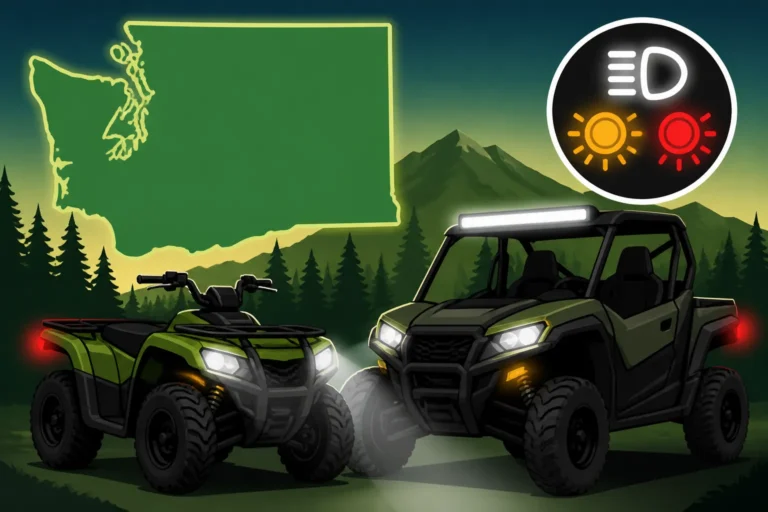
- Headlights and Taillights: These aren't just for looking cool. You need at least one white headlight visible from 500 feet and at least one red taillight visible from 600 feet, especially if riding at dusk or after dark. [Washington Lighting Requirements for WATVs] are specific.
- Brakes: Your WATV must have working brakes capable of stopping the machine effectively. This should be a given, but it’s still a legal requirement.
- Mirrors: At least one mirror, securely attached and positioned to reflect a view of the highway for at least 200 feet to the rear, is usually required. Many opt for two for better visibility. [Washington Mirror Requirements for Road Use] ensure you can see traffic behind you.
- Turn Signals: You must have amber turn signals on both the front and rear of your machine, visible from a sufficient distance. This is crucial for indicating your intentions to other drivers. Fitting [Turn Signals on a Side-by-Side] is a common modification.
- Horn: A working horn, capable of being heard from at least 200 feet, is essential for alerting others to your presence. [Does Washington Require a Horn on an ORV?] Yes, for road use.
- Spark Arrester and Muffler: While these are primarily for off-road use, they ensure your machine isn't excessively loud or a fire hazard on the road either. [Washington Spark Arrester Requirement] and [Washington Muffler Requirements for an ORV] apply.
- Windshield or Eye Protection: You must either have a windshield or wear appropriate eye protection (goggles or a face shield). [Goggles Instead of a Windshield] is a common choice for ATVs.
- Seat Belts: If your machine is designed with seat belts (like most side-by-sides), they must be worn by all occupants. [Buckling Up in a Utility Vehicle] is non-negotiable.
Operator Requirements and Licensing
It’s not just about the machine; the person operating it also has legal obligations. To legally operate a WATV on any public road in Washington State, you must possess a valid driver's license. This means a standard automobile driver's license is sufficient; there isn't a special "WATV license." However, this immediately disqualifies anyone without a valid license, including most minors. [A Valid Driver License on a Washington Road] is a fundamental requirement.
Furthermore, there are age restrictions and supervision rules, particularly for younger riders. If a rider is under 16 years of age, they generally cannot operate a WATV on public roads, even if they have an off-road safety certificate. The public road rules are stricter than the off-road trail rules. For riders under 16, they must be supervised by a licensed adult when riding off-road, but road use is a different ballgame. Always double-check [Washington Rules for Riders Under 16] to ensure compliance, as violating these rules can have serious consequences for both the young rider and the supervising adult.
What Happens When You Break the Speed Limit Rule
Riding your WATV on a road where the speed limit or local ordinance doesn't allow it is a serious offense in Washington State. It's not just a friendly reminder from a park ranger; it's a violation of traffic law, and law enforcement treats it as such. The consequences can range from a costly citation to having your machine impounded, not to mention the increased risk to your safety and the safety of others. It’s a gamble that’s simply not worth taking, especially when the rules are clearly defined.
The frustration that leads some riders to push the boundaries is understandable. You might see a short stretch of 40 mph road that would perfectly connect two amazing trail systems, and the temptation to just "go for it" can be strong. However, that momentary convenience can quickly turn into a headache that sours your entire riding experience. Understanding the potential penalties can be a strong deterrent, reinforcing the importance of doing your homework and sticking to the approved routes.
Citations and Fines for Illegal Road Use
If a Washington State Trooper or county sheriff catches you operating your WATV on a road where it's not permitted – perhaps a road posted above 35 mph that isn't designated for crossing, or a 35 mph road in a populous county that hasn't been opened by ordinance – you can expect a citation. This isn't just a minor warning. These fines can be substantial and will quickly make that shortcut feel incredibly expensive. [What a Washington Citation for No Tabs Costs] can be an eye-opener, and illegal road use often carries similar financial penalties.
Beyond the immediate financial hit, a citation can also mean points on your driving record, depending on the specific infraction. This could lead to increased insurance rates for your primary vehicle, or even more severe consequences if you have a history of traffic violations. The legal process of dealing with a citation, including potential court appearances, can also be a significant drain on your time and energy. It's a reminder that riding an off-road vehicle on public roads brings with it all the responsibilities and legal implications of driving any other registered vehicle. Always know [What a Washington Trooper Checks Roadside] to ensure you're prepared.
The Risk of Impoundment and Accident Liability
In more severe or repeat instances of illegal WATV road use, law enforcement has the authority to impound your machine. Imagine being out on a weekend ride, getting pulled over, and then watching your prized quad or side-by-side get loaded onto a tow truck. Not only is this an incredibly frustrating experience, but the costs associated with towing and impoundment can quickly add up, easily surpassing the initial fine. You'd then be faced with the logistical nightmare of retrieving your machine, likely from a remote impound lot, further ruining your day.
Perhaps even more critically, riding illegally on a public road can have dire consequences in the event of an accident. If you're involved in a collision while operating your WATV on an unauthorized road, your insurance company may deny coverage, leaving you personally liable for damages, injuries, and legal fees. This is a huge financial risk. Even if you have [Washington WATV Insurance Requirements] for on-road use, if you're violating the terms of road access, your policy might not protect you. The legal and financial fallout from an accident in such circumstances could be life-altering, far outweighing any perceived benefit of riding on a restricted road.
Making Sense of Local Ordinances and Maps
Navigating Washington's WATV road access laws requires more than just knowing the state statutes; it demands an understanding of local ordinances and how to find reliable information. Since counties and cities have the authority to open or close roads within the state's framework, knowing what your local jurisdiction has decided is crucial. This is where many riders get bogged down, trying to piece together information from various sources. The good news is that local governments typically want to make this information accessible, even if it sometimes feels like a treasure hunt.
The key is to remember that state law provides the overarching rules, but local ordinances fill in the specifics on the ground. A road that's legal in one county might be illegal just across the county line, simply because the local governments have made different choices. This patchwork approach means your riding plans need to be dynamic and based on up-to-date local information. Don't assume; always verify.
How Counties Publish Their Approved Road Lists
For jurisdictions that have opted to open roads for WATV use, they are required to publish this information. This isn't just a courtesy; it's a legal necessity to inform the public. Typically, you'll find these lists on the county or city website, usually within the public works, planning, or sheriff's department sections. Some counties even have dedicated pages for WATV information, making it easier to find. Searching for phrases like "[Finding a County's Approved Road List]" or "WATV ordinance [County Name]" is a good starting point.
These lists usually specify not only which roads are open but also any specific restrictions, such as hours of operation, seasonal closures, or width limitations. They might also include maps, which are incredibly helpful for visualizing your route. It's important to use the most current version of these lists, as ordinances can be amended, and roads can be added or removed from the approved network. Printing out a copy or saving a digital version to your phone before you ride can be a lifesaver if you encounter questions while out on the trail or road.
The Importance of Current Maps and Signage
Even with a published list, the best way to confirm legality on the ground is through clear signage. Open roads are often marked with specific WATV route signs, indicating that WATVs are permitted. However, in smaller, "open by default" counties, such signage might be less prevalent. In these areas, the absence of a "No ORV" sign on a road posted 35 mph or less is often your indicator of legality. Conversely, a prominent "No ORV" sign overrides any default-open status.
It's also worth noting that many popular off-road areas, like those managed by the Department of Natural Resources (DNR) or the U.S. Forest Service, often provide maps that delineate not only their trail systems but also the connecting roads that are open to WATVs. These maps are invaluable for planning a seamless ride from a staging area to a trailhead and back. Always carry up-to-date maps from the relevant land manager, as they often contain critical information about road access, trail closures, and other important regulations. Combining this with your knowledge of county ordinances creates the most comprehensive picture for legal riding.
Table: Washington WATV Road Access Summary
To help clarify Washington's approach to WATV road access based on speed limits, here’s a quick summary:
| Posted Speed Limit | Action Permitted on Roadway | Conditions & Considerations | Legal Authority to Open Roads |
|---|---|---|---|
| 0-35 mph | General Riding | Must have proper tabs & equipment. | <15k population: Open by default unless closed by ordinance. |
| Riders must have valid driver's license. | >15k population or City: Requires specific ordinance to open roads. | ||
| 36-60 mph | Crossing Only | Must cross at 90-degree angle, yield to traffic. | Local ordinance and WSDOT authorization for state highways. |
| Must have proper tabs & equipment. | Limited to direct crossings, not riding along the roadway. | ||
| 60+ mph | Not Permitted | No WATV use (riding or crossing) allowed. | State law prohibits WATV access on these roads. |
| Exception: May cross at designated intersections if specified for other vehicle types. |
This table provides a concise overview, but remember that the devil is always in the details of local ordinances and specific WSDOT authorizations. Always dig into the specifics for your planned route!
The Importance of Being a Responsible Rider
Ultimately, ensuring continued and expanded access for WATVs on Washington's roads and trails rests heavily on the shoulders of every rider. When we respect the laws, adhere to speed limits, and ride responsibly, we build trust with local communities and demonstrate that WATVs can be safely integrated into the broader transportation and recreation landscape. Conversely, reckless behavior or disregard for regulations can quickly lead to closures and increased restrictions, harming access for everyone.
Think of yourself as an ambassador for the entire WATV community every time you put a tire on pavement or dirt. Adhering to the speed limit rules, ensuring your machine is properly equipped, and always checking local ordinances are not just about avoiding a ticket; they're about preserving and expanding the freedom to ride for future generations. It’s about being a part of the solution, not the problem, and showing everyone that WATV enthusiasts are responsible stewards of both the land and the roads. So, study those maps, know the limits, and ride smart!
Disclaimer
This article is for general informational purposes only and does not constitute professional advice. Laws, prices and regulations vary by location and change over time. Consult a qualified professional for guidance on your specific situation.