Taking the Course Before a Trip
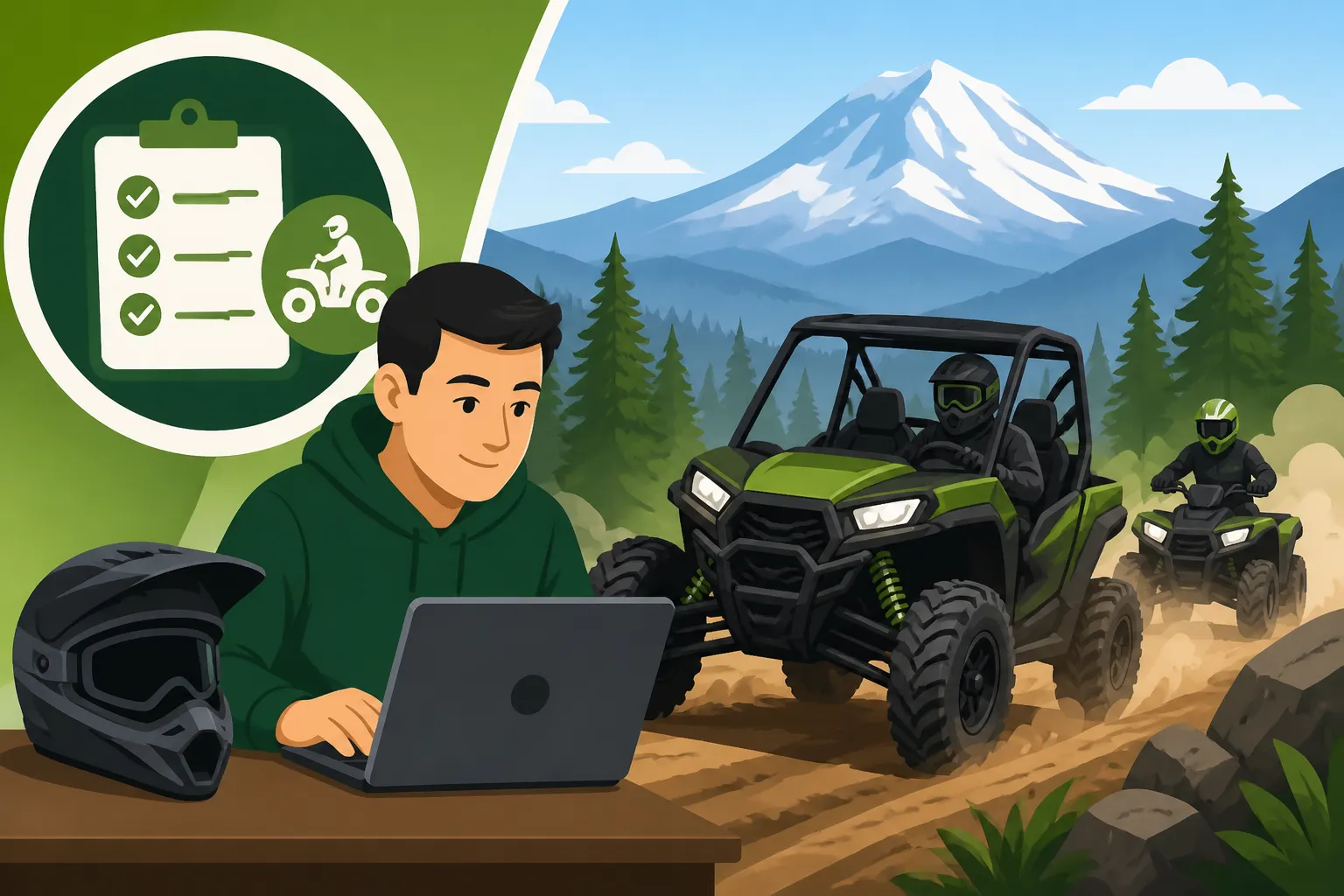
Taking an ATV or UTV safety course before a Washington trip is a smart way to prepare, especially if you’re new to the machine or the terrain. But training is not the same as a permit, and a course certificate does not automatically satisfy every riding rule. Here’s how to choose useful training and check what your trip actually requires.
Does Washington require an ATV or UTV safety course?
Washington does not issue a general ORV safety certificate that every rider must carry to ride. For most trips, completing a course is a safety choice rather than a state registration requirement. That distinction matters: a course may build your skills, but it does not replace machine registration, a required permit, land-access rules, or age and supervision requirements.
The state’s approach can be confusing because people often use “ATV license,” “safety card” and “permit” as if they mean the same thing. They do not. A course record or completion card documents training. Registration tabs or a temporary permit relate to the machine’s legal status. Land-use passes and permits relate to where you ride. For the broader distinction, see Why Washington Issues No ORV Safety Certificate and Does Any Washington Rider Need a Safety Certificate?.
There is an important exception to the idea that training is entirely optional: a course does not waive rules that apply to young riders. Washington has age and supervision requirements for riding on public land. A parent or rider may choose a course to help a young person learn, but still needs to follow the applicable rule about an adult riding alongside. Read What a Fifteen-Year-Old Needs to Ride in Washington and Who Must Ride Alongside a Fifteen-Year-Old before planning a trip with a teen.
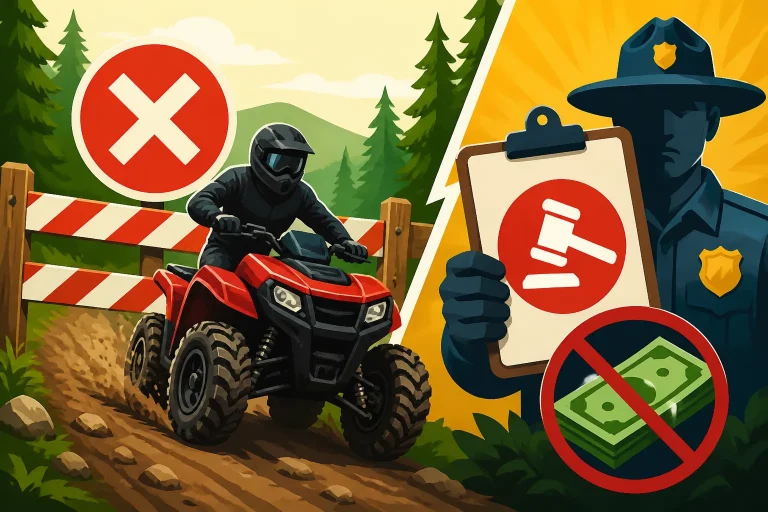
A course also does not make an otherwise unauthorized road or trail legal to use. A rider can be well trained and still be on a closed trail, a road that does not allow ORVs, or private land without permission. Before loading up, check the rules for the specific place you plan to ride, including Washington Rules for Riding DNR Land if your destination is on Department of Natural Resources land.
| What you’re checking | What a course can do | What it does not do |
|---|---|---|
| Riding skills | Teach basic control, hazard awareness and safe habits | Guarantee that a rider can handle every trail or machine |
| Proof of training | Provide a course record or completion card, depending on the provider | Automatically serve as a Washington permit or registration |
| Youth riding | Help a young rider understand safe operation | Replace age, supervision or land-access rules |
| Machine access | Help you prepare to ride responsibly | Register the machine or authorize use of a closed route |
| Out-of-state trip | Help you prepare for unfamiliar conditions | Guarantee that another state will recognize the course or your home-state paperwork |
If you’re traveling from another state, don’t assume that a course certificate is required—or that it will satisfy a requirement—without checking the rules that apply to your home state and destination. Reciprocity concerns whether the state accepts particular out-of-state registrations or permits, not simply whether a rider has taken a class. Start with Washington ORV Reciprocity With Other States and confirm the details for your specific situation.
Choosing a course that will help on the trip
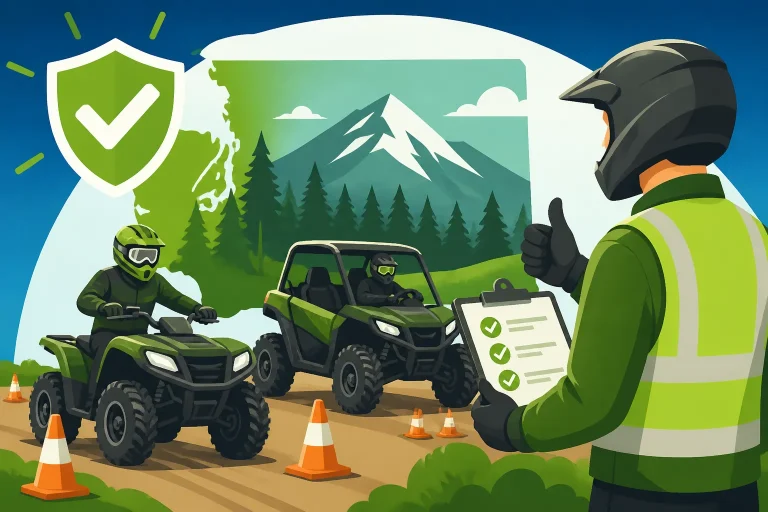
A useful course should match both the vehicle and the rider. A class aimed at a first-time ATV rider may not cover the practical differences involved in operating a side-by-side. Likewise, a brief online lesson can be helpful for learning basic concepts, but it cannot provide the same practice as supervised, hands-on instruction.
Before enrolling, check the course description and ask the provider a few direct questions:
- Which machines does the course cover? Confirm whether instruction is for an ATV, a side-by-side or both. A UTV’s steering, seating, rollover risks and restraint systems differ from a quad’s.
- Does it include practical riding? If the rider has little experience, look for instruction that includes supervised practice, not just videos or a knowledge check.
- Who is the course designed for? Make sure it suits the rider’s age, experience and comfort level. A class intended for experienced adults may not be appropriate for a child.
- What does completion mean? Ask whether the provider gives a completion record and whether the course is educational only or tied to a particular program. Do not assume the card is a government permit.
- What does the rider need to bring? Ask about a machine, helmet, eye protection, clothing and other equipment. Requirements vary by course.
- Can the course accommodate your trip schedule? If there is a hands-on portion, allow time for it before departure rather than relying on a last-minute opening.
For a new rider, practical instruction should cover more than throttle and braking. Look for discussion and demonstration of body position, turning, hills, uneven ground, stopping distance, trail etiquette and what to do when a machine becomes stuck or unstable. UTV instruction should address seat belts and other occupant-protection equipment, while ATV instruction should focus on the rider’s position and how weight shifts affect control.
The course should also make clear that a machine’s size and design affect how it behaves. An ATV is generally operated by a straddling rider who steers with handlebars. A UTV is driven from a seated position, often with a steering wheel and passenger seating. Those differences change how riders should prepare for turns, slopes and passengers. A course that treats all off-road machines as interchangeable may be too general for your needs.
Online instruction or hands-on training?
Online material can be a convenient introduction to basic safety concepts. It may help a rider understand common hazards before arriving at a riding area, and it can be useful for refreshing knowledge. But it cannot assess how someone handles a machine, correct their posture in real time or give them supervised practice on a hill, turn or rough surface.
Hands-on instruction takes more planning, and it may require travel, equipment or a suitable machine. In return, the instructor can observe the rider and offer feedback. For an inexperienced operator, that practical element is often the most valuable part. If the only available option is online, treat it as preparation rather than proof that the rider is ready for challenging terrain.
A course is also not a substitute for a gradual first ride. Start with terrain suited to the least experienced person in the group. A confident rider on familiar ground may still need time to adjust to a different machine, wet roots, loose gravel or steep grades.
Plan the course alongside trip rules and equipment
Taking a course before a trip works best when it is one part of a wider checklist. First, identify the riding area and the land manager. Then confirm that the route is open to your type of machine, check any pass or permit requirements, and make sure the machine’s registration or temporary authorization is in order.
For a visitor, registration details can depend on the machine and the paperwork from its home state. Washington’s reciprocity rules have conditions, so check whether your home-state registration qualifies instead of assuming that any sticker will be accepted. If it does not, a visitor may need a different authorization. See Washington ORV Reciprocity With Other States and Washington Temporary ORV Permit for a Visitor before you travel.
Do not confuse a temporary permit with general access to every road. Washington temporary ORV permits have limits, and a permit intended for off-road use does not automatically allow pavement travel. Likewise, having an on-road registration does not mean every county road or city street is open to ORVs. Check the specific route and restrictions before following a map or a friend’s directions.
A course can help riders recognize risks, but trip preparation must account for local conditions too. Forest roads may be shared with trucks, gates may be closed, and trails can be restricted for weather, fire danger or active work. Check current notices from the land manager shortly before leaving, not only when you first plan the trip. A route shown on an old map may no longer be available.
Use this sequence to keep the paperwork and training questions separate:
- Choose the riding area. Confirm who manages it and whether your machine is allowed.
- Check access rules. Look for closures, required passes, permit conditions and route restrictions.
- Confirm the machine’s status. Review registration, tabs and any visitor requirements that apply.
- Check rider rules. Pay particular attention to age, supervision, helmets and passenger restrictions.
- Select training that fits the machine and rider. Complete any course early enough to practice what you learn.
- Pack the required gear and documents. Keep registration and permits accessible and protected from rain.
- Recheck conditions before departure. Closures and access conditions can change.
Training should include trip-specific habits such as riding within the group’s ability, keeping a safe following distance, stopping where there is room, and agreeing on what to do if riders become separated. For a UTV, make sure everyone knows how to use the restraints and stays seated as directed. For an ATV, passengers should ride only if the machine is designed and approved to carry them; a course cannot make an unsuitable passenger setup safe.
A young rider may benefit from learning basic control in a supervised setting before traveling to a busy riding area. Still, the adult responsible for the trip should check the rules for the land and the rider’s age. Training does not replace direct supervision where supervision is required. It also does not mean a young rider should be sent ahead alone because they have completed a class.
Finally, consider what the course cannot teach about your particular destination. A class may cover general riding technique, but the rider still needs to adjust to local terrain, weather, traffic and trail difficulty. Start conservatively, take breaks, and turn around when conditions exceed the group’s ability. A safety card is not a measure of whether a particular route is suitable.
Make the course count
The most useful course is one the rider can apply before and during the trip. After training, talk through the route, the machine’s controls and the group’s safety plan. Have each rider identify how to stop, where to find emergency equipment and what to do if they encounter a hazard. For a UTV, review occupant restraints and passenger responsibilities; for an ATV, review steering, balance and safe spacing.
If you travel with different experience levels, set expectations before starting. Agree that the group will ride at a pace the least experienced operator can manage, and that anyone can ask to stop without pressure. Choose a meeting point in case you become separated, and make sure everyone knows not to continue onto an uncertain route simply to keep up.
Keep the course record with your trip paperwork if the provider issues one, but don’t present it as a substitute for registration or a permit. If another state, land manager, rental company or organized event asks for documentation, check exactly what they accept. Requirements can vary by program, and a course that is useful for learning may not meet a specific administrative requirement.
Taking a course before a Washington trip is worthwhile when it builds confidence and safer habits. The key is to treat training as preparation—not as permission to ride. Confirm the route, permits, machine paperwork and rider rules separately, then choose terrain that matches the skills the rider has actually practiced.
Disclaimer
This article is for general informational purposes only and does not constitute professional advice. Laws, prices and regulations vary by location and change over time. Consult a qualified professional for guidance on your specific situation.