What Washington Requires of a Young Rider
Taking a young rider out in Washington involves more than choosing a machine that fits. The rules depend on the rider’s age, whether the ride is on public land or a road, and whether the machine’s registration is valid here. This article explains the supervision rule, how permits and out-of-state registrations fit in, and what to check before heading out.
The basic rule for riders under 16
Washington’s key age-related rule for off-road riding on public land is that a rider under 16 must be accompanied by a person who is at least 18 and has a valid driver license. The adult needs to be supervising the ride, not simply somewhere else at the staging area.
That requirement is easy to confuse with a minimum age rule. It does not mean every child under 16 is automatically allowed to ride any machine, on any trail, as long as an adult is present. The rider still needs a suitable machine, permission to use the land, and any required registration or permit. A trail operator or land manager may also set additional conditions.
The age cut-off is based on the rider’s age, not the size of the ATV or UTV. A child riding a small youth ATV is still a rider under 16. So is a teenager operating a full-size side-by-side. The adult supervision requirement does not disappear because a parent considers the rider skilled or because the machine has a speed limiter.
| Situation | What to plan for |
|---|---|
| Rider under 16 on public off-road land | An adult at least 18 with a valid driver license must accompany and supervise the rider |
| Rider 16 or older on public off-road land | The under-16 supervision requirement no longer applies, but other land, machine, and riding rules still do |
| Riding on a public road | Road-use rules apply separately; a supervising adult does not replace a required driver license |
| Riding on private property | Get the owner’s permission and check any applicable local or site-specific restrictions |
| Visiting from another state | Registration or a temporary permit may be needed; it does not waive age or supervision rules |
For a fuller explanation of the supervision requirement, see Washington’s Supervision Rule for Riders Under 16. “Accompanied” should be treated as active supervision during the ride. An adult who drops a young rider at a trail and leaves, or waits far away without being able to monitor the ride, is not a sound plan.
Do not assume Washington issues a separate youth ORV safety certificate that replaces adult supervision. The state’s registration and riding rules are not the same as a training program, and a course or certificate does not give a young rider permission to ignore age, land-access, or road requirements. More on that distinction appears in Why Washington Issues No ORV Safety Certificate.
Public trails, private land, and roads are different
A young rider’s legal situation changes with the type of land and route. Before loading the machine, identify where the ride will happen and what rules apply there. “Off-road” is not one single category: a designated public trail, private timberland, a road open to WATVs, and a private driveway can have different access and operating rules.
Public off-road land
On public off-road land, plan to meet the under-16 supervision requirement and the rules for the specific riding area. The machine may need a current Washington ORV registration or qualifying out-of-state registration. You may also need a land-access pass, depending on the property and trailhead. A registration tab and a parking or recreation pass are separate things.
A parent or guardian should check the area’s current notices before setting out. Trail closures, seasonal restrictions, width limits, machine-type limits, and local requirements can affect whether a particular ATV or UTV can use a route. A trail open to ATVs may not be suitable for a wide side-by-side, and a route shown on an old map may have since closed.
If a young rider is new to public trails, start with terrain and routes that match their experience and the machine’s size. Supervision is not a substitute for a safe pace, appropriate protective gear, or an adult who can respond if the rider has trouble. Washington’s age rule is covered in more detail in [Washington Minimum Age to Ride Public Land].
Private property
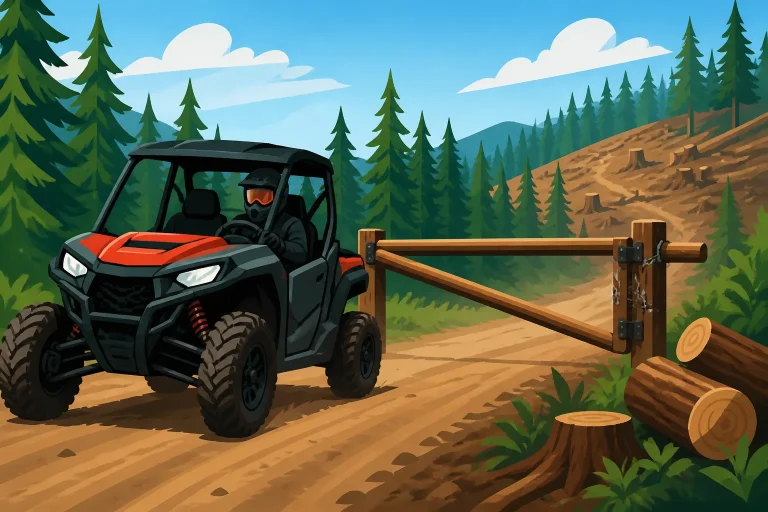
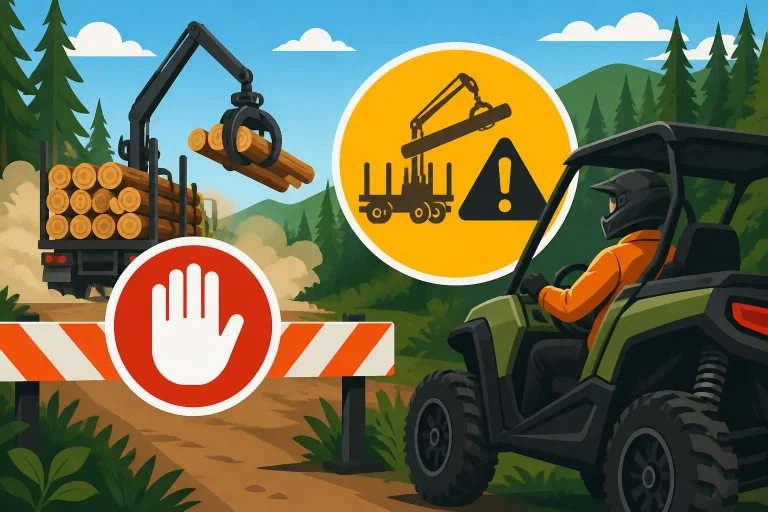
Private land is not automatically free of rules. Get permission from the owner or authorized manager, and ask where riding is allowed. Timberland and other private properties may have gates, active hauling, access permits, or temporary closures. A route that looks like a forest road does not necessarily mean the public can use it.
The public-land supervision rule should not be treated as permission to ride unsupervised elsewhere. A responsible adult should still decide who may operate the machine, set boundaries, and make sure the rider can control it. If the property is operated by a commercial business, ranch, or recreation facility, follow its age and supervision policies as well as applicable law.
Public roads and pavement
Public-road riding is a separate issue from riding a trail. A machine needs to qualify for road use where the road is open to it, and the rider must meet the road rules. A WATV’s tabs or road equipment do not authorize every rider to drive it on pavement.
In particular, do not treat an adult riding along as a replacement for a driver license. If the rider does not have the license required for the road use, adult supervision does not make that ride legal. Check Washington Driver License Rules for WATVs and Washington Rules for Getting Across a Road before planning a route that includes pavement or a highway crossing.
Even when an ATV or UTV is registered for road use, access depends on the location. A road may be closed to WATVs, or a crossing may be allowed only under specific conditions. The safe assumption is that a road is not open just because it connects two trails or leads to a trailhead.
Permits and out-of-state registrations do not change the age rule
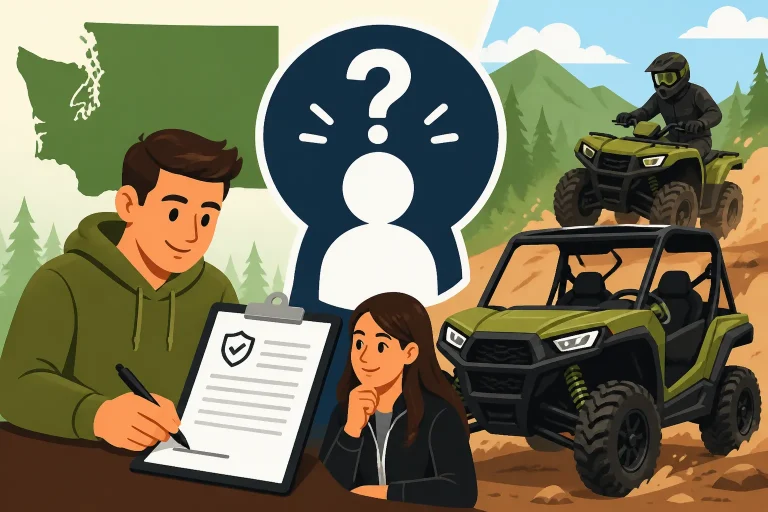
Families visiting Washington sometimes focus on whether their machine’s home-state sticker is accepted or whether they need a temporary permit. Those questions matter, but they do not replace the rules for the person riding.
A valid registration or permit answers a question about the machine’s authorization to be used in Washington. It does not make a rider old enough for a road, remove the supervision requirement for a rider under 16, or grant access to a closed trail. Keep the machine’s paperwork and the rider’s eligibility as two separate checks.
If the machine is registered in another state, check whether Washington recognizes that registration for the type of riding you plan to do. Reciprocity can depend on the home state’s rules and on whether you are riding off-road or trying to use a public road. The details are explained in Washington ORV Reciprocity Rules.
A visitor who does not have qualifying home-state registration may need to look into a Washington temporary permit. The permit is not a substitute for the adult supervision rule, and a temporary off-road permit should not be treated as authorization to ride on pavement. See Washington Temporary ORV Permit for a Visitor and Why a Temporary Permit Keeps You Off Pavement before relying on a short-term permit for a trip.
Registration also does not settle land-access fees. A family may have the right ORV tabs and still need a separate pass for the place they intend to park or ride. Check the land manager’s requirements for the actual trailhead, rather than assuming one permit covers every part of the trip.
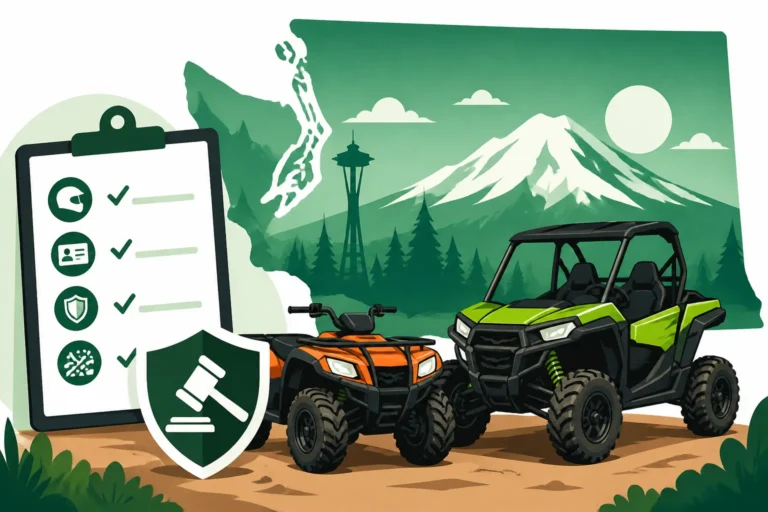
Before traveling, make a short list:
- Confirm the young rider’s age and who will supervise.
- Check that the adult meets the age and driver-license requirements.
- Verify that the machine’s registration or permit is valid for the planned use.
- Confirm the riding area is open to that type and size of machine.
- Check whether the trailhead or land manager requires a separate pass.
- Remove any road segment from the route unless the machine, road, and rider all meet the requirements.
That last point is especially important for visitors. A family may have a valid out-of-state ORV sticker and still be unable to ride a particular Washington road. Road access depends on local rules and the rider’s qualifications, not only on the machine’s registration.
A practical pre-ride check for families
A young rider’s first legal check is only part of trip planning. The machine should fit the rider, the route should suit their ability, and the supervising adult should be close enough to help. If a youth ATV’s controls are difficult to reach, or the rider cannot comfortably stop and turn it, a shorter ride does not solve the mismatch.
Before each outing, use this checklist:
- Confirm the adult’s role. If the rider is under 16 on public off-road land, bring an adult who meets the age and valid-license requirements and will actively accompany the rider.
- Match the machine to the rider. Follow the manufacturer’s age and operating guidance. Consider weight, seat height, throttle response, braking, and the rider’s ability to control the machine.
- Check equipment. Use a properly fitted helmet and appropriate protective clothing. For a UTV, make sure the rider uses the required occupant restraints and follows the vehicle’s passenger rules.
- Choose an appropriate route. Check machine-width limits, difficulty, surface conditions, closures, and whether the route is open to the machine type.
- Keep the paperwork available. Carry the required registration information and any permit or pass information the trip requires. Do not assume a digital copy is accepted everywhere.
- Avoid unplanned pavement. If a trail route reaches a road, know whether riding or crossing there is allowed before continuing.
- Set a communication plan. Agree on a pace, meeting point, and what the rider should do if separated from the adult.
- Check conditions again before departure. Weather, fire restrictions, active work, or a gate closure can change access after a route has been chosen.
A young rider may also benefit from training, even when a state-issued certificate is not required. Instruction can help with braking, throttle control, turning, hill approaches, and trail etiquette. Training does not replace the legal supervision requirement, but it can help a rider develop skills before tackling more demanding terrain.
Do not use a permit as a shortcut around a site’s own requirements. A rental operator, campground, riding area, or private landowner may set stricter age or supervision conditions than the general state rule. Ask before paying for access or traveling with a machine that a young rider may not be allowed to operate there.
The simplest plan is to choose the riding area first, confirm its rules, and then decide whether the rider and machine are a good match. If any part of the route is unclear, contact the land manager or licensing authority before the trip rather than making the decision at a gate.
Disclaimer
This article is for general informational purposes only and does not constitute professional advice. Laws, prices and regulations vary by location and change over time. Consult a qualified professional for guidance on your specific situation.