Washington ORV Reciprocity Rules
Washington ORV reciprocity can save a visitor from buying another registration, but it does not make every machine legal on every Washington trail or road. The key is knowing what your home-state registration covers, when Washington requires a temporary permit, and which local access rules still apply.
What Washington ORV reciprocity means
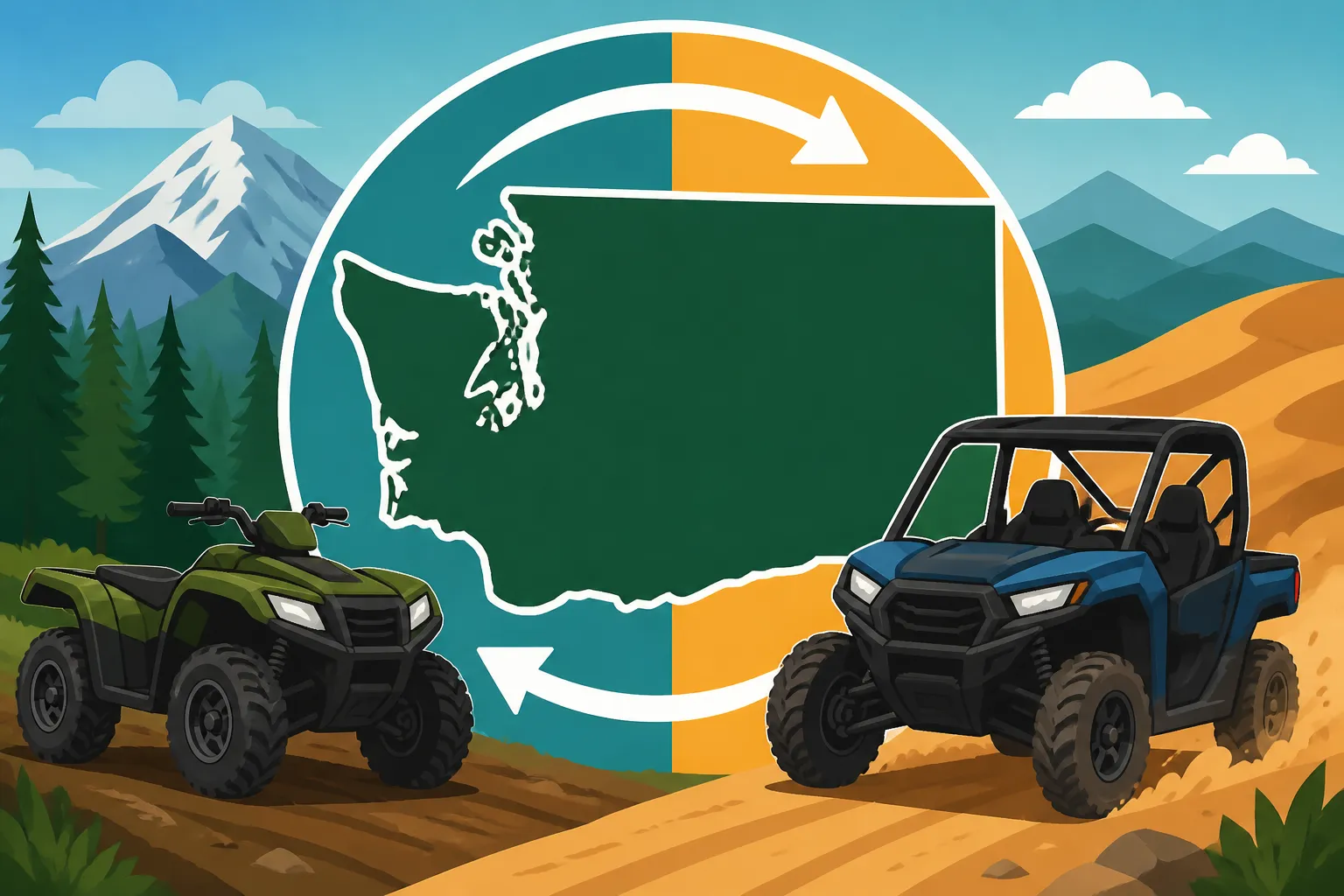
Reciprocity is recognition of an off-road vehicle registration or permit issued by another state. For a visitor, it can mean riding in Washington without first registering the machine here, provided the home-state credential is valid and Washington recognizes it for the type of riding planned.
That recognition is not the same as a blanket waiver of Washington rules. A reciprocal registration does not automatically give a machine road privileges, replace a land-use pass, or authorize riding on a closed trail. It also does not excuse a rider from Washington requirements for helmets, supervision of young riders, sound limits, or other applicable operating rules.
The practical question is not simply, “Is my machine registered at home?” Ask instead:
- Is the registration current and valid for this machine?
- Does Washington recognize the credential for the kind of off-road use I plan?
- Will I ride only on designated trails, or also use roads open to off-road vehicles?
- Does the riding area require a separate access pass or permit?
- Can I show proof of registration while riding?
Washington’s reciprocity rules can depend on what the home state requires and what credential it issues. If your state does not have a comparable registration system, or the machine does not meet the conditions for recognition, you may need a Washington temporary permit. Check the current requirements before travelling rather than assuming that an out-of-state sticker is enough.
A visitor with a valid home-state registration should carry the registration document and make sure the identifying details match the machine. Keep the document protected from rain and dirt, but accessible if asked to show it. The credential should clearly apply to the machine being ridden; a registration for one quad is not permission to use another.
For a broader overview of visitor options, see Washington ORV Reciprocity With Other States and Washington ORV Permit for Visitors. If you are unsure whether your home state’s registration qualifies, confirm with Washington’s licensing agency or the riding-area manager before you leave.
| Situation | What to check before riding |
|---|---|
| Current out-of-state ORV registration | Whether Washington recognizes it for your planned off-road use |
| Home state does not require ORV registration | Whether you need a Washington temporary permit |
| Machine is registered but you plan to ride on a road | Whether road reciprocity applies and the specific road is open |
| Riding area has an entry or parking requirement | Whether a separate land pass or permit is needed |
| Registration is expired, missing, or for a different machine | Whether the credential is valid and tied to the machine you will use |
Where reciprocity stops
The most important limit is that registration reciprocity and permission to ride are different things. A valid out-of-state registration may satisfy a registration requirement, but it does not open a road, trail, forest, or private property to riding.
Trails and public land
Before riding, identify who manages the area and check its current access rules. State-managed land, federal land, local roads, and private timberland can have different requirements. A registration accepted by Washington does not replace an area-specific pass or permission to enter.
For example, some state recreation sites require a Discover Pass, while certain federal recreation locations use a different pass system. Other riding areas may not require a land pass but can still have closures, seasonal restrictions, designated routes, or sound and equipment rules. Verify the requirements for the specific staging area and route, not just the general region.
A closed gate, posted restriction, active timber operation, or seasonal closure takes precedence over the fact that your machine is registered. Conditions can change between planning a trip and arriving. Check official alerts and posted signs, and do not treat an old map or a route shared by another rider as proof that access remains open.
For more on land access, see Washington Rules for Riding DNR Land, [Washington Rules for Riding a National Forest], and Washington Rules for Riding Private Timberland. If a pass is required, make sure it is the one accepted at that site; The Discover Pass and Washington Riders explains where that pass fits into a riding trip.
Public roads and pavement
Off-road reciprocity does not automatically let you ride on pavement. Washington road use is governed by separate requirements. A machine must qualify for the kind of road use being attempted, and the road itself must be open to that use. Local rules matter: a road open in one county or city may be closed to ORVs in another.
Even a machine that is legal for road use in its home state may not meet Washington’s requirements. The equipment, registration status, and route all matter. A road tab or equivalent credential may be required, along with other conditions for operating a WATV on an approved road. Check Washington Road Reciprocity and Its Conditions and What Washington Requires for On-Road ORV Use before planning a pavement connection.
Do not use an out-of-state registration as a reason to ride along a shoulder, cross a road where crossing is prohibited, or travel down a road that is not approved. Road access is specific, not general. A route may include an authorized segment, a prohibited connecting road, and a permitted trailhead entrance just a short distance apart.
Age, safety, and operating rules
Reciprocity does not exempt visitors from Washington’s rider rules. Helmet requirements, passenger restrictions, supervision requirements for younger riders, and other operating rules can still apply. A home-state permit or safety credential should not be assumed to replace a Washington requirement unless the applicable rule says it does.
The same principle applies to machine equipment and conduct. Restrictions on sound, spark arresters, width, night riding, and riding on designated routes may apply to visitors as well as residents. A credential is not a substitute for checking the regulations where you are going.
For younger riders, review Washington’s Supervision Rule for Riders Under 16 and What Washington Requires of a Young Rider. If the planned ride includes roads, confirm the driver-license and equipment rules too. A visitor’s home-state license or vehicle setup does not automatically settle every Washington requirement.
When a temporary permit may be needed
A Washington temporary ORV permit may be relevant when a visitor cannot rely on a recognized home-state registration. This can include situations where the home state does not issue a comparable ORV credential, or where the visitor’s paperwork does not meet the conditions for reciprocity. The right answer depends on the machine and the visitor’s circumstances, so confirm eligibility before buying a permit or heading to a trail.
A temporary permit is not a substitute for checking where you can ride. It may authorize a limited period of off-road use, but it does not create road privileges or override trail closures and land-manager rules. In particular, do not assume a temporary permit allows pavement travel. See Why a Temporary Permit Keeps You Off Pavement and How Long a Washington Temporary Permit Lasts for the limits to check.
A permit is generally tied to the machine and its approved use, not something to pass around among friends. If several people are travelling with different machines, confirm the requirement for each one. A credential displayed on one machine does not cover the rest of the group.
Before relying on a temporary permit, verify:
- Whether your home-state credential qualifies. Check that it is current, applies to the machine, and is recognized for the planned type of riding.
- Whether a Washington permit is required. Ask the appropriate Washington licensing office or consult current state instructions if your home state has no comparable registration or your paperwork is unclear.
- Where the permit allows use. Confirm whether it is for off-road riding only and whether the specific riding area accepts it.
- How to display or carry it. Follow the current instructions for the permit and keep any required documents available while riding.
- Whether you also need a land pass. A temporary ORV permit and a recreation-area pass serve different purposes.
Do not buy a temporary permit just because it sounds like a simpler option if your home-state registration is already recognized. Conversely, do not assume reciprocity applies just because another visitor once rode with the same kind of sticker. Rules can depend on the issuing state, the credential, and the use planned. The official instructions are the best way to resolve that uncertainty.
A practical pre-trip check
A short check before loading the trailer can prevent a registration issue from turning into a missed ride. Start with the machine’s paperwork, then check the land and route. Treat each as a separate question.
- Match the paperwork to the machine. Confirm that the registration or permit is valid and that its identifying information corresponds to the machine you are bringing. Carry the document, not only a photo of a decal or a receipt.
- Confirm reciprocity for your home state. If the state’s ORV system or credential is unclear, ask Washington’s licensing agency whether it is accepted. Do not rely on a friend’s interpretation or an old online discussion.
- Choose the riding area and check its rules. Look for the current land-manager information, route designations, closure notices, and any pass requirement. Find out whether registration must be shown at the trailhead.
- Separate off-road riding from road travel. If the route includes pavement, check whether the machine and credential qualify for Washington road use and whether every road segment is open. A legal trail registration alone is not enough.
- Review rider and machine requirements. Check the rules that apply to the riders’ ages, helmets, passengers, equipment, and operating conditions.
- Keep proof available during the ride. Store the registration and permit where they will stay dry and can be produced if requested. A waterproof pouch or document sleeve can help protect paper during a wet ride; if you buy one online, compare dimensions and closure type rather than assuming every pouch suits your machine.
If you are crossing into Washington from another state, also make sure you understand the difference between a visitor’s temporary permit and a permanent Washington registration. A temporary permit is for a limited situation; it is not necessarily the right route for a machine that will be kept or used in Washington on an ongoing basis. For that situation, see Registering an Out-of-State Machine in Washington.
The safest planning assumption is straightforward: reciprocity may satisfy a registration requirement, but it does not settle every question about access. Confirm the credential, the riding area, any required pass, and the route. When road use is involved, check that separately instead of treating an out-of-state ORV registration as permission to ride anywhere.
Disclaimer
This article is for general informational purposes only and does not constitute professional advice. Laws, prices and regulations vary by location and change over time. Consult a qualified professional for guidance on your specific situation.