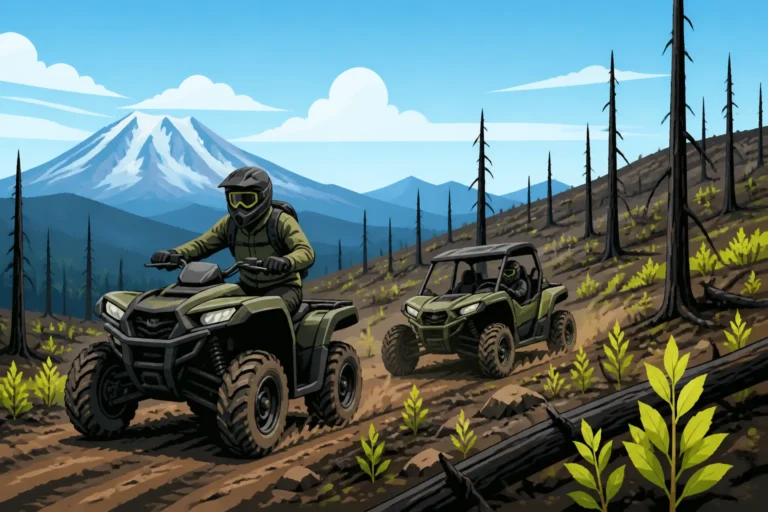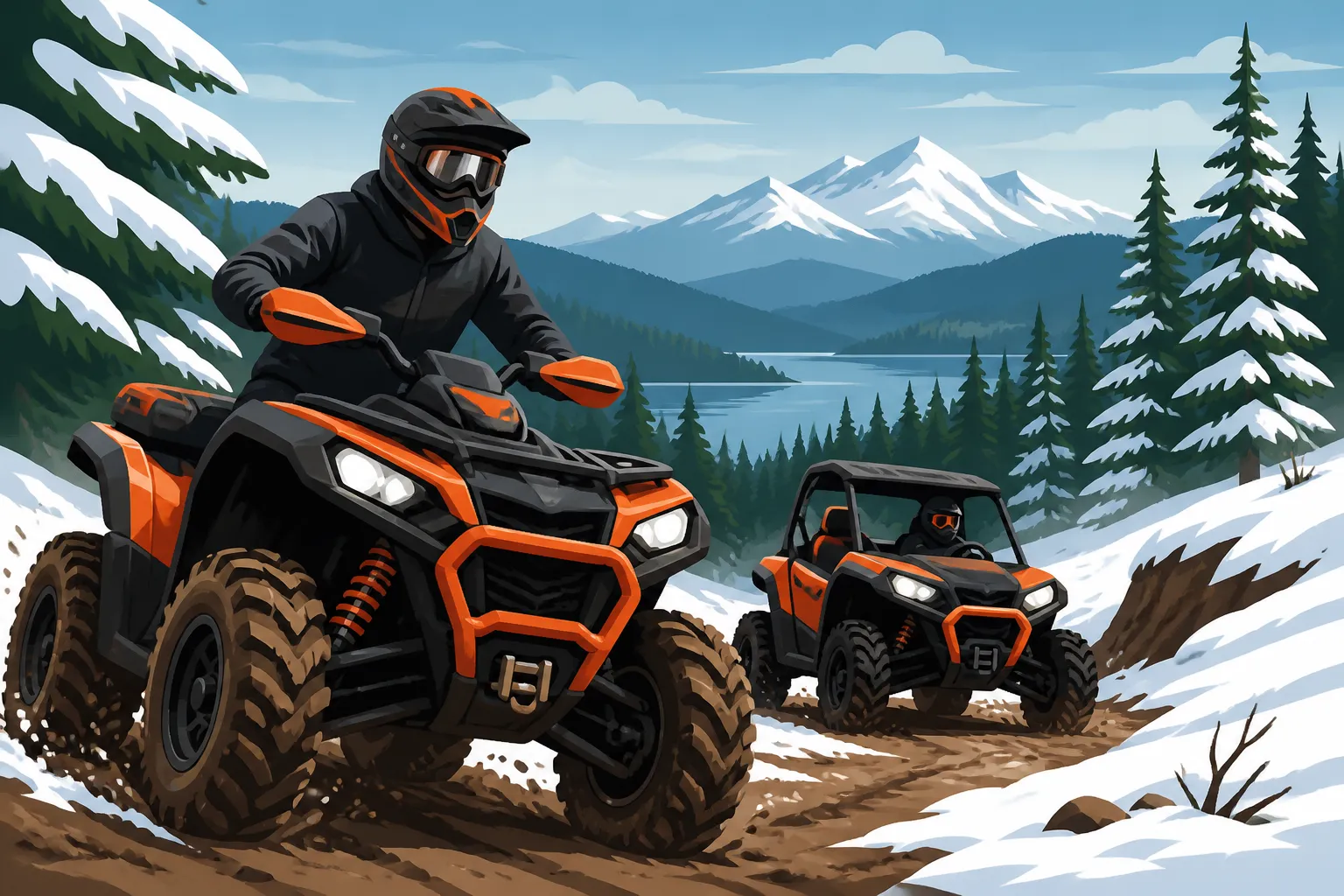
Riding Tahuya in December
December riding at Tahuya can mean slick roots, deep puddles, soft trail edges, and daylight that disappears sooner than you expect. The forest near Belfair offers a wet-season outing for ATV and UTV riders, but conditions and access can change quickly. This guide covers what to check before leaving home, how to prepare your machine, and how to ride more safely in winter weather.
Plan a December Ride at Tahuya
Understand the forest and the season
Tahuya State Forest is in Mason County, east of Belfair, and is a popular place for motorized recreation in western Washington. Its mix of forest roads, designated trails, and riding areas can suit different machines and experience levels, but a familiar summer route may feel very different after weeks of rain.
In December, expect saturated ground, standing water, muddy sections, and slippery roots. A shallow-looking puddle may conceal a rut or a rock, while a firm-looking shoulder can give way under a heavy side-by-side. Water also makes it harder to judge the edge of a trail, particularly where leaves and dark soil blend together.
Tahuya is known as a place where riders may find opportunities beyond the main riding season, but “year-round” does not mean every trail is open every day. Weather, maintenance, active forest work, and temporary closures can affect access. Read [Why Tahuya Rides Year Round] alongside the latest local notices, rather than treating a general description of the season as a guarantee that a particular route is open.
The forest sits in a region where a wet forecast can translate into steadily worsening trail conditions. A short shower may be manageable; a long spell of rain can turn a familiar route into a slow, tiring ride. If you are bringing a novice rider, a child, or someone who has not ridden in mud before, plan a conservative outing with an easy turnaround point.
Check access, maps, and passes before you load up
Look for current notices before driving toward the forest. Closures can be posted for reasons that are not obvious from a trail map, including storm damage, maintenance, timber operations, or safety concerns. A route shown as open on an older map may no longer be suitable or available. Start with [Washington Trail Closures to Check First] and review official forest information before setting out.
Use a map that clearly distinguishes motorized routes from roads and trails closed to your machine. DNR maps are a useful starting point, and [Washington Trail Maps From DNR] can help you understand the official mapping resources. A navigation app such as onX Offroad can be handy for viewing your position and planning a route, but treat it as a planning aid—not a substitute for closure signs, gates, or current land-manager instructions. Download any maps you expect to need before you lose service.
It also helps to separate the different permissions and passes involved. A Discover Pass is associated with parking at certain state recreation sites; it is not the same thing as the machine’s ORV registration or tabs. Confirm what the parking area and riding location require, and display or carry the appropriate documentation as directed. [The Discover Pass and Washington Riders] explains why riders should check pass requirements instead of assuming that one permit covers everything.
| Before the ride | What to check | Why it matters in December |
|---|---|---|
| Trail access | Current closures, gates, and work notices | A route may be closed or altered after storms or during forest work |
| Machine | Correct registration or ORV tabs for the intended use | A parking pass does not replace machine requirements |
| Parking | Whether the chosen site requires a Discover Pass | Requirements can differ by recreation site |
| Route | Map coverage and a realistic turnaround point | Mud and low visibility can make a planned loop take longer |
| Weather | Rain, wind, temperature, and daylight | Cold, wet riders tire quickly and lose visibility as dusk approaches |
| Group | Experience level, fuel, communication, and recovery gear | The slowest rider and most difficult section set the pace |
If the group includes a wide side-by-side, pay particular attention to route width and turning room. A trail that looks manageable for a quad may feel constricted for a larger machine, especially where puddles force riders toward the edge. [Washington Trails for a Wide Side-by-Side] is a useful companion when deciding whether a route fits your vehicle.
Prepare for Mud, Cold, and Short Daylight
Set up the machine for wet trails
Before leaving home, inspect the basics that are easy to overlook when you are excited to ride: tires, brakes, lights, steering, throttle return, battery, and fuel. Check for tire damage and make sure the tread is appropriate for the conditions and your machine. Mud can hide sharp debris, while low traction makes worn tires more noticeable than they might be on a dry trail.
Look over exposed boots, belts, wiring, and connections. A torn CV boot or a loose connection can turn a muddy afternoon into a recovery problem. Make sure the radiator intake is clear if your machine has one, and bring a way to check it during the ride. Wet clay and debris can collect in places where they are hard to see from the driver’s seat.
Keep your machine’s limits in mind. A big throttle burst can dig a rut, throw mud at the riders behind you, or make a slippery climb harder to control. Smooth inputs usually work better: choose a steady line, keep a safe following distance, and avoid spinning the tires simply to keep moving. If a section is becoming badly churned, consider turning around rather than making it worse.
Bring recovery equipment that matches your vehicle and your group’s ability to use it safely. A strap, appropriate rated connection points, and a winch where suitable may help, but recovery gear is not a reason to enter a risky mud hole. If no one can clearly see the bottom or identify a safe exit, skip it. A cold, wet group is not the ideal crew for experimenting with an unknown obstacle.
Dress for getting wet, not just for the forecast
A waterproof outer layer is helpful, but staying warm also depends on what you wear underneath it. Choose layers that retain warmth when damp, use gloves that still let you operate controls, and bring spare dry gloves and socks in a sealed bag. A rain shell that blocks wind can make a noticeable difference when the machine is moving through cold, wet air.
Protect your eyes from rain, mud, and branches. A fogged visor or wet goggles can make it difficult to spot a rut in time, so bring a way to clear or replace your eye protection. For side-by-side riders, check that the windshield and wipers, if fitted, are in usable condition. Do not let a fogged-up windshield become a reason to continue with poor visibility.
Carry warm layers where they will stay dry, along with water and food that are easy to access. Riders often underestimate how quickly a slow winter ride can stretch into the afternoon. If a machine gets stuck or a group has to backtrack, having dry clothing and a snack is more than a comfort; it can help everyone stay patient and make better decisions.
Plan the ride around the available daylight rather than assuming you can finish a route at the same pace as in summer. Start early enough to account for muddy sections, navigation stops, and a slower rider. Turn around while there is still plenty of light to get back to the staging area, load the machines, and drive out safely.
Choose a Sensible Route and Ride at a Winter Pace
Keep the first loop modest
If you have not ridden Tahuya recently, avoid building your first December outing around the longest loop you can find. Choose a route that lets the group assess traction and pace before committing to more distance. Agree in advance on a meeting point, a turnaround time, and a simple rule for what happens if someone wants to stop.
A practical plan might be to start with a shorter, familiar section, then decide whether conditions support adding more mileage. That gives the group a chance to notice how quickly mud is building on tires, whether anyone is getting cold, and how the machine handles slick turns. If the ride is already slower than expected, shorten the plan rather than trying to recover the schedule with faster riding.
For riders looking for a place to practice in a contained setting, research the designated riding features and confirm they are open and appropriate for your machine. [Riding the Gravel Play Pit at Tahuya] offers a Tahuya-specific point of reference, but check the condition and access status before making it the centerpiece of your trip. A feature that suits one rider may be intimidating for a beginner or unsuitable for a particular vehicle.
Those hoping to connect a sequence of routes should have a clear map and a backup plan. [Green Mountain Loops for a Day] can help with broader planning in the area, but winter conditions may change how much distance is reasonable. Build in extra time instead of relying on a tight schedule.
Use smooth, considerate riding habits
Leave more space between machines than you would on dry ground. In mud, the rider ahead may slow suddenly, take a different line, or stop to assess a puddle. Extra distance also reduces the chance that a spray of mud will obscure the next rider’s view.
Approach puddles cautiously. If you cannot see a safe line through them, do not assume that following another machine’s tracks will work. A track may be much deeper than it appears, and a large vehicle can conceal a hole from the rider behind. Stop somewhere safe, assess the route, and choose another way through or turn around if necessary.
On climbs and descents, avoid abrupt steering or braking. Keep your speed controlled and your movements predictable, especially when the trail is narrow. If a group needs to pass, communicate clearly and choose a place with enough room for every machine. Do not widen a trail by driving around a muddy section; that can damage vegetation and create new ruts.
Respect gates, closure signs, and other forest users. A forest road may also be used by maintenance crews or logging traffic, and a gate is not an invitation to find a way around it. If a route is closed, turn back and use a permitted alternative. [Washington's Green Mountain and Tahuya State Forest] provides broader context for planning rides in this part of Washington, including the importance of checking where motorized use is allowed.
Pack for a Safer Outing and Know When to Turn Back
Make a simple winter ride checklist
A useful December checklist is one you can follow even when you are loading in the rain. Put essential items in a waterproof bag or container, and keep emergency supplies separate from gear you expect to use routinely. Before leaving, tell someone where you plan to ride and when you expect to return.
Consider packing:
- A downloaded map and a charged phone or GPS device.
- A first-aid kit and any personal medication.
- Dry gloves, socks, and a warm layer in a sealed bag.
- Water and food for a longer-than-planned outing.
- A flashlight or headlamp for an unexpected delay.
- Basic tools, a tire repair option suited to your machine, and recovery equipment.
- A way to contact the rest of the group if machines become separated.
An app such as onX Offroad can help you prepare a route and keep track of your location, especially where forest roads and trail junctions are confusing. Save maps for offline use before you arrive, and make sure every rider knows the agreed route. Do not assume that a phone will have service throughout the forest or that another person can see your live location.
Use the map alongside physical signs and common sense. A digital line can help you understand where you are, but it cannot tell you whether a trail is washed out, newly blocked, or unsafe to cross. If the app, the sign, and what you see on the ground do not agree, stop and make a conservative choice. Ask a local land manager or choose a route whose status is clear.
Set clear turn-back rules
Decide before the ride what conditions will make the group turn around. Examples include a trail becoming deeply rutted, a rider getting cold or tired, visibility dropping, a machine developing a problem, or the group reaching a closure. Making this agreement ahead of time removes pressure on someone who may otherwise feel they are spoiling the day by asking to stop.
Pay attention to how the group is doing, not just how the machines are doing. A rider who is quiet, shivering, or struggling to keep up may need a break or a quicker return. Stop in a safe place, check everyone’s condition, and adjust the route. A shorter ride that ends comfortably is a better December outing than an ambitious loop that leaves the group cold and hurrying in the dark.
Finally, leave the riding area in good condition. Stay on designated routes, avoid creating bypasses around mud, and pack out any trash. Mud and water are part of winter riding, but unnecessary trail damage can affect access for everyone. If the weather has made a route fragile or unsafe, choosing not to ride it is part of responsible use.
Before you load the machines, review [Washington Riding Areas With Mud] for more wet-trail planning ideas and check local access information again. Tahuya can be rewarding in December when the group arrives prepared, chooses a route that matches conditions, and is willing to turn back when the forest says the day’s plan needs to change.
Disclaimer
This article is for general informational purposes only and does not constitute professional advice. Laws, prices and regulations vary by location and change over time. Consult a qualified professional for guidance on your specific situation.