Ferry Crossings With a Loaded Trailer
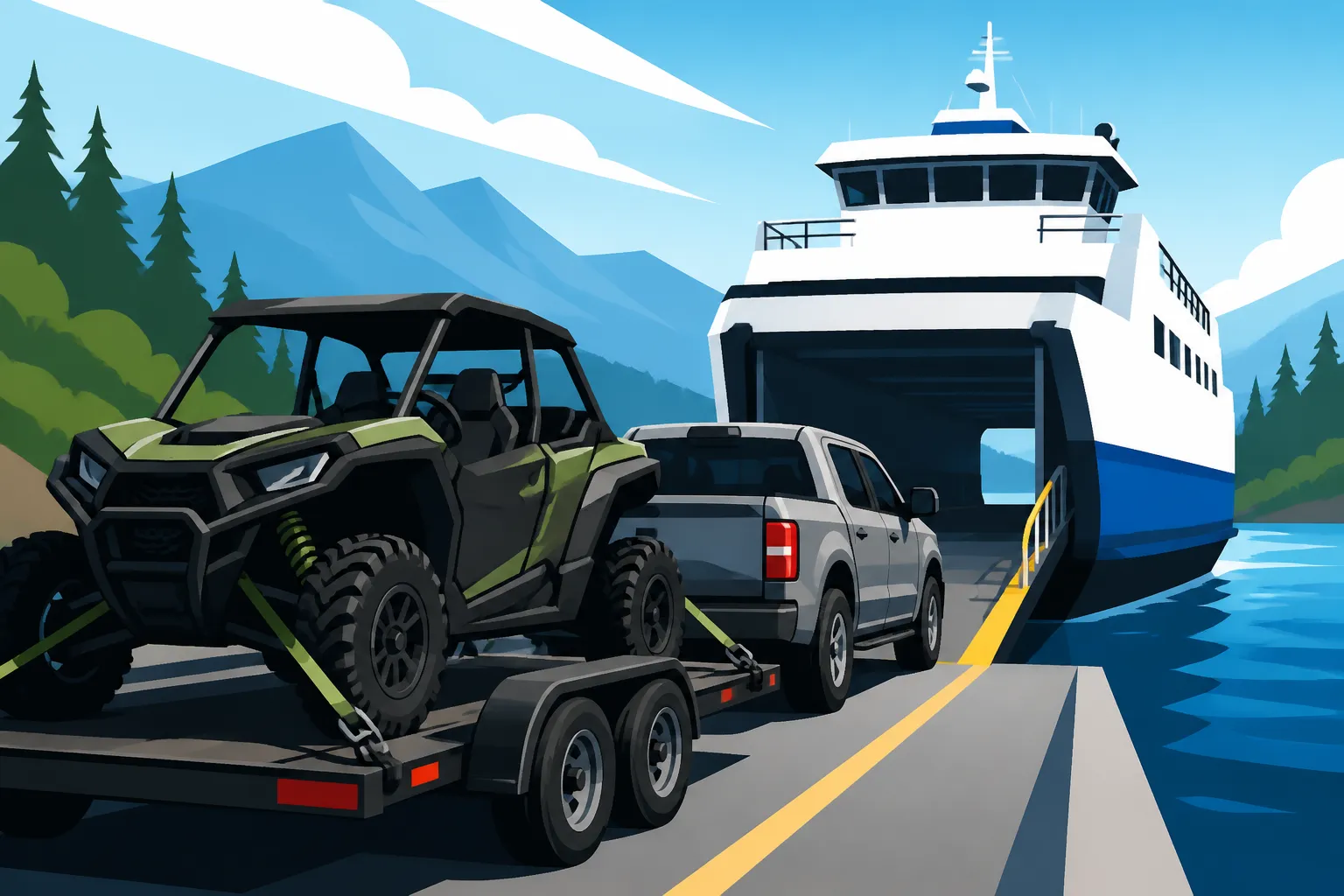
A ferry crossing can turn a simple Washington trail weekend into a stressful one when your ATV or UTV is loaded behind the truck. The tight part is often not the sailing itself but knowing your rig’s total length, arriving in the right lane, and keeping machines and gear secure. This guide walks through planning, loading, boarding, and continuing safely after you reach shore.
Plan the ferry crossing before loading up
Check the route and reservation details
Washington ferry routes connect popular riding regions, but the best crossing depends on where you are starting, where you are headed, and the size of your truck-and-trailer combination. A trip toward the Olympic Peninsula might involve the Seattle–Bainbridge or Edmonds–Kingston route; travel to Whidbey Island may use Mukilteo–Clinton or Port Townsend–Coupeville. A trip farther north could involve Anacortes and the San Juan Islands.
Don’t choose a route based only on what looks shortest on a map. Compare the drive to each terminal, the ferry’s current operating information, and the road miles on the far side. A crossing that saves miles on land may add a wait, a reservation requirement, or a less convenient approach for a long trailer. Check the Washington State Ferries information for your route before leaving, including vehicle reservations where available and any guidance for oversized combinations.
Ferry rules and terminal arrangements can vary by route and change over time. Confirm how the ferry operator classifies your truck and trailer, what dimensions it needs, and whether a reservation applies to your particular trip. If your setup is close to a stated length or height limit, ask the operator how it wants you to determine the measurement rather than estimating from the truck’s registration.
For a broader road-trip plan, include the trailer leg and the time needed to reach the trailhead—not just the crossing. Driving Over a Cascade Pass With a Trailer is useful when your route also crosses a mountain pass, while Fuel Stops Between Riding Areas can help you think through fuel availability between ferry terminals and riding areas.
Measure the whole combination
Ferry vehicle categories and charges are generally tied to the dimensions of the vehicle combination, so know the total length from the front of the tow vehicle to the rear-most point of the trailer or cargo. A machine, spare tire, loading ramp, cargo box, or rack extending behind the trailer can affect that measurement. Check height as well, particularly if you have a tall UTV, roof accessories, a canopy, or a loaded cargo rack.
Measure your setup while it is actually packed for the trip. A trailer that is short when empty may become longer once ramps or other equipment are secured at the rear. Keep the measurements in your phone and, if there is any uncertainty, confirm the correct method with the ferry operator before you arrive.
A quick planning table can keep the details straight:
| What to check | Why it matters | What to do before departure |
|---|---|---|
| Overall combination length | Ferry classification may depend on the full vehicle-and-trailer length | Measure the loaded rig, including anything projecting past the trailer |
| Total height | Tall machines and accessories can affect how a vehicle is handled | Measure to the highest fixed point of the loaded setup |
| Reservation requirements | Some crossings or travel periods may require advance planning | Check the route’s current reservation and arrival instructions |
| Terminal approach | A long trailer needs room to follow signs and move into the correct lane | Review the terminal entrance and avoid last-minute lane changes |
| Trailer condition | A tire or lighting problem can disrupt the trip before boarding | Inspect tires, lights, coupler, safety chains, brakes, and breakaway equipment |
| Riding destination | Ferry arrival does not mean the route to the trail is open or suitable | Check access, permits, closures, and staging options separately |
If you are using onX Offroad to plan the off-highway portion, use it to review trail and access routes, then confirm road status and ferry details with the relevant agencies. A trail map is helpful for seeing how a riding area fits into a trip, but it is not a substitute for current ferry instructions or posted road closures.
Secure the ATV or UTV and trailer
Load for a stable, balanced tow
Load machines according to the trailer manufacturer’s guidance and your towing vehicle’s capacity. Keep the trailer’s weight balanced and the tongue weight within the specifications for your tow vehicle and hitch. If the rear of the truck squats noticeably, the trailer sways, or the steering feels light, stop and correct the loading problem rather than hoping the ferry line will be the hardest part of the trip.
Position each ATV or UTV so it is centered and stable on the deck. Use suitable tie-down points on both the machine and trailer, and secure each machine as directed by its manufacturer. Check straps for wear, hook them to appropriate anchor points, and avoid routing them across sharp edges or parts that could be damaged. A quick tug is not a meaningful inspection if the strap is twisted, loose, or attached to a weak point.
Secure ramps, spare tires, fuel containers, coolers, tools, and riding gear separately so they cannot shift or blow loose. A ramp resting against a machine may seem harmless in the driveway; on a rough road or during a sudden stop, it can move and damage a fender, strap, or light. Tie down small items or put them in closed storage.
Inspect the towing setup before reaching the terminal
Do a walk-around before leaving home and again at a safe stop before entering the ferry queue. Confirm the coupler is latched, safety chains are correctly attached, the breakaway system is connected if your trailer has one, and the trailer lights work. Check tire condition and pressure according to the tire and trailer guidance, and look for loose straps, a shifted load, or anything hanging below the trailer.
Also confirm that the machines are secured in the manner their owner’s manuals recommend. Don’t assume a parking brake alone will keep an ATV or UTV from moving, and don’t improvise a tie-down around a steering part, plastic panel, brake line, or other vulnerable component. If you are unfamiliar with the trailer or machine, practice loading and securing everything at home, where you have time to reposition a strap without blocking traffic.
A wet or windy crossing is not the moment to discover that your paperwork or spare straps are buried under a pile of gear. Keep essentials accessible, and store registration documents in a dry place. Keeping Paperwork Dry in the Rain has practical ideas for protecting documents during a damp Washington ride.
Arrive, queue, and board without rushing
Give yourself room to navigate the terminal
A long truck-and-trailer combination needs more room to turn, stop, and line up than a passenger car. Follow signs for the terminal and vehicle lanes, and avoid cutting across lanes to correct a missed turn. If you arrive in the wrong place, ask ferry staff for direction rather than making a tight maneuver around waiting vehicles.
Allow extra time for traffic, terminal access, and any check-in process. That buffer matters when you are towing through city streets near Seattle or navigating a narrow approach to a smaller terminal. Keep an eye on the trailer’s path around curbs, bollards, and parked cars. A turn that is easy without a trailer can bring the trailer wheels close to an obstacle.
When you join the queue, follow the posted directions and staff instructions. Don’t assume that a vehicle with a trailer will be directed into the same lane or position as a car. If you are unsure whether you are in the correct line, ask before moving forward. Changing lanes late can be difficult for a long rig and can create a hazard for people behind you.
Follow crew instructions during loading
Boarding is a slow, controlled process. Keep a safe following distance, move at the direction of ferry staff, and avoid sudden acceleration or braking. The deck may be damp or uneven, and the tight spacing can make it harder to judge the trailer’s position. Take the route staff indicate, even if it differs from the path you expected.
Once parked, apply the vehicle and trailer parking procedures recommended by their manufacturers and follow any specific instructions from the crew. Do not assume you may remain in the vehicle or return to the vehicle deck during the crossing; follow the ferry’s rules for passengers and vehicle decks. Keep children and pets under control, and do not touch or adjust another person’s vehicle or equipment.
Before leaving the truck, check that the trailer and machines remain secure and that nothing is loose. Do not climb onto a machine or trailer in a busy vehicle deck. If you notice a problem that cannot be safely addressed where you are parked, tell ferry staff and follow their direction.
If this is your first crossing with a loaded trailer, a short practice trip with an uncomplicated route can help you learn how your rig handles terminal turns and close vehicle spacing. It is much easier to learn those habits on a familiar trip than on a holiday departure with a full load and a trail appointment waiting on the other side.
Continue from the terminal to the riding area
Check access, permits, and closures separately
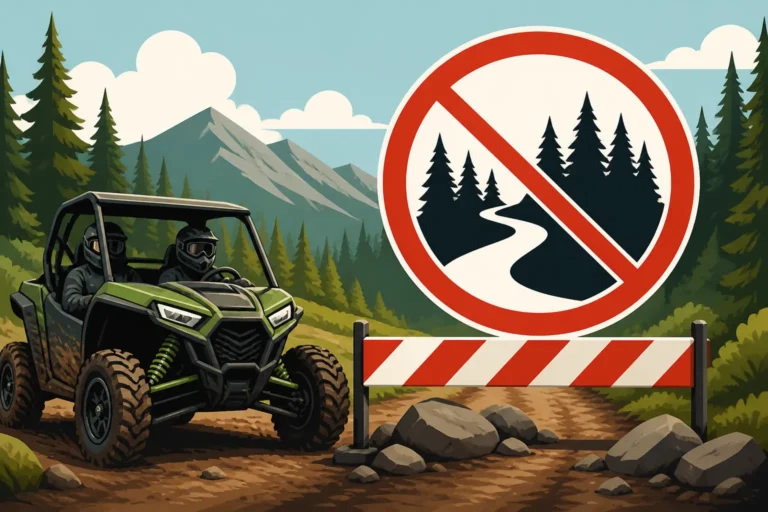
Reaching the other side of Puget Sound does not guarantee that your intended trailhead is open or that your machine is ready for that land. Before you leave, check the riding area’s access road, seasonal closures, trail status, parking or staging arrangements, and any required permits or passes. Confirm that your trailer can reach the staging area and that there is space to turn around or park.
For example, a plan to ride near the Olympic Peninsula may involve a long drive from the ferry terminal, while a trip north or east can include steep grades, narrow roads, or changing weather. onX Offroad can help you inspect the off-road route and nearby trail connections, but verify land-manager notices and road conditions before relying on a route. Washington Trail Closures to Check First and Reading a DNR Recreation Map are useful reminders that map access and open access are not always the same thing.
If you need a place to unload, look for a designated staging lot rather than assuming a roadside pullout is suitable. Check whether the lot has enough room for your tow vehicle and trailer, whether overnight parking is allowed, and whether the route in is appropriate for your rig. Finding a Staging Lot With Room can help you plan for that practical part of the outing.
Make a simple ferry-day checklist
A written checklist is especially useful when more than one person is helping load. The driver can focus on the tow vehicle and terminal directions, while another adult checks tie-downs and keeps small items from being forgotten. Agree in advance who is responsible for the final walk-around; “I thought you checked it” is an easy mistake when everyone is trying to leave.
Before departure, confirm the ferry route and instructions, measure the loaded rig, check reservations if applicable, inspect the trailer, and secure every machine and loose item. At the terminal, follow signs and crew direction. After disembarking, pull over somewhere safe before stopping to recheck the load, rather than pausing in a traffic lane or blocking the terminal exit.
Use a concise checklist like this:
- Confirm the route, sailing information, and vehicle requirements.
- Measure the full loaded combination and record the dimensions.
- Check the tow vehicle, hitch, trailer tires, lights, and safety equipment.
- Secure each machine and stow ramps, tools, and loose cargo.
- Review the route to the trailhead, including closures, permits, and staging.
- Follow terminal signs and ferry crew instructions.
- Recheck the load at a safe location after leaving the terminal.
For the riding portion, keep registration and required riding documents accessible, and make sure each machine is prepared for the type of land and trail you plan to use. [Washington ORV Permits Explained] is a helpful starting point for understanding the permit side of a Washington ride. onX Offroad can complement that planning by helping you visualize trail connections and nearby access roads, while official notices remain the place to confirm closures and operating rules.
A loaded-trailer ferry trip is manageable when you treat it as part of the ride rather than a quick interruption on the way there. Measure the combination, secure the machines and cargo carefully, follow the terminal’s directions, and confirm that the far-side roads and trail access suit your setup. That preparation leaves less to sort out in a crowded lane—and more energy for the ride you came for.
Disclaimer
This article is for general informational purposes only and does not constitute professional advice. Laws, prices and regulations vary by location and change over time. Consult a qualified professional for guidance on your specific situation.