Elk on a Forest Road at Dusk
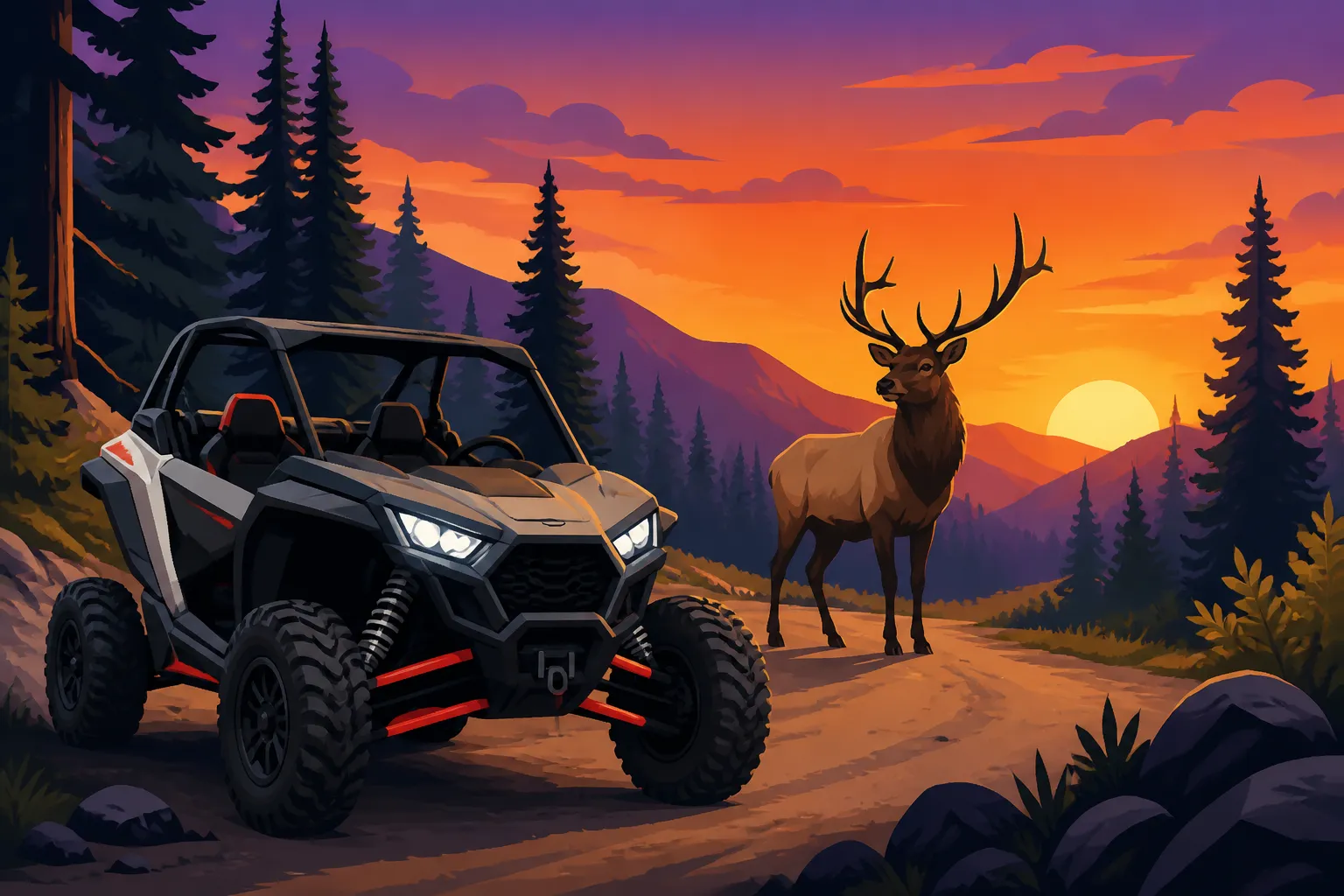
An elk can appear around a blind bend on a Washington forest road with almost no warning, especially when fading light makes its size and movement hard to judge. For ATV and UTV riders, the safest response is to slow down, give the animal room, and avoid trying to pass or crowd it. This guide covers what to do before, during, and after an elk encounter at dusk.
Why Elk on Forest Roads Need Extra Caution at Dusk
Why elk may be near a road
Elk use forested landscapes for cover and move between feeding and resting areas. A road may cross their route, and the open surface can be easier for an animal to travel along than thick brush. That does not mean an elk will move predictably or stay on the shoulder. It may step into the road, turn back, or disappear into trees and reappear farther ahead.
Dusk makes these encounters harder to read. Your eyes are adjusting to lower light, shadows obscure the road edge, and an elk’s dark body can blend into the forest. A rider may also be focused on ruts, rocks, or the machine in front of them. In a UTV, the windshield and cabin can change your view of the road margins; on a quad, helmet and eye protection can narrow what you notice when you’re looking ahead.
Treat any forest road as potential wildlife habitat, not just a route between the staging area and the trail. That is especially important on quiet stretches where there is little traffic or where vegetation comes close to the road. Give yourself enough time to stop within the distance you can clearly see—not the distance you hope is clear.
What makes an elk encounter risky
An elk is a large wild animal, and its response to a person or machine is not reliably predictable. It might stand still, run across the road, move away slowly, or react to being approached. An animal that appears calm is not necessarily comfortable. A cow with a calf, or an animal that feels cornered, may be particularly risky to approach.
The machine itself adds complications. A sudden stop can cause a following rider to collide with you, while swerving can send a quad or side-by-side off the road into a ditch, stump, or steep edge. Trying to squeeze past an elk can also put you close to the animal when it moves. The safest plan is to make the encounter boring: reduce speed early, stop with room to spare, and wait without advancing.
If you ride in a group, agree beforehand that anyone who spots wildlife will signal the others to slow down and stop. Keep enough spacing that the rider behind has time to react. On a narrow road, do not assume the group can turn around safely at the encounter point; look for a broad, stable place to maneuver only after the elk has moved away and the road is clear.
What to Do When You See an Elk
Slow down, stop, and leave an escape route
When an elk appears ahead, ease off the throttle and brake smoothly. Avoid revving, honking, shouting, or making sudden movements to push it along. Stop well back from the animal, and keep your machine pointed in a direction that allows you to retreat if needed. If there are riders behind you, signal them to stop too.
Give the elk plenty of space. Do not ride closer to get a better look, and do not block the direction it might travel. Avoid positioning yourself between an adult and a calf. If the animal moves off the road, wait until it has entered cover and you can see that the route ahead is clear before proceeding slowly. An elk may be hidden just beyond the roadside vegetation.
If it stays in the road, remain patient. A few extra minutes is a better trade than provoking a close encounter or damaging your machine. If you cannot wait safely where you stopped, carefully back away only if you can do so without entering a ditch, blind bend, or other hazard. Do not attempt a tight turnaround beside the animal.
Avoid these common reactions
The urge to pass can be strong when you’re trying to get back to camp before dark, but passing close to an elk is a poor shortcut. The animal may bolt across your path, and low light can make its movement difficult to track. Do not drive toward it to make it move, circle around it, or follow it down the road.
Do not leave your machine to approach for a photo. A camera zoom is safer than closing the distance, and taking a photo is never worth stepping into the animal’s escape path. Keep pets inside a UTV or under secure control, and do not let a dog chase wildlife. If a rider becomes separated from the group during the stop, wait until everyone is accounted for before moving on.
The same caution applies after the elk disappears. It may be standing in brush beside the road or crossing farther ahead. Continue at a reduced speed, scan both road edges, and be prepared to stop again. A blind bend, a dip, or a section where trees crowd the road deserves extra care even if you have not seen another animal.
| Situation | Safer response | Avoid |
|---|---|---|
| Elk is visible ahead | Slow smoothly, stop well back, and alert riders behind you | Accelerating toward it or trying to pass |
| Elk steps off the road | Wait until it is well clear, then proceed slowly | Following it into the trees |
| Elk remains on the road | Stay put if safe and give it time to move | Honking, revving, or crowding it |
| Road is too narrow to turn around | Maintain a safe stop and reassess when the animal leaves | Making a rushed turn near the elk |
| Visibility is fading | Reduce speed and consider ending the ride | Continuing at a pace that exceeds your view |
For broader night-riding preparation, review Washington Rules for Riding After Dark and Riding Back to Camp After Dusk. Those topics are useful even if you plan to be off the road before full darkness: dusk can arrive quickly under dense trees or in a valley.
Plan a Dusk Ride Around Roads, Visibility, and Wildlife
Confirm that the road is open to your machine
A forest road is not automatically open to every ATV or UTV. Access can depend on the road’s managing agency, posted restrictions, vehicle requirements, local rules, and seasonal closures. A road shown on a map may cross public and private land, or it may be closed to motorized use. Check the rules for the specific route before unloading your machine.
For Washington rides, begin with the relevant land manager’s road and recreation information, then pay attention to signs and gates on the ground. A navigation app such as onX Offroad can help you understand the route and see mapped roads, but a map layer is not permission to ride. Confirm access with the agency or landowner and follow posted restrictions. For a broader explanation, see Washington Rules for Riding a Forest Road and Reading a DNR Recreation Map.
Do not continue past a locked gate or a closure sign because the road appears passable. A gate can mark a private boundary, active work area, seasonal restriction, or other access limit. Read What to Do at a Locked Timber Company Gate before planning a route that crosses working forest land. Also check Washington Trail Closures to Check First before leaving; a closure can change the route you expected to use and turn a simple return into a longer ride in fading light.
Build a realistic return plan
Before heading out, set a turnaround time that leaves a buffer for a slow section, a mechanical issue, or a wildlife stop. Tell someone where you expect to ride and when you plan to return. Carry a charged phone, but do not depend on cell service in forested areas. Save or download the route information you need before you lose reception.
Navigation tools can help prevent wrong turns when several roads look alike. onX Offroad may be useful for reviewing a route and keeping track of your position, but compare what you see on the screen with signs, gates, and current agency information. If the app shows a route that conflicts with a posted closure or access restriction, follow the restriction. A track line is a navigation aid, not a legal determination.
Make dusk the latest point of your plan, not the point when you begin thinking about heading back. If the ride is taking longer than expected, turn around at a safe, legal location rather than pressing on toward an unfamiliar road in low light. Be particularly cautious when a route involves narrow roads, steep shoulders, active hauling, or limited places to turn around. Sharing a Gravel Road With Hauling offers related context for managing encounters with work traffic.
Prepare Your Machine and Group for a Wildlife Stop
Make yourself visible and stay in control
Before the ride, check that your machine’s required lighting works and that your helmet and eye protection suit the conditions. Dust, rain, mud on a lamp, or a dirty visor can reduce visibility further. Keep your speed appropriate to what you can see and to the surface under your tires. On wet Washington forest roads, slick roots, loose gravel, and muddy shoulders can make abrupt braking or steering less predictable.
A steady pace matters more than trying to ride fast enough to finish before darkness. Leave extra following distance, particularly if the group includes a mix of quads and side-by-sides with different braking and turning characteristics. Agree on simple signals for slowing, stopping, and regrouping. A rider who sees an elk should not assume everyone else has noticed it.
Check the route’s restrictions before relying on a particular machine or road combination. Some routes may not accommodate a wide UTV, and some forest roads may have vehicle-specific limits. Washington Trails for a Wide Side-by-Side can help you think through width and route suitability. Once you are on the road, obey posted limits and do not use a shoulder or ditch as an improvised passing lane.
Know when to end the ride
A wildlife encounter is a good reason to reassess the rest of the trip. If the group has already lost daylight, encountered poor visibility, or fallen behind its return plan, head back by a route you know is open and suitable for your machine. If you need to stop and regroup, choose a place where you are visible to other road users and not blocking a gate, intersection, or travel lane.
If an elk is injured, trapped, or behaving in a way that presents an immediate danger, do not try to handle it yourself. Move away and contact the appropriate local authorities when you have a safe way to do so. For routine sightings, keep your distance and leave the animal undisturbed. Avoid posting a precise location in a way that could draw people toward the animal.
The best dusk ride is one where you have enough time to respond calmly. Check access, leave a generous return buffer, maintain a speed that matches visibility, and give wildlife space. Those habits make an elk encounter less frightening for the riders and less stressful for the animal.
Disclaimer
This article is for general informational purposes only and does not constitute professional advice. Laws, prices and regulations vary by location and change over time. Consult a qualified professional for guidance on your specific situation.